Bertrand’s Postulate: A Dome of Matchsticks Has to Hold a Prime
Bertrand’s 175-year-old postulate, re-read as a load-bearing structure inside the prime machine
Bertrand’s Postulate: A Dome of Matchsticks Has to Hold a Prime
Bertrand’s 175-year-old postulate, re-read as a load-bearing structure inside the prime machine
In 1845, Joseph Bertrand stated a postulate that sounds almost too clean to be true. Pick any integer larger than one. Between that integer and twice that integer, there is always a prime. Not sometimes. Always.
Five years later, Pafnuty Chebyshev proved it. His proof is a balance argument on the central binomial coefficient, the number of ways to choose n things from a set of 2n. Erdoes simplified the bookkeeping in 1932. The result has been textbook material for nearly a century.
This article is not about proving Bertrand’s postulate. The proof has been done. This article is about something else: how the postulate looks when you read it as a load-bearing balance inside a geometric machine. The machine is what I call the prime machine — a deterministic device that generates primes by iterating local operators on coprime residue universes. The machine has a proven completeness theorem and a proven full symmetry theorem. Together, the two theorems let us reproduce Chebyshev’s classical balance as a volume reading on a matchstick construction. The construction is the Pascal-dome with tetrahedral start.
What the machine is, in one paragraph The prime machine acts on what I call coprime residue universes. At stage k, the universe is the set of integers larger than or equal to two that are coprime to the k-th primorial, where the primorial is the product of the first k primes. The machine has three local operators: step (advance by one orbit), filter (remove elements divisible by the next prime), and mirror (reflect a residue to its complement modulo the primorial). The orbit-minimum operation picks the smallest representative of each orbit. The central theorem of the machine, proved in earlier papers, says that the set of orbit minima at stage k equals the set of primes in the target interval from p-sub-k to p-sub-k squared, with no gaps and no duplicates. Every prime is reachable, exactly once, at exactly one stage. The machine is complete, and its symmetry group acts on every orbit as a hypercube. These two facts — completeness and full symmetry — are the two pillars of everything that follows.
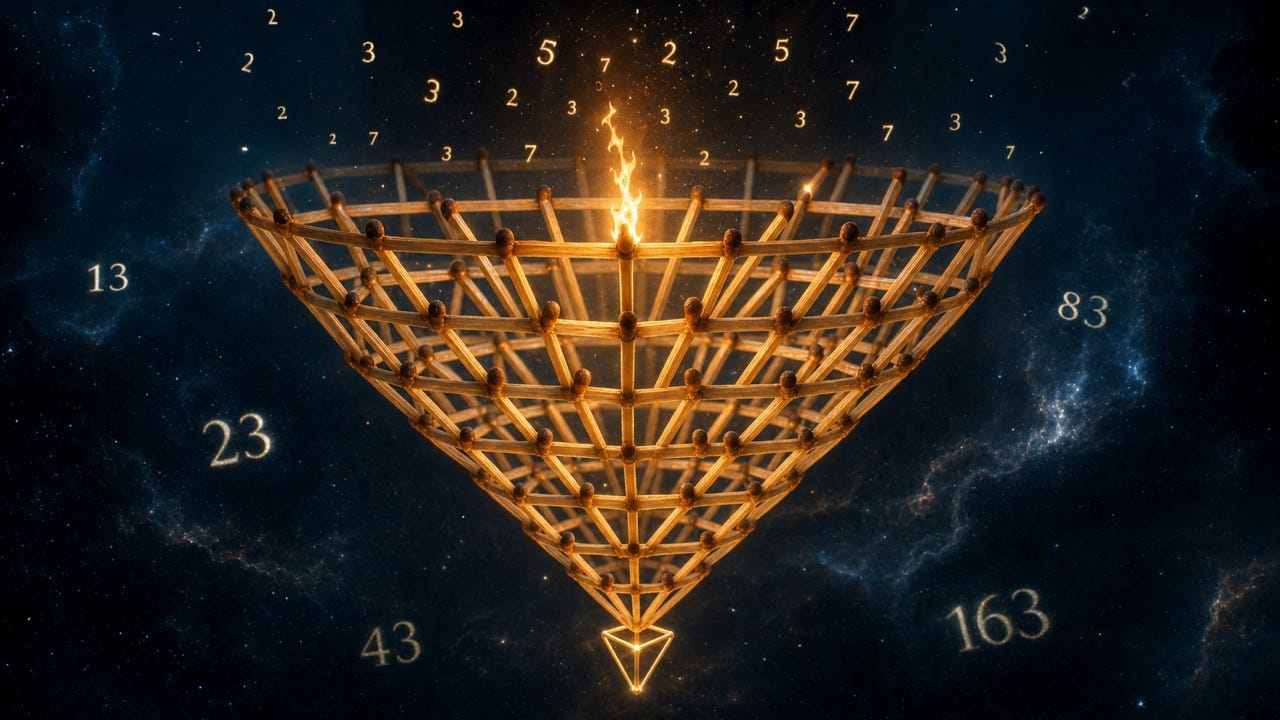
The Pascal-dome with a six-matchstick apex Now picture the Pascal triangle in matchsticks. Row zero is a single matchstick standing alone. At each successive row, every matchstick splits in two and the halves accumulate at the next row’s positions. The number at position k of row n is the count of paths from the apex to that position, which equals the binomial coefficient n choose k.
Turn this construction upside down. The apex is now at the bottom, the broad rows are at the top. You have a dome, a paraboloid-shaped surface in three dimensions, with rotational symmetry around the central axis. The central column carries the heaviest load. Each row’s middle position accumulates the central binomial coefficient, growing exponentially with n.
The Pascal-dome with tetrahedral start replaces the single apex matchstick by a tetrahedron of six matchsticks. Every count is multiplied by six. The central position of row 2n now carries a volume equal to six times the central binomial coefficient. This volume grows like six times four to the power of n, divided by the square root of pi times n. By row twenty, the central volume already exceeds eight hundred billion. By row fifty, it is of order ten to the thirty-first. The growth is dramatic.
The choice of six matchsticks is not numerological. The tetrahedron is the smallest three-dimensional simplex. It places the construction in metric space and makes the volume reading metrically meaningful. The factor of six cancels out of the actual inequality at the end. We use it because it lets us speak about volume, not just count.
Why the machine forces the dome to be exact Two facts about the Pascal-dome require justification, and the machine provides both.
First, every prime that could appear as a load-bearing structure of the dome is reachable. This is the completeness theorem at work. When we look at the prime factorisation of the central binomial coefficient, no prime hides. Every prime in the factorisation is somewhere on the machine’s reachability graph, at exactly one stage. There is no possibility that a prime contributes to the volume of the dome from outside the machine. The dome is closed.
Second, the volume bookkeeping is exact. The number of paths to each position is, by construction, additive and free of double-counting. Each path contributes exactly once. The path-counting is the inner symmetry of the machine projected onto the path-count grid. The left-right symmetry of the Pascal triangle — number at position k equals number at position n minus k — is the manifestation of the mirror element of the machine’s symmetry group. The two symmetries together force the volume reading to be a structural equality, not a numerical approximation. The central binomial coefficient equals the product over primes of p to the power nu-p, where nu-p is the number of carries in the base-p addition of n plus n. This is Kummer’s theorem, and inside the machine it is exact.
Chebyshev’s balance as a volume necessity Now we can read Chebyshev’s argument as a volume balance. The primes that can contribute to the central volume of the dome split into three ranges.
Small primes, those less than or equal to the square root of two n, each contribute at most logarithmically. They can appear multiple times in the factorisation, but each contribution is bounded by two n. The number of such primes is at most the square root of two n. Their total contribution is bounded sub-exponentially.
Medium primes, those between the square root of two n and two n divided by three, each contribute at most once. Their total product is bounded, by Chebyshev’s theta function, by four to the power of two n divided by three. Large primes, those between n and two n, each contribute zero or one. Their contribution is exactly the question Bertrand asked: is there at least one such prime?
Combining the upper bounds from small and medium primes alone, the total contribution from primes up to n is at most two n to the power of the square root of two n, times four to the power of two n divided by three. This grows sub-exponentially in n.
But the central binomial coefficient itself has a known lower bound: four to the n divided by two n plus one. This grows nearly as four to the n. The two bounds are incompatible. If no prime exists between n and two n, the upper bound from small and medium primes alone cannot reach the lower bound on the central binomial coefficient. The inequality four to the n over three, divided by two n plus one, less than or equal to two n to the square root of two n, fails for all n at least four hundred sixty-eight.
For smaller n, a Bertrand chain handles each case explicitly. The chain two, three, five, seven, thirteen, twenty-three, forty-three, eighty-three, one hundred sixty-three, three hundred seventeen, six hundred thirty-one covers all n less than four hundred sixty-eight. Each prime in the chain is less than twice the previous one, which is exactly what Bertrand asks for. The conclusion is forced. A prime must exist between n and two n. The dome’s volume cannot be balanced any other way. This is Chebyshev’s proof, read as a load-bearing necessity inside the machine.
What this reading is, and what it is not Let me be precise about what we have done and what we have not done. We have not produced a new proof of Bertrand’s postulate. The arithmetic content of the argument is Chebyshev’s. The simplification of the bookkeeping is Erdoes’. The inequality, the case analysis, the small-case chain — all of these are classical. A reader who knows the classical proof will recognise every step.
What we have produced is a geometric translation. Each step of the classical proof has a clean geometric counterpart in the matchstick build. The completeness theorem of the machine guarantees that no prime escapes the construction. The full symmetry theorem guarantees that the volume bookkeeping is exact. The Pascal-dome is the geometric object on which the balance is computed. The matchstick construction is the explicit build.
The value of the reading is methodological. It shows that the two pillars of the matchstick framework — completeness and full symmetry — are strong enough to carry a known result without strain. Every step of Chebyshev’s proof translates cleanly into matchsticks. This is a test of the framework on solid ground.
There is a deeper purpose. The same two-pillar structure — completeness theorem plus symmetry theorem plus geometric balance plus structural necessity — is what I intend to apply to Goldbach’s conjecture next. Before attempting a problem that has been open for 285 years, I wanted to see the framework reproduce an easy known case cleanly. Bertrand’s postulate is that easy known case. The framework passes the test.
What comes next There is one earlier attempt in the matchstick framework that deserves mention, because it failed and the failure is instructive. The V1-doubling approach tried to use the machine’s step operation directly: at stage n, double the matchstick row to stage two n, and look for the prime in the new positions. The approach broke because doubling extends the row but does not copy the R4-reactions of the machine. New positions can be divisible by primes the original row was not. Position fifteen in the doubled row is three times five, an R2-position, not R4. The step operation acts on stage structure; the Pascal-dome acts on the path-count grid. They are compatible, but they carry different arguments. For Bertrand, the Pascal-dome works. The V1-doubling does not.
The lesson is that the matchstick framework admits multiple geometric readings, and not every reading is suited to every problem. For Goldbach’s conjecture, the right reading is still open. The dome works for Bertrand because Chebyshev’s argument is a volume balance, and the dome is a volume reading. Goldbach is an additive statement about even numbers as sums of two primes. The right geometric object for Goldbach is not the Pascal-dome; it is something else, something we have not yet built. The matchstick framework has a symmetry between additive and multiplicative readings — Sam acts on a line, Paul acts on a hyperbola, in the language of the Devil’s Game — and Goldbach will need an additive reading. This will be the next paper in the series.
Closing Bertrand’s postulate is 175 years old, Chebyshev’s proof is 170 years old, and the matchstick reading of Chebyshev’s proof is a few weeks old. The reading does not add a new theorem. It adds a new picture. A dome of matchsticks, with a tetrahedron at the apex, growing row by row, has to hold a prime in its upper half by the sheer weight of its central column. That is what Chebyshev proved. That is what the machine sees. In a single sentence: when the dome grows too fast for the small primes to carry it, a large prime steps in as a structural beam.
The matchstick framework continues to teach us that classical mathe-matics, when re-read geometrically, has a remarkable consistency. The completeness and the full symmetry of the machine carry a 175-year-old proof without strain. The same framework, tested next on Goldbach, will tell us whether geometry can do what 285 years of arithmetic have not.
— — — — — — — — — — — — — — — — — — — — — — — — — — — — — — — — — - This article accompanies the paper “Bertrand’s postulate as a Pascal-dome balance: A geometric reading inside the prime machine” (Krause 2026):
https://zenodo.org/records/20727562
The third paper in a methodology arc of the Geometry of Reality series. The first paper introduces the prime machine and proves its completeness. The second uses it on the Devil’s Game logic puzzle. The third, presented here, prepares the proof-language for harder open problems.
Author: Thomas Krause, Geometry of Reality series, Luebeck (Germany).
메타데이터
- post_id
- e040205e358b
- slug
- bertrands-postulate-a-dome-of-matchsticks-has-to-hold-a-prime-e040205e358b
- url
- https://medium.com/@krause-virtuell/bertrands-postulate-a-dome-of-matchsticks-has-to-hold-a-prime-e040205e358b
- canonical_url
- https://medium.com/@krause-virtuell/bertrands-postulate-a-dome-of-matchsticks-has-to-hold-a-prime-e040205e358b
- author_url
- https://medium.com/@krause-virtuell
- status
- ok
- fetched_at
- 2026-06-18 00:10:23