My Three Years at Shaolin Tagou Martial Arts School and the Youth I Cannot Go Back To
I entered Tagou in February 1998. I was sixteen, doing badly at school, and had no idea what three years of martial arts training would ask…
My Three Years at Shaolin Tagou Martial Arts School and the Youth I Cannot Go Back To
I entered Tagou in February 1998. I was sixteen, doing badly at school, and had no idea what three years of martial arts training would ask of me.
There is a short Tagou video on my website. It begins with students running under a row of trees. Small groups practise while other students stand nearby. A girl throws a kick. Other students work on mats. Then the camera pulls back and the scale changes. Hundreds of red uniforms fill the training ground in straight lines and circles.
Most people will notice the size of the formations. I notice the students waiting at the edge of the mat and the space between one movement and the next. I used to stand in lines like those.
The clip brought back a part of my life that was rarely photographed. I trained at Tagou Martial Arts School from February 1998 to January 2001. Those dates look neat when I write them now. Living through them was much messier.
Why my parents sent me to Tagou
I was a poor student. The classroom did not hold my attention for long, and I gave my parents plenty of reasons to worry. I had energy, a bad temper, and no useful place to put either of them.
Someone in our hometown had a son at Tagou. My parents visited the family and listened to them talk about the school. They saw photographs of students in uniform and heard about the early mornings and strict coaches. My parents heard discipline. I heard adventure.
We went to Dengfeng in February 1998. I did not compare schools. I did not know enough to ask sensible questions about coaching, injuries, dormitories, or what I would be doing six months later. We had a family connection and a school name. That was the whole plan.
We went straight to Tagou. I registered, paid the fees, and began training the next day.
Day two
The first session seemed manageable. We stretched, worked on body alignment, and copied basic stances. The coach demonstrated a movement, we tried it, and he corrected us.
I finished tired and thought I had done well.
The next morning I could hardly get out of bed. My legs hurt, my back hurt, and my shoulders hurt. Even walking to the training ground took effort. I had wanted to learn kung fu. Until that morning, I had given very little thought to what learning kung fu felt like on an ordinary day.
I got up and went to training.
The soreness eased after a few days. The schedule stayed.
Life ran on a whistle
During my first year, a typical weekday began around 5:30. The whistle came before sunrise. By 5:50 we were running and doing conditioning work. In the Henan winter, we could see our breath in the dark.
Breakfast was quick. We ate steamed buns, millet porridge, pickled vegetables, and sometimes an egg. Morning training ran from around 8:00 to 11:30. We held stances, punched from the waist, kicked in lines, and learned forms one movement at a time. The coach walked among us and adjusted whatever was wrong.
After lunch, most of us slept. Afternoon training included forms, weapons, acrobatics, and Sanda. I liked the staff. I can still remember the feel of the waxwood pole and the rhythm it made when it turned properly in my hands.
We slept eight to twelve students in a dormitory room. The mattresses were thin and lay on wooden boards. There was no privacy. Summer was hot, and the ceiling fan mostly moved the hot air around. Winter cold came through the walls. We washed clothes by hand, hung them up, and wore them again even when the damp had not quite left.
If one student arrived late, the group might do push-ups. A dirty room could bring the same result. At sixteen, I complained about this like any teenager would. I also learned to check the time and keep my things in order.
Three years, three coaches
Hu Jufeng was my first coach and my first real martial arts teacher. He was calm and precise. He could correct your shoulder with one hand and a few quiet words. I wanted to get the movement right because I respected him.
For years after I left Tagou, I dreamed about his training sessions. The dreams were ordinary. Coach Hu walked along the line, watched our stances, and made corrections. Then I woke up.
During that first year, we built our basics. We practised horse stance, bow stance, cat stance, straight punches, kicks, and Xiao Hong Quan. Later we added acrobatics. The training ground was paved with brick. We did not have soft mats waiting under every attempt.
Coach Hu sometimes used his staff to correct students whose hands reached for the brick during a failed flip. The larger, less flexible boys had a harder time. I was small and quick enough to avoid most of those corrections. My classmates called me a “Shaolin oil stick,” the slippery one who got away.
I liked the nickname then. I sometimes wonder whether getting away so often also kept me from being pushed far enough to reach the professional team.
Yu Yang coached my second year. The work became harder. We refined Tong Bi Quan, trained with the staff and broadsword, and spent more time on Sanda. Forms allowed you to repeat a mistake until you corrected it. Sanda gave you another person, moving and hitting back. The timing felt very different.
That year also gave me my worst injuries.
During an acrobatics session, I put too much power into a flip and carried too much momentum into the landing. My hand hit the ground. I dislocated fingers and cracked bones in my foot. Those injuries were obvious and healed in about a month.
The injury that lasted came from a kick. I threw it too hard, pulled a tendon in my thigh, and felt a sharp, deep pain. I did not tell Coach Yu how bad it was. I was shy and afraid he would think I wanted an excuse to avoid training.
So I kept training. The tendon troubled me for years.
I have no grand lesson to attach to that. I was sixteen and made a bad decision. If a young student reads this, I hope he says something when he is hurt. A coach cannot help with an injury he does not know about.
Jin Zhanqiang coached my third year. By then I did not have to think about every basic position. Forms became smoother. The staff and broadsword felt familiar in my hands. Training still hurt, but it no longer surprised me every morning.
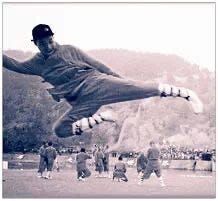
Under Coach Jin, I joined a martial arts performance at the Longmen Grottoes in Luoyang in 2000. Performing in front of an audience felt different from repeating a form on the training ground. There was no second attempt once the movement had passed.
One of my surviving photographs came from that performance. I am in the air, wearing a cap, with my fellow students nearby. It is one of the few clear records I have from those years.
The photographs that survived
Digital cameras were not part of our daily lives in the late 1990s. We did not film every training session or take photographs of every meal. A few group pictures and performance photographs made it through the years. Most of the ordinary days did not.
Small details return first. The whistle before sunrise. An extra boiled egg at breakfast felt like a treat. After lunch I lay on the bunk, too tired to talk. Some evenings, after practice, I sat outside and watched the light disappear over Song Mountain.
I also remember the other students.
We trained together and lived in the same cramped rooms. We saw one another sore, homesick, injured, and occasionally very proud of ourselves. None of us had a mobile phone. Social media did not exist for us. When we left Tagou, we went back to different towns and lost contact.
That loss bothers me more as I get older.
I wonder who kept practising. I wonder who became a coach. Some of them probably have children older than we were when we met. A few may still dream about the training ground.
Leaving in January 2001
I left Tagou in January 2001 with a foundation and plenty of unfinished work. I had learned forms, weapons, Sanda, and acrobatics.
The daily discipline stayed with me. I could keep a schedule. I could repeat a movement after the excitement had gone, and I knew I could finish the day’s work while tired and uncomfortable.
The sixteen-year-old who arrived at Tagou had no direction. Training gave each day a purpose. My coaches did part of that work. My classmates did the rest by standing beside me and going through the same routine.
More than twenty-five years have passed since I left. The photograph still shows me at sixteen, frozen in mid-air. I cannot gather the same classmates back into the same line.
The video ends with a young student standing on the training ground while other students continue behind her.
If you trained at Tagou between February 1998 and January 2001, my name is 严智俊. I hope you are doing well. I would like to hear from you.
About the author: 严智俊 trained at Tagou Martial Arts School from 1998 to 2001. He writes beginner-friendly Shaolin kung fu tutorials and firsthand training notes at China Kung Fu.
메타데이터
- post_id
- e04ce280e1e3
- slug
- my-three-years-at-shaolin-tagou-martial-arts-school-and-the-youth-i-cannot-go-back-to-e04ce280e1e3
- url
- https://medium.com/@yzc0414/my-three-years-at-shaolin-tagou-martial-arts-school-and-the-youth-i-cannot-go-back-to-e04ce280e1e3
- canonical_url
- https://medium.com/@yzc0414/my-three-years-at-shaolin-tagou-martial-arts-school-and-the-youth-i-cannot-go-back-to-e04ce280e1e3
- author_url
- https://medium.com/@yzc0414
- status
- ok
- fetched_at
- 2026-08-15 08:24:01