Purpose & Mission Led by Vision
How vision, purpose, and mission align into an optimal framework for creation
Purpose & Mission Led by Vision
How vision, purpose, and mission align into an optimal framework for creation
The question from Part 3 remains: How do vision, purpose, and mission work together as a system?
This is not a theoretical question. It is the practical challenge that determines whether meaningful work succeeds or stalls. People who have clearly articulated their vision, identified their purpose, and defined their mission still fail to make progress. The elements exist, but they do not function together.
The problem is not absence. It is misalignment.
Vision can point in one direction while purpose pulls toward another. Mission can serve beneficiaries that the vision never accounted for. Purpose can motivate work that the mission cannot execute. When the three elements exist without integration, they produce friction instead of momentum.
This explains why so many well-intentioned initiatives collapse under their own weight. The vision inspires. The purpose motivates. The mission begins. But the parts never connect into a coherent whole. Energy dissipates across misaligned efforts.
Alignment requires structure.
Parts 1 through 3 of this series established what each element does individually. Purpose is the proposal, the intention placed forward. Vision is the future state that gives purpose its direction. Mission is the tangible expression that names who benefits and how they are served.
But understanding each element separately does not reveal how they function together. That requires a framework.
Enhavim: Purpose & Mission Led by VISION
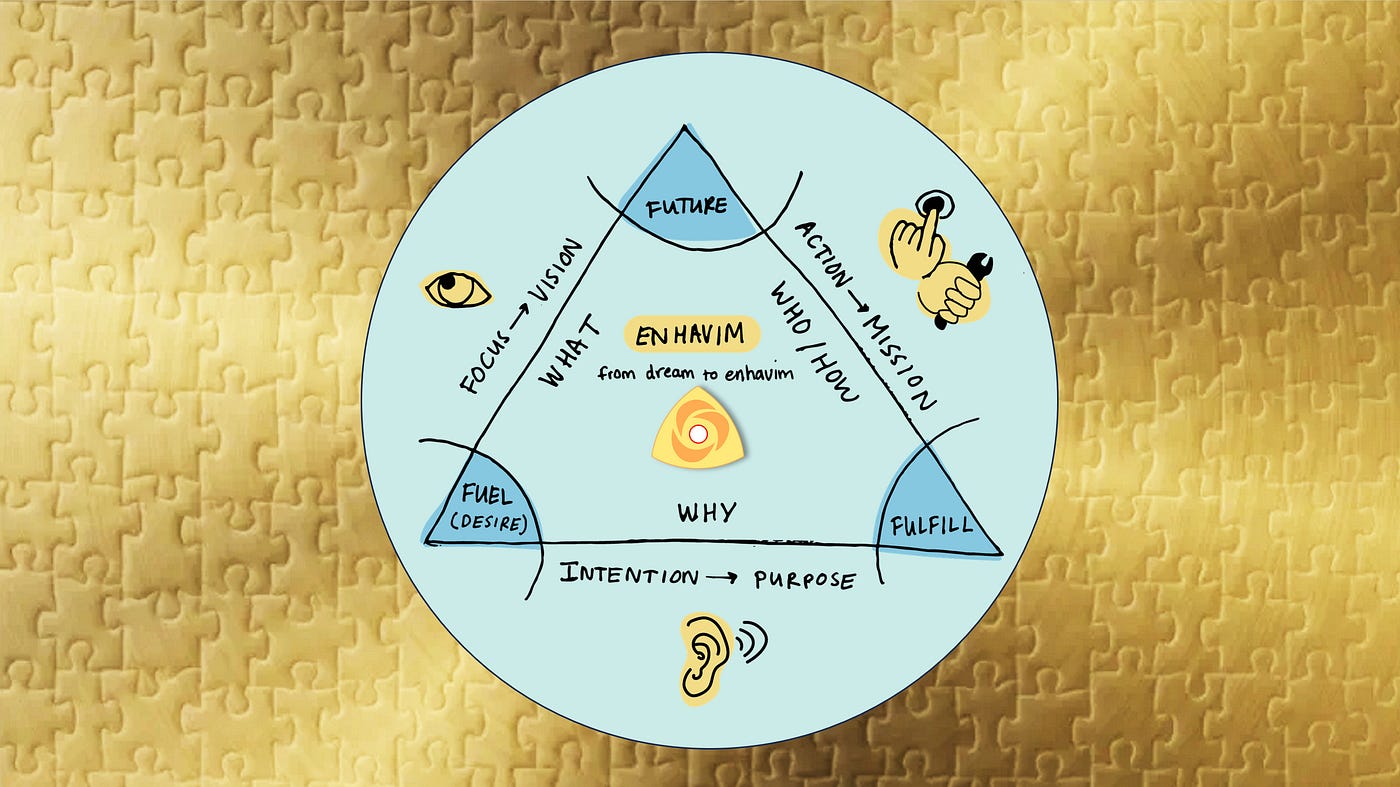
Enhavim is the framework that aligns vision, purpose, and mission into a unified system for meaningful creation. It is not a rebranding of existing concepts. It is a deliberate structure that positions each element in its proper relationship to the others.
The name itself carries weight. Enhavim was constructed from multiple linguistic roots to embody the concept it describes. The “EN” prefix from Old English and Greek signifies connection and proximity. “HA” from Hawaiian represents the breath of life, the vital force. “VIM” from Latin carries strength, energy, and vigor. Together, the word sounds ancient and substantial because it was designed to anchor work that matters.
Enhavim is defined as Purpose & Mission Led by VISION. This is not arbitrary. Vision leads because it establishes the endpoint. Without a clear vision, purpose has no target and mission has no direction. Vision comes first not because it is more important, but because the other elements depend on it for context.
Purpose fuels the work. It provides the motivation and the reason the vision deserves pursuit. Purpose is the why, but it only functions when connected to a specific what. Vision supplies that what.
Mission follows. It makes vision and purpose tangible by defining who benefits and how they are served. Mission is where intention meets execution, where the abstract becomes concrete.
The sequence is fixed: Vision, Purpose, Mission. Reversing the order or skipping steps produces the misalignment that stalls progress.
The Framework in Practice
Enhavim breaks the path from imagination to manifestation into five distinct steps:
1. Imagination captured and idealized becomes a Vision. This is where the future state is seen and articulated. Vision is not vague aspiration. It is a specific image of what could be, made clear enough that others can see it too.
2. Vision with reason and intention becomes a Purpose. Once the vision is established, purpose identifies why that future matters. Purpose is the motivation that sustains effort when obstacles appear. It answers the question of why this vision deserves energy and commitment.
3. Purpose that defines and benefits people becomes a Mission. Mission makes the work real by naming who it serves and how that service occurs. This is where Who Before How operates. The beneficiaries are identified first. Then the team. Then the methods.
4. Mission with strategy, objectives, goals, tactics, and clearly defined dates becomes a Plan. Planning translates mission into executable steps. Strategy positions the work. Objectives define success. Goals mark progress. Tactics describe methods. Dates create accountability. Without planning, mission remains theoretical.
5. Plan backed by consistent action manifests your Enhavim. Action is what separates intention from accomplishment. A plan without execution produces nothing. Consistent action over time brings the vision into being, guided by purpose and enacted through mission.
Each step builds on the previous one. Skip a step and the framework collapses. Vision without purpose lacks motivation. Purpose without mission lacks form. Mission without planning lacks structure. Planning without action produces only documents.
Why Alignment Matters
When vision, purpose, and mission are aligned within the Enhavim framework, decisions become clearer. Every choice can be evaluated against three questions:
Does this serve the vision we are building toward? Does this align with the purpose that motivates this work? Does this support the mission of who we serve and how we serve them?
If the answer to any question is no, the choice eliminates itself.
This is the practical value of a unified framework. It provides a reference point for every decision. It prevents mission drift. It maintains focus when distractions appear. It ensures that all effort moves in the same direction.
Enhavim also clarifies the relationship between the inspirational and the operational. Vision is inspirational. Purpose is motivational. Mission is tangible. Strategy is positional. Goals are operational. Projects are executional. Tactics are procedural. Tasks are transactional. Together, the results are transformational.
Each level serves a function. Each level depends on the others. The framework connects the abstract to the concrete, the visionary to the practical, the inspirational to the transactional.
From Question to Framework
Part 1 established that “What’s your purpose?” is the wrong question because purpose cannot function in isolation. Part 2 showed that vision must precede purpose. Part 3 demonstrated that mission makes vision and purpose tangible through Who Before How.
Part 4 completes the argument. Vision, purpose, and mission are not separate pursuits. They are interconnected elements of a single framework. Enhavim is that framework.
The original question returns with new clarity. Not “What’s your purpose?” but “What vision are you proposing to serve, what purpose fuels that commitment, and whose lives will change through the mission you enact?”
When those three questions are answered and aligned, meaningful work becomes possible.
Enhavim is an intentional exercise to create a meaningful endeavor. It transforms imagination into manifestation through structure, sequence, and sustained action. It is the framework that turns aspiration into legacy.
Sources:
Part 2: What Future Do You See Worth Serving?
Part 3: Who Benefits and How Will You Reach Them?
This is Part 4 of a four-part series examining the components that make purpose operational. To explore how to apply the Enhavim framework read more about it in the book, https://createinthenow.com/

메타데이터
- post_id
- e04ece5add03
- slug
- purpose-mission-led-by-vision-e04ece5add03
- url
- https://medium.com/@sherrierose/purpose-mission-led-by-vision-e04ece5add03
- canonical_url
- https://medium.com/@sherrierose/purpose-mission-led-by-vision-e04ece5add03
- author_url
- https://medium.com/@sherrierose
- status
- ok
- fetched_at
- 2026-06-13 07:35:29