Why Most Fortunes Disappear in Exactly 3 Generations
The math behind dynastic wealth failure, and the families that solved it
Why Most Fortunes Disappear in Exactly 3 Generations
The math behind dynastic wealth failure, and the families that solved it
Photo by Alison Pang on Unsplash
There’s a proverb that shows up in nearly every culture on earth.
In English: “Shirtsleeves to shirtsleeves in three generations.” In Chinese: “Wealth does not survive three generations.” In Italian: “From stalls to stars to stalls.” The Japanese, the Scots, and the Brazilians all have their own version.
The universality of the saying should tell you something. This isn’t a cultural problem. It’s a math problem.
And when you actually run the numbers, the outcome is almost mechanical. A $100 million fortune, left to compound and divide across a typical family tree, fragments into modest wealth within four generations. No market crash required. No fraud, no scandal, no catastrophic mismanagement. Just arithmetic.
The interesting question isn’t why most fortunes disappear. It’s how a handful of families have defied the math for over a century.
The Dilution Math
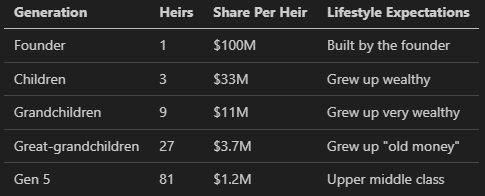
Start with a founder who builds a $100 million fortune.
That founder has three children. Each inherits roughly $33 million (after estate taxes, more like $20 million, but let’s be generous and assume effective tax planning).
Each of those children has three children. Now $33 million splits into $11 million per grandchild.
Those grandchildren each have three children. $11 million becomes $3.7 million.
One more generation: $3.7 million becomes $1.2 million.
Generational Lifestyle Expectations
$1.2 million is a nice nest egg. It is not a fortune. And this calculation assumes zero taxes, zero spending, and zero inflation. In the real world, all three are working against the family simultaneously.
Within four generations, a nine-figure fortune fragments into something that wouldn’t cover a house in most major cities.
That’s the dilution math. And it’s only the first problem.
The Lifestyle Inflation Problem
Each generation inherits less capital but develops more expensive tastes. This is the silent killer of family fortunes, and it operates on psychology, not finance.
The founder built the fortune from nothing. They remember scarcity. They know what it feels like to check a bank balance with anxiety. That memory acts as a natural governor on spending. A founder with $100 million might spend $500,000 per year, a 0.5% withdrawal rate. Conservative. Sustainable.
The second generation grew up wealthy. They attended private schools, traveled internationally, and developed expectations that match their childhood. On a $33 million inheritance, they might spend $1 million per year. That’s a 3% withdrawal rate. Still technically sustainable if invested well.
The third generation grew up very wealthy but inherited only $11 million. Their lifestyle expectations were set by the previous generation’s spending, not their own capital base. They spend $1.5 million per year on a $11 million portfolio. That’s a 13.6% withdrawal rate.

Generational spending problem
At a 13.6% withdrawal rate, the portfolio is being liquidated. It doesn’t matter what the market does. The math is terminal.
This is the pattern that repeats across cultures and centuries. Lifestyle expectations are inherited from the generation above. Capital is divided among the generation below. Eventually, the two lines cross, and spending exceeds what the capital can support.
The behavioral psychology here is important. Nobody in the family experiences a sudden drop in wealth. Each generation receives less than the one before, but they don’t feel poor. They feel rich. The $11 million grandchild grew up watching their parents spend freely on a $33 million base. They simply continue the pattern. The mismatch between expectations and capital is invisible until the money runs out.
The Return vs. Withdrawal Problem
Even in the more moderate scenario (where each generation exercises some discipline), the math is unforgiving.
A well-diversified portfolio might earn 6% to 7% annually over long periods. But if the family withdraws 8% to 10% to fund lifestyle, philanthropy, and family expenses, the portfolio shrinks by 2% to 4% per year in real terms.
On a $100 million portfolio, a 2% annual net shrinkage means losing $2 million per year. That doesn’t sound catastrophic until you compound it over 30 years. After three decades, the portfolio is down to roughly $55 million in nominal terms, and significantly less after inflation.
The formula is simple:
Net Growth = Investment Return — Withdrawals — Taxes — Inflation
If this number is negative, the fortune is dying. Slowly, invisibly, but dying.
For a typical wealthy family:
- Investment return: 6% to 7%
- Withdrawals: 4% to 8%
- Taxes on gains and income: 1% to 2%
- Inflation erosion: 2% to 3%
Net growth often sits at negative 1% to negative 3%. The family doesn’t notice because the nominal balance looks large. But in purchasing power terms, the fortune is evaporating.
The Tax Erosion Problem
Without sophisticated estate planning, taxes accelerate the decline dramatically.
Federal estate taxes in the U.S. can claim up to 40% of assets above the exemption threshold at each generational transfer. State estate taxes add additional erosion. Capital gains taxes on the liquidation of concentrated positions reduce transfer value further.
Consider the compounding effect across three generations:

Three generations of wealth transfer
Three generations of estate tax alone, ignoring spending, inflation, and investment losses, reduce $100 million to $21.6 million. Add in the dilution across multiple heirs, and you’re looking at individual inheritances in the low single-digit millions.
This is why families without trust structures experience the most rapid wealth decline. Each generational transfer is a taxable event that permanently removes capital from the family’s compounding base.
The Governance Problem
There’s one more failure mode that the math doesn’t capture: governance collapse.
By the third generation, a family that started with one founder and one vision now has 20 or more cousins sharing ownership of the same assets. They grew up differently. They have different values, different financial needs, and different ideas about what the family fortune should do.
Some want to sell the family business. Others want to keep it. Some want aggressive investments. Others want safety. Some need distributions now. Others don’t.
Without a formal governance structure, these disagreements become destructive. Families are forced to liquidate assets (often at unfavorable valuations) to buy out dissenting members. Legal fees consume capital. Emotional conflicts override financial logic.
The governance problem is why many family fortunes die not from bad investments, but from family lawsuits. It’s the human element that no financial model can fully account for, and it often accelerates the timeline from three generations to two.
The Dynastic Wealth Formula
So what separates the families that survive from the ones that don’t?
It comes down to one equation:
Annual Return >= Spending + Taxes + Inflation
If the left side is larger, the fortune compounds. If the right side is larger, the fortune decays. The margin between the two determines whether wealth survives a century or evaporates in three generations.
Here’s what the math looks like for a family that gets this right:

Net real growth, profitable example
A 1% net real growth rate sounds trivial. But compounded over 100 years, it roughly triples the fortune in real terms. Over 150 years, it has grown fivefold.
The key insight: dynastic wealth doesn’t require spectacular returns. It requires iron discipline on the spending side. The families that survive for centuries aren’t the ones with the best investors. They’re the ones who kept withdrawals below the growth line for generation after generation.
The Vanderbilt Failure
The Vanderbilts were once the richest family in America.
Cornelius Vanderbilt died in 1877 with a fortune estimated at $100 million (roughly $2.5 billion in today’s dollars). He was the wealthiest person in the United States at the time.
Within 50 years, the fortune was effectively gone.
What happened? His heirs treated the fortune as a spending account rather than a compounding engine. They built palatial mansions (the Biltmore Estate cost the equivalent of $300 million in today’s dollars). They threw legendary parties. They maintained estates that required armies of servants. They lived on a scale that made European royalty look modest. Multiple generations spent lavishly, with each branch of the family competing to outdo the others in conspicuous consumption.
By 1973, when 120 Vanderbilt descendants gathered at Vanderbilt University for a family reunion, not one of them was a millionaire.
The Vanderbilt collapse illustrates every failure mode simultaneously: dilution across many heirs, lifestyle inflation that exceeded capital growth, no centralized governance, no trust structures, and no institutional framework to preserve capital across generations.
They distributed money to heirs. The heirs spent it.
The Rockefeller Solution
The Rockefellers faced the same math. They solved it.
John D. Rockefeller’s fortune peaked at roughly $900 million in 1913. Adjusted for inflation, that’s approximately $25 billion to $30 billion in today’s dollars. The Rockefeller family has now maintained significant wealth for over a century, spanning six generations.
The difference was structural, not individual.
What the Rockefellers Did Differently
1. They institutionalized the fortune.
Instead of distributing wealth directly to heirs, Rockefeller placed assets into a network of trusts, foundations, and family-controlled investment entities. The capital was locked inside institutions. Heirs received income from these institutions, not the principal itself.
This single decision neutralized the dilution problem. It doesn’t matter if there are 200 descendants when the capital base remains unified and professionally managed.
2. They created separate compounding engines.
The family fortune was split into multiple vehicles, each compounding independently:
- Family trusts that held investment portfolios
- Rockefeller & Co. (now Rockefeller Capital Management), a professional family office
- The Rockefeller Foundation and other philanthropic endowments
- Real estate holdings, including Rockefeller Center
Each vehicle had its own investment strategy, its own management, and its own compounding trajectory. Diversification happened at the institutional level, not by dividing assets among individuals.
3. They “gave away” money to Rockefeller-controlled institutions.
This is the part that gets misunderstood. Rockefeller’s legendary philanthropy (funding the University of Chicago, Rockefeller University, and the Rockefeller Foundation) wasn’t charity in the way most people understand it.
Those institutions received Rockefeller capital, which then compounded inside endowments managed by Rockefeller-affiliated advisors. The family maintained significant influence over the institutions and their investment policies. The capital was “given away” from a tax perspective, but it never actually left the Rockefeller orbit.
This created a compounding loop: capital that would have been taxed at 40% to 60% during generational transfers instead flowed into tax-exempt endowments, where it could compound indefinitely.
4. They educated heirs and built governance.
Rockefeller descendants were expected to learn finance, serve on family boards, and participate in the management of family institutions. This wasn’t optional. The family established formal governance structures (family councils, investment committees, succession plans) that prevented the kind of governance collapse that destroys other families.
The result: a fortune that has compounded for over 110 years while supporting hundreds of descendants. The Rockefeller approach wasn’t about investment brilliance. It was about institutional compounding. The structures did the work. Individual heirs could be mediocre investors, and it wouldn’t matter because they never had direct control of the capital base.
The Key Difference
The Vanderbilts and the Rockefellers started with comparable fortunes in the same era, in the same country, under the same tax code.
One family is effectively broke. The other still controls billions.
The difference isn’t investment skill. It’s architecture.
Ordinary wealth distributes money to heirs. Each heir receives capital, spends it according to their own judgment, and passes whatever remains to the next generation. The dilution, lifestyle, and tax problems compound until nothing is left.
Dynastic wealth distributes income to heirs. Capital stays locked inside institutions (trusts, foundations, family offices, endowments). Heirs receive distributions from these institutions, but they never touch the principal. The compounding base remains intact across generations.
This is a fundamentally different approach to intergenerational wealth. It treats the fortune not as a pool of money to be divided, but as an institution to be governed.
What This Means for Capital Allocators
You don’t need $100 million to apply these principles. The framework scales.
The dynastic wealth formula (Return >= Spending + Taxes + Inflation) works at any capital level. A family with $5 million that keeps net real growth positive will compound that wealth indefinitely. A family with $500 million that lets spending exceed returns will watch it evaporate.
The structural lessons are straightforward:
- Never distribute principal. Use trusts, LLCs, or other structures to separate ownership from access. Heirs receive income, not capital.
- Keep spending below the growth line. The single most important variable in multigenerational wealth isn’t returns. It’s the withdrawal rate.
- Institutionalize governance early. Before the family grows large enough for disagreements to become destructive, establish formal decision-making processes.
- Use tax-advantaged structures aggressively. Every dollar lost to estate taxes is a dollar permanently removed from the compounding base.
- Educate heirs. Financial literacy isn’t inherited. It must be taught deliberately, or the next generation will spend what the previous generation built.
The proverb is real. The math is relentless. But the Rockefellers proved it’s not inevitable. The fortune doesn’t have to disappear in three generations.
It just requires treating wealth as an institution rather than an inheritance.
Lester Leong writes about capital allocation, wealth structures, and the mechanics of compounding across generations. Follow for portfolio updates and analysis.
Disclaimer: This is not financial advice. These are analytical frameworks shared for educational purposes. Do your own research before making financial decisions.
메타데이터
- post_id
- e0544a4cb604
- slug
- why-most-fortunes-disappear-in-exactly-3-generations-e0544a4cb604
- url
- https://medium.com/gradient-growth/why-most-fortunes-disappear-in-exactly-3-generations-e0544a4cb604
- canonical_url
- https://medium.com/gradient-growth/why-most-fortunes-disappear-in-exactly-3-generations-e0544a4cb604
- author_url
- https://medium.com/@LesterLeong
- status
- ok
- fetched_at
- 2026-06-12 22:02:08