Why GHG Protocol & Carbon Accounting Certification Is Now Mandatory for ESG Careers
For years, companies spoke confidently about their carbon footprints while quietly admitting something uncomfortable inside their…
Why GHG Protocol & Carbon Accounting Certification Is Now Mandatory for ESG Careers
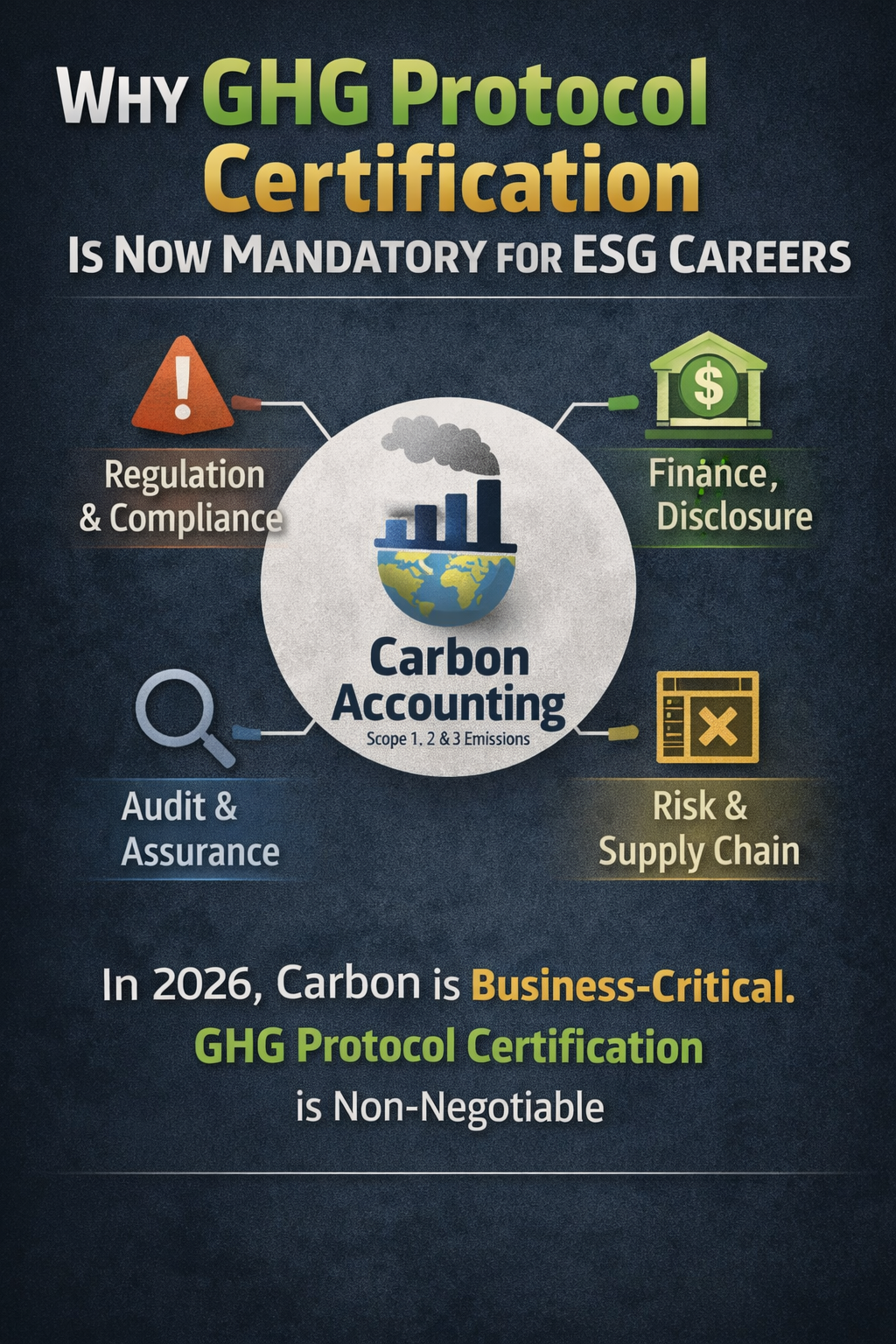
For years, companies spoke confidently about their carbon footprints while quietly admitting something uncomfortable inside their organizations: they were not fully sure the numbers were right.
That ambiguity was tolerated when emissions disclosures were voluntary and largely symbolic. It is no longer tolerated now.
By 2026, GHG Protocol–aligned carbon accounting certification has moved from a specialist credential to a baseline requirement across ESG, sustainability, finance, procurement, and risk roles. Not because companies suddenly became more climate-conscious — but because carbon data now sits directly inside regulation, contracts, capital markets, and audits.
Carbon is no longer a sustainability metric. It is a business liability if handled poorly.
How Carbon Accounting Became a Business-Critical Skill
The turning point was not a single regulation or climate summit. It was convergence.
Carbon data began flowing simultaneously into:
- regulatory disclosures
- supplier contracts and procurement decisions
- investor due diligence
- bank lending and insurance underwriting
- product claims and customer scrutiny
Once emissions numbers entered these systems, approximation stopped being acceptable. Companies realized that weak carbon accounting exposed them to legal risk, reputational damage, and financial penalties.
This is why organizations now prioritize GHG Protocol certification: it provides a defensible, globally accepted method for measuring and reporting emissions across Scope 1, Scope 2, and Scope 3.
Why Employers Trust GHG Protocol Over Other Carbon Credentials
Carbon training programs are multiplying rapidly. Employers are selective about which ones they trust.
GHG Protocol remains dominant because it is:
- used by regulators, not just consultants
- embedded in reporting frameworks worldwide
- referenced by auditors and assurance providers
- neutral, open, and globally consistent
When companies are challenged on their emissions — by regulators, investors, or NGOs — the first question is not “Did you calculate carbon?” but “Did you follow GHG Protocol?”
Certification aligned to this framework signals that you can operate under scrutiny.
Scope 3: The Real Reason Demand Has Exploded
Most professionals underestimate why carbon accounting skills are suddenly everywhere. The answer is Scope 3.
For many companies, 70–95% of emissions sit outside their direct control — in suppliers, logistics, product use, and end-of-life treatment. Measuring these emissions requires judgment, data quality assessment, estimation techniques, and documentation discipline.
Companies cannot outsource this entirely anymore. Regulators expect internal ownership. Auditors expect internal controls. Procurement teams expect integration into sourcing decisions.
Professionals trained in GHG Protocol methodology are therefore pulled into:
- supplier engagement programs
- data governance initiatives
- contract design
- internal carbon pricing models
- transition planning
This is why carbon accounting certification often leads to role expansion beyond sustainability teams.
Carbon Accounting Is No Longer an “Environmental” Role
One of the most important shifts in 2025–26 is who owns carbon data.
It now routinely involves:
- finance teams validating calculations
- internal audit reviewing assumptions
- procurement managing supplier data quality
- legal teams reviewing claims and disclosures
- strategy teams using emissions data for capital allocation
Carbon accounting has become a cross-functional discipline, and certification helps professionals operate credibly across these boundaries.
This is also why employers increasingly prefer candidates who pair GHG Protocol training with experience in finance, supply chain, or risk — not just environmental backgrounds.
The Career Impact of Carbon Accounting Certification
Among ESG credentials, carbon accounting has one of the clearest links to salary growth and job security.
Professionals with GHG Protocol expertise are often perceived as:
- reducing regulatory exposure
- lowering dependence on consultants
- enabling net-zero commitments to withstand scrutiny
- protecting brand and investor trust
As a result, they are frequently retained during restructurings and given broader mandates during ESG reorganizations.
In many organizations, carbon accounting has quietly become a promotion pathway rather than a niche role.
Why This Certification Is Required Even Outside ESG Roles
An important trend is that professionals who do not identify as “ESG specialists” are now pursuing carbon accounting certification.
This includes:
- procurement leaders managing supplier emissions
- finance professionals supporting climate disclosures
- consultants advising on transition strategies
- risk managers modeling climate exposure
For these roles, GHG Protocol certification provides legitimacy. It allows professionals to engage in climate discussions without being dismissed as superficial or symbolic.
Carbon Accounting and Audit Readiness
As sustainability reporting moves toward assurance, carbon accounting sits at the center of audit readiness.
Auditors now examine
- boundary definitions
- calculation methodologies
- data sources and assumptions
- consistency year-over-year
- governance and documentation
Professionals trained in GHG Protocol understand how to design emissions inventories that can survive this scrutiny. This is one of the main reasons employers increasingly treat this certification as non-negotiable.
What GHG Protocol Certification Does Not Do
It is important to be clear: this certification does not make you a climate scientist. It does not teach activism. It does not replace engineering expertise.
What it does is far more valuable to employers.
It teaches you how to:
- measure emissions consistently
- document decisions transparently
- explain trade-offs credibly
- operate inside regulatory and assurance environments
That is exactly what companies need as climate claims become legally and financially sensitive.
Why Carbon Accounting Is a Long-Term Career Skill
Some ESG skills fluctuate with trends. Carbon accounting will not.
As long as companies emit greenhouse gases — and they will for decades — they must measure, manage, and justify those emissions. The frameworks may evolve, but the need for defensible carbon data will only increase.
This makes GHG Protocol certification one of the most durable ESG credentials available.
Not glamorous. Not optional. Essential.
The Bottom Line for Serious Professionals
If you work in ESG, sustainability, finance, procurement, or risk — and you do not understand carbon accounting — your career ceiling is already lower than it needs to be.
GHG Protocol certification is not about standing out. It is about staying credible.
And in the ESG labor market of 2026, credibility is what companies pay for.
메타데이터
- post_id
- e058f6df4293
- slug
- why-ghg-protocol-carbon-accounting-certification-is-now-mandatory-for-esg-careers-e058f6df4293
- url
- https://medium.com/@anandv_62921/why-ghg-protocol-carbon-accounting-certification-is-now-mandatory-for-esg-careers-e058f6df4293
- canonical_url
- https://medium.com/@anandv_62921/why-ghg-protocol-carbon-accounting-certification-is-now-mandatory-for-esg-careers-e058f6df4293
- author_url
- https://medium.com/@anandv_62921
- status
- ok
- fetched_at
- 2026-06-16 19:09:56