Workflow Orchestration & DataOps Orchestration: A Deep Dive into Airflow, Dagster, Prefect, Kestra…
Introduction
Workflow Orchestration & DataOps Orchestration: A Deep Dive into Airflow, Dagster, Prefect, Kestra, Maestro, and Oozie
Introduction
Modern data platforms are no longer simple collections of databases and ETL jobs. Organizations today operate complex ecosystems consisting of transactional systems, streaming platforms, data lakes, warehouses, machine learning pipelines, analytics applications, and real-time operational workloads. Data flows continuously across these systems, often requiring hundreds or even thousands of interconnected processes to execute reliably and in the correct sequence.
As organizations scale their data operations, managing these workflows becomes increasingly challenging. A single business report may depend on dozens of upstream transformations. A machine learning model may require data from multiple sources, each with its own refresh schedule and quality requirements. When one component fails, downstream processes can be delayed, creating operational disruptions that impact decision-making across the organization.
Historically, many organizations relied on simple scheduling mechanisms such as cron jobs or enterprise workload schedulers. While effective for small-scale automation, these approaches were not designed to handle the growing complexity of modern data ecosystems. As data engineering evolved into a distinct discipline, the need emerged for specialized orchestration platforms capable of managing dependencies, monitoring execution, handling failures, and providing visibility into increasingly sophisticated data pipelines.
This need gave rise to workflow orchestration platforms. Initially focused on scheduling and dependency management, these tools have evolved into comprehensive DataOps platforms that integrate observability, metadata management, governance, lineage tracking, infrastructure automation, and software engineering best practices.
Today, workflow orchestration sits at the heart of modern data platforms. It acts as the control plane that coordinates data movement, transformation, validation, and delivery across distributed systems. Whether operating a cloud-native analytics platform, a machine learning environment, or a large-scale enterprise data warehouse, organizations increasingly rely on orchestration platforms to ensure reliability, consistency, and operational efficiency.
Understanding the orchestration landscape is therefore essential for any organization building a modern data platform. The ecosystem has expanded significantly, offering a diverse set of tools that address different architectural philosophies, operational requirements, and organizational maturity levels.
The Evolution of Workflow Orchestration
The concept of workflow orchestration predates modern data engineering. Early ETL systems often relied on simple job scheduling mechanisms that executed scripts at predefined times. Database administrators commonly used operating system schedulers such as cron on Unix systems or Task Scheduler on Windows servers to automate routine tasks.
While these approaches worked adequately for small environments, they quickly became difficult to manage as workflows grew more complex. Dependencies between jobs were often hardcoded. Monitoring capabilities were limited. Failure recovery typically required manual intervention. Documentation frequently lagged behind implementation, creating operational risks as systems evolved.
To address these challenges, enterprises adopted workload automation platforms capable of coordinating larger numbers of jobs across multiple systems. These schedulers introduced dependency management, centralized monitoring, and administrative controls. However, they were often expensive, proprietary, and designed primarily for infrastructure operations rather than data engineering.
The emergence of large-scale data processing frameworks such as Hadoop introduced new orchestration requirements. Organizations needed mechanisms to coordinate distributed processing workloads running across clusters. Tools such as Apache Oozie emerged during this period, providing orchestration capabilities specifically designed for Hadoop ecosystems.
A major turning point occurred with the introduction of Apache Airflow in 2014 at Airbnb. Airflow popularized the concept of defining workflows as code using Python. Rather than relying on graphical configuration interfaces, engineers could express dependencies, scheduling logic, and workflow structure directly within version-controlled code repositories. This approach aligned orchestration with software engineering practices and significantly improved maintainability.
As cloud-native architectures gained adoption, orchestration requirements continued to evolve. Organizations sought greater flexibility, dynamic workflow generation, event-driven execution, metadata awareness, and tighter integration with modern development workflows. New platforms such as Dagster, Prefect, and Kestra emerged to address these needs, each representing a distinct philosophical response to limitations observed in earlier systems.
Today, workflow orchestration extends far beyond scheduling. Modern platforms increasingly incorporate DataOps principles, treating data pipelines as managed software products. Features such as lineage tracking, asset awareness, automated testing, deployment automation, observability, and governance have become essential components of orchestration ecosystems.
The future of orchestration is increasingly centered on intelligent automation, event-driven execution, and deeper integration with the broader data platform lifecycle. As AI-assisted operations become a reality, orchestration systems will increasingly shift from passive coordinators into active, self-healing infrastructure components.
Core Capabilities Every Orchestration Platform Must Provide
Before evaluating individual tools, organizations should establish a clear understanding of what a production-grade orchestration platform must deliver. The following capabilities form the foundational criteria against which any serious candidate should be assessed.
Scheduling Scheduling determines when workflows execute. Basic orchestration systems rely on time-based triggers using interval or cron-style expressions. However, production environments increasingly require support for calendar-aware scheduling, backpressure-based throttling, dynamic runtime scheduling, and conditional execution logic. A robust scheduling engine must handle daylight saving transitions, time zone conversions, and business calendar awareness without manual workarounds.
Dependency Management Most data workflows are not independent units. They form complex dependency graphs where downstream tasks must wait for upstream results. Orchestration platforms must model these relationships accurately, handle cross-DAG or cross-pipeline dependencies, and manage dataset-level dependencies where task execution is triggered by the arrival of data rather than the passage of time.
Retry and Failure Handling Production pipelines encounter transient failures caused by network instability, resource contention, third-party API timeouts, and infrastructure disruptions. Orchestration platforms must provide configurable retry policies with exponential backoff, dead-letter handling for unrecoverable failures, partial retry support for resuming failed sub-graphs, and automated alerting to notify engineers when intervention is required.
Backfilling Backfilling allows organizations to reprocess historical data for a specified date or time range. This capability is essential for recovering from data quality incidents, applying schema changes retroactively, or populating new pipelines with historical data. A robust backfill implementation must handle dependency resolution correctly across the historical window and avoid race conditions with live executions.
SLA Monitoring Service level agreements define the expected completion times for critical workflows. Orchestration platforms must support SLA configuration per workflow, provide early warning mechanisms when pipelines are at risk of breaching their targets, and generate escalation alerts when deadlines are missed. Without proactive SLA management, data consumers may remain unaware of delays until business impact has already occurred.
Observability Observability encompasses the ability to understand the internal state of orchestration systems through the data they emit. This includes structured logging, execution metrics, duration histograms, task-level performance tracking, and integration with external monitoring systems such as Prometheus, Datadog, or Grafana. Effective observability enables engineers to diagnose failures quickly and identify performance degradation before it becomes critical.
Metadata Management As data ecosystems grow, metadata becomes essential infrastructure. Orchestration platforms increasingly collect and expose rich metadata about workflow executions, task performance, data asset ownership, schema information, and operational health. This metadata feeds data catalogs, governance systems, and analytical tools used by data engineers, analysts, and platform teams.
Lineage Tracking Data lineage provides visibility into how data moves and transforms across a platform. When a business metric appears incorrect, lineage enables engineers to trace the problem back through upstream transformations to its root cause. Orchestration platforms with native lineage capabilities dramatically reduce the time required to diagnose data quality incidents and support regulatory compliance requirements around data provenance.
Event Triggers Modern data platforms increasingly operate as event-driven systems rather than purely schedule-driven ones. Orchestration platforms must support triggers based on file arrivals, message queue events, database change data capture streams, API callbacks, and sensor-based polling. Event-driven execution reduces latency between data availability and processing, improving freshness for downstream consumers.
Resource Management Orchestration platforms must manage compute resources efficiently to avoid system overload. This includes concurrency limits at the workflow, task, and pool levels, priority queues that ensure critical pipelines preempt lower-priority work, and integration with infrastructure platforms such as Kubernetes and cloud autoscaling systems to dynamically provision resources based on workload demand.
CI/CD Integration Treating orchestration code as software requires integration with continuous integration and deployment pipelines. Orchestration platforms should support automated testing of workflow definitions, deployment through version-controlled release pipelines, environment promotion across development, staging, and production, and rollback mechanisms when problematic deployments are detected.
Security and Governance Enterprise deployments require comprehensive security controls. Orchestration platforms must support role-based access control, secrets management integration, audit logging of all administrative actions, network isolation capabilities, and compliance with organizational security policies. As data governance requirements tighten globally, platforms that natively embed governance controls will have a significant operational advantage.
Understanding the Workflow Orchestration Landscape
Before evaluating specific orchestration platforms, it is important to understand the architectural concepts that underpin modern workflow management systems.
Most orchestration platforms represent workflows as Directed Acyclic Graphs, commonly referred to as DAGs. A DAG models tasks as nodes connected through dependency relationships. The graph structure ensures that tasks execute in the correct sequence while preventing circular dependencies that could create execution deadlocks. The acyclic constraint is fundamental: within a single execution, a task cannot depend on its own output, though iterative patterns can be approximated through dynamic task generation or sub-dag invocation.
Scheduling mechanisms determine when workflows execute. Traditional scheduling models rely on time-based triggers such as hourly, daily, or weekly intervals. Modern platforms increasingly support event-driven execution, allowing workflows to respond dynamically to changes in data, infrastructure events, API calls, or messages from streaming platforms.
Dependency management forms another critical capability. Data pipelines rarely operate in isolation. Orchestration platforms coordinate complex chains of tasks, ensuring downstream processes execute only after upstream dependencies have completed successfully. Advanced dependency models support cross-workflow dependencies, sensor-based waiting, and dataset-level triggers that activate pipelines when specific data becomes available.
Metadata has become a central component of orchestration architectures. Modern platforms collect information about workflow execution, data assets, operational metrics, ownership, lineage, and system health. This metadata enables advanced observability, governance, troubleshooting, and optimization capabilities. The shift from treating metadata as a by-product of execution toward treating it as first-class infrastructure represents one of the most important evolutions in orchestration design.
A significant trend within the industry is the shift from task-centric orchestration toward asset-centric orchestration. Traditional systems focus on managing workflow execution steps. Asset-aware platforms focus instead on the data products being created, transformed, and consumed throughout the platform. This perspective improves lineage visibility, simplifies dependency reasoning, and aligns orchestration more closely with business outcomes. Rather than asking “did the task run?”, asset-centric systems ask “is the data product fresh, correct, and available?”
Execution environments also vary across platforms. Some orchestrators manage their own compute infrastructure, while others delegate task execution to external systems such as Kubernetes, Spark clusters, cloud functions, or managed container services. The degree of infrastructure coupling influences operational complexity, scalability ceiling, and cost management.
These architectural concepts influence how modern orchestration tools are designed and explain many of the differences observed across today’s leading platforms.
Workflow Orchestration as the Control Plane of a Modern Data Platform
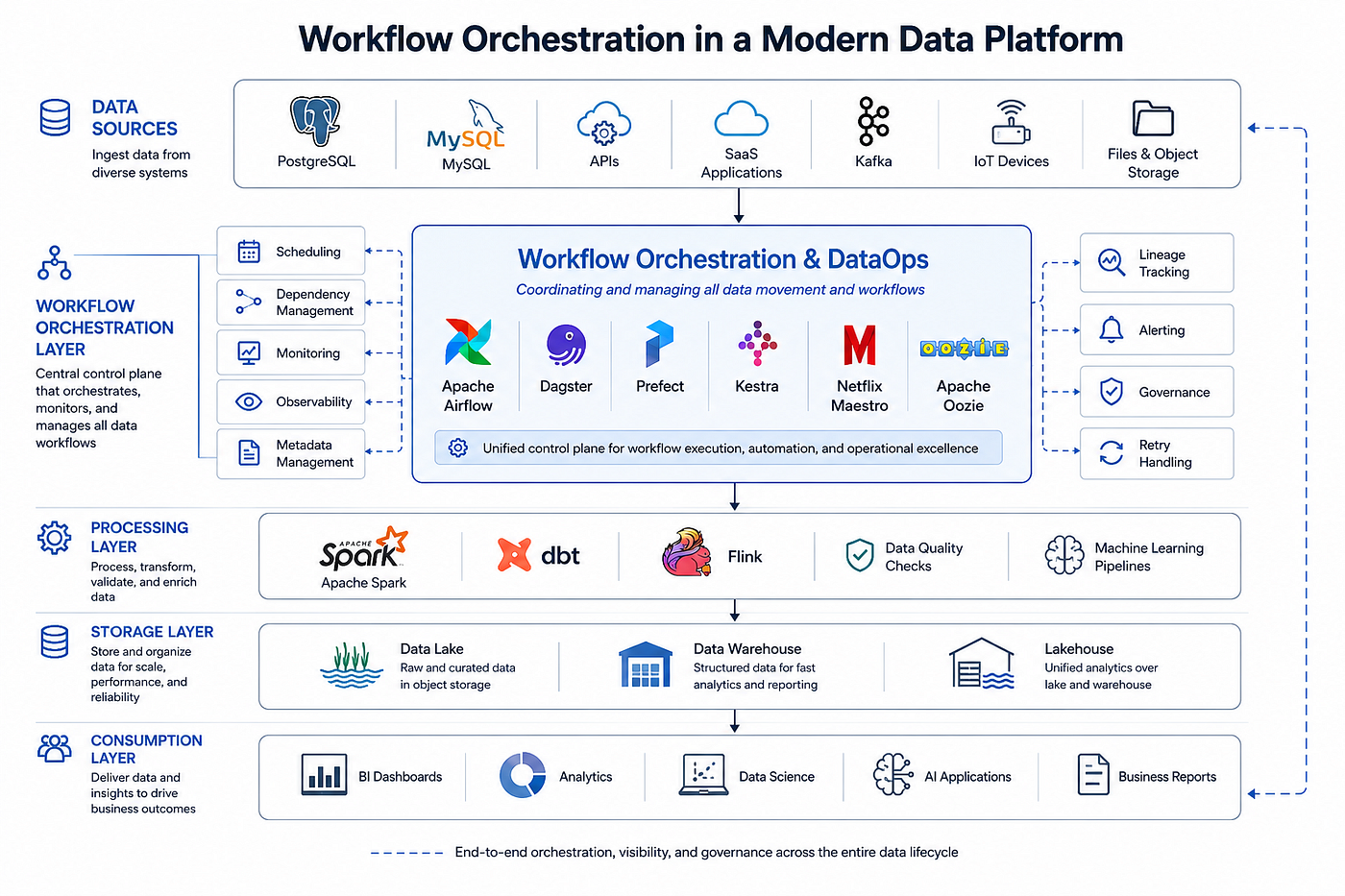
Workflow orchestration platforms such as Apache Airflow, Dagster, Prefect, Kestra, Netflix Maestro, and Apache Oozie act as the central control plane of modern data platforms, coordinating data ingestion, processing, storage, governance, monitoring, and downstream analytics workloads.
Apache Airflow
What Problem Does It Solve?
Apache Airflow emerged to solve the challenges associated with managing complex workflows through code rather than configuration. It addressed limitations found in traditional schedulers by providing a flexible, Pythonic framework for expressing workflow dependencies programmatically. Before Airflow, data engineering teams frequently relied on fragile shell scripts, undocumented cron chains, or expensive proprietary tools that discouraged rapid iteration.
Airflow brought workflows into the software engineering mainstream by enabling version control, code review, automated testing, and modular design patterns for pipeline development.
Architecture and Design Philosophy
Airflow follows a DAG-centric architecture where workflows are defined using Python code. The platform consists of several core components working together. The Scheduler continuously evaluates DAG definitions, determines which tasks are ready to execute based on their dependencies and schedule intervals, and submits those tasks to an execution queue. Workers pick up tasks from the queue and execute them using operator logic. The Web Server provides a rich user interface for monitoring executions, inspecting task logs, managing connections, and administering the system. The Metadata Database stores state information for all DAG runs and task instances.
Airflow supports multiple executor backends. The Sequential Executor runs tasks one at a time and is suitable only for development environments. The Local Executor runs tasks in parallel on the scheduler node. The Celery Executor distributes tasks across a pool of worker nodes using a message broker such as Redis or RabbitMQ. The Kubernetes Executor spawns individual pods for each task, providing strong isolation and dynamic resource allocation.
The platform emphasizes extensibility through a rich plugin architecture. Operators encapsulate task logic for specific systems and services. Hooks provide reusable connection management abstractions. Sensors pause execution until external conditions are met. The provider package ecosystem, now maintained as separate installable packages, spans cloud providers, databases, analytics platforms, messaging systems, and hundreds of other integrations.
Why Organizations Choose It
Organizations often select Airflow because of its maturity, ecosystem breadth, and widespread industry adoption. Having been donated to the Apache Software Foundation and maintained by a large open-source community, Airflow benefits from years of production hardening, extensive documentation, and an enormous base of operational knowledge available through forums, conferences, and published engineering content.
Engineers familiar with Python can rapidly develop workflows while leveraging a large collection of community-maintained integrations. The DAG-as-code model integrates naturally with existing software development workflows including version control, peer review, and CI/CD pipelines.
The talent pool is another practical advantage. Airflow has become a de facto standard across many data engineering teams, reducing hiring and training challenges.
Strengths in Real-World Deployments
Airflow excels in batch-oriented data processing environments where workflows execute on predictable schedules and depend on rich integration with diverse external systems. Its extensive operator library enables orchestration across cloud provider services, relational databases, columnar warehouses, distributed processing engines, machine learning platforms, notification systems, and many other targets.
Organizations running Airflow on managed platforms such as Google Cloud Composer, AWS MWAA, or Astronomer benefit from reduced operational overhead while retaining the flexibility of the core framework. The TaskFlow API, introduced in Airflow 2.x, significantly improved the developer experience for Python-native workflows by reducing boilerplate and making data passing between tasks more intuitive.
Its strong community support and extensive documentation further contribute to operational confidence, particularly for teams without dedicated platform engineering resources.
Limitations and Trade-Offs
Airflow’s flexibility can introduce complexity. Large deployments often require significant operational expertise to tune scheduler performance, manage DAG parsing overhead, configure worker scaling, and maintain metadata database health. Without careful architecture, Airflow environments can become difficult to upgrade and operationally fragile.
The scheduler, while much improved in version 2.x, can become a bottleneck at very large scale. Environments with thousands of concurrently active DAG runs require careful resource planning and often benefit from the KubernetesExecutor or CeleryKubernetesExecutor for mixed workloads.
Airflow also remains fundamentally task-centric rather than asset-centric. Understanding what data has been produced, what its quality status is, and how assets relate to each other requires additional tooling layered on top of the core platform.
Dynamic task generation has historically been a weakness, though Airflow 2.x introduced the Dynamic Task Mapping feature to address this. Despite improvements, highly dynamic workflows can still feel awkward within the DAG paradigm.
Ideal Use Cases
Large-scale ETL pipelines, data warehouse transformation orchestration, cloud analytics platforms, business intelligence refresh pipelines, and enterprise reporting environments with stable, well-understood scheduling patterns.
Who Should Consider It?
Organizations seeking a proven orchestration platform with strong community adoption, broad ecosystem support, and an extensive talent pool. Teams that prioritize stability, ecosystem breadth, and operational predictability over cutting-edge architectural features.
Dagster
What Problem Does It Solve?
Dagster was created to address limitations associated with task-centric orchestration by introducing an asset-oriented perspective. The platform focuses on understanding the data products being managed rather than merely scheduling execution steps. Its creators observed that traditional orchestrators treated pipelines as sequences of computational tasks without any inherent understanding of what those tasks were producing or consuming from a data perspective.
Dagster aims to make the relationship between code, data, and business value explicit and inspectable, rather than treating data assets as implicit side effects of task execution.
Architecture and Design Philosophy
Dagster centers around software-defined assets. Rather than defining a task and implicitly assuming it produces some output, Dagster requires developers to declare the data assets they are creating and the upstream assets they depend upon. This explicit asset declaration enables the platform to construct a complete graph of data dependencies across the organization.
The execution model separates asset definition from execution planning. Dagster determines what needs to be materialized based on asset staleness, dependency changes, and user-defined freshness policies. Jobs orchestrate asset materialization with explicit control over scheduling and execution parameters.
The Dagit web interface provides rich visibility into asset graphs, materialization history, data quality checks, and operational metadata. The asset catalog gives teams a single location to understand the current status and lineage of all managed data products.
Dagster also introduces strong typing through its type system, enabling runtime validation of data passed between assets. This reduces the risk of silent data quality failures propagating through pipelines undetected.
Why Organizations Choose It
Teams adopt Dagster because it aligns orchestration with modern DataOps practices. Asset awareness simplifies lineage tracking, testing, and operational management. Instead of reasoning about whether tasks ran successfully, teams can reason about whether specific data products are fresh, valid, and available for consumption.
Dagster’s integration with the dbt ecosystem is particularly compelling for analytics engineering teams. Organizations using dbt for transformation logic can manage dbt models as Dagster assets, enabling unified lineage and scheduling across the full data platform.
Strengths in Real-World Deployments
Dagster excels in environments where data products, governance, and lineage are strategic priorities. Its asset-centric model makes it significantly easier to answer operational questions such as which downstream consumers will be affected if a specific upstream table is delayed, or which assets need to be rematerialized following a schema change.
The developer experience is widely regarded as one of the strongest among modern orchestration platforms. Its testing framework enables engineers to unit test individual assets in isolation, integration test asset graphs with configurable resources, and validate data quality expectations programmatically.
Dagster Cloud provides a managed deployment option that eliminates infrastructure management overhead while providing enterprise-grade features including branch deployments, which allow teams to test pipeline changes in isolated environments before merging to production.
Limitations and Trade-Offs
Organizations migrating from traditional DAG-centric systems may face a conceptual learning curve. Dagster’s asset model requires developers to think differently about pipeline design, which can slow initial adoption in teams with deep Airflow experience.
Its provider ecosystem, while growing rapidly, remains smaller than Airflow’s. Teams requiring highly specialized integrations may find themselves writing more custom connector logic.
Ideal Use Cases
Modern cloud-native data platforms, analytics engineering environments with dbt integration, organizations adopting data mesh architectural principles, and teams building data products where lineage, governance, and quality management are first-order concerns.
Who Should Consider It?
Teams prioritizing data lineage, governance, developer productivity, and asset-centric operations. Organizations that view their data platform as a collection of managed data products rather than a collection of scheduled jobs will find Dagster’s model particularly well-aligned.
Prefect
What Problem Does It Solve?
Prefect emerged as a response to operational challenges observed in traditional workflow systems, particularly the brittleness and rigidity of purely static DAG definitions. Its founders argued that real-world data workflows are inherently dynamic and that orchestration systems should embrace rather than resist that reality.
Prefect’s design philosophy centers on a principle called “negative engineering” — the observation that a disproportionate fraction of data engineering effort goes into handling failures, retries, alerting, and error recovery rather than building new capabilities. Prefect aims to absorb this negative engineering burden into the platform itself.
Architecture and Design Philosophy
Prefect organizes workflows as flows and tasks. Flows are Python functions decorated with Prefect metadata. Tasks represent individual units of work within a flow. Unlike static DAG systems, flow structure is determined at runtime based on actual Python execution, enabling highly dynamic workflow generation including loops, conditionals, recursion, and external data-driven branching.
The Prefect server manages scheduling, state tracking, and operational visibility. Prefect Cloud provides a managed version with additional enterprise features. Workers poll for scheduled flow runs and execute them in configured infrastructure environments including local processes, Docker containers, Kubernetes pods, and serverless functions.
Prefect’s state management system is one of its most sophisticated features. Every flow run and task run transitions through a defined state machine. States carry contextual information, enabling fine-grained retry logic, human-in-the-loop approval gates, and complex conditional execution patterns.
Why Organizations Choose It
Organizations often adopt Prefect because it reduces orchestration complexity while maintaining flexibility. Existing Python code can often be converted into Prefect flows with minimal modifications, reducing the migration barrier compared with systems that require substantial workflow redesign.
The deployment model is particularly flexible. Prefect supports hybrid execution where the control plane runs in Prefect Cloud while computation executes within the organization’s own infrastructure. This simplifies security, compliance, and network isolation requirements.
Strengths in Real-World Deployments
Prefect performs particularly well in dynamic workflows where execution paths cannot be fully determined at DAG parse time. Pipelines that process variable numbers of records, iterate over dynamically discovered datasets, or branch based on runtime API responses are natural fits for Prefect’s execution model.
Its concurrency primitives, including task runners backed by concurrent futures, Dask, or Ray, enable efficient parallel execution without requiring infrastructure-level orchestration of worker pools.
The Prefect UI provides clean operational visibility with flow run timelines, task state histories, log streaming, and deployment management. Automation rules enable event-driven responses to operational conditions such as automatically retrying a flow after infrastructure recovery.
Limitations and Trade-Offs
Organizations with very large numbers of concurrently scheduled workflows may encounter scaling considerations around the Prefect server’s state management overhead. Very high-frequency triggering patterns require careful infrastructure sizing.
Teams that heavily rely on Prefect Cloud’s managed features face vendor dependency, though the open-source server remains a viable self-hosted alternative.
Ideal Use Cases
Dynamic data pipelines with runtime-determined structure, API integration workflows, ML pipeline orchestration, event-driven data processing, and teams seeking maximum developer productivity with minimal orchestration overhead.
Who Should Consider It?
Teams seeking a balance between operational simplicity and orchestration flexibility. Engineers who prefer writing idiomatic Python without the constraints of rigid DAG definition patterns. Organizations that need strong support for dynamic execution and event-driven workflow triggering.
Kestra
What Problem Does It Solve?
Kestra addresses a specific gap in the orchestration landscape: the need for a platform that can serve both data engineering teams and general infrastructure automation teams within a unified environment. Many organizations maintain separate systems for data pipeline orchestration and general IT workflow automation, creating operational silos and duplicated tooling overhead.
Kestra also targets teams that prefer declarative configuration over imperative code, offering a model more accessible to operators and platform engineers who are not primarily software developers.
Architecture and Design Philosophy
Kestra uses a declarative YAML-based workflow definition model. Workflows are described as structured configuration files specifying tasks, dependencies, triggers, and execution parameters. The platform provides a rich plugin ecosystem that covers data processing, cloud services, databases, messaging systems, HTTP requests, scripting, and infrastructure automation.
The architecture is built on top of Apache Kafka for event streaming and a relational database for state management, giving it strong durability and horizontal scalability characteristics. The execution engine supports both local and distributed deployment topologies.
Kestra supports multiple trigger types natively: schedule-based triggers with cron expressions, webhook triggers for API-driven execution, file detection triggers for landing zone monitoring, message queue triggers for streaming integration, and flow completion triggers for cross-workflow dependencies.
Why Organizations Choose It
Kestra is attractive to organizations seeking a platform that does not require Python expertise to operate. Its YAML-based approach lowers the barrier for teams with diverse technical backgrounds, enabling operations engineers, analytics engineers, and data engineers to collaborate on workflow definitions without a steep learning curve.
Its event-driven architecture makes it particularly well-suited for real-time and near-real-time orchestration patterns where latency between data availability and processing must be minimized.
Strengths in Real-World Deployments
Kestra excels in cloud-native environments where teams orchestrate heterogeneous workloads spanning data pipelines, infrastructure automation, API integrations, and reporting processes. Its plugin system simplifies integration with a broad range of external systems without requiring custom operator development.
The platform’s built-in namespace management provides logical isolation for different teams or environments within a shared deployment. Revision history and audit logging support governance and change management requirements.
Limitations and Trade-Offs
Kestra’s ecosystem maturity is lower than that of Airflow or Prefect. Some specialized integrations require custom plugin development. Its community is growing but remains smaller compared to more established platforms.
Organizations with very complex Python-native pipeline logic may find the YAML abstraction limiting compared with code-first approaches.
Ideal Use Cases
Unified data and operational workflow orchestration, cloud-native event-driven processing, environments with mixed technical teams, and organizations seeking deployment simplicity without sacrificing scalability.
Who Should Consider It?
Teams that value declarative workflow definitions, need to orchestrate both data pipelines and general automation processes, and prefer minimal infrastructure complexity in their orchestration layer.
Netflix Maestro
What Problem Does It Solve?
Netflix Maestro was developed internally to coordinate the enormous scale and diversity of workflows operating within Netflix’s data ecosystem. At the scale Netflix operates, existing open-source solutions encountered limitations around workflow volume, execution throughput, metadata management, and operational reliability under continuous high-load conditions.
Maestro reflects the requirements of organizations where workflow orchestration is a genuine engineering challenge at scale rather than simply an operational tooling choice.
Architecture and Design Philosophy
Maestro is designed as a massively scalable workflow orchestration service. Its architecture treats workflows as versioned, parameterized templates that can be triggered by schedules, events, or API calls. The platform maintains comprehensive metadata about every workflow execution and supports sophisticated dependency expression across workflows.
It separates workflow definition from execution, enabling centralized workflow governance while distributing actual computation across diverse infrastructure. Integration with Netflix’s internal compute and storage infrastructure enables seamless scaling across millions of daily workflow executions.
Maestro incorporates sophisticated retry logic, step-level granularity in failure handling, and comprehensive audit trails supporting both operational debugging and compliance requirements.
Why Organizations Choose It
Netflix’s engineering team developed Maestro because no existing solution adequately addressed their requirements. For organizations operating at comparable scale with similarly demanding reliability requirements, Maestro’s architectural choices offer relevant lessons even if direct adoption is not feasible.
Netflix has published detailed technical content about Maestro’s design, making it a valuable reference architecture for organizations building internal orchestration systems at scale.
Strengths in Real-World Deployments
Maestro excels in extremely large-scale environments where thousands of concurrent workflow executions are the norm rather than the exception. Its metadata-driven design provides rich operational visibility even across enormous execution volumes.
The platform’s parameterized workflow model enables workflow reuse across different contexts and data partitions, reducing redundancy in pipeline definitions.
Limitations and Trade-Offs
Maestro is not available as a general open-source product. Organizations outside Netflix cannot directly adopt it without significant custom engineering effort to decouple it from Netflix’s internal infrastructure.
Its complexity is calibrated to Netflix’s operational requirements, which means many of its architectural decisions may be overkill for organizations operating at significantly smaller scales.
Ideal Use Cases
Hyperscale data platforms, organizations operating millions of daily workflow executions, and engineering teams building internal orchestration systems where existing open-source tools have been validated as insufficient.
Who Should Consider It?
Organizations operating at genuine hyperscale who have exhausted the capacity of existing open-source platforms. Engineering teams studying Maestro’s architecture as a reference model for large-scale orchestration system design.
Apache Oozie
What Problem Does It Solve?
Apache Oozie emerged during the Hadoop era as a specialized workflow scheduler designed specifically for coordinating distributed processing workloads within Hadoop ecosystems. Before Oozie, Hadoop administrators frequently chained MapReduce jobs using fragile shell scripts or simple cron-based mechanisms that provided no dependency management or failure recovery.
Oozie provided a structured orchestration layer that understood Hadoop’s processing model and could reliably coordinate complex multi-stage data processing workflows involving MapReduce, Hive, Pig, Sqoop, and HDFS operations.
Architecture and Design Philosophy
Oozie uses an XML-based workflow definition model. Workflows describe sequences of actions, control flow nodes including decision points and parallel execution forks, and error handling paths. A central Oozie server coordinates workflow execution by submitting actions to Hadoop cluster resources.
Coordinator jobs enable scheduled and dataset-triggered workflow execution. Bundle jobs manage collections of coordinator jobs as a single operational unit. These abstractions provided enterprise-grade scheduling capabilities within the Hadoop ecosystem during the peak of on-premise big data deployments.
Why Organizations Choose It
Organizations adopted Oozie because it integrated deeply with the Hadoop stack and required no additional infrastructure beyond a Hadoop cluster. Its action types were specifically designed around Hadoop execution patterns, making it the natural choice for Hadoop-native workflows.
For organizations already deeply invested in Hadoop infrastructure, Oozie provided reliable orchestration without introducing new system dependencies.
Strengths in Real-World Deployments
Within Hadoop environments, Oozie’s deep integration with YARN resource management, HDFS, and Hadoop-native processing engines provides coordination capabilities that generic orchestrators may struggle to replicate without custom integration work.
Its coordinator model for data-availability-triggered execution aligns well with batch processing patterns where downstream jobs must wait for upstream data to land in HDFS before proceeding.
Limitations and Trade-Offs
As cloud-native architectures gained prominence, Oozie’s relevance declined. Its XML-based workflow definitions are verbose and difficult to manage compared with code-first or declarative YAML alternatives. Developer experience lags significantly behind modern platforms.
Oozie’s architecture is tightly coupled to the Hadoop ecosystem, making it poorly suited for cloud-native, multi-system orchestration. Organizations migrating away from on-premise Hadoop toward cloud data platforms typically replace Oozie with modern alternatives as part of their migration.
Active development on Oozie has slowed significantly as the broader industry has shifted away from traditional Hadoop deployments.
Ideal Use Cases
Legacy Hadoop data processing environments, organizations with significant existing Oozie workflow investments, and situations where complete migration to modern orchestration platforms is deferred for operational or budgetary reasons.
Who Should Consider It?
Organizations maintaining existing Hadoop infrastructure where Oozie is already operational. Teams evaluating Oozie as a new platform should strongly consider modern alternatives given the direction of the industry.
Comparative Analysis
Airflow remains the most broadly adopted orchestration platform and benefits from unmatched ecosystem maturity. Dagster introduces a modern asset-centric model that aligns closely with DataOps practices. Prefect focuses on developer productivity and operational simplicity through dynamic execution. Kestra emphasizes event-driven execution and deployment accessibility through declarative definitions. Maestro demonstrates what orchestration looks like when hyperscale is a genuine requirement. Oozie reflects the requirements of legacy Hadoop environments and occupies a declining but still relevant niche.
Criteria Airflow Dagster Prefect Kestra Maestro Oozie Ease of Adoption Medium Medium High High Low Medium Learning Curve Moderate Moderate Low Low High Moderate Workflow Definition Python DAG Python Assets Python Flows YAML JSON/API XML Scalability High High High High Very High High Cloud Native Strong Excellent Excellent Excellent Strong Limited Event Driven Moderate Strong Strong Excellent Strong Limited Dynamic Workflows Limited Moderate Excellent Good Strong Limited Asset Awareness Limited Excellent Moderate Moderate Moderate None Developer Experience Good Excellent Excellent Good Moderate Limited Observability Good Excellent Good Good Strong Basic Lineage Tracking Limited Excellent Moderate Moderate Strong None CI/CD Integration Good Excellent Good Good Moderate Limited Enterprise Adoption Very High Growing Growing Growing Specialized Legacy Managed Cloud Option Yes Yes Yes Yes Internal No Community Maturity Very High Medium Medium Emerging Limited Mature Open Source Yes Yes Yes Yes No Yes
Choosing the Right Orchestration Platform
Selecting an orchestration platform is not purely a technical decision. It involves organizational context, team capabilities, existing infrastructure, long-term architectural direction, and operational maturity. The following framework provides structured guidance across different organizational profiles.
Early-Stage Startups Startups typically prioritize speed, simplicity, and low operational overhead. Engineering teams are small, infrastructure budgets are constrained, and the ability to iterate quickly matters more than enterprise-grade operational features. Prefect and Kestra often align well with these requirements. Both offer managed hosting options that eliminate infrastructure management overhead and enable rapid pipeline development without significant platform investment.
Mid-Sized Organizations Mid-sized organizations frequently balance flexibility with growing governance needs. Data teams are expanding, stakeholder expectations are increasing, and operational reliability is becoming critical. Airflow, Dagster, and Prefect are common choices in this segment. The optimal selection depends on whether the organization prioritizes ecosystem breadth and hiring ease (Airflow), data product governance and lineage (Dagster), or developer productivity and dynamic execution (Prefect).
Large Enterprises Large enterprises often prioritize ecosystem maturity, governance capabilities, integration with existing tooling, and operational stability. Airflow remains dominant in this segment due to its broad ecosystem and well-understood operational characteristics. Dagster continues gaining traction among enterprises modernizing their data platforms and investing in data mesh architectures. Organizations with strong engineering teams and complex governance requirements may find Dagster’s asset model delivers strategic long-term value.
Regulated Industries Organizations operating in heavily regulated environments such as financial services, healthcare, and government benefit from orchestration platforms with strong lineage tracking, audit logging, and governance integration. Dagster’s metadata-driven architecture and lineage capabilities make it particularly well-suited. Airflow with appropriate plugins and operational controls can also satisfy regulatory requirements, though it requires more custom integration effort.
Hadoop-Centric Environments Organizations maintaining significant Hadoop infrastructure may continue relying on Oozie for existing workflows while evaluating migration paths toward modern platforms. A phased migration strategy that replaces Oozie workflows incrementally as they are refactored for cloud-native architectures is a common approach.
Streaming and Event-Driven Platforms Organizations operating streaming data architectures benefit from orchestration platforms with strong event-driven execution capabilities. Kestra and Prefect both support rich event trigger models. Dagster’s sensor-based execution can also support event-driven patterns, particularly for data-availability-triggered workflows.
ML and AI Platforms Machine learning and AI platforms require orchestration that handles both training workflows and inference pipelines. Prefect’s dynamic execution model handles the variable runtime characteristics of ML workloads well. Dagster’s asset model aligns naturally with managing trained model artifacts alongside feature datasets and evaluation results. Both platforms have growing integrations with MLflow, Weights and Biases, and other ML tooling.
Migration Considerations
Many organizations eventually evaluate migrating from one orchestration platform to another as requirements evolve. Understanding migration complexity helps inform strategic platform decisions.
Migrating from Oozie to a modern platform is typically driven by Hadoop deprecation or cloud migration initiatives. The XML-based workflow definitions rarely map cleanly to Python-based systems, making migration a rewrite exercise rather than a translation. However, the business logic within Hive or Pig actions often transfers to SQL or Spark equivalents during the same migration cycle.
Migrating from Airflow to Dagster or Prefect is increasingly common as organizations modernize their platforms. Both Dagster and Prefect offer tooling and documentation to assist with Airflow migration. The primary challenge is conceptual rather than technical: engineers must shift their mental model from task execution sequences to asset materialization or dynamic flow execution.
Organizations migrating between managed Airflow providers, such as moving from MWAA to Astronomer or Google Cloud Composer, typically experience lower friction since the underlying DAG definitions remain compatible, though provider-specific configurations and operator versions may require adjustment.
The Future of Workflow Orchestration
The workflow orchestration landscape continues to evolve rapidly, driven by changes in data architecture patterns, cloud infrastructure capabilities, and the emergence of artificial intelligence as both a workload type and an operational tool.
Asset-Centric Models Will Become Standard The shift from task-centric to asset-centric orchestration, pioneered by Dagster, is increasingly influencing other platforms. Airflow’s introduction of the Datasets API represents an acknowledgment that asset awareness is becoming a table-stakes expectation. Future orchestration platforms will increasingly treat data products as first-class entities with explicit ownership, freshness policies, quality expectations, and lineage graphs.
AI-Augmented Operations Artificial intelligence will play an increasingly important role in orchestration operations. Future systems may automatically detect anomalous execution patterns and adjust scheduling parameters in response. Natural language interfaces could enable non-technical stakeholders to query pipeline status, understand data freshness, and investigate quality issues without engineering intervention. AI-assisted pipeline generation, where orchestration logic is synthesized from business requirements or data schema analysis, represents a longer-horizon possibility that several platform providers are actively exploring.
Autonomous Remediation Today’s orchestration platforms primarily surface failures and provide tools for manual intervention. Next-generation platforms will increasingly attempt autonomous remediation of common failure patterns: automatically scaling infrastructure in response to workload growth, rerouting tasks when infrastructure components fail, and applying learned retry strategies based on historical failure patterns. The goal is to reduce the operational burden on data engineering teams by having the orchestration platform itself handle routine failure scenarios.
Unified DataOps Platforms The boundary between orchestration and other data platform capabilities is blurring. Modern orchestration platforms increasingly incorporate data quality management, metadata cataloging, lineage visualization, and observability tooling that were traditionally provided by separate specialized tools. This convergence is creating more comprehensive DataOps platforms that provide end-to-end visibility and control over the full data lifecycle from ingestion through consumption.
Event-Driven Architecture as Default Schedule-based execution is gradually giving way to event-driven execution as the dominant orchestration model. As data platforms integrate more deeply with streaming infrastructure, orchestration systems will increasingly respond to data availability signals, infrastructure events, and business triggers rather than executing on fixed time intervals. This shift reduces latency, improves resource efficiency, and better reflects the actual dynamics of data production and consumption in modern organizations.
Infrastructure Abstraction Future orchestration platforms will increasingly abstract away infrastructure concerns entirely. Engineers will define workflows in terms of data transformations and dependencies, while the orchestration platform automatically selects, provisions, and manages the appropriate compute resources based on workload characteristics, cost constraints, and performance requirements. Serverless orchestration models, where computation is provisioned transiently for each task execution without persistent worker infrastructure, are already emerging and will likely become dominant for many workload types.
Conclusion
Workflow orchestration has evolved from simple job scheduling into one of the most critical and architecturally significant components of modern data platforms. As organizations manage increasingly complex data ecosystems spanning cloud services, streaming platforms, machine learning systems, and analytics applications, orchestration platforms provide the coordination, visibility, reliability, and governance required to operate at scale with confidence.
No single orchestration platform is universally superior across all organizational contexts.
Apache Airflow offers unmatched ecosystem maturity, a vast integration library, and a global talent pool that makes it a safe and well-understood choice for the majority of data engineering environments. Its continued evolution through the 2.x release series has addressed many historical limitations around dynamic task generation, developer experience, and scheduling performance.
Dagster introduces a fundamentally different and increasingly compelling asset-centric model that aligns orchestration with modern DataOps and data mesh architectural principles. For organizations that treat their data platform as a collection of managed data products, Dagster’s philosophy provides a more natural and operationally transparent foundation.
Prefect emphasizes developer productivity, operational simplicity, and dynamic execution flexibility. Its ability to treat existing Python code as orchestrated workflows, combined with strong support for cloud-native deployment patterns, makes it a strong candidate for teams that prioritize iteration speed and modern infrastructure.
Kestra delivers a declarative, event-driven orchestration experience that lowers the barrier for diverse technical teams and unifies data pipeline orchestration with general infrastructure automation within a single platform.
Netflix Maestro demonstrates that at sufficient scale, bespoke orchestration infrastructure becomes a strategic engineering investment. Its architecture provides valuable lessons for any organization confronting genuine hyperscale orchestration challenges.
Apache Oozie, while declining in relevance, continues to serve organizations with significant Hadoop infrastructure investments. Understanding its limitations helps motivate the migration investments required to transition toward modern cloud-native alternatives.
Selecting the right platform requires honest assessment of organizational scale, team technical capabilities, existing infrastructure investments, architectural direction, governance requirements, and long-term operational goals. The best platform is not necessarily the most sophisticated or the most feature-rich — it is the one that the team can operate reliably, extend confidently, and align with the direction the broader data platform is heading.
As DataOps practices mature and data platforms become increasingly autonomous, workflow orchestration will continue evolving from workflow management infrastructure into intelligent operational control systems. The platforms that successfully make this transition — embedding AI, autonomous remediation, asset intelligence, and deep observability into their core architectures — will define the next era of data engineering.
메타데이터
- post_id
- e06fb44a4f62
- slug
- workflow-orchestration-dataops-orchestration-a-deep-dive-into-airflow-dagster-prefect-kestra-e06fb44a4f62
- url
- https://medium.com/@halfbloodangel777/workflow-orchestration-dataops-orchestration-a-deep-dive-into-airflow-dagster-prefect-kestra-e06fb44a4f62
- canonical_url
- https://medium.com/@halfbloodangel777/workflow-orchestration-dataops-orchestration-a-deep-dive-into-airflow-dagster-prefect-kestra-e06fb44a4f62
- author_url
- https://medium.com/@halfbloodangel777
- status
- ok
- fetched_at
- 2026-07-29 01:43:05




