A Slow-Rewind for The Fast-Forward World
The Future of Slowness and The Quest to Unwind Our Perception of Speed
A Slow-Rewind for The Fast-Forward World
The Future of Slowness and The Quest to Unwind Our Perception of Speed
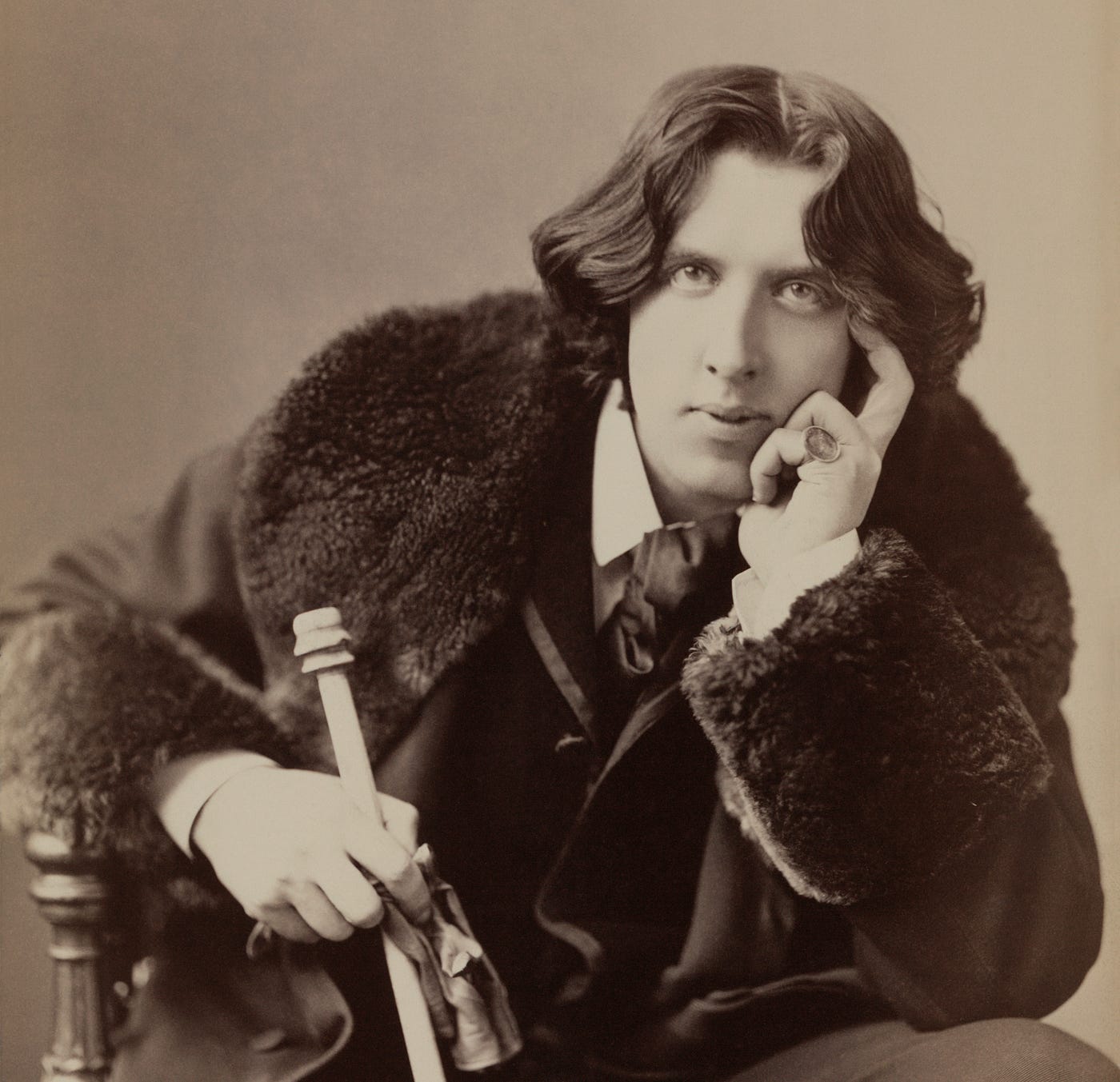
Photo by Olegs Jonins on Unsplash
When I found Philip Teale’s Future of Slowness series, I read all four essays in one sitting. Then I closed my laptop and did nothing for two weeks.
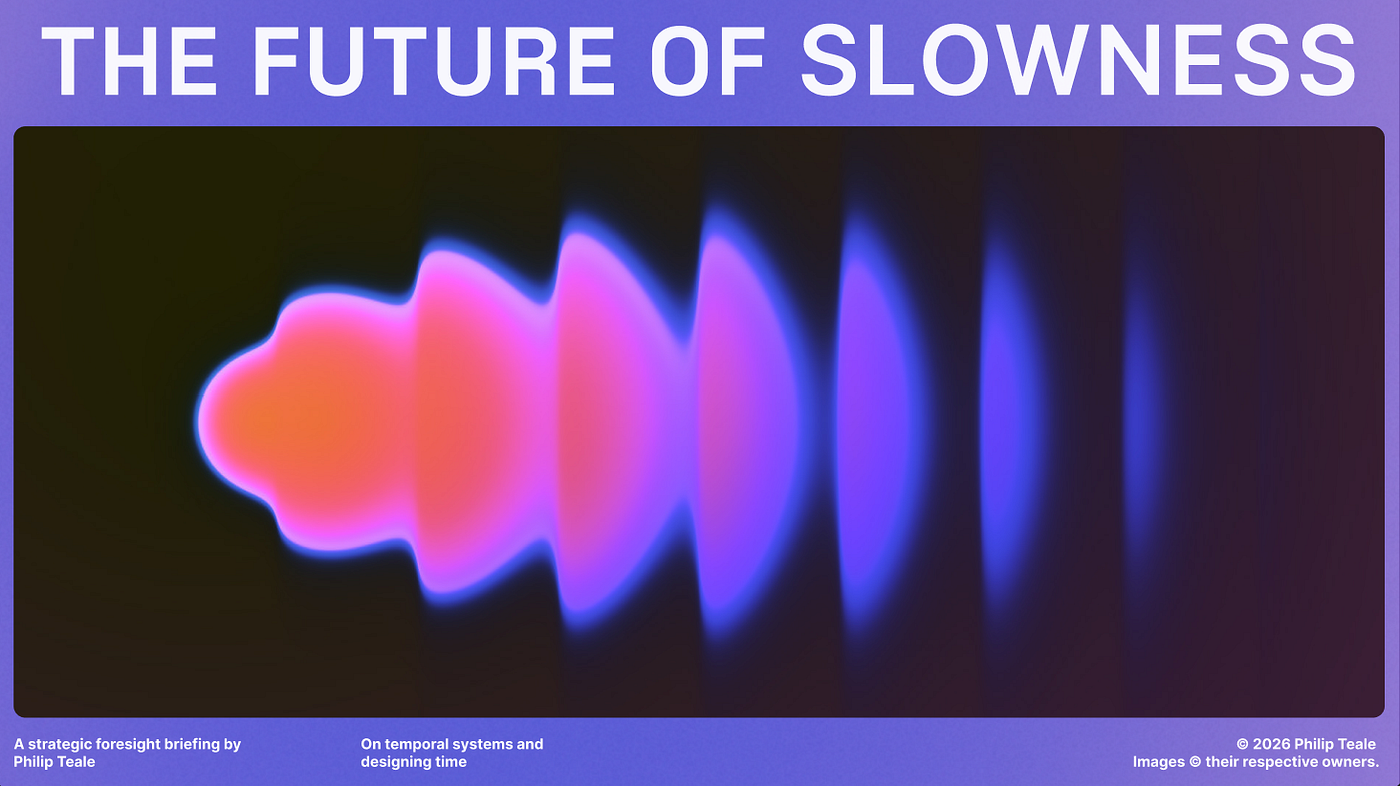
Source: Philip’s Figma Slides
The writing hit somewhere close to home, and I needed time to understand why. That sitting-with-it, that deliberate pause before responding, turned out to be the most honest way I could begin this essay. Which is fitting, given the subject.
I am a writer and creative strategist based in Indonesia. I have spent years thinking about how culture shapes the way people move, decide, and make things. Philip is a London-based cultural researcher doing the same work from a different geography. When I read his essays, I felt the particular excitement of recognizing a mind working on a problem adjacent to mine, and the particular itch of knowing I had something to add.
This essay is my attempt to scratch that itch. A response from someone who found, in Philip’s question, a reason to look more carefully at what was already around him.
If Philip is Link on a quest, I suppose I am an NPC handing him something from a world he has not visited yet. Consider this essay an ocarina (Zelda reference, anyone?). Whether it opens new paths is for him to discover.
Buying Time
Philip has spent four essays chasing one central question. Can the logic of Mediterranean slowness be imported into cities addicted to speed?
“…Can you import the logic of Mediterranean slowness into other, more Western contexts? In places like London, New York, and other megacities, is it possible to have slowness beyond marginal pockets of time and space? What would it take to amplify slowness in systems addicted to speed?” — Philip Teale
In *Stuck on fast-forward*, he makes the case for urgency. We have moved beyond speed into acceleration, a distinction that matters. Speed is fast. Acceleration means fast is no longer enough.
He traces the lineage from the Slow Food movement’s 1986 protest against a McDonald’s in Rome, through the colonisation of attention by social media, to the present moment, where, as tech writer Tina He observed through the lens of Jevons paradox, the labour-saving effect of AI tools is simply accelerating the pace of work by raising productivity expectations.
Speed saves time. The saved time becomes more work. The trap tightens.
“The politics of time — who gets to decide ownership over our time and how — is arguably one of the most important power struggles of the 21st century so far.” — Philip Teale
Philip identifies time itself as an instrument of power. Who decides how we spend it, and when, is one of the defining struggles of this century. That framing is exactly right.
In *Seeds of slowness*, he goes looking for prototypes. Ritualised gatherings. Infrastructures of care. Calm-by-design technology. The four-day work week. EU right to repair legislation. He is alert to the dangers of what he calls “the gentrification of slowness,” the way the concept risks becoming the exclusive property of those wealthy enough to opt out of urgency.
In *Speculative slowness, he dreams aloud. Shared meals as a slow ritual. The afternoon siesta *as a workplace intervention. Radical curation as an antidote to infinite choice.
And in *The cost of slow*, he lands on what is at stake. The future of slowness is “as much about counterculture as it is about structural and technological changes.” Making hidden costs visible. Challenging the idea that slowing down is a liability.
The sentence I keep returning to is from his first essay.
“Slowness isn’t about rejecting the clock as if capitalism didn’t exist, but choosing when to ignore its rule. It’s about us authoring time, as opposed to time authoring us.” — Philip Teale
Authoring time.
I read that sentence in a warung where I had been sitting for two hours, with a glass of tea that had gone cold and an owner who had refilled my water twice without being asked. The man at the next table had been on the phone for twenty minutes in a conversation that appeared to have no agenda whatsoever. And nobody had asked me to leave.
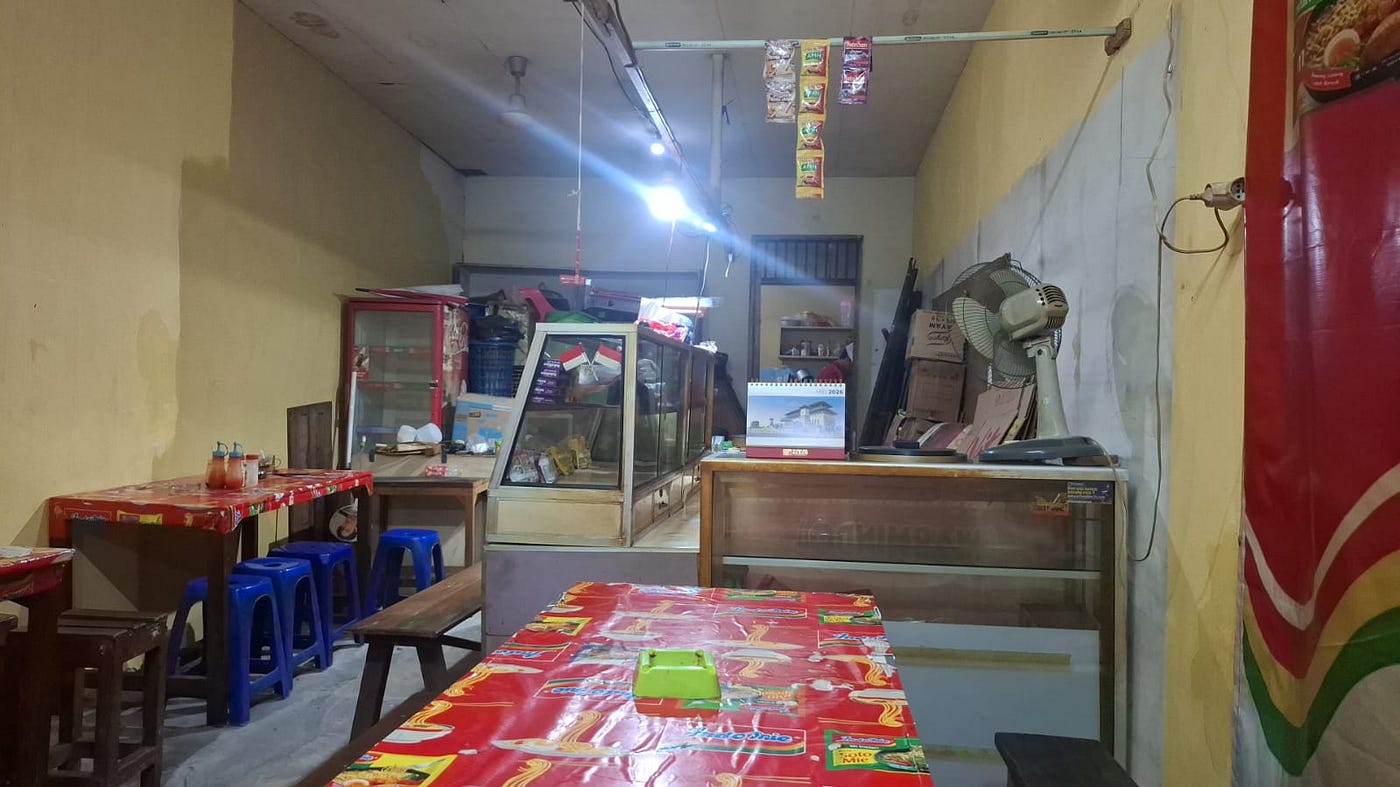
The “warung” I was talking about at 3 AM. The man on the phone was on the far left beyond the frame.
Philip was describing, in the language of contemporary cultural theory, what was happening around me. He just did not know where to look.
Wound Up Wrong. Alon-alon Waton Kelakon.
I want to take Philip’s best insight, “authoring time, as opposed to time authoring us,” and push it one step further. Because I think it points to something that his framework has not quite named.
There is a Javanese proverb that Indonesians have argued about for generations.
*“Alon-alon waton kelakon.”*
It is usually translated as “slowly but surely.”
That translation is incomplete in a way that matters. The word alon-alon describes a state in which heart, mind, and action move in alignment, what Javanese culture calls keselarasan. When everything clicks and moves in harmony, properly, with the right fit, at the right time, for the right ones. In a clockwork precision, I might say.
Waton kelakon means “so that it is accomplished,” with integrity, without harm. The proverb says nothing about pace. It says everything about the quality of intention behind any movement.
A philosopher and cultural thinker named Emha Ainun Nadjib, known across Indonesia as Cak Nun, once described this distinction through a story about rushing to an airport on a car.
[embed]
He was late, so the driver accelerated. And he noticed something. The faster he went, the farther the airport felt. The distance grew with his impatience. “Semakin kamu ngebut, semakin jauh hakikatnya.” The more you rush, the farther the truth becomes.
I perceive that rushing is a symptom of misalignment. Someone whose heart, mind, and actions are pointing in the same direction feels close to their destination, regardless of physical distance. Someone who rushes has not yet arrived at that alignment.
Alon-alon is a philosophy of deliberacy.
Consider a firefighter running into a burning building. Moving as fast as their bodies allow. But if their heart knows this is their purpose, their mind knows what the situation requires, and their body executes without hesitation, that is alon-alon. Every movement is deliberate. Nothing wasted.
Consider a scientist observing bird migration across continents. Months pass. A single rushed observation, published too early, would collapse the pattern. Her patience is the appropriate speed for what she is trying to understand.
Alon-alon is both of them moving at exactly the speed their purpose requires, because their intention is clear. Everything has its proper takaran, its correct measure. The right pace is always a consequence of alignment, never a value in itself.
In *Seeds of slowness*, Philip asks why he does not replace “slow” with less ambiguous words like “mindful” or “intentional.” He finds them insufficient. Too small to carry the weight of a systemic critique.
I agree, they are insufficient. The word he is looking for already exists. It is keselarasan. And the practice it describes goes somewhere those English words cannot follow.
Philip is building a counterweight to speed. Keselarasan offers a different axis altogether.
Before Time Was Money
Philip worries, in *Seeds of slowness*, about the gentrification of slowness. The risk that only the wealthy get to be time-rich. He wants seeds that belong to everyone.
A gentle thought here, from someone who grew up with this.
[embed]
The warung, the small, informal food stall on virtually every street in Indonesia, is, by Philip’s own taxonomy, an “infrastructure of care.”
It is also a ritualised gathering space, a tactile community anchor, a site of hours-long conversation with no agenda. And it is accessible to anyone with a few thousand rupiah, less than the price of a London coffee. There is no gentrified version of the warung. It has always belonged to everyone.
[embed]
Nongkrong is the practice of gathering with no defined agenda or endpoint. A warung, a roadside, a friend’s front porch. You drink something, you talk about something or nothing, and time passes at a rate nobody is monitoring. It requires no organization. It requires only a place to sit and other people who also have nowhere urgent to be.
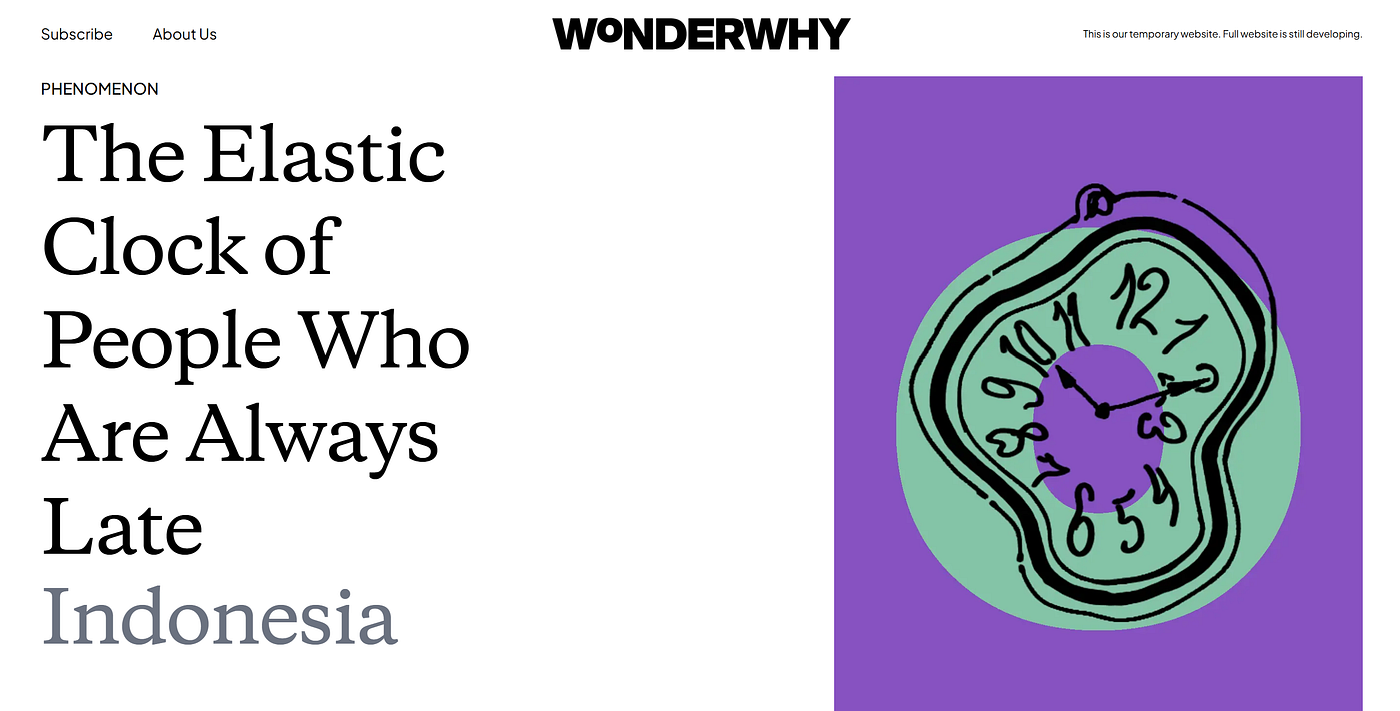
Source: Wonder Why SEA
*Jam karet*, rubber time, is the living refusal of the formulation Barbara Adam wrote, and Philip cited in his first essay.
“Where time is equated with money, speed becomes an important economic value.”
In the world of jam karet, that equation does not apply. Appointments are approximations. The first hour of any gathering is the time during which arrival happens, during which the social fabric reassembles itself. It is relational time, doing exactly what it is supposed to do.
[embed]Jam Karet (Rubber Time) Stay in the present in the Balinese waymedium.com
[embed]
*Mudik* is the practice of returning to one’s home region before Eid al-Fitr. In 2025, the Indonesian Ministry of Transportation recorded 154.6 million people making this journey, more than half the country’s population moving simultaneously back to their origins.
They go because the pull of where they come from temporarily overrides the logic of where they work. For the duration of Lebaran, the productivity machine pauses. Millions of people decided, simultaneously, that something else mattered more.
[embed]“Mudik”: The Great Indonesian Exodus Pradita Utama, Detik.commedium.com
In *Seeds of slowness*, Philip argues that transformative seeds of slowness must “begin at the level of feeling and meaning.”
Mudik has always begun there.
And in his 1 June 1945 speech, the one that gave birth to Pancasila, Sukarno distilled five founding principles of the Indonesian nation down to one. He called it Negara Gotong Royong, a gotong royong state, a nation built on mutual aid and shared burden.
Philip identifies “infrastructures of care” as one of his key seeds of slowness. Indonesia’s first president named it the foundation of the entire country.
What Philip calls seeds are old-growth trees here, in Indonesia.
Your 2040, Our Every Tuesday
In *Speculative slowness*, Philip asks what it would look like to apply new technology to social rituals. He imagines shared meals as a slow practice. Mixed-reality dinners with AR holograms of distant family members at the table. A way to make the communal meal happen again in cities where it has been lost.
The communal meal has not been lost in Indonesia. It simply never left.
When someone has a hajatan (celebration) here, a wedding, a circumcision, a new child, the family cooks. A lot.
[embed]
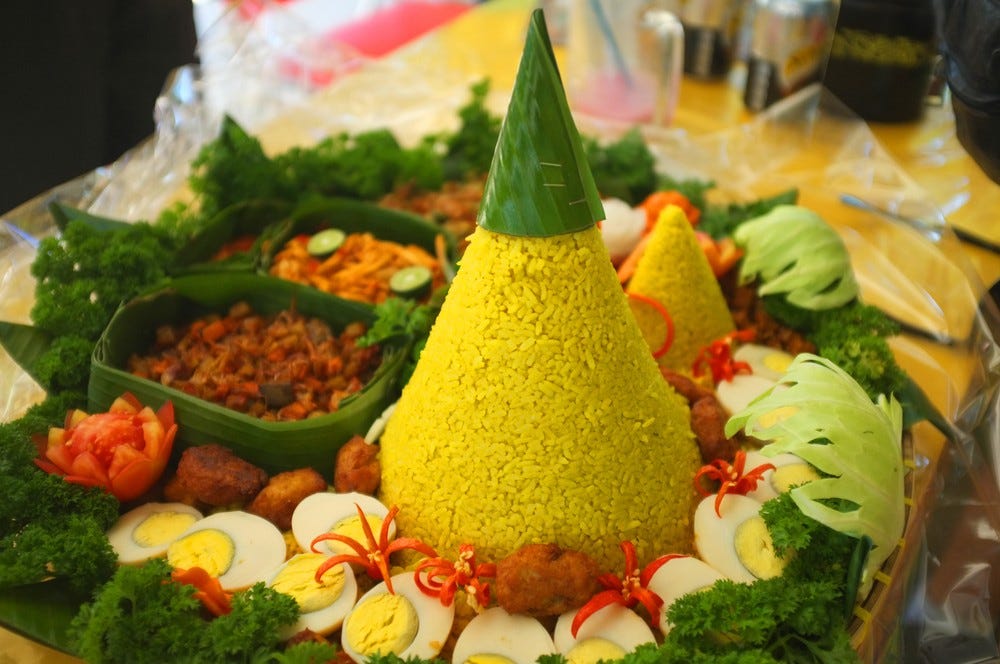
The cooking is not done alone. Neighbors arrive. Someone brings their own wok. Someone else takes over the rice. The food is distributed. What Philip is dreaming of building already happens regularly, without an app, without AR glasses, without a product brief.
Source: The Jakarta Post
It is called *tumpeng* at its most ceremonial.
Source: Good News From Indonesia
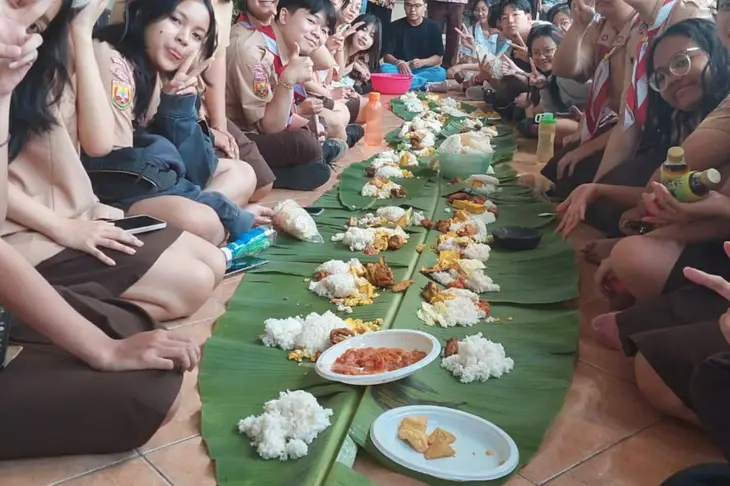
Ngaliwet, when it is casual, rice cooked in coconut milk, spread on banana leaves, eaten together on the floor.
The version that needs no name is simply that whenever there is a hajatan, the neighborhood shows up and cooks together.
Philip also speculates about normalising the afternoon siesta at work. Sleeping pods. A Mediterranean rhythm imported into the corporate day.
Source: Denpasar Viral
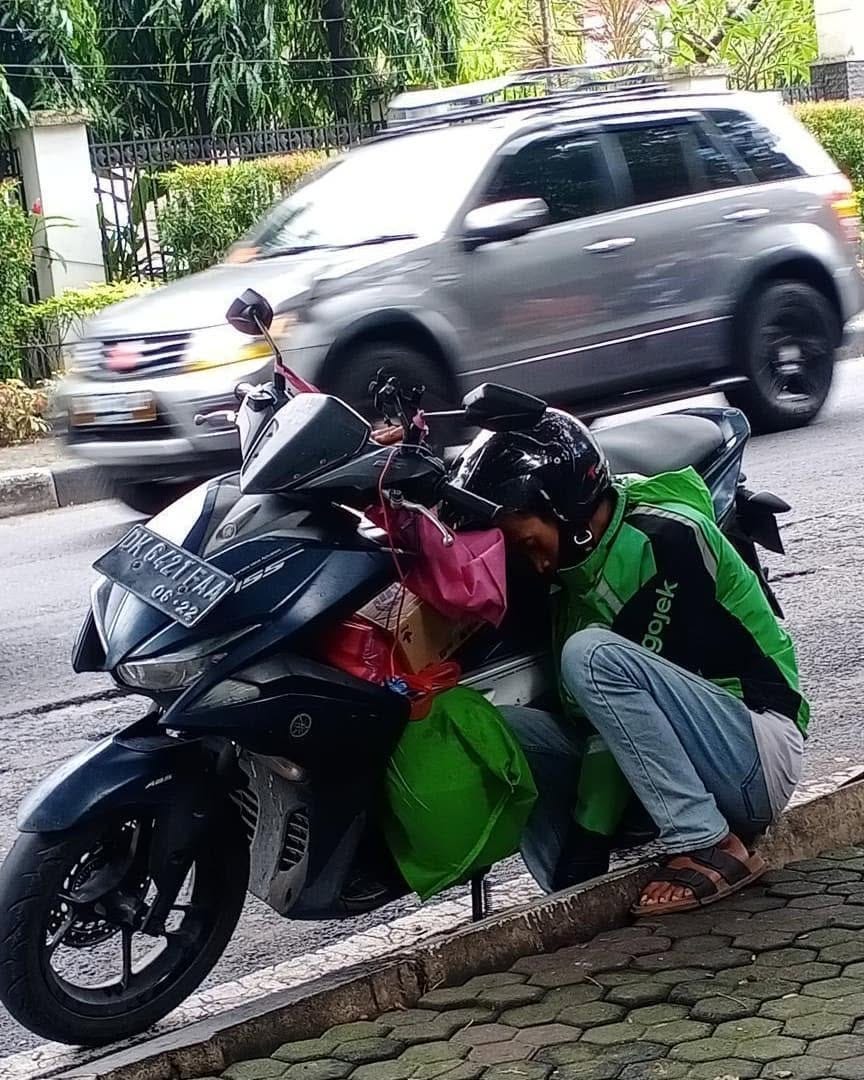
Here too, the practice already exists. It is the bike driver asleep on his motorbike at noon, helmet still on.
It is that “ngopi dulu”, let me get coffee first, a culturally sanctioned pause before any demanding task.
It is that “sebat dulu”, let me have a cigarette first, a deliberate withdrawal from urgency practiced daily by millions.
These are improvised, collective, human intervals inserted into the working day.
Philip is speculating about futures that are Indonesian presents. The question worth sitting with is why those presents feel so hard to recognize as the thing being searched for.
Making Time, Not Chasing It
The argument for Indonesian deliberacy runs deeper than living practice.
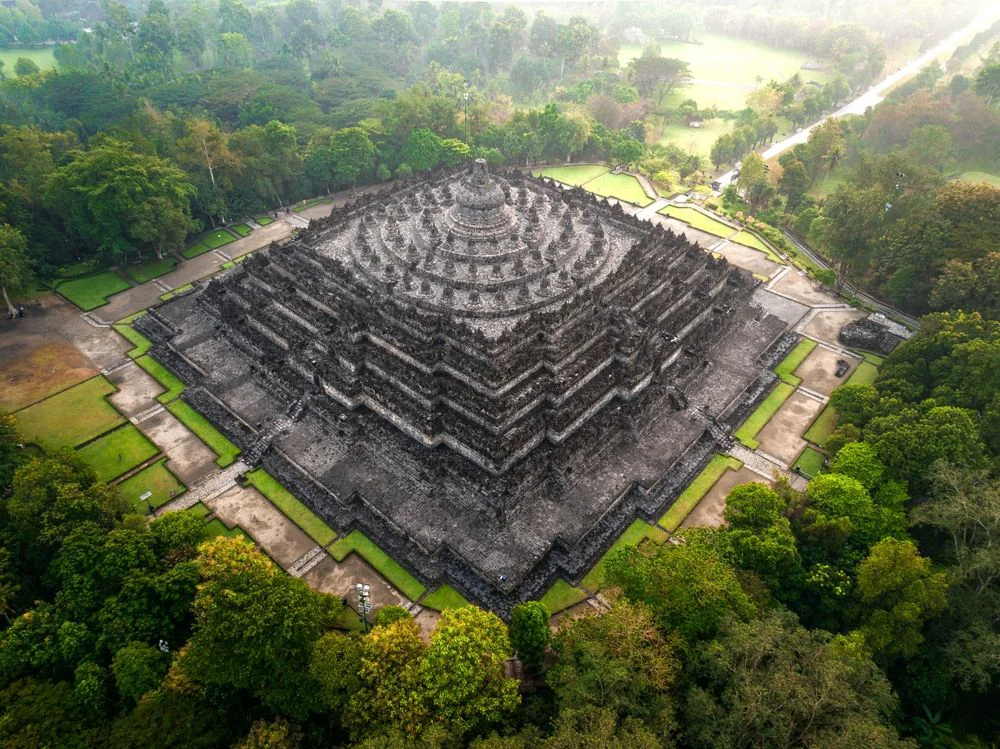
Borobudur Temple. Source: Indonesia Travel
Indonesia is a country of stone monuments. Temple complexes that took generations to build are spread across Java, Bali, and Sumatra. Borobudur, completed around 825 CE, was constructed from approximately two million blocks of volcanic stone. The sculptural program of Prambanan, built a generation later, shows an ambition that still astonishes.

Source: Tempo
The people who built these monuments had iron. The *keris, Indonesia’s sacred dagger, proves it. The blade of a traditional keris* is produced by folding and welding different iron alloys together, layer by layer, creating patterns in the metal that require sophisticated metallurgical knowledge.
[embed]
A community capable of making a keris was building in stone by choice, by deliberate decision about permanence.
We chose stone because stone lasts.
A building made faster, from less permanent material, does not survive a century. A temple carved into volcanic rock on a hillside in Central Java survives earthquakes, invasions, and dynasties.
Our ancestors who chose stone were deciding who they were building for. They were building for grandchildren’s grandchildren who had not yet been born. That is alon-alon waton kelakon rendered in architecture.
Making time, rather than chasing it.
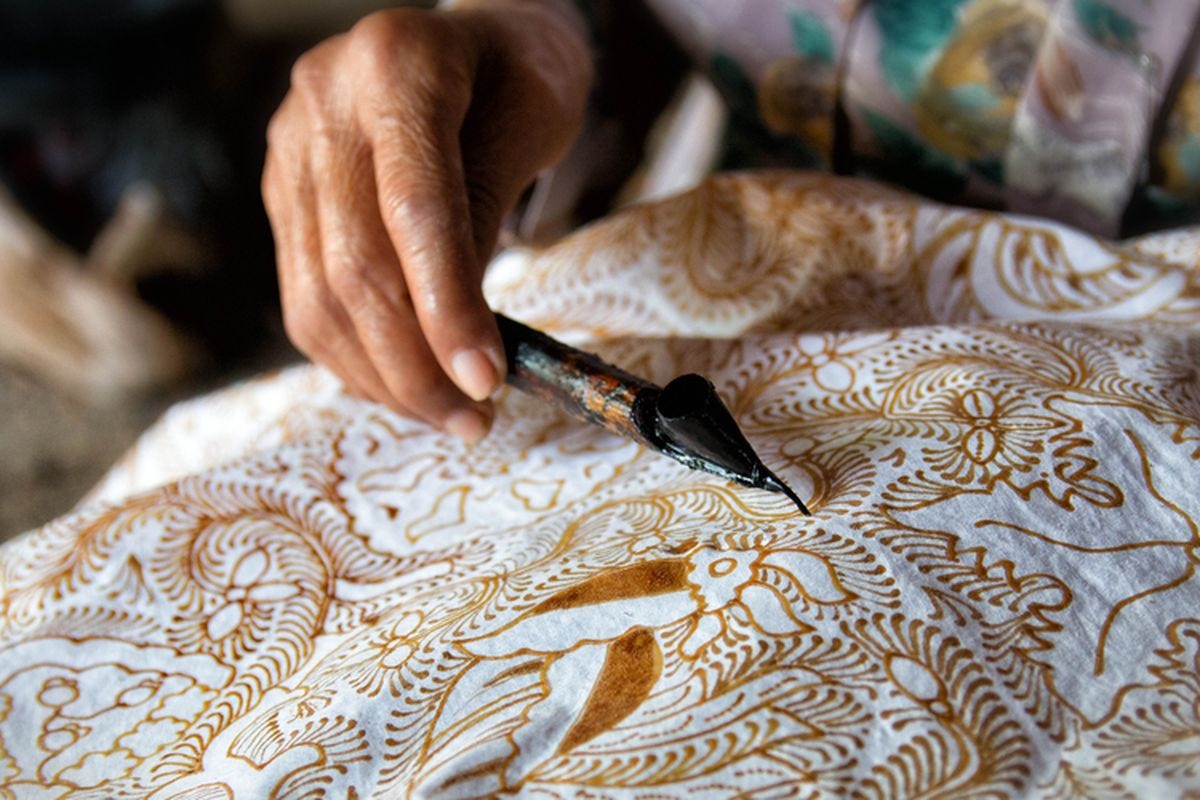
And then there is batik. A single piece of hand-drawn *batik tulis* takes weeks, sometimes months, to complete.
Source: Kompas
Each dot of wax is applied by hand through a small copper tool called a canting. The pattern is written, stitch by careful stitch. Tulis means written.
Source: The Jakarta Post
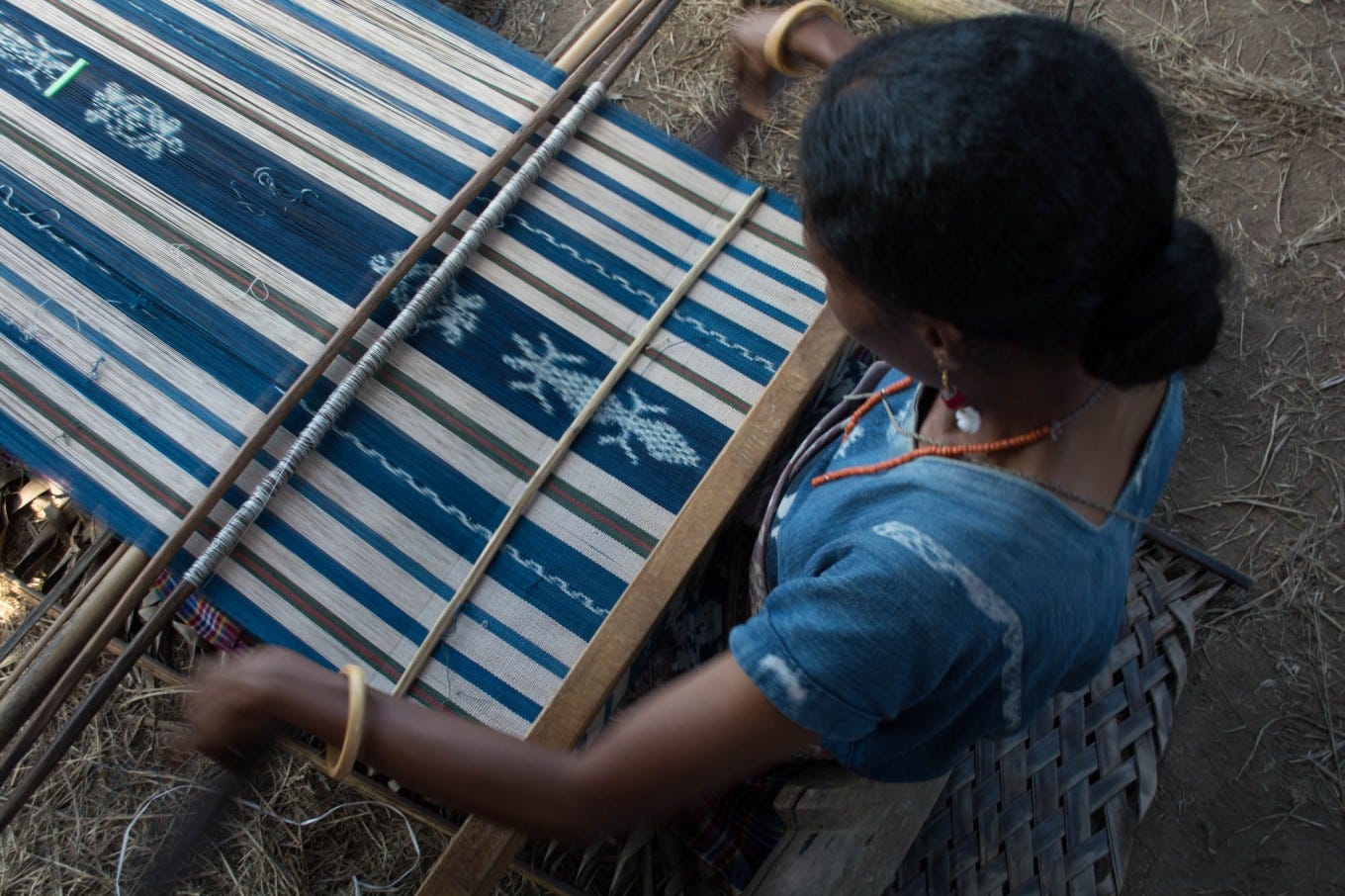
Tenun ikat cloth from Flores can take six months to a year per piece. The threads are dyed before they are woven, using patterns that carry the history of the family who made them. The color only sets correctly if you wait. You cannot rush the indigo.
[embed]
These are crafts made deliberately because their makers understood that the beauty of a certain kind cannot be compressed. The cloth is patience, made visible and wearable.
After the Rush Hour
We tend to think of traditional wisdom as innocence speaking to experience, as advice from people who had not yet encountered the thing they were warning against.
But consider the civilization that produced alon-alon waton kelakon.
The Majapahit Empire, at its height in the 14th century, commanded maritime trade routes across Southeast Asia. Srivijaya, before it had been, for centuries, one of the most powerful trading networks in Asia. These were active, expanding, commercially competitive civilizations. That kind of reach requires urgency, logistics, and the willingness to move fast when the moment demands.
And yet, alon-alon waton kelakon. The proverb survived them both.
What if it were the advice of people who had already been through their own rush hour and had already learned what rushing without intention costs?
What if the wisdom was earned the hard way, across generations of expansion and overreach? What if the proverb is the conclusion of a civilization that had already been to the place Philip is describing, and had chosen, deliberately, to remember what it found there?
That question cannot be answered with certainty. But it changes how the proverb sits.
A Different Kind of Jet Lag
Jet lag is a specific kind of disorientation. Your body clock is set to one timezone, but the world around you is running on another. You are physically present in the new place. Temporally, you are somewhere else entirely. You feel foggy, out of sync, suspended between two times without fully belonging to either.
Indonesia is experiencing something like that, culturally.
The body clock, the one set by generations of nongkrong, jam karet, gotong royong, mudik, is still ticking on Indonesian time. But the aspirational signals, the co-working spaces, the productivity content, the hustle aesthetics on TikTok, are calibrated to a different timezone entirely.
The result is a country that inhabits two temporal worlds simultaneously and feels fully at home in neither.
[embed]
A writer named Paksi Raras put the displacement plainly. When Indonesian elders advised their grandchildren to live alon-alon, the grandchildren called the advice kuno, old-fashioned, a relic of a slower time.
Then something happened. Julia Roberts traveled to Ubud in the 2010 film Eat Pray Love to find what she called balance. Westerners arrived in Indonesia specifically to find what Indonesians were busy throwing away. When the concept returned later, packaged as slow living, spoken in English, validated by the Global North, the grandchildren started paying attention.
“Even the Balinese want an iPhone now” — Purnama Melissa
This is the cultural jet lag in full effect. The thing Indonesians mocked as backward becomes aspirational the moment it lands with a Western passport. The body is in one place. The internal clock has been reset to follow someone else’s sun.
Philip ends *The cost of slow* by noting that his work is not done. Slowness is “a lens for making hidden costs visible.”
I agree with him. And one hidden cost his lens has not yet reached is the temporal disorientation of cultures that already had what the West is searching for, and are now losing it in real time, without the vocabulary to name the loss.
The West is searching for a new timezone to live in. Indonesia already had the timezone. It is just struggling to remember how to read the clock.
Still Ticking
The clock has not stopped. It has changed shape.
Jam karet still operates. Arrivals still happen in layers. Nongkrong still happens, increasingly in cafés with laptop screens open alongside the tea, the form surviving while the content migrates toward productivity.
Sebat dulu, let me have a cigarette first, is still a genuine pause, a withdrawal from urgency practiced daily by millions who would not describe it as temporal philosophy.
Ngopi, let us get coffee, carries the same social function the warung always did. An unstructured interval in which nothing productive is expected of anyone.
And mabar, short for main bareng, playing together, the practice of gathering to play video games through the night until dawn, is the living descendant of nongkrong.
The medium has changed. The reflex has not. A group of young Indonesians who would not recognize themselves in any description of Javanese temporal philosophy is doing what their grandparents did on the front porch.
Occupying shared time with no agenda and no defined endpoint.
Sumber: Detik
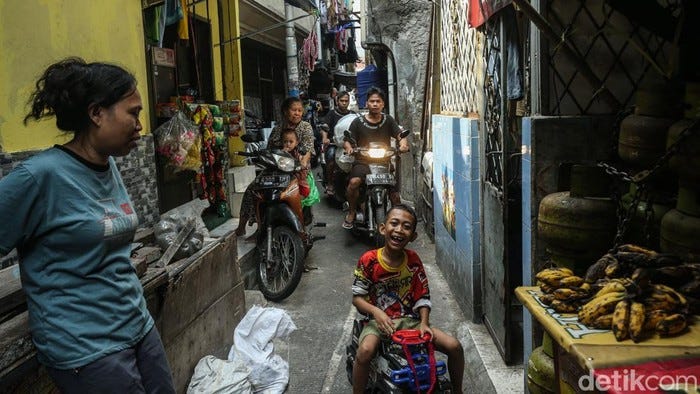
In the densely packed neighborhoods of Indonesian cities and towns, the gang alleyways where houses share walls and front porches face each other across a meter of space, the clock runs differently. People talk across their front doors. Children move between houses without knocking. A neighbor’s problem becomes a shared problem within the afternoon. No app needed. No organization required. The clock here has always run on a different setting.
The DNA survives. It has simply forgotten what it is called and why it matters.
[embed]
On Your Own Time
Philip Teale reached out after reading my essay on cultural keystone signals in Indonesia.
He said the piece showed “super interesting interdisciplinary thinking.”
I want to say, before anything else, thank you. Genuinely.
His series made me look at what was around me with new attention. I had never thought of nongkrong as a “ritualised gathering” or of gotong royong as an “infrastructure of care.”
Those were his words, and when I placed them next to the practices I grew up with, they fit. His framework gave me a new way to see what I already knew. That is the best thing a writer’s work can do for another.
Philip writes that he believes challenging the temporal norms of the West could unlock something for the wider world. I think he is right, and I think the unlocking works both ways.
There is a world here that has been pressing play, at the right speed, for a very long time. While it is still running, it is worth a visit.
Come here, Philip. Beyond Bali. Beyond Java.
Come to Sumba, in Nusa Tenggara Timur. Watch a kubur batu, a megalithic stone tomb, being built. The Sumbanese still construct these structures today, moving enormous stones across the island through communal labor, holding ceremonies that last for days. This is living practice in 2026. The reason they do it in stone, with this much collective time, is the same reason Borobudur was built in stone. They are making something for grandchildren who have not yet been born.
Come to Ende or Sumba and sit with a weaver. A single piece of ikat cloth from this region takes months. The threads are dyed before the weaving begins. The color only sets if you wait.
Come to the gang neighborhoods of any mid-sized Indonesian city. Stay three days. Count how many problems get solved without anyone opening an app.
There is no fast-forward here. There is no rewind either. There is just the particular quality of time that happens when people know exactly why they are doing what they are doing, and have no interest in doing it any faster than it needs to be done.
On your own time, of course.
*Ryandi Pratama is a writer and creative strategist based in Indonesia. He writes about the intersection of culture, narrative, and how ideas move through people. This essay was written in response to Philip Teale’s “Future of Slowness” series on Mutant Futures. More at Creative Strategy Insight.*
메타데이터
- post_id
- e07032197e0f
- slug
- a-slow-rewind-for-the-fast-forward-world-e07032197e0f
- url
- https://medium.com/@ryandipp/a-slow-rewind-for-the-fast-forward-world-e07032197e0f
- canonical_url
- https://medium.com/@ryandipp/a-slow-rewind-for-the-fast-forward-world-e07032197e0f
- author_url
- https://medium.com/@ryandipp
- status
- ok
- fetched_at
- 2026-07-27 01:10:15