XORA Finance and the Regulatory Reality of Crypto Neobanks: Why ‘Not a Bank’ Status Matters for XRP…
Learn why XORA’s “not a bank” status matters for XRP holders, from custody and compliance to consumer protections.
XORA Finance and the Regulatory Reality of Crypto Neobanks: Why ‘Not a Bank’ Status Matters for XRP Holders in 2026
Learn why XORA’s “not a bank” status matters for XRP holders, from custody and compliance to consumer protections.
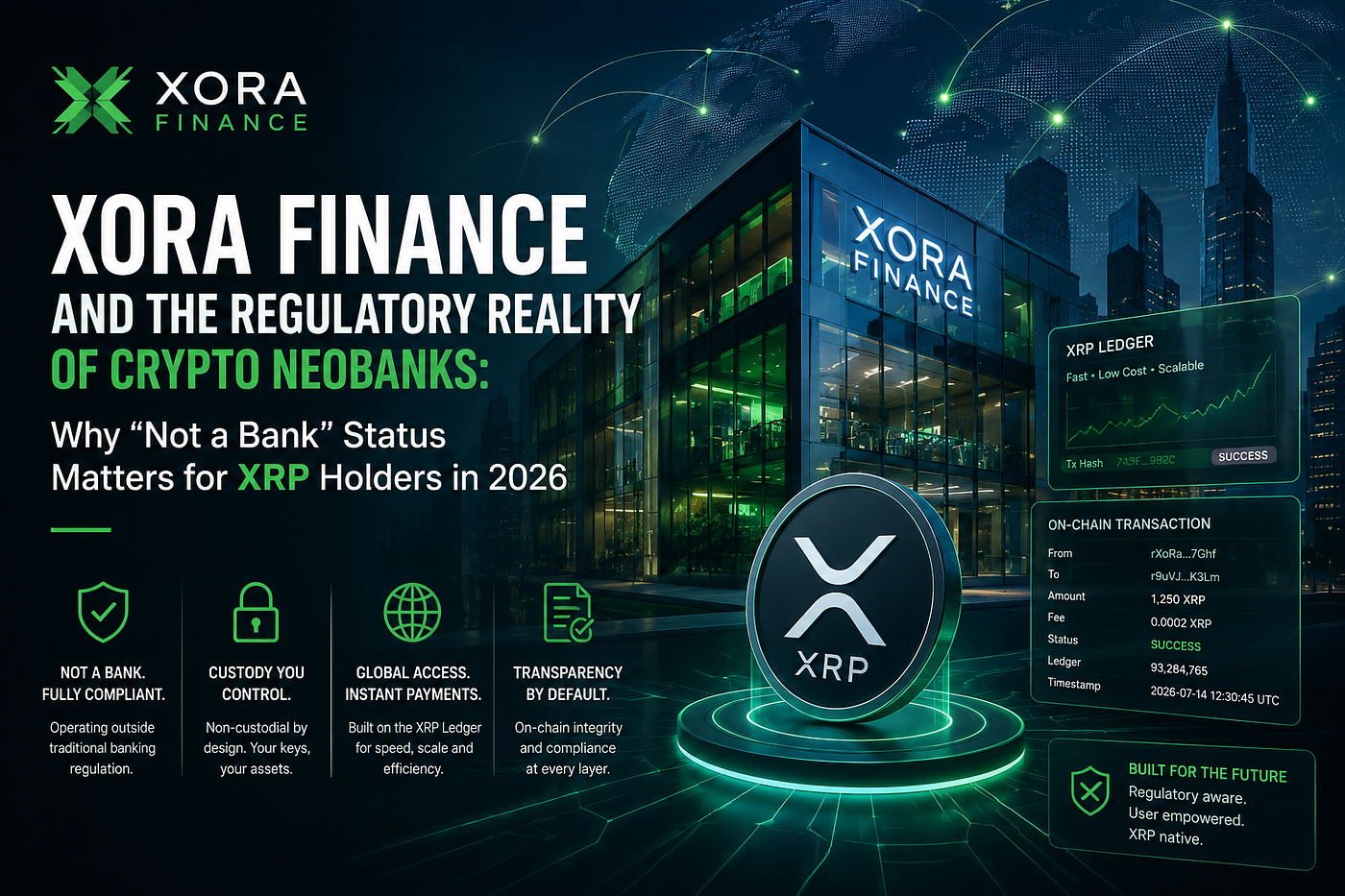
Intro
As digital asset firms rush to provide users with increasingly complex financial products and services, a novel category of financial institution has emerged: crypto neobanks.
These platforms offer familiar traditional banking experiences alongside blockchain and crypto utilities like near-instant global settlement, verifiable custody, crypto spending, self-sovereign ownership, among other benefits. While neobanks look and feel like digital versions of traditional banks, their differences reside underneath the interfaces.
The majority of crypto neobanks, unlike licensed traditional banks, are not subject to prudential supervision, do not accept insured deposits, and have no access to central banking liquidity facilities.
Typically, these platforms operate within digital asset regimes, e-money, and payment legal frameworks of the jurisdictions in which they conduct business. Thus, the legal remedies that their users can pursue differ significantly from those available to commercial bank customers. This distinction is critical as blockchain-based financial services evolve.
The XRP ledger (XRPL) has gained notoriety within the digital asset industry as a purveyor of fast, cost-efficient, international transactions. As the crypto industry aligns itself with institutional and consumer needs, XRPL-based applications are positioning themselves as viable infrastructure for various financial products and services.
XORA Finance, an XRPL-native application, points to this trend. The platform positions itself as a financial service provider tailored for XRP retail holders while categorically distinguishing itself from traditional licensed banks. This positioning transcends mere branding: it helps define the platform’s regulatory/legal obligations while referencing the regulatory regimes it operates within.
This article argues that the most fundamental question users have regarding neobanks is not whether they are built on Ethereum, Solana, Avalanche, or on XRPL rails. Or whether a neobank presents itself as “ institutional grade” or “ crypto-native.” The core question revolves around whether participants understand and appreciate the legal ramifications that arise when they entrust their assets to a neobank (a custodial neobank in this case).
Utilizing XORA Finance as a reference, this article strives to explore the regulatory realities surrounding crypto neobanks through the lens of two questions:
- What legal distinction exists between crypto neobanks and licensed commercial banks?
- How does architectural design (custodial or non-custodial) relate to regulatory obligations and customer rights?
Undoubtedly, crypto neobank success hinges on whether the platforms can reconcile decentralized tech with the legal certainty retail and institutional participants demand. The technological affordances alone are insufficient, unfortunately.
Towards those ends, it is clear that the phrase “ not a chartered bank,” which features prominently in XORA Finance publications, is not just a disclaimer. It begs a careful examination of digital asset laws, banking regulations, consumer protection laws, and emerging compliance posture attendant to blockchain-based finance.
Without much further ado…..
What Does “Not a Bank” Signify?
In the rapidly evolving digital asset ecosystem, transparency around a platform’s regulatory/legal status remains an extremely valuable signal. As consumer and institutional adoption of crypto expands, firms that uphold transparency and compliance are bound to capture a lion’s share of the burgeoning market.
XORA Finance, an XRPL- native neobank, stands out in this regard. For instance, XORA does not claim to be a bank in the traditional sense. XORA’s positioning is a deliberate act that is reflective of the industry’s drive towards transparency and responsible innovation. [**1**]
A major misconception regarding neobanks revolves around the notion that they are simply online banks without physical branches. While neobanks typically replicate the experiences associated with digital traditional banks via sleek mobile interfaces, instant payments, savings features, and debit cards, the law establishes a profound distinction.
For XRP holders, understanding the difference between a crypto neobank and a traditional bank is pertinent. For instance, when a person deposits their funds in a bank, banking regulations guarantee them various protections, including but not limited to: consumer protection rules, corporate governance standards, operational resilience requirements, deposit insurance schemes, prudential capital requirements, and frameworks designed to resolve financially distressed banks. These protections exist because the banking industry plays a crucial role in ensuring financial stability. [**2][[3](https://www.yields.io/insights/us-banking-regulations)**]
Neobanks often provide similar services to banks, but they do not provide users with bank-like legal protections and guarantees. A crypto neobank’s legal structure determines, among other things, custody arrangements, whether assets are held in a bankruptcy-remote manner, and which regulations govern platforms. How neobanks are marketed/branded is immaterial.
Custodial and non-custodial arrangements also impact a neobank’s legal standing. Platforms that control their customers’ private keys take on obligations that differ from those of their non-custodial counterparts. A custodial model triggers various considerations, including anti-money laundering requirements, asset segregation, insolvency risks, consumer expectations, and compliance requirements. [**4][[5](https://xora.finance/terms)**]
Unlike self-custodial neobanks, custodial neobanks hold users’ private keys and manage compliance and security internally. This feature plays a critical role in solving crypto’s user experience and mass adoption challenge.
By eliminating the technical and cognitive barriers associated with navigating blockchain applications, custodial neobanks make crypto accessible to all (non-technical users, especially). Furthermore, by taking custody of user funds, neobanks unlock features that are impossible to implement in pure DeFi platforms, including instant customer support, insured-deposit-like products, and enhanced customer care services.[**4] [[7](https://www.techtarget.com/searchsecurity/definition/private-key)**]
Why Does Custody Matter?
A question that all neobank users ought to ask themselves before engaging a platform is not what network a protocol is built on or whether the platform is regulated. Users must ask themselves one fundamental question: who controls my private keys?
In Traditional banking, the issue of custody rarely crosses users’ minds. Generally, when a customer deposits funds in a bank account, the duty to secure those funds lies with the bank, as established by banking regimes across the globe. Typically, customers of licensed deposit-taking institutions expect that those institutions implement statutory deposit protection programmes, have adequate reserves, undergo supervisory examinations, uphold data privacy, ensure operational resilience, among other things. [**2**]
XORA Finance utilizes a custodial model, meaning it takes full control of users’ private keys and manages the underlying blockchain mechanics on their behalf. As expected, this establishes a tremendous shift in user experience, risk and liability management compared to traditional banking and self-custodial solutions. For instance, XORA reserves the right to limit withdrawals and impose holds for compliance and security reasons ( Section 4 of Terms of Service). [**5**]
Under this model, XORA accepts liability for losses that stem from incidents attributable to it (cyber attacks and internal malfunctions). Conversely, XORA is not responsible for losses resulting from market volatility, errors in yield calculations, XRPL validator errors, third-party actions, etc. [**5**]
In response to insolvency risk, XORA leverages operational and legal segregation. XORA applies account-specific destination tags for routing funds into a segregated treasury, guaranteeing that owed balances are linked to specific users in the platform’s internal ledger. XORA segregates funds to ensure its creditors have no insolvency recourse to customer funds. In the event of an orderly wind-down, XORA commits to reconciling its internal ledger with the on-chain treasury to make depositors whole. [**4**]
To further protect customer deposits, XORA Finance has a planned depositor-reserve buffer designed to absorb lending counterparty defaults. Protocol revenue will fund the buffer, and it is targeted at 5% of deposits. Crucially, XORA maintains that the buffer does not amount to an FDIC-style guarantee, and that its public on-chain address and balance will be published once it’s live. [**4] [[6](https://xora.finance/whitepaper)**]
A custodial model is not just a technical preference; it operates as a regulatory trigger. Generally, regulations across the world treat platforms that take custody of customer funds differently from those that merely provide infrastructure. Once a platform takes control of users’ private keys, for instance, additional regulatory obligations emerge. These include, but are not limited to:
- Operational resilience obligations
- Segregation of user assets from platform assets
- Record-keeping requirements
- Security of customer assets
- capital/reserve requirements
- Governance and internal control obligations
- Auditing obligations
- AML/CFT compliance obligations
- Privacy considerations
For clarity of discussion, XORA does not claim to hold a CASP license.
The aforementioned obligations are by no means exhaustive. But they demonstrate the burden that attaches to custodial arrangements. Licensing frameworks such as MiCA prescribe requirements for CASPs offering administrative and custody services to EU residents (Article 3(1)(15) defines a CASP).[**8**] Additionally, upon authorization by a national competent authority, custodial crypto neobanks must satisfy strict custodial obligations under MiCA.
For example, Article 75 requires the segregation of user assets from those of the platform. Article 76 provides that a CASP is liable to its customers for losses unless it can prove that the losses occurred due to an event beyond its control. [**8**]
Important to note, non-EU crypto neobanks may only serve EU residents on a strictly “ reverse solicitation” basis. That is, where a client reaches out to the neobank independently ( without responding to a neobank’s marketing). Actively marketing or targeting EU clients implies full licensing requirements regardless of whether the platform is based in the EU. [8] [9] [10]
Where XORA Finance Fits
When a platform publicly distinguishes itself from a bank, it does so out of legal/regulatory considerations, not just to manage client expectations. This allows a platform to manage a regulatory/legal framework that defines its relationship with customers.
For users, this positioning raises various questions:
- Are user funds classified as deposits legally?
- Are customer funds FDIC-insured or eligible for any other form of deposit insurance?
- Which regulatory body oversees the platform?
- Does the institution operate as a tech platform, custodian, or payment provider?
- What prudential requirements does the platform apply?
- What happens to user funds in case of insolvency?
The answers to these questions depend on the jurisdiction which the institution operates and its licensing model. Generally, because of legal structuring, two institutions offering nearly identical services may implicate different regulatory obligations.
Crypto neobanks like XORA Finance represent a paradigm shift from traditional fintech solutions. Instead of merely digitizing banking services, crypto neobanks integrate distributed ledger tech into investment, payment, and custody products. This posture is reflective of the industry’s broader trend: Offering bank-like services without claiming the legal status associated with conventional commercial banks (or licensed deposit-taking institutions).
Typically, crypto neobanks offer:
- Cross-border payment services
- Digital asset-linked debit cards
- Stablecoin support
- Tokenized asset services and products
- Reward or yield programmes
- Fiat on-and off-ramps
- Crypto wallets
- Foreign exchange functionality
- Concierge banking
Section 3 of XORA’s terms of service states:
“Your deposited XRP and supported TRX balances are held in custodial wallets managed by Xora. While we implement robust security measures, deposits are not insured by the FDIC, SIPC, or any government agency.” [5]
For XORA users, the legal status of the platform ought to be examined per the legal framework that governs its operations, rather than the assumptions its branding and/or user interface may trigger. However, it is important to note that XORA’s custodial architecture is designed for compatibility with EU, US, and Singapore’s regulatory frameworks. [**6**]
Since XORA operates as a custodial neobank, its regulatory obligations go beyond merely enabling access to the XRP ledger. The custodial model enjoins XORA to implement appropriate compliance, security, governance and operational controls to safeguard client funds. [**4**]
For XRP users, due diligence involves examining more than user experiences and transaction speeds. Considerations revolve around asset segregation, security architecture, regulatory oversight, custody arrangements, and insolvency protections are crucial in understanding the protocol’s risk profile.
Critically, the distinction between non-custodial and custodial neobanks highlight the broader principles that are applicable to the digital asset industry: generally, legal responsibility follows control. Where a platform exercises discretionary control over client assets, stringent regulatory expectations attach. This principle demonstrates why custody remains a major issue in crypto regulation. It also explains why it should be a key consideration for anyone looking to commit their digital assets to a crypto neobank.
XORA Finance demonstrates compliance via a combination of explicit risk disclosures, auditable custodial mechanics, and regulatory alignment. Based on the platform’s White paper, Terms of Service, and security documents, the platform demonstrates regulatory alignment in the following ways:
- XORA’s custodial architecture is designed to align with major regulatory frameworks, including Singapore MAS PS Act, MiCA, and US regulations. [**6**]
- XORA’s user agreements and operations are governed by State of Delaware laws.[**5**]
- XORA enforces compliance with contractual agreements through mandatory binding arbitration under the American Arbitration Association (AAA) rules. [**5**]
- XORA maintains a segregated treasury account on the XRP ledger. Every client is assigned a unique destination tag, which routes their funds into the treasury and maps them to an internal ledger. [**5][6**]
- To guarantee solvency, the platform conducts daily reconciliations, ensuring that the on-chain treasury balance compares with its internal ledger balances. [**6**]
- The XORA protocol is mathematically calibrated to maintain a solvency variant. This ensures the on-chain treasury balance is equal or greater than the protocol’s outstanding obligations to users and required network reserves. [**6**]
- Since the treasury address is public, any person can verify (independently) the platform’s backing via the XRPL blockchain explorer (XRPscan). [**5] [[12](https://xrpscan.com/)**]
- XORA maintains contractual and technical safeguards against illicit activities. XORA’s terms of service explicitly forbid users from using the platform for illicit activities like sanctions evasion, money laundering and terrorist financing. Additionally, the protocol conducts active-freeze and anti-drain checks on all withdrawals, ensuring high-risk outflows are manually investigated by the compliance team.[**5**]
- XORA upholds a “mundane” transparency policy, ensuring the platform is not associated with misleading claims. For instance, XORA discloses that it is not a chartered bank and that deposits are not insured by any government agency, including the FDIC and SIPC. Additionally, XORA clearly states that its XRP yield is not a guaranteed return from external lending activities and that the yield is a time limited subsidy. [**6][[13](https://xora.finance/yield-source)**]
Why Do Crypto Neobanks Avoid Banking Licenses?
Crypto neobanks, including custodial ones, avoid pursuing banking licenses due to a combination of reasons, including: prohibitive costs, strategic agility, and regulatory incompatibility. Thus, rather than becoming banks, most crypto neobanks pursue less burdensome Trust Chatters, Electronic Money Institution licenses (EMI), or engage existing banks through partnerships, which are enabled by Banking-as-a-Service plans. [**11**] Furthermore, While there are efforts to reconcile blockchain-based offerings with traditional legal regimes, many aspects of the technology remain incompatible with regulations.
Conclusion
One of crypto’s core promises is to provide unprecedented access to financial services by dismantling the socio-economic, physical and technological barriers that underpin traditional finance. Financial innovations like neobanks play a critical role in the realization of this goal. Neobanks are a manifestation of a paradigm shift from institution-centric banking to user-first financial services.
Crypto neobanks bridge digital asset services with traditional banking by providing seamless integration of various features, including crypto custody, trading, fiat accounts, and debit cards on mobile-first interfaces. This, among other things, removes the need for multiple banking applications while enabling financial transactions at internet speed. Most importantly, neobanks provide access to DeFi, yield-bearing crypto products, and stablecoin payments while offering daily utility, crypto-backed lending services, custodial and non-custodial options.
Crypto neobanks are revolutionizing financial services by offering bank-like services/products while leveraging blockchain technology. Be as it may, innovation does not negate the need for compliance. Suffice to say, if blockchain-based offerings are to realize their core promises, it is critical that either pursue sufficient/full decentralization and/or align themselves with regulations. Granted, innovation always precedes the law. Under such circumstances, it is often advisable for projects to build within legally accepted parameters.
As the XORA Finance study demonstrates, its architecture and “ not a bank” status establishes significant distinctions that may influence its regulatory posture. For XORA users, the key considerations surpass the affordances made possible by the underlying blockchain.
Understanding a protocol’s design philosophy is crucial in assessing its operational and legal risk profile. Undoubtedly, the success of crypto neobanks hinges, not only, on better user experiences, higher yields, and faster payments but also on their ability to foster trust through responsible innovation, transparent governance, and robust compliance strategies.
References
- TechBullion: Why We Built a Neobank on the XRP Ledger
- Justia: Banking Regulations & Legal Protections for Consumers
- Yields: Comprehensive Overview of US Banking Laws and Regulations
- XORA Finance: How Xora protects deposits
- XORA Finance: Terms of Service
- XORA Finance White Paper
- Techtarget: What is a private key?
- MiCA: Regulation — 2023/1114 — EN — MiCA — EUR-Lex
- Legal Nodes: The EU Markets in Crypto-Assets (MiCA) Regulation Explained
- Bits of Blocks: Fully licensed: What does MiCA mean for crypto intermediaries?
- Beigemedia:The Legal Architecture of US Neobank Formation
- XRPSCAN
- XORA:Where XORA yield comes from
- World Economic Forum: Legal and Regulatory Compliance
메타데이터
- post_id
- e0785f4da437
- slug
- xora-finance-and-the-regulatory-reality-of-crypto-neobanks-why-not-a-bank-status-matters-for-xrp-e0785f4da437
- url
- https://medium.com/@jeffersonmmongare/xora-finance-and-the-regulatory-reality-of-crypto-neobanks-why-not-a-bank-status-matters-for-xrp-e0785f4da437
- canonical_url
- https://medium.com/@jeffersonmmongare/xora-finance-and-the-regulatory-reality-of-crypto-neobanks-why-not-a-bank-status-matters-for-xrp-e0785f4da437
- author_url
- https://medium.com/@jeffersonmmongare
- status
- ok
- fetched_at
- 2026-07-18 20:40:49



