The ALBA Synchrotron and the Black Box of Science
I’ve always had a bit of an old man’s spirit, but there are moments when that side of me really comes into its own. A few weeks ago, my…
The ALBA Synchrotron and the Black Box of Science
I’ve always had a bit of an old man’s spirit, but there are moments when that side of me really comes into its own. A few weeks ago, my inner retiree went to visit one of the most sophisticated — and, in my view, least well-known — infrastructures in Catalonia.
I’m talking about the ALBA synchrotron, a particle accelerator located in Cerdanyola del Vallès, about 30 minutes from Barcelona by car (or over an hour and three different buses for someone like me, who doesn’t drive). It’s a €200 million facility that produces an intense light used to analyze materials at the atomic scale.
I visited with a group of students from 42 Barcelona, the programming school I’ve written about here before, which recently began offering trips to innovation and technology centers as part of its training program.
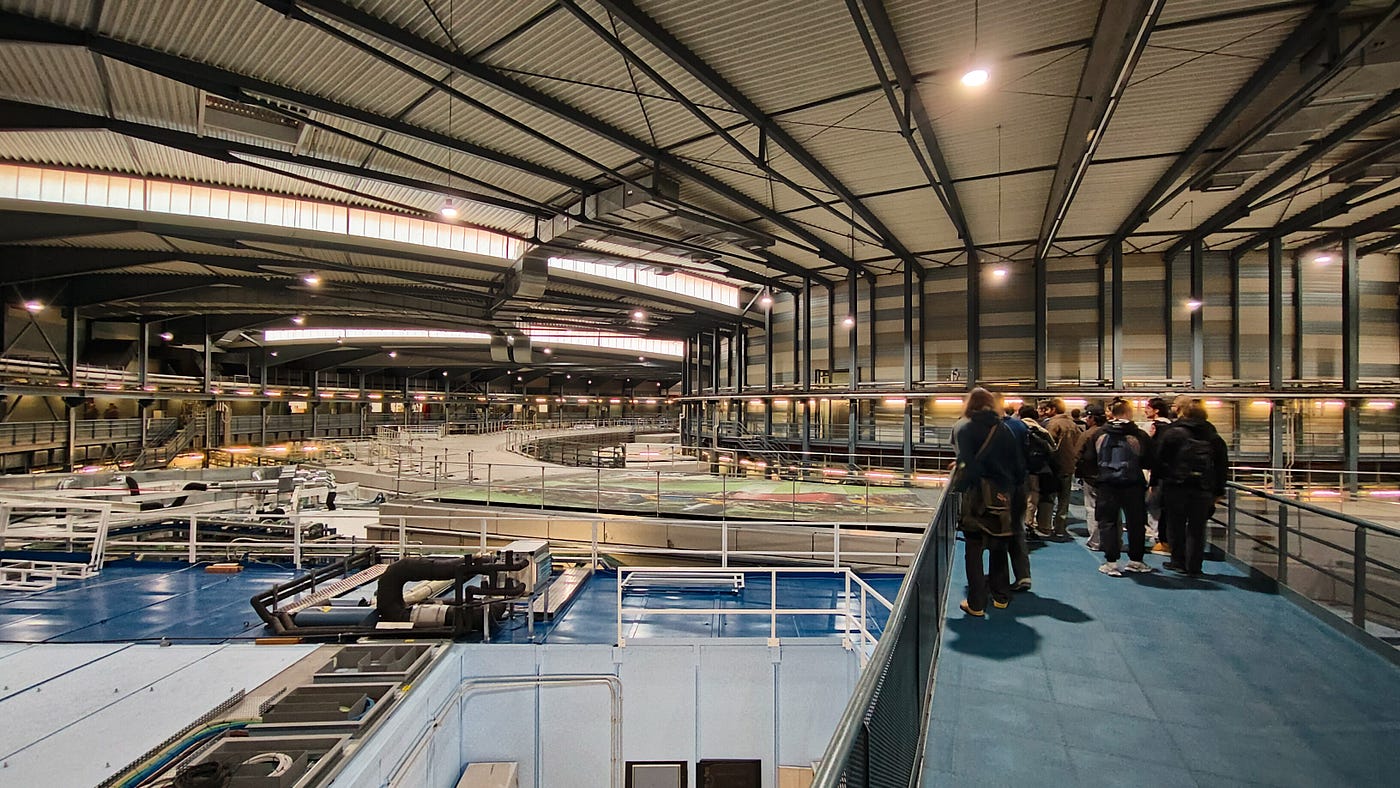
While we were waiting outside the facility for our badges, I couldn’t help noticing that the synchrotron building looks rather plain and conventional. It could easily be the headquarters of a large company on the outskirts of any major city. From the inside, though, the building’s large circular structure felt entirely different.
Like CERN, but not quite
Put simply, a synchrotron is a large ring — about 250 meters in circumference — that accelerates electrons (or other particles) to speeds close to that of light, making them circulate using magnets. As their path is bent, the particles emit a very intense light known as synchrotron radiation, which ranges from infrared to X-rays.
But that light doesn’t stay in the ring. It is extracted at specific points and directed into laboratories built around the perimeter, each designed for a particular type of experiment. In these labs, known as ‘beamlines’, the light is used as a kind of microscope to study the structure of materials, proteins, cells, and even works of art in extraordinary detail. The synchrotron allows researchers to see, with remarkable precision, what cannot be observed using conventional methods.

Diagram of a synchrotron surrounded by laboratories.
Before visiting the center, I assumed ‘synchrotron’ was just a catchy name for a smaller-scale version of a particle accelerator like CERN. In reality, while the two are similar — both are particle accelerators — their purposes are different. CERN accelerates particles to make them collide and reveal what matter is made of. ALBA, on the other hand, accelerates electrons to near-light speeds not to smash them, but to make them emit an extraordinarily intense light. The goal is not to collide particles, but to generate light that allows matter to be observed at extremely high resolution.
The black-boxing of science
We spent more than two hours walking around the synchrotron, like visitors touring a construction site, circling the beamlines and peering from the outside into the control rooms that keep the facility running. The ring that accelerates the particles, however, is sealed inside a concrete conduit that visitors cannot access.

The French philosopher Bruno Latour pointed out that in science there are facts that are known and facts that are not, and that before being accepted, the latter go through a series of debates until they eventually become settled and no longer questioned. Borrowing a term from cybernetics, Latour called these settled agreements “black boxes”: devices or systems that are taken for granted — often without being fully understood — because constantly reopening them would bring progress to a halt. You don’t need to understand how a microscope works in order to use it. You don’t need to know where a company’s servers are to send an email.
It seems to me that something similar happens at the ALBA synchrotron. Academics and companies from many countries use it for their experiments, yet they cannot actually see the ring that accelerates the particles or question how the synchrotron works. In fact, they probably wouldn’t be able to explain its operation in detail. Even the technicians guiding our visit admitted they weren’t comfortable answering certain questions about how the ring functions, since their expertise lies in computing and they don’t fully understand how the particles are accelerated or how the experiments are carried out.
Trust and ignorance
The fact that the synchrotron is a black box is not a flaw. As Latour explains, this is how science works. Not fully understanding everything that happens there is precisely what makes the facility possible.
The paradox is that the more sophisticated scientific and technological infrastructures become, the less comprehensible they are. Each user masters a technique, a specific tool, a small part of the system. But the whole escapes any single individual’s understanding. Knowledge no longer resides in one person, but is distributed across a network of specialists who, together, make everything work.
We live surrounded by technologies we can no longer explain. As Arthur C. Clarke famously put it, “Any sufficiently advanced technology is indistinguishable from magic.” It is within that uneasy balance between trust and ignorance that contemporary science and technology are built.
메타데이터
- post_id
- e084e651d9e2
- slug
- the-alba-synchrotron-and-the-black-box-of-science-e084e651d9e2
- url
- https://medium.com/@ferranesteve/the-alba-synchrotron-and-the-black-box-of-science-e084e651d9e2
- canonical_url
- https://medium.com/@ferranesteve/the-alba-synchrotron-and-the-black-box-of-science-e084e651d9e2
- author_url
- https://medium.com/@ferranesteve
- status
- ok
- fetched_at
- 2026-08-11 19:41:39