The Fuente Magna Bowl and the Forgotten Voyagers: Could Ancient Civilizations Have Reached the…
Image Generated Using ChatGPT
The Fuente Magna Bowl and the Forgotten Voyagers: Could Ancient Civilizations Have Reached the Americas?
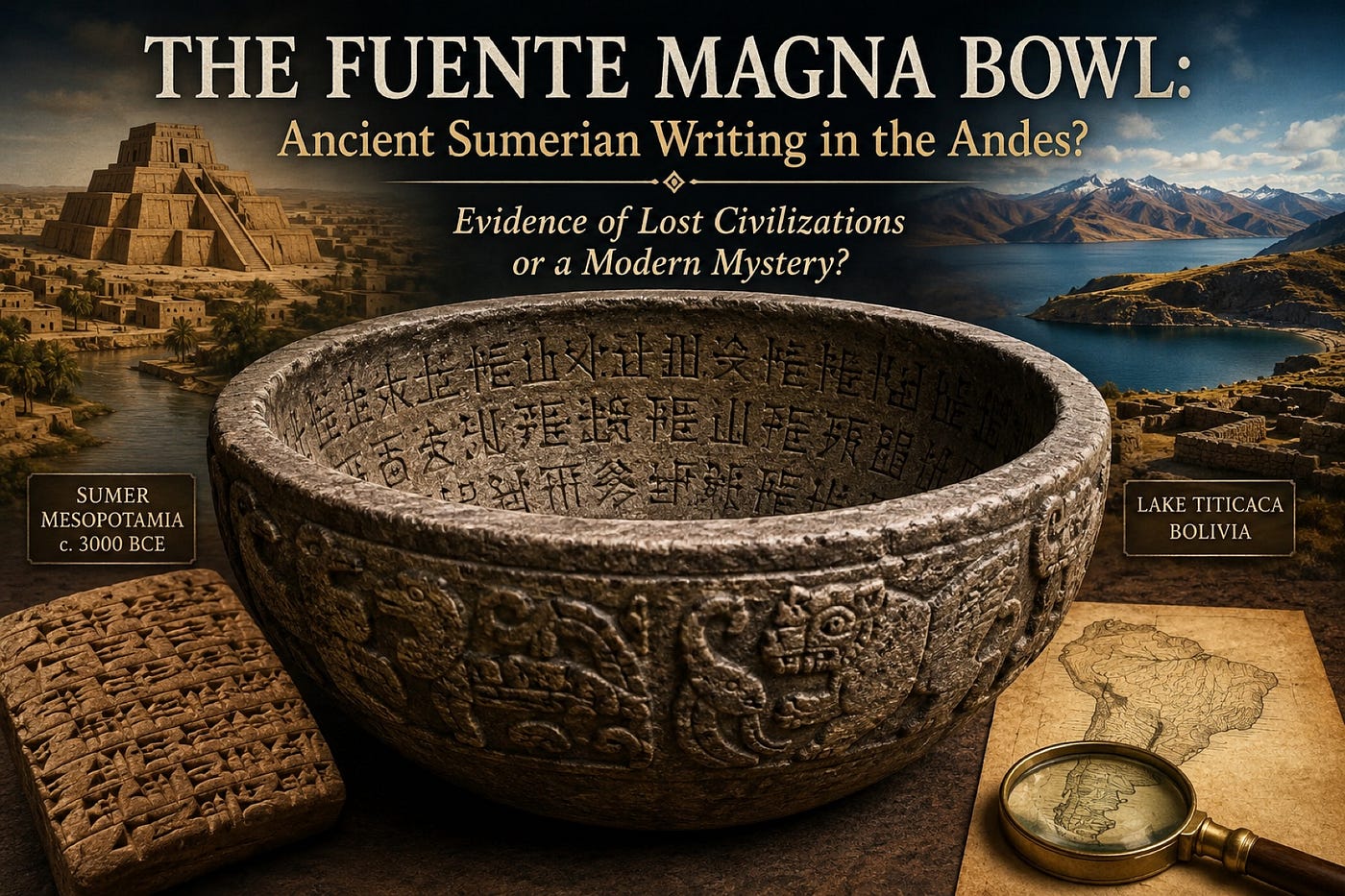
Image Generated Using ChatGPT
History often feels settled.
The pyramids were built in Egypt. Sumer arose in Mesopotamia. The Americas developed independently. Columbus crossed the Atlantic in 1492, opening the door between two worlds that had been separated for thousands of years.
Yet every so often, an artifact appears that refuses to fit neatly into the accepted story.
One such object is the Fuente Magna Bowl, a mysterious stone vessel discovered near Lake Titicaca in Bolivia during the 1950s. To many archaeologists, it is likely a misunderstood artifact, a modern alteration, or perhaps even a forgery. To others, it may represent one of the most provocative clues that ancient civilizations crossed oceans long before recorded history says they did.
The bowl itself appears unremarkable at first glance. Its exterior contains carvings consistent with Andean artistic traditions, including animal motifs common to the region. The mystery lies on the inside.
Etched into the vessel are symbols that some researchers claim resemble Sumerian cuneiform and Proto-Sumerian pictographs, writing systems associated with one of humanity’s earliest civilizations. Sumer flourished in ancient Mesopotamia, in what is now Iraq, roughly 5,000 years ago.
If the inscriptions are genuinely Sumerian, the implications would be extraordinary.
How could a writing system from the cradle of civilization appear thousands of miles away in the Andes Mountains?
Mainstream archaeologists remain skeptical for good reason. The bowl was not recovered during a documented scientific excavation. No detailed records exist showing its precise location or archaeological context. Without that information, it becomes difficult to determine the bowl’s age or authenticity.
In archaeology, context matters almost as much as the artifact itself.
An object discovered in a carefully documented excavation can often reveal its story. An object that appears without provenance invites uncertainty. Because of this, many experts believe the Fuente Magna Bowl is not strong enough evidence to support claims of ancient transoceanic contact.
Yet the mystery persists because the bowl raises a larger question.
Have we underestimated the capabilities of ancient peoples?
For generations, historians assumed that long-distance ocean voyages were beyond the reach of early civilizations. Modern research has steadily challenged that assumption. Polynesian navigators crossed immense stretches of the Pacific Ocean using stars, currents, winds, and generations of accumulated knowledge. Experimental voyages such as Thor Heyerdahl’s Kon-Tiki expedition demonstrated that relatively simple vessels could survive journeys across vast oceans.
In recent years, evidence has also emerged suggesting contact between Polynesians and South America before European arrival. Genetic studies and botanical clues involving the sweet potato have convinced many researchers that ancient peoples were more mobile than previously imagined.
If some ancient cultures crossed oceans, could others have done the same?
This question becomes even more intriguing when the Fuente Magna Bowl is considered alongside another South American mystery.
Along the coast of Peru, the ancient Paracas culture has attracted attention for decades. The Paracas people are famous for their remarkable textiles, advanced medical practices, and elongated skulls created through deliberate cranial modification. More recently, preliminary DNA studies conducted on some Paracas remains generated headlines when researchers suggested possible genetic affinities with populations from western Eurasia, the Caucasus, or the Near East.
These claims remain highly controversial.
Many geneticists have pointed out concerns regarding sample size, contamination, methodology, and the lack of extensive peer-reviewed confirmation. As a result, no scientific consensus exists that the Paracas people originated from or were directly connected to populations from the Middle East.
Yet the claims continue to generate interest because they raise a fascinating possibility. If future DNA research were to confirm unexpected Old World ancestry in ancient South American populations, historians would be forced to reconsider long-standing assumptions about prehistoric migration and contact.
The Fuente Magna Bowl and the Paracas DNA claims are often linked by alternative researchers for precisely this reason. Neither piece of evidence stands as proof. Both remain debated. Together, however, they point toward a broader question that remains unresolved.
How much of humanity’s ancient story has been lost?
History has repeatedly shown that accepted narratives can change.
For much of the twentieth century, many archaeologists believed the first humans arrived in the Americas approximately 13,000 years ago. Today, discoveries from multiple sites suggest human presence may stretch back far earlier. Ancient DNA research has transformed our understanding of human migrations, revealing unexpected connections among populations once thought to be isolated.
Again and again, new evidence has reminded us that the past is often more complicated than our models.
This does not mean every mystery is evidence of a forgotten civilization. Extraordinary claims still require extraordinary evidence. A single artifact, especially one lacking clear archaeological context, cannot overturn centuries of scholarship. Nor can disputed genetic studies rewrite human history on their own.
But mysteries deserve investigation.
The Fuente Magna Bowl may ultimately prove to be a forgery. It may be an authentic Andean artifact later modified by modern hands. The inscriptions may only resemble Sumerian writing through coincidence. Or perhaps the bowl represents a clue to a chapter of human history that remains undiscovered.
At present, we simply do not know.
What makes the bowl fascinating is not that it proves ancient Sumerians reached South America. It does not. Rather, it reminds us that there are still unanswered questions at the edges of our historical understanding.
The history of humanity may be less like a straight line and more like a vast ocean scattered with islands of evidence. Some islands are well mapped. Others remain shrouded in fog. Every so often, an artifact emerges from that fog and challenges us to look again.
The Fuente Magna Bowl is one of those artifacts.
Whether it eventually proves to be an archaeological dead end or a genuine clue to forgotten voyages, it serves an important purpose. It encourages us to remain curious, to question assumptions, and to remember that the story of humanity is still being written.
Somewhere between skepticism and imagination lies discovery. The Fuente Magna Bowl sits precisely at that intersection, waiting for future generations to determine whether it is merely an intriguing mystery — or a glimpse into a lost chapter of our shared past.
메타데이터
- post_id
- e085abd10407
- slug
- the-fuente-magna-bowl-and-the-forgotten-voyagers-could-ancient-civilizations-have-reached-the-e085abd10407
- url
- https://medium.com/@joshlevin10/the-fuente-magna-bowl-and-the-forgotten-voyagers-could-ancient-civilizations-have-reached-the-e085abd10407
- canonical_url
- https://medium.com/@joshlevin10/the-fuente-magna-bowl-and-the-forgotten-voyagers-could-ancient-civilizations-have-reached-the-e085abd10407
- author_url
- https://medium.com/@joshlevin10
- status
- ok
- fetched_at
- 2026-06-24 11:06:28