Constitutional Integrity and Equal Citizenship in India
One of the most common objections raised whenever concerns about Sharia, parallel legal systems, or religious accommodation are discussed…
Constitutional Integrity and Equal Citizenship in India
One of the most common objections raised whenever concerns about Sharia, parallel legal systems, or religious accommodation are discussed is that any attempt to address them would violate “religious” freedom.
Yet democracies impose qualification standards on institutions every day.
Corporations must satisfy legal requirements. Charities must satisfy legal requirements. Educational institutions must satisfy legal requirements. Political parties, trusts, and public officials must satisfy legal requirements. No organization receives public privileges simply by requesting them.
Why should religious organizations be treated differently, particularly in the case of Islam, which defines itself as a deen — a complete system governing law, politics, economics, social relations, family life, commerce, morality, and worship, in which divine law takes precedence over man-made law — rather than merely a religion in the modern Western sense of the word?
This question formed the basis of the legislative proposal presented in my book A Civilizational Reckoning: Understanding the Threat, Reclaiming the Future, which concluded with a constitutional threshold proposal, legislative drafts for Canada, the United Kingdom, the United States, and France, and a guide to adjudication.
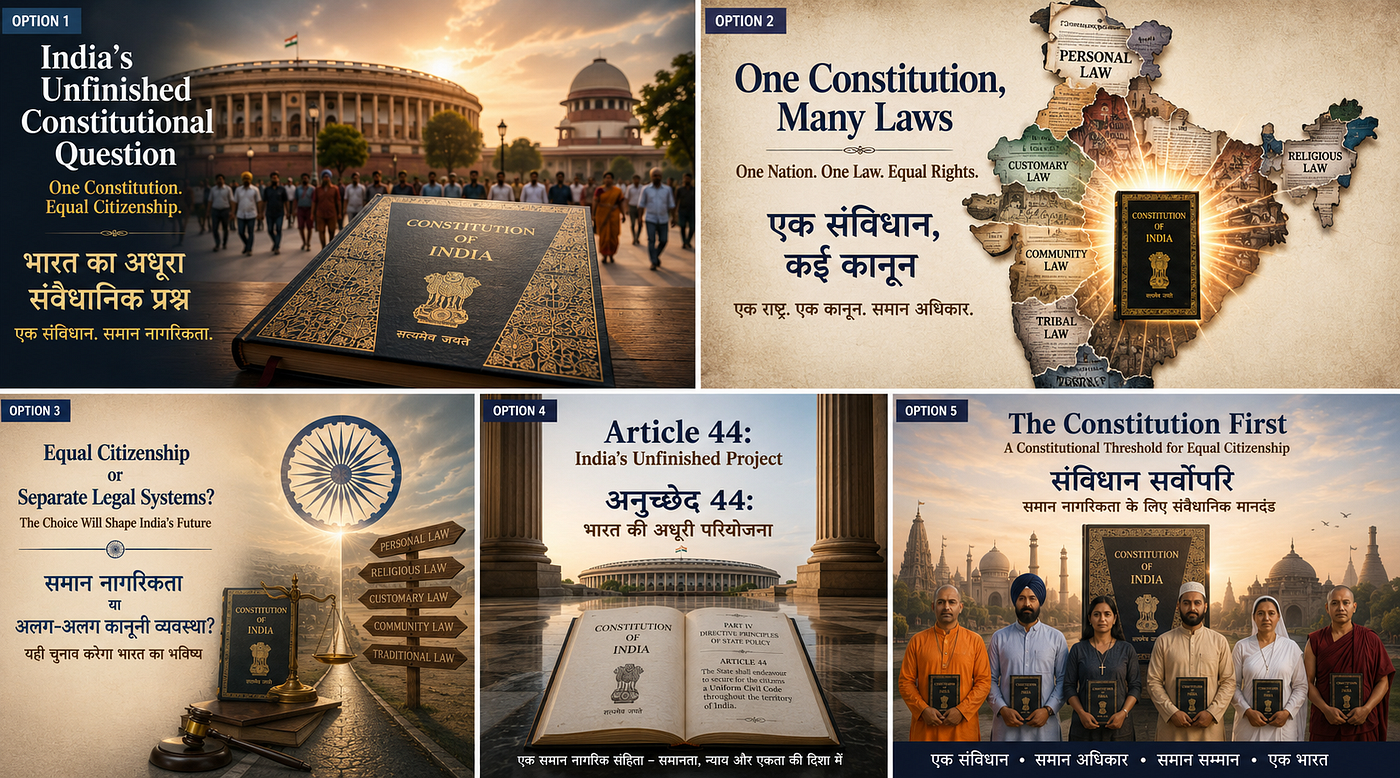
I have now adapted that same legislative proposal and supporting documentation for India in a new bilingual English-Hindi booklet:
Constitutional Integrity and Equal Citizenship in India / भारत में संवैधानिक अखंडता और समान नागरिकता
The booklet examines one of India’s most enduring constitutional questions: how a democratic state committed to equal citizenship should respond when different citizens remain subject to different personal laws based upon religious affiliation.
More broadly, it addresses a question relevant to every non-Islamic country:
What criteria should organizations satisfy before receiving legal privileges, tax exemptions, educational recognition, charitable status, public funding, or other benefits and permissions granted by the state?
The proposal does not prohibit belief, regulate private faith, or define theology.
Instead, it proposes a simple principle: organizations seeking public privileges should demonstrate consistency with the constitutional order from which those privileges are derived.
The booklet includes:
- India’s Unfinished Constitutional Question
- A Legal Path Forward for India
- Draft Legislation: Constitutional Integrity and Equal Citizenship Act, 2026
- Doctrinal Clarification for Use in Assessing Eligibility
Although tailored specifically for India, the underlying framework can be modified for any non-Islamic country seeking to protect freedom of conscience while maintaining constitutional supremacy and equal citizenship.
The booklet is available free in PDF format and as a Kindle edition.

메타데이터
- post_id
- e08b85d7efad
- slug
- constitutional-integrity-and-equal-citizenship-in-india-e08b85d7efad
- url
- https://medium.com/@poi-nps/constitutional-integrity-and-equal-citizenship-in-india-e08b85d7efad
- canonical_url
- https://medium.com/@poi-nps/constitutional-integrity-and-equal-citizenship-in-india-e08b85d7efad
- author_url
- https://medium.com/@poi-nps
- status
- ok
- fetched_at
- 2026-07-10 03:02:36