Invisible Architecture: Creating Emotion With Darkness in Midjourney
Most creators believe stronger images require more.
Invisible Architecture: Creating Emotion With Darkness in Midjourney
Most creators believe stronger images require more.
More objects, More textures, More storytelling, More details.
But sometimes emotion appears when you remove almost everything.
Some images do not speak because of what they show.
They speak because of what they hide.
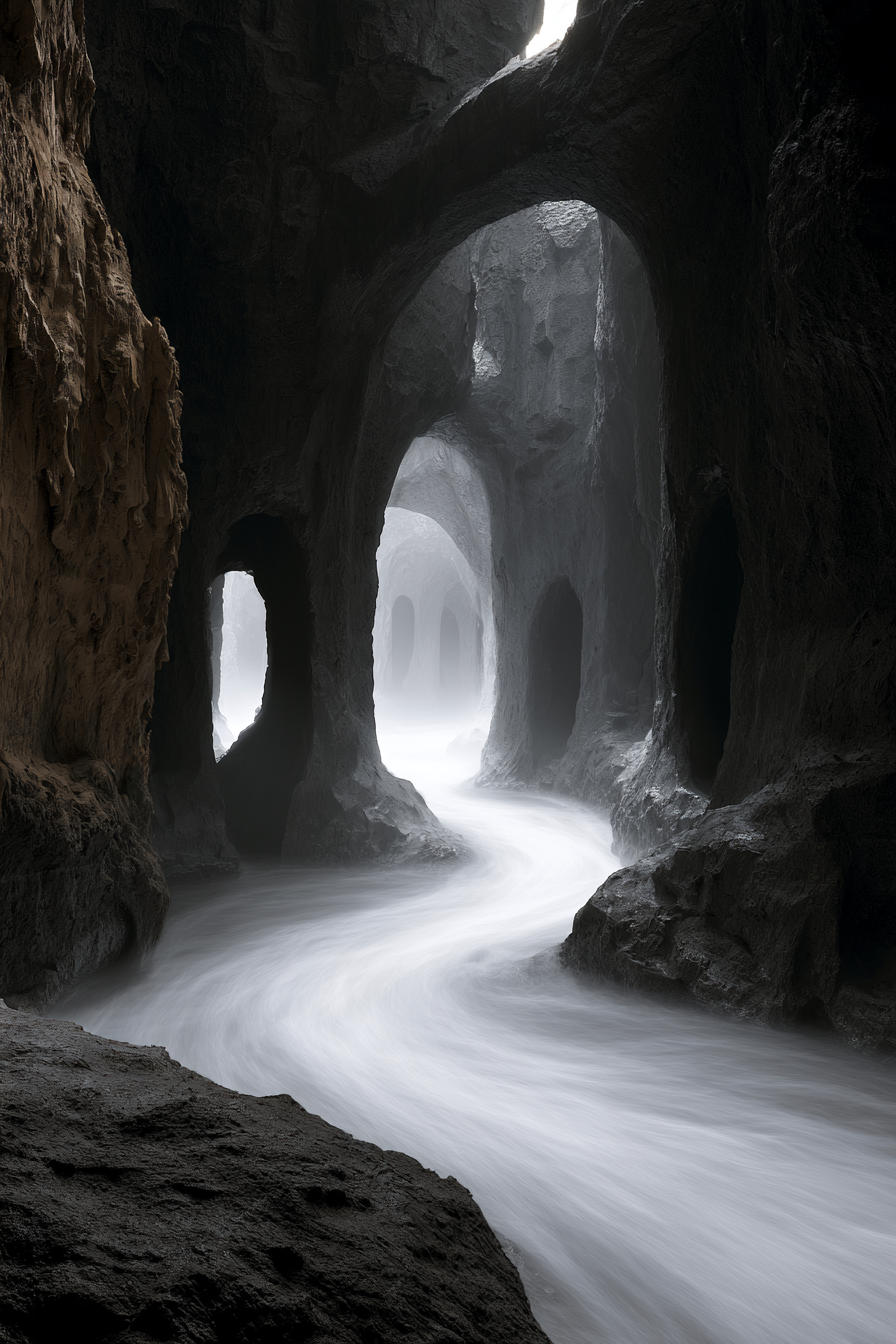
The image above is not really about caves.
It is not about architecture.
It is not even about fog.
It is about invisible architecture.
The architecture created by darkness itself.
What Makes This Image Work
Before we touch a single prompt, let’s understand why this image arrests attention. Great Midjourney recreations start not with words, but with reading.
The palette is almost monochromatic and that’s the power. Deep charcoal blacks dominate the frame, punctuated by warm sand-brown stone textures on the left wall. The luminous element, the mist-river is pure white with soft silver gradients. There is no color competition. The eye has one path: follow the light.
The light behaves like a fluid. It doesn’t illuminate, it flows. It curves, narrows, widens, and pools. This liquid-light quality is the visual signature of the entire image. It suggests long-exposure photography, slow shutter silk effects, or the way fog moves through cathedral ruins at dawn.
The architecture grounds the surreal. Without the stone arches, carved niches, and rough-hewn walls, this would be pure abstraction. The ancient architectural elements give the image weight, history, and believability. They are the anchor that makes the impossible feel real.
Depth is built through layering. Notice how the arches recede, smaller, then smaller still, then lost in white. The composition creates a vanishing point that draws the viewer forward and upward simultaneously. This is classical perspective used in a deeply cinematic way.
The Problem With Most Atmospheric Images
Many creators trying to generate mysterious images often write prompts like:
“dark cave with fog”
“mysterious tunnel”
“haunted corridor”
The problem?
These prompts describe objects.
But emotion rarely comes from objects.
Emotion usually comes from relationships.
The relationship between:
light and darkness
visible and hidden
silence and detail
movement and stillness
Weak Prompt:
dark cave with arches and white fog, Nikon Z8, 35mm lens, f11, — ar 5:8 — raw — v 8.1

Result:
generic cave
generic fog
generic atmosphere
Slightly Stronger Prompt:
massive underground stone corridor disappearing into blackness while pale atmospheric fog drifts through ancient openings, monochromatic atmosphere, cinematic shadows Nikon Z8, 35mm lens, f11, — ar 5:8 — raw — v 8.1

Result:
better atmosphere
still object driven
Still Stronger Prompt:
subterranean void carved into black volcanic walls, long exposure flowing white mist like liquid light revealing only fragments of forgotten architecture, shadow dominated composition, monochromatic palette, , Nikon Z8, 35mm lens, f11, — ar 5:8 — raw — v 8.1

What changed?
Not more details.
Better visual relationships.
Rule Number One
Darkness Is Structure.
Most creators treat darkness as background.
But darkness can become:
framing
depth
weight
hierarchy
composition
Darkness defines where the eye can go.
Large black areas create visual pressure and this pressure creates emotion.
Why The Flowing Light Works
Without the white path: the image collapses.
The luminous path acts as: movement, guidance, composition, narrative.
The eye naturally follows curves.
“Which means curved light becomes visual storytelling.”
Compare:
Straight Light: cold, static, mechanical
narrow carved tunnel illuminated by Straight light, serpentine pathways through darkness, black shadow surrounding fragmented stone architecture, cinematic contrast, monochromatic atmosphere, Sony A7R IV, 50mm lens — ar 5:8 — raw — v 8.1

Curved Light: organic, alive, mysterious, emotionally attractive
narrow carved tunnel illuminated by long exposure flowing silver mist, serpentine pathways through darkness, black shadow surrounding fragmented stone architecture, cinematic contrast, monochromatic atmosphere, Sony A7R IV, 50mm lens — ar 5:8 — raw — v 8.1

The Hidden Power Of Fragmented Architecture
Notice something important.
You cannot fully see the architecture.
You only see fragments.
Fragments create questions, Questions create curiosity.
Curiosity keeps viewers looking longer.
Instead of: full temple, full cave, full castle
Try:
partial openings, hidden corridors, fragmented arches, half-visible structures…
Prompt Example:
long exposure of flowing mist ribbon exposes only fragments of carved openings, fragmented arches inside half-visible structures, enormous negative space, cinematic monochrome atmosphere, Leica SL3, 28mm lens — ar 5:8 — raw — v 8.1

Negative Space Is Doing Most Of The Work
The image is mostly empty.
This is important.
Large empty spaces create: scale, silence, isolation, visual breathing room
When creators feel an image is weak:
they often add more.
Often the solution is: remove more
isolated long exposure of silver mist serpentine pathway disappearing through dark cavern walls with only two distant architectural openings visible, minimal texture density, extreme shadow dominance, monochrome rendering, Fujifilm GFX100 II, 35mm lens — ar 5:8 — raw — v 8.1

Camera Logic Matters More Than Most People Think
This style strongly suggests:
long exposure
tripod stability
deep focus
controlled contrast
This is why: 35mm works well, 28mm works well, f8–f11 often feels natural
Deep focus helps preserve architecture.
Long exposure creates temporal softness.
ancient volcanic passageways illuminated by moving white atmospheric currents, long exposure simulation, deep focus rendering, black shadow compression, Nikon Z8, 35mm lens, f11, tripod logic — ar 5:8 — raw — v 8.1

Final Thought
The strongest atmospheric images rarely reveal everything.
Because mystery requires missing information.
Sometimes the most important object inside your image is not the object itself.
Sometimes it is the darkness around it.

long-exposure effect, glowing mist ribbon winding through a sequence of gothic stone arches underground, each arch smaller and brighter than the last, deep black shadows, silver-white light, surreal realism, extreme depth of field, — ar 2:3 — v 8.1
Libée Lune

메타데이터
- post_id
- e09a2c490b74
- slug
- invisible-architecture-creating-emotion-with-darkness-in-midjourney-e09a2c490b74
- url
- https://medium.com/@libelune/invisible-architecture-creating-emotion-with-darkness-in-midjourney-e09a2c490b74
- canonical_url
- https://medium.com/@libelune/invisible-architecture-creating-emotion-with-darkness-in-midjourney-e09a2c490b74
- author_url
- https://medium.com/@libelune
- status
- ok
- fetched_at
- 2026-06-09 15:37:30