How you can use FeedSeer to escape the algorithm.
NOTE: This essay is about a capability that I built for Twitter in 2022 which is no longer available. Unfortunately, Twitter has changed…
How you can use FeedSeer to escape the algorithm.
NOTE: This essay is about a capability that I built for Twitter in 2022 which is no longer available. Unfortunately, Twitter has changed their API rate limits and pricing such that it is prohibitively expensive for me to provide this capability, and I was forced to shut it down. The capability in question is still important and I imagine that I will launch it again in the future for other social networks that are more open to third party developers.
The algorithms that social media sites use to sort and amplify content have become a subject of controversy, as many people believe these algorithms drive engagement with content that is misleading or divisive. Social media companies should be delivering us the product that we want. Some people enjoy reading The National Enquirer and others want to read the Economist. Unfortunately, social media sites always seem to give us the Enquirer.
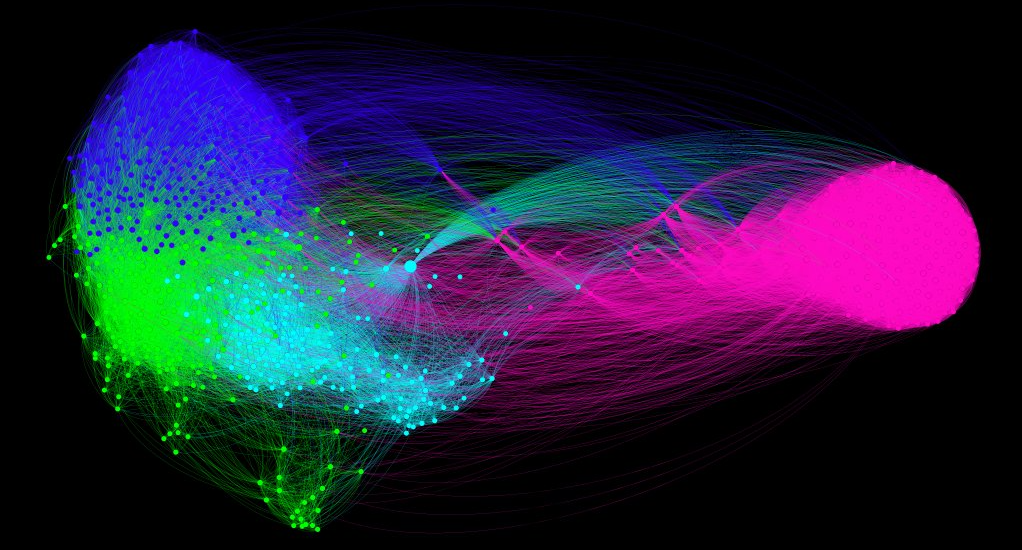
A social network analysis from FeedSeer.
Part of the reason is that computers today simply aren’t smart enough to understand what the content we’re sharing actually means. If a lot of people engage with a piece of content, these computer algorithms assume that the content is interesting and should be amplified to even more readers. In many cases, this assumption is flawed.
I love Twitter. I’ve been a user since 2008 and I built FeedSeer on top of Twitter because I think it provides the best foundation for constructing a better social media experience. However, there are facets of Twitter’s algorithm that I don’t like. For example, it often shows us content that was liked by people that we follow.
When you interact with a post on Twitter, you have the choice of either liking it or retweeting it. When you chose to like it, you are making a deliberate choice to provide positive feedback about that tweet WITHOUT sharing it with your followers. You, a human being, who understands the content and its context, made a specific decision about what should happen with that content, and then Twitter’s computer algorithm comes along and reverses that decision, sharing it with your followers anyway.
Perhaps there are good reasons that you chose not to retweet that tweet. Maybe it expresses a sentiment that you agree with but would be misunderstood or taken out of context by the people who follow you. By underestimating the importance of the signal you gave Twitter through your choice, Twitter’s algorithm ends up promoting content that can be divisive.
Twitter provides a way to turn off the algorithm by reverting your feed to “Latest Tweets” and often this change has a noticeable cooling effect on the nature of the content that you see. Gone are the high engagement tweets that no one you follow actually retweeted. All you see are the most recent posts from the feeds you’ve personally selected.
Unfortunately, when you follow lots of people on Twitter, the “Latest Tweets” function has a downside. When you completely remove engagement from the picture and only see a chronological timeline, you aren’t necessarily seeing the most important or the most noteworthy tweets that have appeared since you last used the app — just the latest ones.
Another way to break your feed down so that you can zero in on particularly interesting content is to use Twitter’s “lists” feature, which provides you with a chronological view from a specific set of feeds. However, manually maintaining lists and keeping them updated is a lot of work.
This is why I built FeedSeer. I wanted a tool that would automatically sort the Twitter accounts I follow into lists and keep those lists updated as I follow new people and unfollow ones I no longer want to see.
It’s a different type of algorithm, one that puts me in control — I decide which accounts to follow, and when I read lists on Twitter, I only see tweets from those feeds. However, FeedSeer automatically breaks my feed down into categories, which allows me to focus in on particular subject areas that interest me. This helps me find important and noteworthy tweets that might not surface if I was just looking at “Latest Tweets.”
The result is a cooler reading experience that also allows me to decide which topics I care about at any particular moment.
In order to get this benefit out of FeedSeer, you have to let it analyze your social network. FeedSeer uses graph analytics to automatically identify communities within your feed that cluster close together. Once FeedSeer’s analysis is complete, go to the “Lists” tab, name each cluster it has discovered, and tell it to push those clusters back to Twitter as lists. Due to Twitter’s API rate limitations, it can take time for FeedSeer to populate lists, but the wait is worth it. As my lists populated when I first launched the tool, I found a new and different reading experience that wasn’t possible before.
I’ve truly escaped the algorithm. And you can too.
FeedSeer merely scratches the surface of what is possible here. In the future, I will be adding additional features that highlight content to you in new ways. I truly believe that better algorithms are possible. The problem is not algorithms in general. The problem is that we haven’t built the right ones yet. We will.
If you haven’t joined FeedSeer, please give it a try and let me know your feedback. I hope it provides a taste of a better future for social media.
메타데이터
- post_id
- e09c94170dba
- slug
- how-you-can-use-feedseer-to-escape-the-algorithm-e09c94170dba
- url
- https://medium.com/@_decius_/how-you-can-use-feedseer-to-escape-the-algorithm-e09c94170dba
- canonical_url
- https://medium.com/@_decius_/how-you-can-use-feedseer-to-escape-the-algorithm-e09c94170dba
- author_url
- https://medium.com/@_decius_
- status
- ok
- fetched_at
- 2026-07-26 18:12:23