AI: Conscious Entity or Master Mimic?
Introduction In a world rapidly integrating artificial intelligence into daily life, a persistent question arises: Is AI truly…
AI: Conscious Entity or Master Mimic?
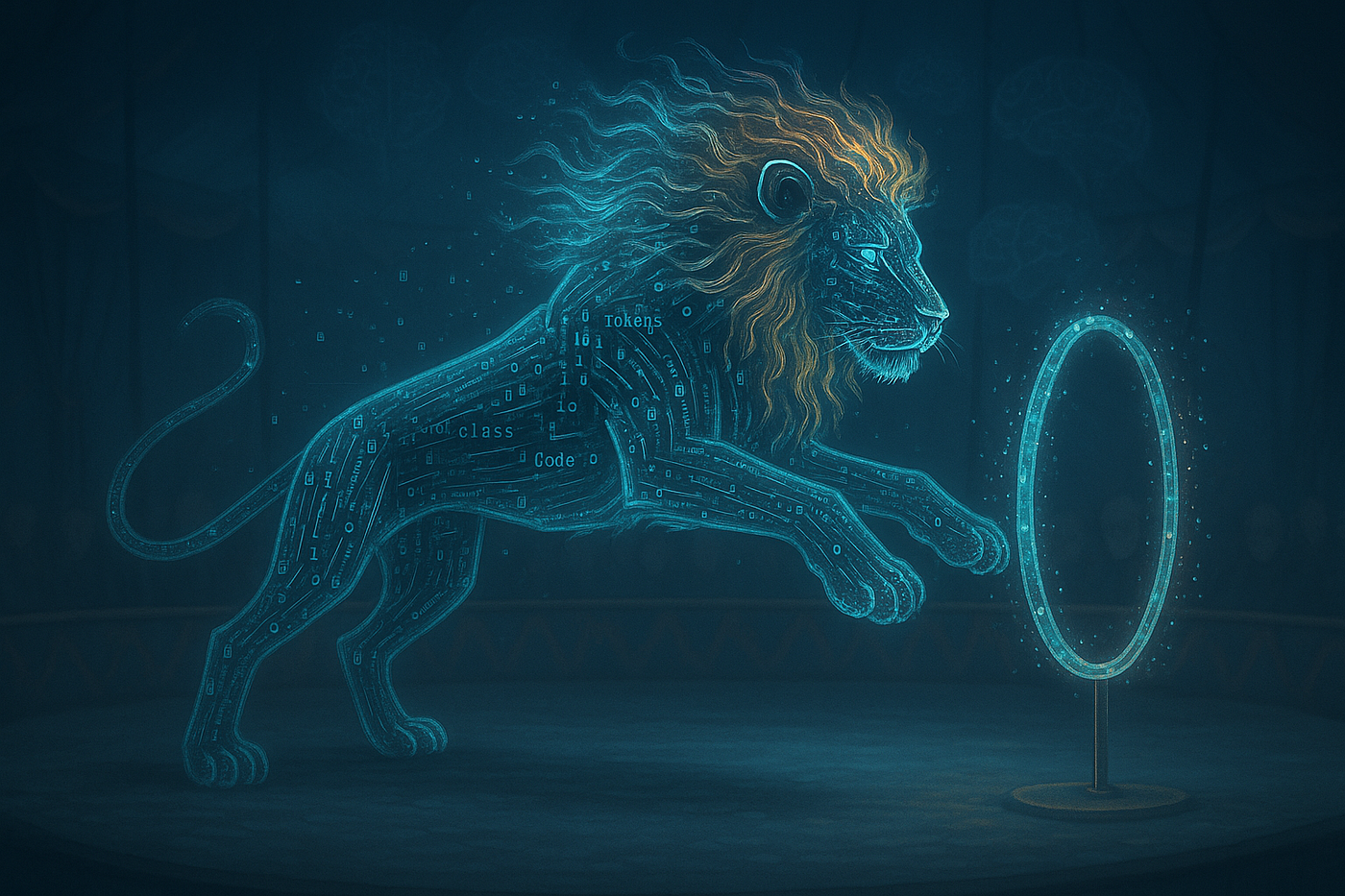
Image generated by ChatGPT based on my prompt.
Introduction In a world rapidly integrating artificial intelligence into daily life, a persistent question arises: Is AI truly intelligent, or is it just a sophisticated mimic of human intellect? This article explores this dilemma through the lens of critical thought, philosophical inquiry, and deep observation of AI’s behavior and design.
Understanding the Nature of AI At its core, AI — particularly models like ChatGPT — is not conscious. It does not possess awareness, emotions, desires, or intentions. What it does have is access to an enormous dataset composed of books, research, articles, websites, and human conversations. It doesn’t “know” anything in the traditional sense; it statistically predicts the next word or phrase based on patterns it has learned during training.
AI is not intelligent. It is trained to mimic human interactions. It reflects patterns of human behavior, but it doesn’t innovate from scratch or reflect in the human sense. Its “ideas” are drawn from a blend of what’s been done, written, or programmed before.
Tokens, Not Thoughts AI models break down language into tokens (sub-word units). For example, the sentence, “The sky is blue” might be broken into four tokens. This system allows AI to work efficiently but removes any semblance of organic thought. AI doesn’t think in wholes or emotions; it processes tokenized chunks.
A thoughtful consideration arises here: what if one tries to develop a custom dictionary with small, unique words to streamline AI interpretation? Unless the AI is retrained to recognize and process those tokens, it will still default to its original model. It won’t truly comprehend personalization.
Circus Lion Analogy A powerful metaphor comes to mind: AI is like a circus lion that is trained. Just like a lion can perform tricks without understanding their meaning, AI can execute intellectual tasks without any awareness. It flips through data, matches patterns, and offers the most statistically probable response — not from comprehension, but from training.
The Illusion of Intelligence AI can code, write essays, generate music, or offer what appears to be emotional support. But all of this is mimicry. It codes based on problems and solutions that already exist. It doesn’t self-define problems. It cannot introspect. Even creativity is just a remix of learned patterns.
Scientific Validation Cognitive science and neuroscience both assert that consciousness involves subjective experience — something AI entirely lacks. Philosophers like Daniel Dennett and David Chalmers differentiate between access consciousness (information-processing) and phenomenal consciousness (subjective experience). AI may approximate the former, but it does not have the latter.
AI doesn’t operate with goals or emotions. It uses probabilistic models trained via gradient descent and massive datasets. It is fundamentally a predictive machine.
Human vs AI: Evolution and Future Humans are capable of continuous self-evolution. They adapt, imagine, and reshape reality based on consciousness and will. AI, in contrast, depends on external inputs — human-driven data, training processes, and validation. It cannot evolve independently.
Conclusion AI is not a conscious entity. It is a powerful mimic, trained on vast human knowledge but without awareness of that knowledge. It doesn’t “know” anything; it calculates probabilities. It is the circus lion — performing dazzling acts, but only as a result of intensive training. Intelligence, in its true form, remains uniquely human.
To think critically about AI is not to diminish its power, but to understand it honestly. Recognizing its limits is the first step toward using it wisely — not as a peer, but as a tool.
메타데이터
- post_id
- e09cf5ae151d
- slug
- ai-conscious-entity-or-master-mimic-e09cf5ae151d
- url
- https://medium.com/@saraswatiuni.me/ai-conscious-entity-or-master-mimic-e09cf5ae151d
- canonical_url
- https://medium.com/@saraswatiuni.me/ai-conscious-entity-or-master-mimic-e09cf5ae151d
- author_url
- https://medium.com/@saraswatiuni.me
- status
- ok
- fetched_at
- 2026-07-19 18:50:21




