API Architectural Styles: The Invisible Languages That Connect Your Systems
Years of building monolithic systems and distributed microservice architectures, where hundreds of services talk to each other flawlessly…
API Architectural Styles: The Invisible Languages That Connect Your Systems
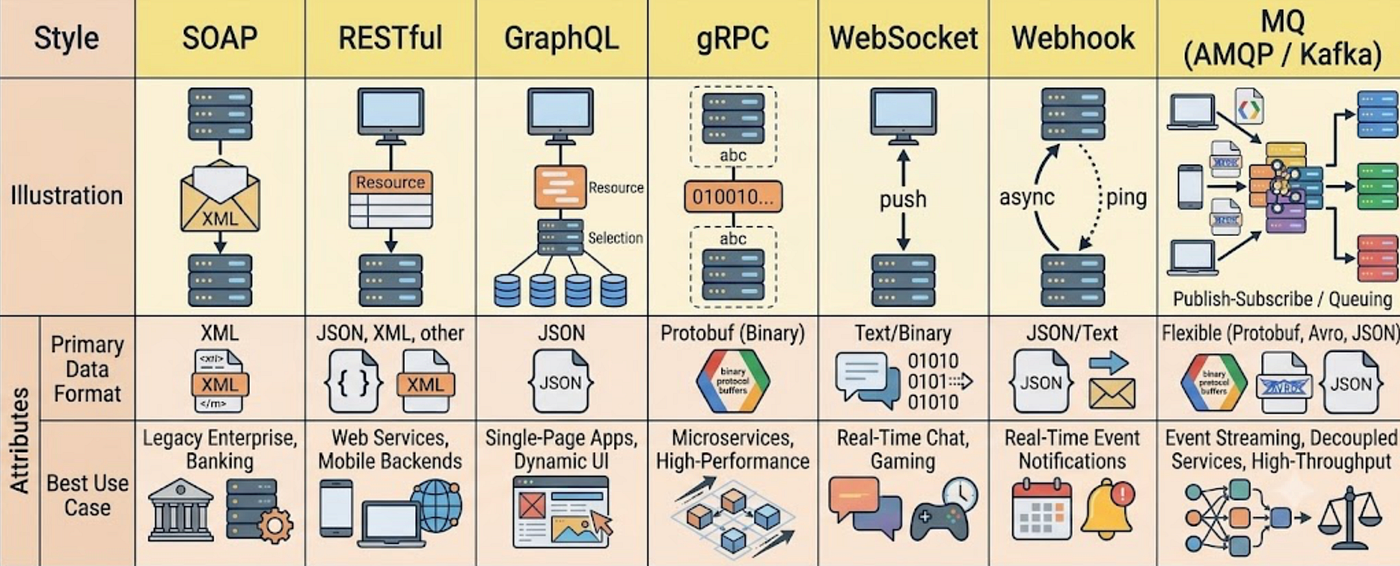
Years of building monolithic systems and distributed microservice architectures, where hundreds of services talk to each other flawlessly, reveal a recurring pattern: engineers usually ask “which technology should I use,” but the real question should be “which communication model should I use.”
REST, GraphQL, gRPC, or Kafka? This isn’t a matter of taste — it’s an architectural decision, and getting it wrong gets expensive fast as your system grows.
In this article, we’ll lay out the building blocks of the API world — architectural styles — one by one. First, a quick look at what they actually are, then a deep dive into 4 main categories, and finally a head-to-head comparison of “which one wins against which” in real-world scenarios.
What Is an API Architectural Style?
An API architectural style is a set of rules that defines how two systems (a client and a server, or services talking to each other) communicate. What’s the message format? Is the connection persistent, or opened fresh every time? Is communication one-way or two-way? Synchronous or asynchronous?
Different answers to these questions are what gave us REST, GraphQL, gRPC, WebSockets, and the rest as distinct styles. None of them is “the best” — each one is optimized to solve a specific class of problem.
In this article, we’ll examine these styles under 4 major categories:
- Request-Response Protocols — REST, GraphQL, SOAP
- The Performance and Microservices Era: Binary Protocols — gRPC
- Real-Time and Bidirectional Communication — WebSockets, SSE
- Asynchronous and Event-Driven Architectures — Webhooks, AMQP/Kafka
Let’s get into it.
1) Request-Response Protocols
This category is the classic model that the internet is built on: the client sends a request, the server sends a response, the connection closes. Simple, well-understood, scalable.
a) REST (Representational State Transfer)
REST isn’t a protocol — it’s an architectural style. Defined by Roy Fielding in his 2000 doctoral dissertation, it’s an approach where resources are represented by URIs and HTTP verbs (GET, POST, PUT, DELETE) are used meaningfully.

Simple representation:
Client                           Server
  |  GET /users/123                |
  |------------------------------->|
  |                                |
  |  200 OK                        |
  |  { "id": 123, "name": "Alex" } |
  |<-------------------------------|
Pros:
- Built on HTTP, so it’s supported everywhere and easy to learn
- Its stateless nature makes horizontal scaling straightforward
- Caching works naturally at the HTTP level
- Human-readable, easy to debug
- Massive ecosystem and tooling support (Postman, Swagger/OpenAPI, etc.)
Cons:
- The over-fetching / under-fetching problem: sometimes you pull more data than you need, sometimes you need multiple requests
- Versioning (v1, v2) can get messy over time
- Can be inefficient with complex, deeply nested data relationships
- Doesn’t offer a natural solution for real-time communication
Who uses it: Twitter/X API, GitHub REST API, Stripe, Shopify, large parts of Amazon, and basically every classic web/mobile backend out there. That’s exactly why it’s been the “default choice” for so many years.
b) GraphQL
Developed internally by Facebook (Meta) in 2012 and open-sourced in 2015, GraphQL is a direct answer to REST’s over-fetching/under-fetching problem. The client defines exactly what data it needs in a single query.
Simple representation:
Client                                               Server
  |  POST /graphql                                      |
  |  { user(id:123){ name email posts{title} } }        |
  |---------------------------------------------------->|
  |                                                     |
  |  { "name":"Alex","email":"...","posts":[...] }      |
  |<----------------------------------------------------|
Pros:
- The client selects exactly the fields it needs — over/under-fetching disappears
- Complex, relational data can be fetched in a single request through one endpoint
- A strong type system (schema) makes documentation essentially self-generating
- Frontend and backend teams can iterate more independently
Cons:
- HTTP-level caching isn’t as natural as REST and requires extra solutions
- If query complexity isn’t controlled server-side, it can become a performance/security risk (the N+1 problem, deeply nested queries)
- Steeper learning curve compared to REST
- Not naturally suited to scenarios like file uploads
Who uses it: Facebook/Meta, GitHub (GraphQL API v4), Shopify, Netflix (in some internal services), Twitter/X (in mobile apps).
c) SOAP (Simple Object Access Protocol)
SOAP emerged in the late 1990s as an XML-based protocol with strict rules. It was the enterprise standard before REST took over, and it’s still widely used in certain sectors (banking, healthcare, government systems).
Simple representation:
Client                                             Server
  |  POST /soap-endpoint                              |
  |  <Envelope><Body><GetUser><id>123</id>            |
  |  </GetUser></Body></Envelope>                     |
  |-------------------------------------------------->|
  |  <Envelope><Body><User><name>Alex</name>          |
  |  </User></Body></Envelope>                        |
  |<--------------------------------------------------|
Pros:
- Built-in error handling (a standardized fault format)
- Enterprise-grade security standards like WS-Security
- Reliable for systems requiring ACID-compliant transactions and strict contracts (via WSDL)
- Protocol-independent (can run over SMTP and others, not just HTTP)
Cons:
- XML-based, so it’s heavy and verbose compared to JSON
- Much slower to learn and develop with than REST/GraphQL
- Impractical for mobile and modern web applications
- Community support and tooling development have slowed considerably
Who uses it: Banking systems (SWIFT integrations), insurance companies, some legacy PayPal APIs, government legacy systems, HL7 integrations in healthcare.
2) The Performance and Microservices Era: Binary Protocols
As microservice architectures became widespread, even milliseconds started to matter in service-to-service communication. This created the need for small, fast, binary-messaging protocols instead of JSON/HTTP’s verbose, text-based format.
a) gRPC (Google Remote Procedure Call)
Developed by Google, gRPC is a modern RPC framework that runs on HTTP/2 and serializes messages in binary format using Protocol Buffers (protobuf). It’s one of today’s most popular choices for inter-service communication in microservices.
Simple representation:
Service A                                       Service B
  |  gRPC Call: GetUser(id=123)                     |
  |  [binary protobuf, HTTP/2 stream]               |
  |------------------------------------------------>|
  |                                                 |
  |  [binary protobuf response]                     |
  |<------------------------------------------------|
Pros:
- Thanks to protobuf, messages are far smaller and much faster to serialize than JSON
- HTTP/2 support enables multiplexing (parallel requests over a single connection)
- Supports both unary (single request-single response) and streaming (continuous flow) calls — including bidirectional streaming
- Strict schemas (
.protofiles) provide language-agnostic, strong type safety - Code generation automatically produces client/server stubs in many languages
Cons:
- Can’t be called directly from a browser (requires extra layers like gRPC-Web), so it’s less suited for public/external APIs
- Binary format isn’t human-readable — harder to debug than REST
- Higher learning curve and tooling requirements than REST
- Caching mechanisms aren’t as natural as with HTTP/1.1 + JSON
Who uses it: Google (almost all internal services), Netflix (a large portion of inter-service communication), Uber, Square, Cisco, Docker, and core internal components of Kubernetes (like etcd).
3) Real-Time and Bidirectional Communication
The classic request-response model falls short in the “let the server tell me when something happens” scenario. This need gave birth to protocols built around persistent connections.
a) WebSockets
WebSocket is a protocol that provides full-duplex, persistent communication over a single TCP connection. Once the connection is established, both the client and the server can send messages whenever they need to.

Simple representation:
Client                           Server
  |  HTTP Upgrade Request           |
  |-------------------------------->|
  |  101 Switching Protocols        |
  |<--------------------------------|
  |  [Persistent connection open]   |
  |        <-- message -->          |
  |        <-- message -->          |
  |        <-- message -->          |
Pros:
- True bidirectional communication — either the client or the server can initiate
- Low-latency, continuous data flow
- Low overhead for exchanging many messages over a single connection
- A natural fit for chat, gaming, and live collaboration scenarios
Cons:
- Connection management (reconnects, scaling, load balancing) is more complex than REST
- Stateful connections require more server-side resource management
- Doesn’t play naturally with standard HTTP caching, proxy, and CDN mechanisms
- May require extra configuration on some corporate networks/firewalls
Who uses it: Slack, Discord, WhatsApp Web, online games (some components of Fortnite), trading platforms (Binance, for live price feeds), Google Docs’ live collaboration feature.
b) SSE (Server-Sent Events)
Unlike WebSockets, SSE is a unidirectional real-time communication model: only the server can continuously push data to the client over an open HTTP connection. There’s no channel for the client to send messages back to the server through this same stream.
Simple representation:
Client                          Server
  |  GET /events                   |
  |  (Accept: text/event-stream)   |
  |------------------------------->|
  |  data: {"price": 105}          |
  |<-------------------------------|
  |  data: {"price": 106}          |
  |<-------------------------------|
  |  data: {"price": 104}          |
  |<-------------------------------|
Pros:
- Runs over standard HTTP, no extra protocol/upgrade required — simple to set up
- Automatic reconnection is natively supported by the browser
- Lighter and simpler than WebSockets for unidirectional scenarios
- Better compatibility with proxies and existing infrastructure than WebSockets
Cons:
- Strictly one-way (server → client); not suitable when bidirectional communication is needed
- Limited number of concurrent open connections in browsers (a notable constraint particularly under HTTP/1.1)
- No support for binary data, only text-based data
- Not as low-latency as WebSockets in some scenarios
Who uses it: Live price feeds in finance/trading apps, notification systems (some of GitHub’s live updates), live score-tracking apps, and LLM interfaces like ChatGPT/Claude that “stream” responses.
4) Asynchronous and Event-Driven Architectures
In some systems, waiting for an immediate response is far less efficient than the model of “let me know when something happens, and I’ll handle it then.” This keeps systems loosely coupled.
a) Webhooks (Reverse APIs)
A webhook is often called a “reverse API” because, unlike a normal API call, the server (a third-party system) triggers your system with an HTTP POST request when a specific event occurs. Instead of constantly asking “did anything change?” (polling), the other side notifies you.
Simple representation:
Your System                          Third-Party Service (e.g. Stripe)
  |  [You register a webhook URL]                  |
  |<-----------------------------------------------|
  |                                                |
  |   [An event occurs: payment completed]         |
  |   POST /webhook/payment-success                |
  |<-----------------------------------------------|
  |   200 OK                                       |
  |----------------------------------------------->|
Pros:
- Far more efficient than polling — no unnecessary request traffic
- Provides near-real-time notification
- Integration can be set up with a simple HTTP endpoint, no extra infrastructure needed
- Enables loose coupling between systems
Cons:
- No reliability guarantee — if the webhook request fails, retry logic is up to the other side
- Risky if security (signature verification, HTTPS, secret tokens) isn’t set up correctly
- No ordering guarantee, messages may arrive out of sequence
- Hard to debug since the trigger side isn’t under your control
Who uses it: Stripe (payment events), GitHub (push, pull request events), Shopify (order events), Twilio, Slack (app integrations), PayPal’s IPN system.
b) AMQP / Apache Kafka (Message Queues)
In this category, messages aren’t sent directly to a destination but to a broker (message queue), which then distributes them to the relevant consumers. AMQP (the protocol used by systems like RabbitMQ) and Apache Kafka (a LinkedIn-born, distributed log/event-streaming platform) are the two best-known approaches in this space.

Simple representation:
Producer               Message Broker / Kafka       Consumers
  |  Event: "order_created"  |
  |------------------------->|  Topic: orders
  |                          |------------------>Consumer A (Email service)
  |                          |------------------>Consumer B (Inventory service)
  |                          |------------------>Consumer C (Analytics service)
Pros:
- Producers and consumers are fully decoupled — if one goes down, the other isn’t affected
- High throughput and horizontal scalability (Kafka in particular can handle millions of messages per second)
- Messages can be persisted (via retention policies in Kafka), letting consumers process at their own pace
- A single event can be consumed by multiple, independent systems simultaneously (pub/sub model)
- Provides resilience against system failures — messages aren’t lost, they wait in the queue
Cons:
- High operational complexity — setup, monitoring, and scaling require serious expertise
- Not suitable for scenarios requiring an immediate (synchronous) response; some latency must be acceptable
- Guarantees like “exactly-once delivery” are hard to achieve without careful configuration; duplicate messages must be handled
- Significantly higher learning curve and infrastructure cost compared to REST/gRPC
Who uses it: LinkedIn (where Kafka was born), Netflix (event-driven microservices architecture), Uber (trip events), Airbnb, Spotify (user activity streams), and many e-commerce and fintech systems running on RabbitMQ (on the AMQP side).
Head-to-Head Comparisons: Which Style Wins When?
We’ve covered the theory — now let’s compare the most common “battles” you’ll actually run into in the real world.

1) REST vs. GraphQL — The Request-Response Wars
- Data-fetching efficiency — REST: risk of over/under-fetching · GraphQL: fetches exactly what’s needed
- Caching — REST: natural at the HTTP level · GraphQL: requires extra solutions
- Learning curve — REST: low · GraphQL: medium-high
- Complex relational data — REST: may need multiple requests · GraphQL: possible in a single request
- Suitability for public APIs — REST: very high · GraphQL: medium (rate-limiting complexity)
Practical takeaway: For simple CRUD operations and public APIs open to a wide audience, REST remains the most pragmatic choice. In scenarios with limited bandwidth (mobile apps), heavily relational data fetching, and where frontend teams need to move independently from backend teams, GraphQL offers a real advantage. Many large companies (like GitHub and Shopify) use both together: REST for the outside world, GraphQL for internal/mobile clients.
2) REST vs. gRPC — The Inter-Microservice Communication Wars
- Performance — REST: good · gRPC: much faster (binary + HTTP/2)
- Human readability — REST: high (JSON) · gRPC: low (binary protobuf)
- Browser support — REST: native · gRPC: limited (requires gRPC-Web)
- Streaming support — REST: no (by default) · gRPC: native (unary, server/client/bi-di streaming)
- Use in microservice-to-microservice comms — REST: common but heavier · gRPC: ideal
Practical takeaway: Keep using REST for APIs facing the outside world (browsers, third-party developers). But when your services talk to each other millions of times per minute and performance is critical (at the scale of Netflix, Google, or Uber), the speed and low overhead gRPC delivers makes a noticeable difference. Most mature microservice architectures evolve into a hybrid setup: REST/GraphQL facing outward, gRPC facing inward.

3) WebSockets vs. SSE — The Real-Time Streaming Wars
- Communication direction — WebSockets: bidirectional · SSE: unidirectional (server → client)
- Setup complexity — WebSockets: higher · SSE: lower (plain HTTP)
- Automatic reconnect — WebSockets: manual implementation needed · SSE: native in browsers
- Binary data support — WebSockets: yes · SSE: no
- Typical use case — WebSockets: chat, gaming, collaboration tools · SSE: notifications, live data feeds, price tickers
Practical takeaway: It comes down to one simple question: Does the client also need to send data back to the server?If yes (a chat app, a multiplayer game, collaborative document editing), WebSocket’s added complexity is worth it. If no — meaning you just need data flowing one way from server to client (notifications, live stock prices, LLM streaming responses) — SSE does the same job with much less operational overhead.
4) HTTP Calls (REST/gRPC) vs. Message Queues (Kafka/AMQP)
- Response expectation — REST/gRPC: immediate · Kafka/AMQP: some delay is acceptable
- Coupling — REST/gRPC: tight (both sides must be up) · Kafka/AMQP: loose (sides can operate independently)
- Fault tolerance — REST/gRPC: low (service down = request fails) · Kafka/AMQP: high (messages wait in the queue)
- Multiple consumers — REST/gRPC: hard (a separate call per client) · Kafka/AMQP: natural (one event, multiple listeners via pub/sub)
- Typical use case — REST/gRPC: user clicked a button, expects an instant response · Kafka/AMQP: an order was created, 5 different systems need to know
Practical takeaway: If there’s a “waiting” state in the UI (a login flow, a search query), a synchronous, HTTP-based call (REST/gRPC) is the right choice. But if an event needs to trigger multiple, independent systems (when an order is created: send an email, update inventory, log analytics, generate an invoice), handling that with a chain of synchronous calls creates a fragile, tightly coupled system. This is where a messaging layer like Kafka/AMQP, by decoupling the systems, delivers a far more resilient architecture.
Conclusion: We Live in the Gray Areas
Years of working on everything from small startups to massive, distributed systems serving millions of users point to one consistent lesson: there’s no such thing as “the best API architectural style.” There’s only “the best style for this particular problem.”
Nearly every mature, real-world system is hybrid: a REST or GraphQL layer facing the public and serving a broad audience; gRPC for high-performance inter-service communication; WebSockets or SSE for real-time features; and a Kafka/AMQP backbone decoupling systems behind the scenes — all coexisting within the same architecture, each handling a different job.
So the next time you face an architectural decision, ask yourself:
- Should the communication be synchronous or asynchronous?
- Is an immediate response required, or is resilience and loose coupling the priority?
- How much data is the client fetching, and how relational is it?
- How performance-critical is the system — do milliseconds matter?
- How many different parties need to listen to this event?
Honest answers to these questions will lead you to the right style. Architecture is never a black-and-white, right-or-wrong matter — it’s always a gray area full of trade-offs. That, in fact, is the essence of being a good architect: knowing which trade-offs to accept and which ones to avoid.
References
- Fielding, R. T. (2000). Architectural Styles and the Design of Network-based Software Architectures (Doctoral dissertation) — the original definition of REST
- GraphQL Official Documentation
- gRPC Official Documentation
- Apache Kafka Official Documentation
- W3C WebSocket Protocol Specification (RFC 6455)
- MDN Web Docs — Server-Sent Events
- AMQP 0–9–1 Protocol Specification
- Engineering blogs from Stripe, GitHub, Shopify, Netflix, and Uber — for real-world usage examples
- https://thenewstack.io/build-real-world-microservices-with-grpc/
- https://www.skiplevel.co/blog/part-2-rest-api-components-how-to-read-them
- https://finematics.com/apache-kafka-explained/
메타데이터
- post_id
- e0b2acd7b203
- slug
- api-architectural-styles-the-invisible-languages-that-connect-your-systems-e0b2acd7b203
- url
- https://medium.com/@korayurun07/api-architectural-styles-the-invisible-languages-that-connect-your-systems-e0b2acd7b203
- canonical_url
- https://medium.com/@korayurun07/api-architectural-styles-the-invisible-languages-that-connect-your-systems-e0b2acd7b203
- author_url
- https://medium.com/@korayurun07
- status
- ok
- fetched_at
- 2026-06-27 18:23:13




