John Wheeler’s plan to understand reality may be gaining traction
The It-from-Bit program to derive all of quantum reality, including space and time, from information has seen some of its greatest leaps in…
John Wheeler’s plan to understand reality may be gaining traction
The It-from-Bit program to derive all of quantum reality, including space and time, from information has seen some of its greatest leaps in the last few years.
Quantum information is one of the hottest topics in quantum since cat meets box and one of the most exciting areas of study right now is how space and time emerge. You may have heard of connections between quantum information and spacetime, like ER=EPR, the dubious connection between entanglement and wormholes that made headlines a couple of years ago, but this is not that. There is a clear program, going back at least to the 1970s, originating with John A. Wheeler, Feynman’s and Everett’s (of Many-Worlds fame) PhD advisor, that the geometry that defines space and time must be emergent from bits.
This It-from-Bit program is more than just a philosophical aphorism. It is a research program that argues that the spacetime geometry that Einstein developed into his theory of general relativity, when you get down to its microscopic description, becomes a collection of quantum bits (qubits) and that what we know as space and time emerge from their entanglement or increasing information.
In the 1980s, Page and Wootters showed how time could emerge from the entanglement of stationary quantum systems with other systems that act as clocks. Now, researchers have added space to the mix as well. The best review of this I have found is a PhD thesis by Favalli that came out only last year, where he generalizes previous work on time and a single space dimension (hence eliminating rotations) to the usual four dimensions.
If quantum gravity ever becomes a viable theory, I think it must move beyond geometry, which, unfortunately, many theories such as string theory are stuck in. Admittedly, string theory has different goals than emergent space-time protocols, but nevertheless, if treated as fundamental, it goes against Wheeler’s belief that all physical reality must be reducible to information.
The program to do that rests on a few pieces. The first is John A. Wheeler’s It-from-Bit philosophy. The second is a relativity mechanism for quantum mechanics called Quantum Reference Frames. And the third is how we get emergent space and time from quantum entanglement. Bring all this together and we find perhaps the strongest direction to achieving a genuine understanding of microscopic reality: space, time, and matter all at once. And all of this is a hot topic right now with a lot of progress made only in the last few years.
Wheeler often indulged in flowery language that was often misinterpreted, but he had clear ideas about what he believed constituted reality. From this essay by Wheeler:
The Wheeler It-from-Bit Philosophy
It from bit symbolizes the idea that every itme of the physical world has at bottom — at a very deep bottom, in most instance — an immaterial source and explanation; that what we call reality arises in the last analysis from the posing of yes-no questions and the registering of equipment-evoked responses; in short, that all things physical are information-theoretic in origin and this is a participatory universe. The Search for Links — John Archibald Wheeler
Let’s unpack that.
Wheeler is saying that everything we regard as physical reality is a string of answers to yes or no questions that arise from the interaction between what we think of as reality- electrons, protons, atoms, buildings, planets, black holes, and so on, -and our measurement apparati.
Thus, we participate in the universe via an information exchange with it.
Perhaps, you wonder, however, why we would want to do away with geometry as fundamental. Why is information so much more critical?
Wheeler has a point in this case that we perceive the world as information. Geometry is something we infer about the world. We cannot perceive a continuum.
Wheeler’s program, therefore, has three questions, four no’s, and five clues:
The questions:
- Why existence?
- Why quantum?
- Why “one world” from many observers?
The Nos
- No tower of turtles
- No laws
- No continuum
- No space, no time
The Five Clues
- The boundary of a boundary is zero
- No question? No answer!
- The super-Copernican principle
- “Consciousness”
- More is different
Bear with me as I go through all this because, without it, you won’t understand the progress that is being made right now.
The Questions
The questions are sensible at least, and they are the ones that motivated Wheeler in his quest to understand reality. We all want to know why we exist. Some of us say God, but I’m not sure that Wheeler is referring to the Almighty. He’s talking about how existence comes into being, which goes hand-in-hand with his participatory universe.
Asking why quantum is shorthand for asking why, at the microscopic level, the universe is quantum when at our level of the everyday it is not. Wheeler believes that if we understand existence and how it comes into being, we could understand why it has to be quantum.
The last one might be disputed by Many-Worlds adherents. Wheeler argued there was a single world. This also goes into the participatory universe model. We are part of the same universe, but each of us is granted our own POV.
Wheeler answered the why quantum question with the answer “Because what we call existence is an information-theoretic entity” thus quantum mechanics encodes that information theoretic reality and classical physics emerges when information and communication become so dense that it appears to be a continuum.
To answer existence, however, he needed to answer the third question: how do we get a single world out of information that many participants share?
To answer this, we have to get to the no’s and the clues.
The Nos
No tower of turtles, a reference to William James (although James didn’t say turtles; he said “rocks”), means that we cannot allow for an infinite regress. We cannot simply have a set of physical laws that has under it another set of physical laws ad infinitum. At some point the structure must stop.
To avoid infinite regress, Wheeler suggested a loop instead:
“Physics gives rise to observer-participancy; observer-participancy gives rise to information.”
In other words, the universe is like a distributed computer program that runs on its observers, which could be computers or people.
No laws: Wheeler rejected the idea that the universe was, in fact, a machine, however. A machine has laws and rules it follows. Where do those laws come from? No, the universe must be in some sense self-referencing. It must induce laws upon itself. It must be self-organising. He compared it to a piece of music that observers were all playing together on a great piano-with the notes being bits.
No continuum: Wheeler suggests that mathematics has made it clear that the continuum doesn’t exist. I’m not sure what the heck he’s talking about here, possibly the axiom of choice, which is a weird mathematical rule that defies physical logic. The continuum indeed causes a lot of problems in physical laws that would be resolved with a discrete approach. He points to one, which is that quantum theory creates such large fluctuations at the tiniest scales that if a continuum did exist, it would break causality apart. Thus he says, “This circumstance reminds us anew that no account of existence can ever hope to rate as fundamental which does not translate all of continuum physics into the language of bits”.
No space, no time: Wheeler suggests, following Leibniz, that space and time are not real but inventions that we use to order things. There are strong reasons to believe that time is not fundamental. For one thing, it breaks when we try to weld quantum physics with general relativity. The equation that bears his name, the Wheeler-DeWitt equation, has no time in it at all. In any case, this no is a corollary of the third no since space and time are continuous.
The Clues
The Clues give us a direction to what the answers to the questions are, given the no’s.
The boundary of a boundary is zero: this is just a principle from the mathematics of topology. More correctly, the boundary of a boundary is empty because a boundary is necessarily closed in on itself. If you think of it, suppose I have a sphere enclosing a space. The sphere is the boundary of the space, but what is the boundary of the sphere? It has none because the sphere is closed. Wheeler hoped that this principle would lead us to all physical laws from no laws at all in the same way. In other words, can we “bound” physical law in something that itself has no boundary, no laws?
No question? No answer! Quantum physics tells us that we can’t have an answer about any physical object unless we measure it. Thus, all of reality as we perceive it is the result of interrogation. In Wheeler’s conception of quantum physics, when the question is not asked, the answer doesn’t exist. We can’t ascribe an answer, such as a position or momentum to an electron, unless we make a measurement. It makes no sense. If you ask where an arbitrary electron is in a room, the only sensible answer, as British physicist Brian Cox correctly points out, is that it fills the room. Ask the electron where it is using some kind of measurement aparatus, however, and it will localize. It will give you an answer.
The super-Copernican principle: The idea here is that not only are human beings not in a special location in the universe, which is the Copernican principle, but we are also not living at a special time. In particular, Wheeler is rejecting the concept that the beginning of the universe has a special status because it is unobserved. Indeed, he rejects any aspect of reality that is unobserved. The universe only has meaning for those who observe and participate in it in the here and now. History only has information as it is measured and interpreted by those living now. We need not, therefore, account for the bits to construct unobserved universe at all. It-from-bit means observed bits, not imagined ones. Existence across time is built by the inhabitants, the observer-participants who engender reality. As Wheeler frequently repeats: “Meaning is the joint product of all the evidence that is available to those who communicate.”
“Consciousness”: People often say (even Wikipedia gasp) that Wheeler believed consciousness to be the organizing principle, the ground of the participatory universe. But that’s not true. In fact, in an article in The New York Review of Books in 1979, Wheeler and Martin Gardner (who presented wonderful mathematical puzzles in Scientific American for many years) claimed that Wheeler found attempts to connect his name with the involvement of consciousness in quantum mechanics “increasingly irritating”. He tried and failed to clear his name with a talk to the AAAS called “Not Consciousness But the Distinction Between the Probe and the Probed as Central to the Elemental Quantum Act of Observation” where Wheeler emphasized his “agreement with Niels Bohr that acts of QM measurement are made by devices which can be monitored by computers, and thus disassociate himself from those who argue that human consciousness is essential to QM observation.” This is why Wheeler places “consciousness” in quotes. He says that while some consider thought essential to physical reality, “we, however, steer clear of the issues connected with consciousness.” He did not consider consciousness necessary to be an observer-participant of reality. Thus, the clue isn’t the existence or requirement of consciousness but its irrelevance. His view of observer-participation is not traditionally anti-realist but rather has a strictly information theoretic viewpoint. Hence it would be better to call Wheeler an information-realist.
Note: Wheeler considers an observer to be something that makes an irreversible act of registration or acquisition of information. Thus, it is the irreversibility and registration of information that matters, not consciousness.
More is different: This is the observation that emergent properties exist and therefore, time and space likewise may simply be the different that emerges from more information.
That is the Wheeler program. You see that Wheeler didn’t really see the bits from which it comes as being “down there” at the bottom of existence somehow. No, they are all there is. Everything else is emergent. Likewise, he was skeptical of those who sought to place consciousness front and center in quantum interpretation. He considered it pseudoscience. The bits aren’t necessarily in our thoughts.
Nevertheless, how the emergent reality, Newton’s laws, Maxwell’s equations, and Einstein’s relativity, comes about is important because it isn’t as if we just saw a bunch of binary numbers and decided that was space and time. We experienced space and time first. Our brains interpret the reality of our senses that way. We have to know how that experience rises up from bits.
Quantum Reference Frames
Before we can understand how space and time emerge, we have to understand how space and time relate to one another in the quantum realm. Our classical intution, here, fails us because it fails to take quantum uncertainty into account.
Hence, we need the concept of a Quantum Reference Frame (QRF), which is an extension of the idea of reference frames from relativity to quantum mechanics. Many researchers in quantum gravity have suggested they are essential to understanding it.
A rather beautifully written paper called “Quantum Reference Frames for Lorentz Symmetry” by Apadula, Castro-Ruiz, and Brukner extends QRFs to Lorentz transformations. These are the translations upon which Einstein’s theory of relativity are based and include boosts and rotations (where a boost is like an acceleration). Prior to this paper, most work on QRFs had been non-relativistic, Newtonian stuff.
You might ask why we need QRFs at all. Can’t we just deal with space and time in the ordinary way in quantum mechanics?
The idea for QRFs goes back at least to the 1980s with a paper by Aharonov and Kaufherr simply titled “Quantum frames of reference”. They were attempting to resolve a paradox.
Suppose you have a measuring device and you want to measure the position of a particle Q to a certain accuracy. In order to achieve this accuracy, by the laws of quantum mechanics, you have to give up knowing the velocity to a some accuracy. Heisenberg’s uncertainty principle shows these to be anti-correlated. The tighter your bound on the position, the looser your bound on the velocity.
That’s fine because you don’t need the velocity. You want to measure the position with maximum accuracy.
Yet, when you make the measurement, the unknown velocity of Q imparts an unknown acceleration onto the measuring device. This means that you now have quantum uncertainty about where the measuring device itself is.
If you want to do another measurement now you are in trouble because your measuring device is at an unknown position so you can’t calibrate, externally, where anything it measures is.
Traditionally, the way quantum mechanics resolved this paradox is to assume that the mass of the measuring device is infinite. With an infinite mass, the measuring device becomes an immovable object, and everything is fine. But if you want to take into account small measuring devices, perhaps made of quantum particles themselves, you have to be able to account for reference frames that have quantum uncertainty in them.
That is where QRFs come from.
They characterize the kickback made to a measuring device by a measurement so you can understand the full quantum measurement picture.
That was 42 years ago and what had relatively humble beginnings has now become a critical component in the search for emergent spacetime and maybe quantum gravity. Using these, particularly the Lorentz formulation, allows us to tie space and time together in a quantum way that we could not before.
How Space and Time Emerge from Quantum Entanglement
The Page and Wootters framework mentioned in the introduction is the idea that time is simply “what is shown on a quantum clock” and that when a quantum system becomes entangled with another quantum system that acts as a clock, then it has an experience of time. It’s that simple.
The same goes for space.
A student, Favalli, meanwhile, just last year in his PhD thesis, discussed how Einstein’s clock and rod formalism that underlies special and general relativity can be generalized to quantum clocks and rods using Page-Wootter’s entanglement prescription along with QRFs.
Divide up the universe into two subsystems R and S where R is the reference frame for S. The system S has no intrinsic notion of distance or location. It must get it from R. One can then have a frequency spectrum act as a clock. This can be used to define both time and space, even when the spectrum is discrete.
This means that we experience time because we exist in a universe that contains both us and quantum fields that entangle with us to create time but the universe, externally, has no time at all. The flow of time emerges through correlation between the systems. This can be realized in a totally static quantum system.
This makes the answer to what is time: “it’s what [quantum] clocks measure”.
A simple example is given with two non-interacting electrons in a uniform magnetic field pointing in the z direction.
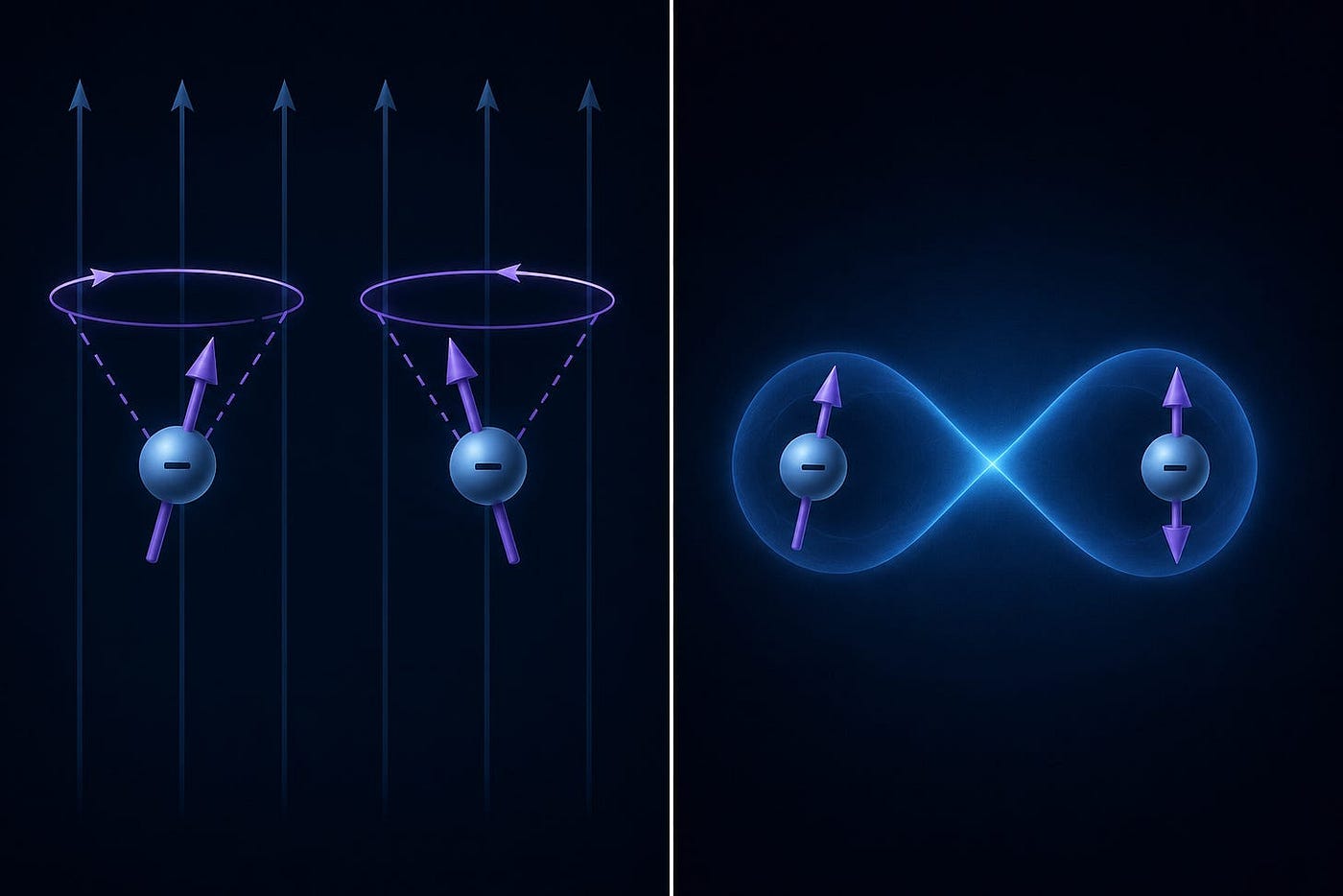
Left: Two non-interacting, time-dependent electrons spin precesses together in a uniform magnetic field. Right: Two entangled, time-independent electrons have correlated spin.
Left: Two non-interacting, time-dependent electrons spin precesses together in a uniform magnetic field. Right: Two entangled, time-independent electrons have correlated spin.
First, let’s look at how this would work in a universe with time.
At time 0 both spins are pointing in the x direction suppose.
The equations of motion in the magnetic field require the spins of the particles to precess together around the z axis where the magnetic field is pointing.
If we make measurements of the two particles spins in the x-y plane, they will, with high probability, be the same since they are precessing together around the z-axis.
Now, let’s look at this without time in what is called in quantum mechanics a stationary state but with the particles entangled such that they have opposite direction spin.
Now, treat one particle as a clock and its spin direction as if it were the pointer of an ordinary clock. The other particle is the object that we want to experience time.
Again, simultaneously measure the spins of the two particles in the x-y plane. There will be a high probability that the two measurements are the same.
This may seem unimportant but what we have done is use entanglement as a substitute for time. One particle’s spin acts like a clock for the other particle.
In the first case, with time, both particles precess together with respect to an externally imposed time. They are highly correlated in time without being entangled.
In the second case, without time, the clock particle has the same role as time did in the time-dependent case and the object particle’s spin direction is correlated with it.
If for example, the simultaneous measurement found that the clock was pointing in the positive x-direction, the other particle, when measured in the x-direction, would almost certainly be found pointing in the same direction.
In quantum mechanics, note, the spins of the particle do not have a definite value until they are measured. This is one of the features that distinguishes quantum particles from classical. You can’t say that the time particle is frozen prior to being measured. It is actively spread over all possible clock values. It represents all of time at once. Only when the measurement is made does the actual clock value emerge and the value of the object is given.
This means that while in the first, time-dependent case you are participating in time the same way as the particles, in the second, stationary case, you are given a God’s-eye view of time. All of time is simultaneously represented for you and only when you dip your toe in, by measuring, to extract a particular time do you experience a moment.
Now, we will talk about how we can get evolution over time without explicit time.
Imagine a single stationary state for the entire history of the universe represented by a quantum wavefunction. This state contains all past, present and future states of the universe. We no longer have a God’s eye view because we can’t exist outside the universe. Instead, we ask what happens when measurements are made inside the universe.
Here is a paraphrase of an explanation by Wootters:
You as an observer are analogous to the object particle above. Your state is highly correlated with the state of the rest of the world. When you make a measurement of the world you are simultaneously measuring your own internal state. This is a combined measurement made within the universe. It doesn’t collapse the whole quantum state of the universe but you experience one of the many possible states within the universal quantum wavefunction. The correlations contained in this wavefunction because of entanglement for example restrict what kind of measurement outcomes you can experience. These correlations between your own state and the world are interpreted by you as the passage of time.
In other words, when you experience the passage of time it is because your brain is correlated by entanglement with the universe and every time you make a measurement by experiencing something, from waking up in the morning to reading this article, you perceive it as time passing.
This happens because it is possible to subdivide the universal wavefunction into two subwavefunctions: a system and a clock. The system includes you. The entanglement of the system with the clock is what allows for the experience of dynamical evolution. In essence, every moment experienced is connected to a clock reading, and the sum total of all those moments is the universal wavefunction.
From these considerations, it is possible to derive the time-dependent equations for the universe from the stationary equations and show they are equivalent.
This formalism, of course, has no arrow of time. It doesn’t explain why time moves forward in one direction, but it is possible to show how an arrow can emerge from it. One simply has to show that entanglement between the observer and observed universe increase in one direction. This can simply be present within the stationary universal wavefunction. That increasing entanglement creates an irreversible direction for time to flow and explains why we remember the past but not the future.
Although impressive work, this theory never progressed beyond a toy model and many criticisms were leveled against it over the years. Most of these turned out to be surmountable but, for whatever reason, there wasn’t much interest until about 15 years ago. For example, Giovannetti, Lloyd, and Maccone, in 2015, revised the framework and showed how the model can reproduce the correct statistics for measurements made sequentially at different times, which was one of the major criticisms by Kuchar. In 2014 it was demonstrated experimentally for the first time. This is the point where it really took off and began to be extended to all space and time.
QRFs allow the mechanism to be extended to space since now one can describe the relationship between space and time through, e.g., quantum Lorentz transformations. Space is simply represented by entanglement with spatial wavefunctions that act as measuring rods, eliminating the need for explicit geometry. Why are there three spatial dimensions and one time? No one has figured that part out.
The Problem With Time
I don’t know about you but the Page-Wootters mechanism bothers me for pretty much the same reason the block universe bothers me. It dutifully obeys the Wheeler dictum: “steer clear of the issues connected with consciousness.” The conscious experience of time is nowhere represented in the theory. Rather, it is a clear way of getting time evolving quantum states from stationary states. It also presents a clear way of getting an arrow of time. It does not address why we experience time the way we do: one moment after another.
In Page-Wootters time is replaced by correlation. Nothing moves from one measurement to the next. Rather, all clock readings coexist.
There is no mechanism that traverses those readings.
This is a philosophical problem, I suspect, not a physics problem. After all, I could just be experiencing a single moment and no others. I would have no way to tell. My consciousness can only grasp a single moment at a time. My memories contain correlations between the present and the past. These are really present within the stationary state. Nothing requires time to be “moving”.
Consider a thought-experiment. Two beings in two identical universes. One being experiences each moment in their life one after another. The other being experiences them out of order like Billy Pilgrim in Slaughterhouse Five. Both would have identical experiences of their lives because their memories would present to them their pasts in sequential order regardless of the sequence they experienced them in. (Billy’s memories, on the other hand, are literally out of order.) In fact, all the moments don’t have to be experienced at all. I could have just been created with memories intact 5 seconds ago, and I would never know. I cannot prove that I or the universe have actually traversed the moments present within it.
Perhaps the universe was created last Monday and the whole history of the universe before that is just there but never experienced.
What I’m getting at is there has to be a distinction between the existence of dynamics, evolution, and sequence within the universe that we call time and the actual experience of sequential moments. But that only matters if you care about what consciousness does. If you don’t care, if you “steer clear” then Page-Wootters is all you really need and it is very, very clever.
I keep thinking that Page-Wootters needs to take this into account because, frankly, the block time approaches bother me. I like the way it gets time from entanglement information. I don’t like how all the moments just sit there all together. That works fine for space. Not time.
At the risk of going off on a tangent, let’s consider briefly how Page-Wootters might be rebuilt in the style of an Alfred North Whitehead process philosophy. You can do this by creating something like causal set theory where instead of time being correlation with a clock, time is defined causally. The Page-Wootters quantum clock is replaced by some causal ordering where events are sequenced to one another. Instead of a stationary universal wavefunction, you have a generator of events.
Thus, replace the set of states correlated with clock readings with a directed graph of moments or “occasions”. Then Page-Wootters universal wavefunction becomes a global constraint on the graph rather than a description of a stationary universe.
In this sense, you don’t have a static set of events waiting to be experienced, which is how Page-Wootters feels to me. Instead, you have, in process philosophy, a succession of occasions and experience is that succession. There is no experiencer-experienced separation. No observer-observed. You are the universe experiencing itself.
Conclusion
I think that there is a lot of goodness in this approach to space and time which is not present in other approaches. If space and time are emergent from information through a Page-Wootters-like mechanism, then it is possible that one can avoid a lot of problems. For example, the naive quantum description of General Relativity, which is called the Wheeler-DeWitt equation, is notoriously lacking in any dependence on time. It is stationary. Moreover, as Wheeler points out, as you go to smaller and smaller distances, quantum fluctuations become larger and larger until they explode. Yet, if space is just emergent from entanglement, then that creates a natural cutoff where our description of space is no longer valid. The holy grail of quantum gravity might be lying just on the other side of that divide.
Originally published at https://timandersen.substack.com.
메타데이터
- post_id
- e0b8dbc5faa1
- slug
- john-wheelers-plan-to-understand-reality-may-be-gaining-traction-e0b8dbc5faa1
- url
- https://medium.com/the-infinite-universe/john-wheelers-plan-to-understand-reality-may-be-gaining-traction-e0b8dbc5faa1
- canonical_url
- https://medium.com/the-infinite-universe/john-wheelers-plan-to-understand-reality-may-be-gaining-traction-e0b8dbc5faa1
- author_url
- https://medium.com/@andersentda
- status
- ok
- fetched_at
- 2026-08-18 12:11:07