Time Tracking ROI Calculator: How to Measure the Business Impact Before Buying Software
Investing in new software is rarely just a technology decision, it’s a business decision. For growing service businesses, every software…
Time Tracking ROI Calculator: How to Measure the Business Impact Before Buying Software
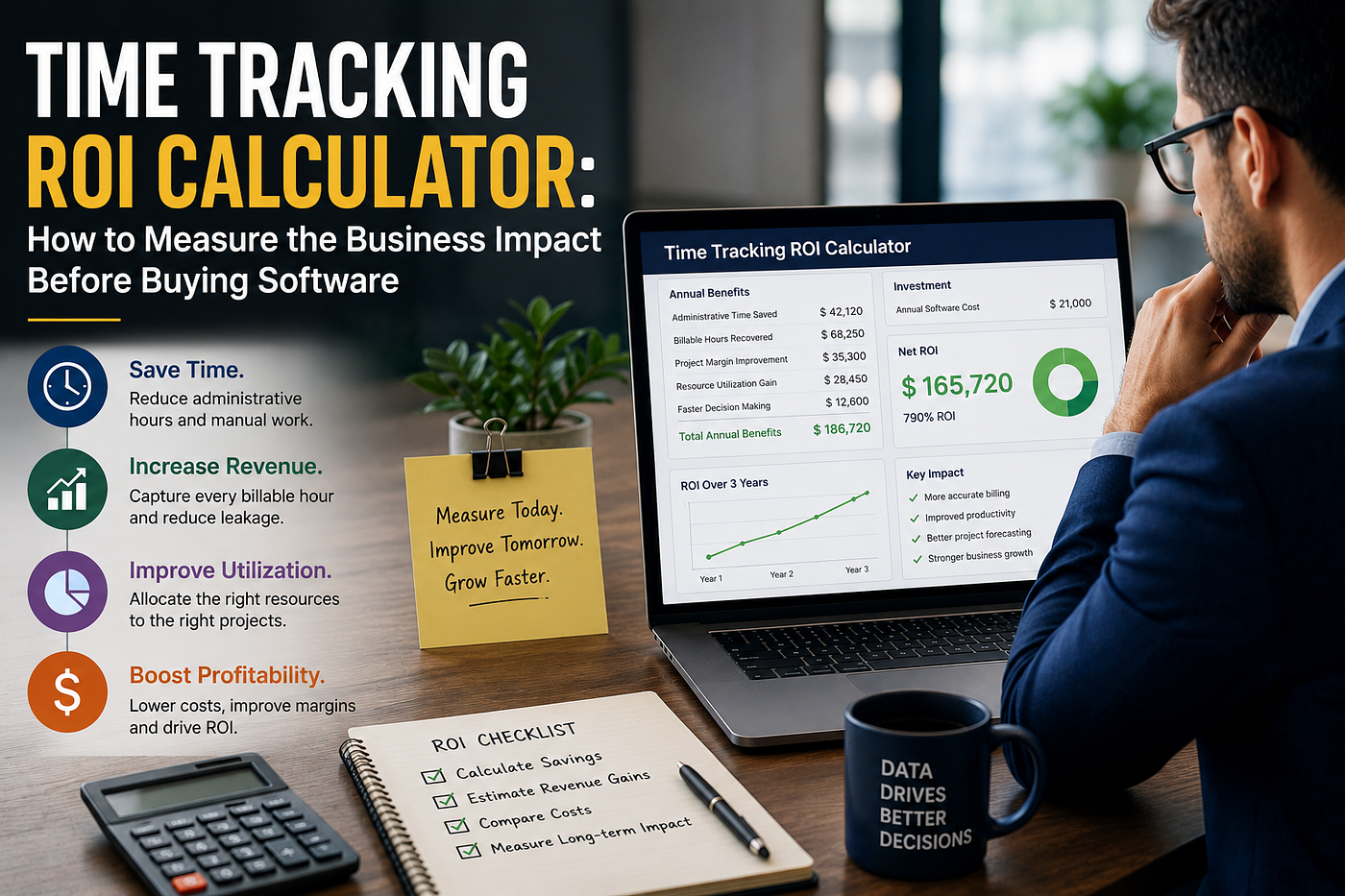
time tracking ROI calculator
Investing in new software is rarely just a technology decision, it’s a business decision. For growing service businesses, every software purchase must contribute to improved efficiency, stronger profitability, or better customer outcomes.
Yet many organizations compare features, pricing, and user interfaces without asking the most important question: Will this investment generate measurable business value?
That’s where an ROI calculation becomes essential. Instead of relying on assumptions, leaders can estimate the financial impact of implementing a time tracking solution before making a purchase. By measuring potential savings, recovered revenue, and operational improvements, decision-makers gain the confidence to invest in technology that supports long-term growth.
Why ROI Matters More Than Features
Feature comparisons are useful, but they rarely explain whether software will deliver a meaningful return.
The real value of best time tracking software lies in the operational improvements it creates across the business. Rather than simply recording work hours, it helps organizations reduce administrative effort, improve billing accuracy, optimize workforce utilization, strengthen project forecasting, and provide managers with real-time operational visibility.
For executive teams, these outcomes matter far more than the number of available features. A solution that saves hundreds of administrative hours or helps recover missed billable work often delivers significantly greater value than one with a longer feature list.
Evaluating software through the lens of ROI shifts the conversation from cost to business impact.
What Should a Time Tracking ROI Calculator Measure?

A meaningful ROI assessment begins with understanding how time tracking influences daily operations. Instead of focusing on software capabilities alone, businesses should evaluate the measurable improvements the solution can deliver.
1. Administrative Time Saved
Managers, finance teams, and project leads often spend several hours each week reviewing timesheets, correcting errors, preparing reports, and following up on missing entries.
Estimating the hours spent on these repetitive tasks provides a clear opportunity to measure potential savings through automation.
2. Billable Hours Recovered
When employees forget to log work or complete timesheets from memory, valuable billable hours can be lost.
More accurate time records help organizations invoice clients for work that might otherwise go unbilled, directly increasing revenue without adding additional projects or staff.
3. Project Margin Improvements
Historical time data makes future project estimates more accurate.
By reducing underestimated effort and controlling project overruns, businesses improve project profitability while minimizing unexpected costs.
3. Resource Utilization
Understanding how employee time is distributed across projects helps managers balance workloads more effectively.
Better utilization reduces idle capacity, prevents employee burnout, and ensures available resources are invested where they create the greatest business value.
4. Faster Decision-Making
Operational reports prepared manually often become available only after important decisions have already been made.
Real-time reporting allows leaders to identify bottlenecks, workload imbalances, and delivery risks early enough to take corrective action.
A Simple ROI Formula Every Business Can Use
An ROI calculator doesn’t need to be complicated. The objective is to compare estimated annual business gains with the annual investment required.
A simple formula is:
Estimated Annual Savings — Annual Software Cost = Net ROI
To estimate annual savings, consider:
- Administrative hours eliminated through automation
- Additional billable revenue recovered
- Reduced payroll or billing corrections
- Lower project overruns
- Improved resource planning
- Fewer delays caused by manual reporting
For example, imagine a 75-person consulting firm saves 15 managerial hours each week through automation. Combined with recovering just 20 additional billable hours per month and reducing project overruns by a small percentage, the annual savings could easily exceed the software subscription cost.
This approach gives decision-makers a practical way to evaluate whether the investment makes financial sense before implementation.
Why AI Makes ROI More Predictable
Modern AI time tracking software for IT teams increases ROI by improving both accuracy and efficiency.
Instead of relying entirely on manual entries, AI-assisted systems automatically capture work activity, organize time records, and generate operational insights with minimal employee effort.
This provides several advantages:
- More accurate project data
- Reduced administrative workload
- Faster reporting
- Better workload forecasting
- Improved utilization visibility
- Earlier identification of delivery risks
Perhaps more importantly, AI helps managers make decisions using current operational data rather than outdated reports.
Rather than replacing human oversight, AI strengthens it by highlighting trends and opportunities that may otherwise remain hidden.
Beyond the Numbers: Business Benefits That Are Harder to Measure
Some of the most valuable outcomes of implementing a modern time tracking solution cannot be measured solely in financial terms.
Employees spend less time completing administrative tasks and more time focused on meaningful work. Finance teams process client invoices more quickly because time data is available sooner. Project managers gain greater confidence in planning future engagements, while executives receive clearer visibility into operational performance.
These improvements also strengthen client relationships through more accurate billing, predictable delivery schedules, and improved communication.
Many organizations use platforms like Workstatus to combine automated time capture with utilization reporting, project insights, and operational dashboards, helping leaders evaluate both measurable ROI and long-term operational improvements.
While these benefits may be difficult to quantify precisely, they often contribute significantly to sustainable business growth.
Conclusion
Purchasing software should never be based solely on features or subscription pricing. The better question is how much value the investment will create for the business over time.
By estimating administrative savings, recovered billable work, improved project margins, and stronger operational visibility, organizations can make more informed investment decisions before implementation. A structured ROI assessment transforms software evaluation from a technology discussion into a strategic business decision.
With modern time tracking software, growing service businesses gain more than automated timesheets , they gain the insights needed to improve efficiency, strengthen profitability, and support long-term growth with confidence.
메타데이터
- post_id
- e0c4eef4d857
- slug
- time-tracking-roi-calculator-how-to-measure-the-business-impact-before-buying-software-e0c4eef4d857
- url
- https://medium.com/@ash_16543/time-tracking-roi-calculator-how-to-measure-the-business-impact-before-buying-software-e0c4eef4d857
- canonical_url
- https://medium.com/@ash_16543/time-tracking-roi-calculator-how-to-measure-the-business-impact-before-buying-software-e0c4eef4d857
- author_url
- https://medium.com/@ash_16543
- status
- ok
- fetched_at
- 2026-07-19 12:23:55