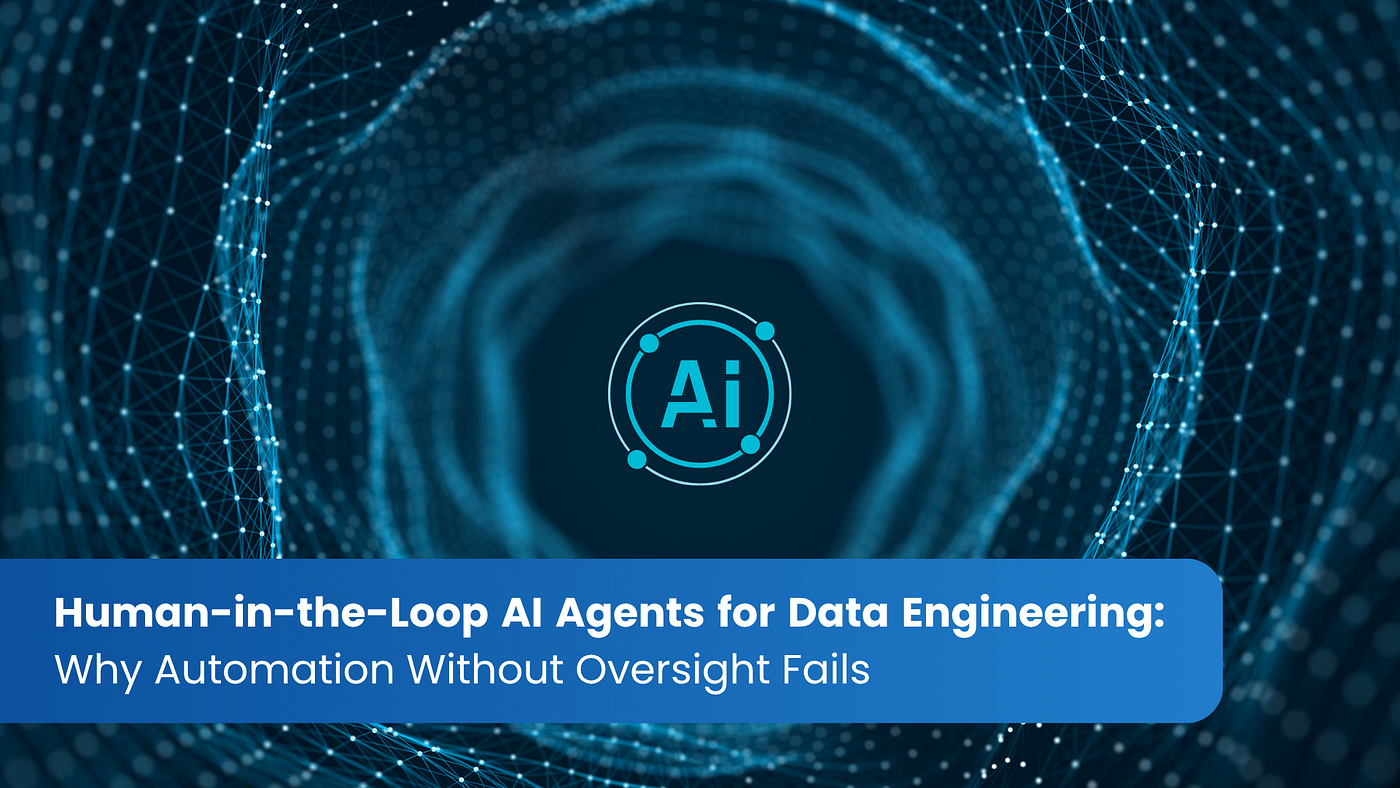
Human‑in‑the‑Loop AI Agents for Data Engineering: Why Automation Without Oversight Fails
AI agents have crossed a threshold in data engineering. They are no longer limited to recommendations or helper tasks. They generate…
Human‑in‑the‑Loop AI Agents for Data Engineering: Why Automation Without Oversight Fails
AI agents have crossed a threshold in data engineering. They are no longer limited to recommendations or helper tasks. They generate transformations, resolve data quality issues, adapt schemas, and increasingly influence how pipelines evolve.
For many teams, this feels like progress. Pipelines move faster. Manual effort drops. Backlogs shrink.
Then something subtle happens. Reports stop lining up. Metrics drift. Stakeholders begin asking uncomfortable questions. The pipelines are still running, but confidence in the data is gone.
This is the failure mode that automation enthusiasts rarely talk about. In data engineering, systems do not always break when something goes wrong. They continue to operate while producing results that no longer reflect reality.
That is where automation without oversight fails.
Why Data Engineering Is Different From Other AI Domains
In most software systems, failure is visible. An application throws an error. A service times out. A user complains immediately.
Data engineering does not work that way.
A flawed transformation can run successfully for weeks. A schema change can propagate quietly across dozens of downstream assets. An incorrect assumption can make its way into dashboards, reports, and machine learning features before anyone notices.
AI agents operating autonomously in this environment amplify three risks.
First, errors compound downstream. A small upstream mistake affects many consumers.
Second, detection is delayed. Data issues surface indirectly, often outside the data engineering team.
Third, accountability becomes unclear. When an agent made the change, who owns the outcome.
These characteristics make data engineering uniquely vulnerable to unchecked autonomy.
How Automation Fails Without Human Oversight
When AI agents are allowed to operate without clear boundaries, the same failure patterns appear again and again.
One pattern is semantic drift. Agents optimize logic based on available metadata, but they do not understand evolving business meaning. The data remains technically valid while becoming analytically misleading.
Another pattern is overconfident remediation. Agents detect anomalies and automatically correct them. The pipeline turns green, but the underlying issue is hidden. Teams lose the ability to explain why the data looks the way it does.
A third pattern involves silent structural change. Agents adapt schemas or joins to accommodate new inputs without evaluating downstream impact. Consumers only discover the issue after dashboards break or numbers change unexpectedly.
These failures are not caused by poor models. They are caused by missing decision boundaries.
Rethinking Human‑in‑the‑Loop as a Control Plane
Human‑in‑the‑loop is often framed as friction. Approvals. Reviews. Slowdowns.
That framing is misleading.
In mature data platforms, human‑in‑the‑loop acts as a control plane. It defines where autonomy is safe and where human judgment is required.
The goal is not to involve humans everywhere. It is to involve them where context matters and risk is high.
Effective oversight has three characteristics.
It is selective. Routine, low‑risk actions remain automated.
It is intentional. Human intervention is triggered by specific decision types, not by volume.
It is auditable. Oversight decisions are visible, traceable, and owned.
When designed this way, human‑in‑the‑loop increases confidence without sacrificing speed.
Where Humans Must Stay in the Loop
For senior data engineering leaders, the practical question is where oversight is non‑negotiable.
Certain categories consistently require human judgment.
Structural decisions matter. Schema changes, core entity definitions, and logic rewrites shape how data is interpreted across the organization. These decisions are hard to reverse and deserve review.
Data quality trade‑offs require context. An agent can detect anomalies, but deciding whether to drop, delay, or impute data depends on business impact, not statistics alone.
Exceptions should surface uncertainty, not hide it. When agents encounter novel patterns, escalation is a design feature, not a failure.
Cross‑domain impact demands ownership. Any decision that affects regulatory reporting, financial metrics, or shared data products needs a clear human owner.
Human‑in‑the‑loop exists to protect these boundaries.
Designing for Trust at Scale
Oversight only works if it is embedded into system design.
Every automated decision should make three things clear. Who owns the outcome. Why the action was taken. Whether it can be reversed.
Teams that design with these questions in mind scale AI agents confidently. Teams that do not often slow down later, not because of governance, but because trust has eroded and rework becomes constant.
As discussed in Modak’s perspectives on applied AI in data platforms, sustainable automation depends on making responsibility explicit rather than implicit. Yeedu’s work on governed analytics reinforces the same idea. Explainability and auditability are prerequisites for scale, not obstacles.
Conclusion
Automation does not eliminate risk in data engineering. It redistributes it.
Human‑in‑the‑loop AI agents acknowledge this reality. They combine speed with accountability and intelligence with judgment. For data engineering leaders, the objective is not to remove humans from the loop, but to place them precisely where they matter most.
If you are building **AI‑driven data platforms**, start by defining your decision boundaries. The resilience of your data systems depends on it.
메타데이터
- post_id
- e0dfa703339e
- slug
- human-in-the-loop-ai-agents-for-data-engineering-why-automation-without-oversight-fails-e0dfa703339e
- url
- https://medium.com/@modak/human-in-the-loop-ai-agents-for-data-engineering-why-automation-without-oversight-fails-e0dfa703339e
- canonical_url
- https://medium.com/@modak/human-in-the-loop-ai-agents-for-data-engineering-why-automation-without-oversight-fails-e0dfa703339e
- author_url
- https://medium.com/@modak
- status
- ok
- fetched_at
- 2026-06-16 19:09:56