Seen Geetham
For context, for the non-Telugu readers, Sing Geetham is a movie that’s recently been in theatres; it’s what I can only describe as a…
Seen Geetham
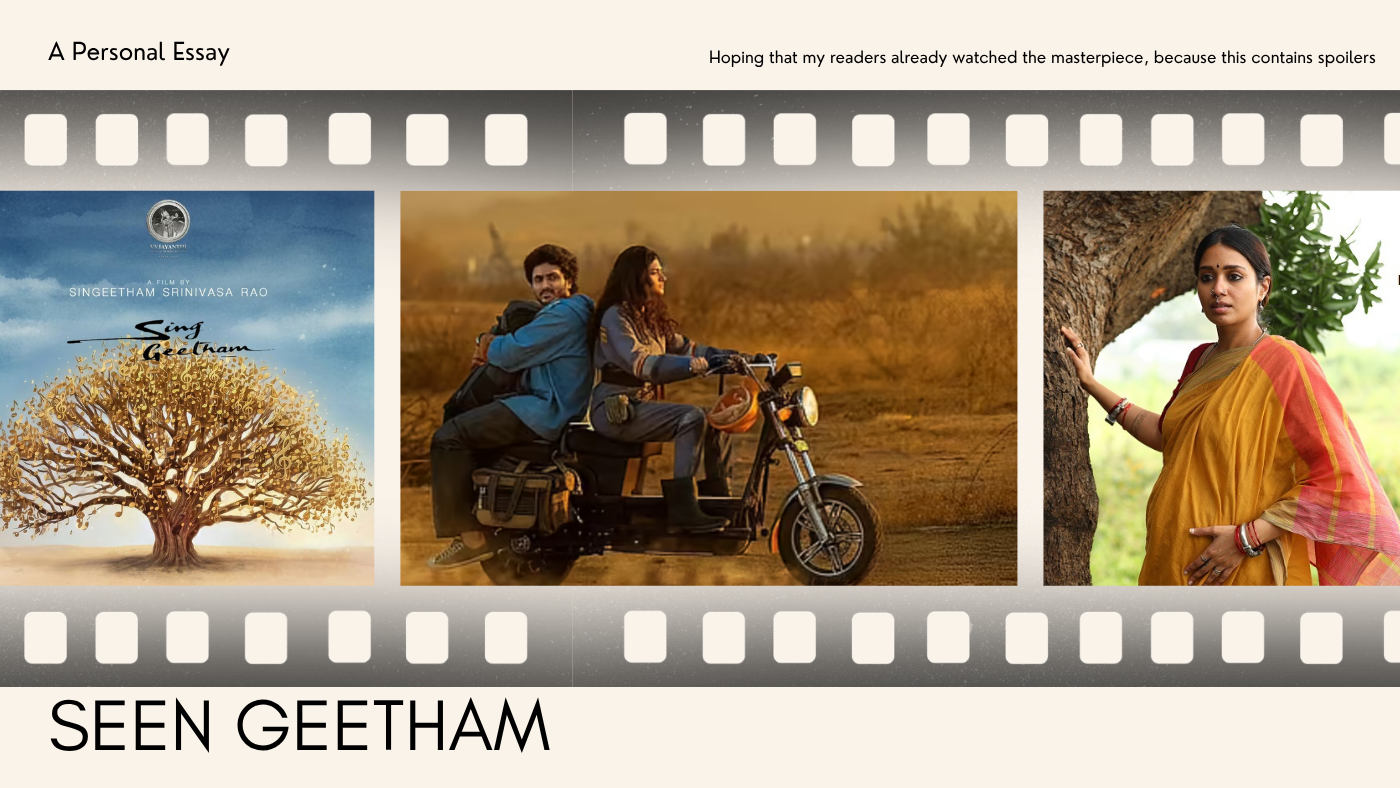
For context, for the non-Telugu readers, Sing Geetham is a movie that’s recently been in theatres; it’s what I can only describe as a musical fantasy where a curse makes everyone sing. But the story is much deeper than that.
My story starts with a tree. Just like this one. My tree was an old mango tree. One that used to give over 2000 fruits in one season. Whose branch used to be as big as me when I was 6.
Sing Geetham takes me back to that singular moment in time, when I stared wide-eyed up at that old mango tree. We lost that tree to a storm, four years later. Never lost that moment, my awe as a 6 year old. The rough texture of the bark under my fingertips, the rustle of leaves, speckled shade under the tree.
My story with my tree. Gowri’s story with her tree. Everyone’s story with their trees. That was supposed to be our life. Our lives are made to be inexplicably connected to trees, the birds, the seasons and the sun. But we strayed too far. As a society, we chased endless wealth and glory, and found ourselves with endless strife. Did I just tell the plot of Sing Geetham, or was it the truth we buried deep and ignored its existence?
They say blood of the covenant is thicker than the water of the womb. Feels just right when Shailajamma hands her tree over to young Gowri to love, to nourish, to protect. The young girl takes that as a lifelong pact, belongs to her tree as much as the tree belongs to her. And when Shailajamma’s own blood returns to take, extract, mine, Gowri does everything in her power to protect her tree.
The moment I saw the scene with Shailajamma, young Gowri and their tree in the dark theatre, something warm settled in my stomach. We, women have always been at the forefront of preservation. Somehow, we have always been the fiercest protectors of what has nurtured us so far; we always belonged to nature, as much as nature belonged to us. Singeetham Sir has written us a story without ever naming it.
Somehow, even betrayal is inherited; greed is too. Shailajamma’s husband took their son far away from their lived philosophy. The prodigal son returns, morally bankrupt and shortsighted, at the beginning. He falls in love with Gowri, and yet he falls short even in his love. If he loved her enough, he would have taken up her cause too. In fact, the idea to kill her tree roots from him. Ironically, it’s his mother’s tree too, passed on as moral inheritance. Pratap’s love, like his inheritance, stays surface-level. Gowri’s is all-consuming. The greedy businessman returns too, with his daughter as the boss lady, a thread of inherited greed and institutional disdain towards anything natural.
When we are introduced to Kuberapuram, we see the current state of decay. A barren hill, a dangerous boarded-up mine entrance, one tree — Gowri’s. Pratap charms his way to the village for his part of the inheritance, to clear his debts. Money is all he sees. The lives of the villagers, the future of Kuberapuram, are not his concern.
When Dia Mirza called out patriarchy for causing climate disasters, people laughed at her. She was, rightly, talking of this urge to conquer, raze, erase. Rules of patriarchy are clear: you own, you control, you slash, burn and earn. How did we even decide the ownership of one species on a planet that houses a billion others? Who said that we are given that right?
Sing Geetham, I am not sure how many will realise this, but by placing the women as protectors and men as betrayers, it subtly jabs at the self-same patriarchy. And it’s brilliant in that execution. Because the transformation of Pratap and other men through the movie shows that men were not the problem; it’s the systemic urge instilled in us by patriarchy to assume that if we own it, we are free to abuse it. While women in the movie say: since it’s my tree, I’d protect it, I’d preserve it, I will refuse to see it as a cash cow or a tool for extraction.
The timing of the movie itself is golden, when shortsightedness and vacillation of a few in power are bringing ruin to Hyderabad’s last green lung. Water-guzzling AI data centres are threatening to engulf green lands in Vizag. Our greed and institutional disdain at the root of it all. Sing Geetham is a warning that human greed is driving us to absolute, irreversible chaos.
The terrifying last 20 minutes of the movie, where touch turns one to golden statues — the children were the first to pay, as they self-sacrificed to protect a pregnant woman. Will we let our children sacrifice their lives to let the planet live a little longer? Will we let the extraction continue until the next generation is pushed to the brink? Is that the Midas touch we are all running towards? If we still stay divided on the urgency of climate change, will we ever survive the extraction end stage?
At the crux of it all, we still have our trees. In KBR, in Kanche Gachibowli, in the Vikarabad forest pockets. And like Gowri, we need to belong to them, now more than ever.
To think that it took 40 years for Singeetham Sir to bring this to the screens is a testament to what rots in the industry is what rots in Kuberapuram too. It’s a testament to what rots in society at large. Right when our people are signing off the future of our children for money and benefits of the next election.
The terrifying last 20 minutes of the movie may happen in real life. Life has never given us the luxury of a plot device. No demi-god can make it rain and let the curse wash away. So the diagnosis is here, long-arrived before we even opened our eyes to it. Do we have the wisdom of our ancestors who Chipko’ed themselves to trees before it’s too late? Or are we still debating the reality of climate change? Let’s think hard about it. As we watch Sing Geetham and celebrate it.
If we still cannot belong to our trees, we might not deserve this planet.
It started as a reverence for the story, the master storyteller, and it ended up as an ecofeminist commentary. I cannot apologise for that.
메타데이터
- post_id
- e0dfe97be569
- slug
- seen-geetham-e0dfe97be569
- url
- https://medium.com/@laasya10493/seen-geetham-e0dfe97be569
- canonical_url
- https://medium.com/@laasya10493/seen-geetham-e0dfe97be569
- author_url
- https://medium.com/@laasya10493
- status
- ok
- fetched_at
- 2026-07-14 09:19:07