Impact Analysis in IBM DataStage: A Simple Python-Based Approach
As a Data Engineer, while working on IBM DataStage projects, I am pretty sure that you would have likely run into this situation when;
Impact Analysis in IBM DataStage: A Simple Python-Based Approach
Photo by UX Indonesia on Unsplash
As a Data Engineer, while working on IBM DataStage projects, I am pretty sure that you would have likely run into this situation when;
- A table changes OR
- A file layout is updated OR
- A parameter value needs to be modified OR
- Need to figure out which job sent out email with specific subject or filename to users OR
Could be anything else for which you need to quickly find out list of jobs/objects that contain a specific string, for impact analysis.
In real enterprise environments, answering this question is rarely straightforward. Projects often contain hundreds or thousands of jobs, routines, and parameter sets. Documentation is outdated, lineage tools are incomplete (or at times broken for your particular use case) and manual inspection is both time consuming and error prone.
The practical reality
In many teams, impact analysis still comes down to:
- Manually opening jobs in Designer
- Searching keywords in exported DSX files
- Relying on tribal knowledge
What teams usually need is not perfect lineage, but a fast, reliable way to narrow down the impact list of a change.
Treating DSX as structured text
DataStage already gives us something useful: DSX exports.
DSX files contain the full definitions of DataStage jobs, parameter sets, and routines in a structured text format. By scanning these files directly, we can answer a very practical question:
Which DataStage objects reference this table, file, or string?
This doesn’t require connecting to internal repositories or building complex metadata models. It’s simple string-based impact analysis that has to be applied consistently.
A lightweight Python utility
To make this easier, I put together a basic but effective Python script that:
- Takes an exported DSX file as input
- Searches for a given string (table name, file name, parameter, etc.)
- Identifies DataStage objects where the string appears
- Writes the results to a clean, readable output file
The script is intentionally minimal:
- No external dependencies
- No proprietary repository access
- Easy to read and modify
It mirrors how impact analysis is actually performed in many real-world DataStage environments.
How it works — high level understanding
The script follows a very simple flow:
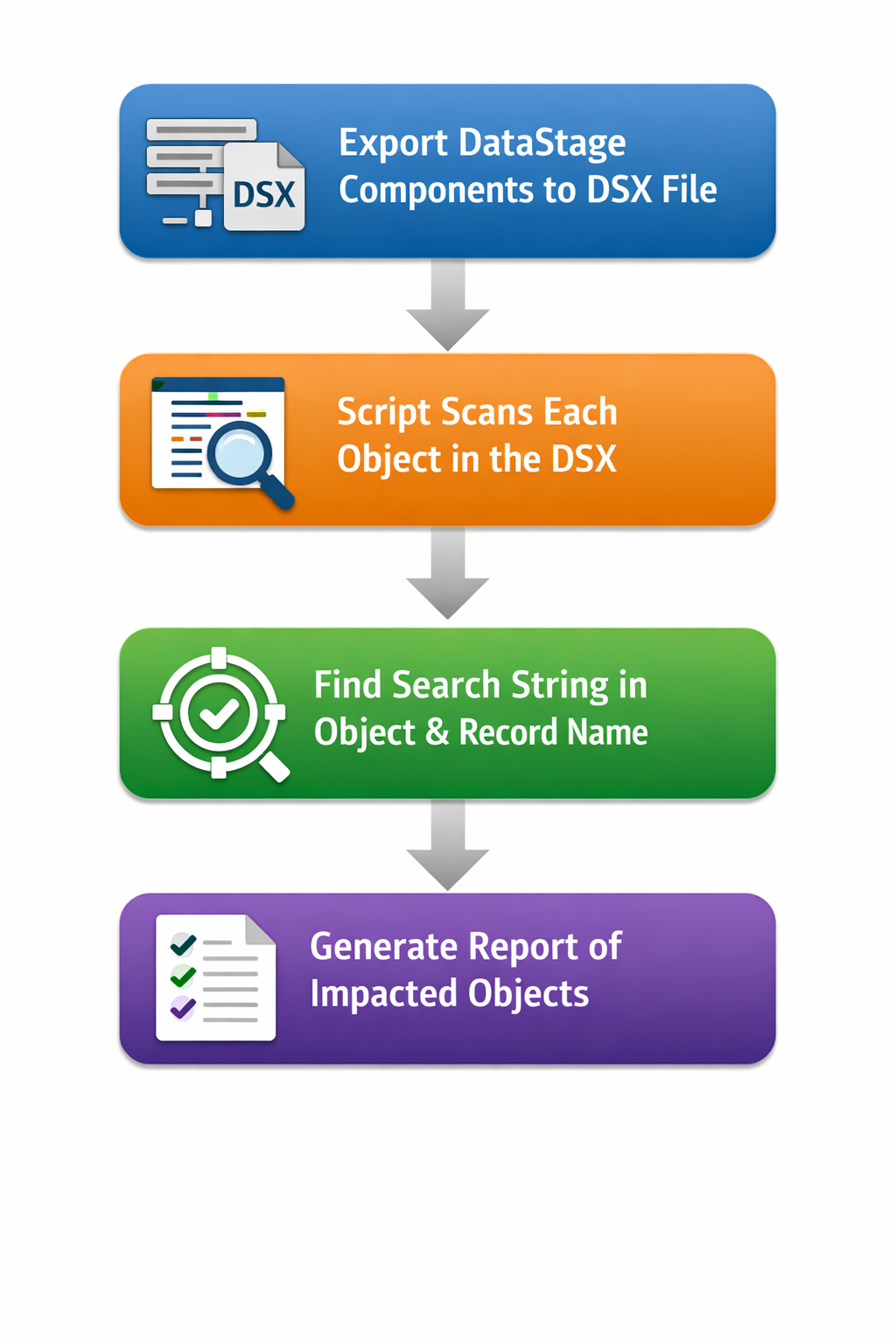
There is no attempt to infer lineage or semantics. The goal is purely practical: quick, repeatable impact analysis.
Usage:
python ds_impact_analyzer.py <dsx_file> <search_string>For example:
python ds_impact_analyzer.py project_export.dsx CUSTOMER_TABLEThis produces a text file in the same directory as the script, containing:
- The search string
- The input DSX file name
- A count of impacted objects
- A list of object names where the string was found
It is meant to be something you can run quickly, get an answer, and move on.
Example output
The script generates a simple text report like this:
datetime: 2026-02-10 15:01:33
search string = CUSTOMER_TABLE
input file: project_export.dsx
total match count: 4
------------------------
below is the list of objects where the search string was found
1. object name: LOAD_CUSTOMER_DIM
2. object name: UPDATE_CUSTOMER_FACT
3. object name: PS_CUSTOMER_TABLES
4. object name: ROUTINE_SQL_HELPER
You can find the code here:
Github Repo: ibm-datastage-utility/find-where-used at main · LogicBuilder45/ibm-datastage-utility
I hope this small, practical script helps save valuable time during impact analysis. If you run into any issues or have ideas to enhance it, feel free to reach out. I’m happy to discuss and collaborate further.
메타데이터
- post_id
- e0e7f86f6f4c
- slug
- impact-analysis-in-ibm-datastage-a-simple-python-based-approach-e0e7f86f6f4c
- url
- https://medium.com/@saqibk0510/impact-analysis-in-ibm-datastage-a-simple-python-based-approach-e0e7f86f6f4c
- canonical_url
- https://medium.com/@saqibk0510/impact-analysis-in-ibm-datastage-a-simple-python-based-approach-e0e7f86f6f4c
- author_url
- https://medium.com/@saqibk0510
- status
- ok
- fetched_at
- 2026-07-13 06:23:13