When Medication Meets Lifestyle: Why GLP-1s Work Best with Real Change
GLP-1 receptor agonists were originally developed to treat type 2 diabetes, improving blood-sugar control and metabolic health. But…
When Medication Meets Lifestyle: Why GLP-1s Work Best with Real Change
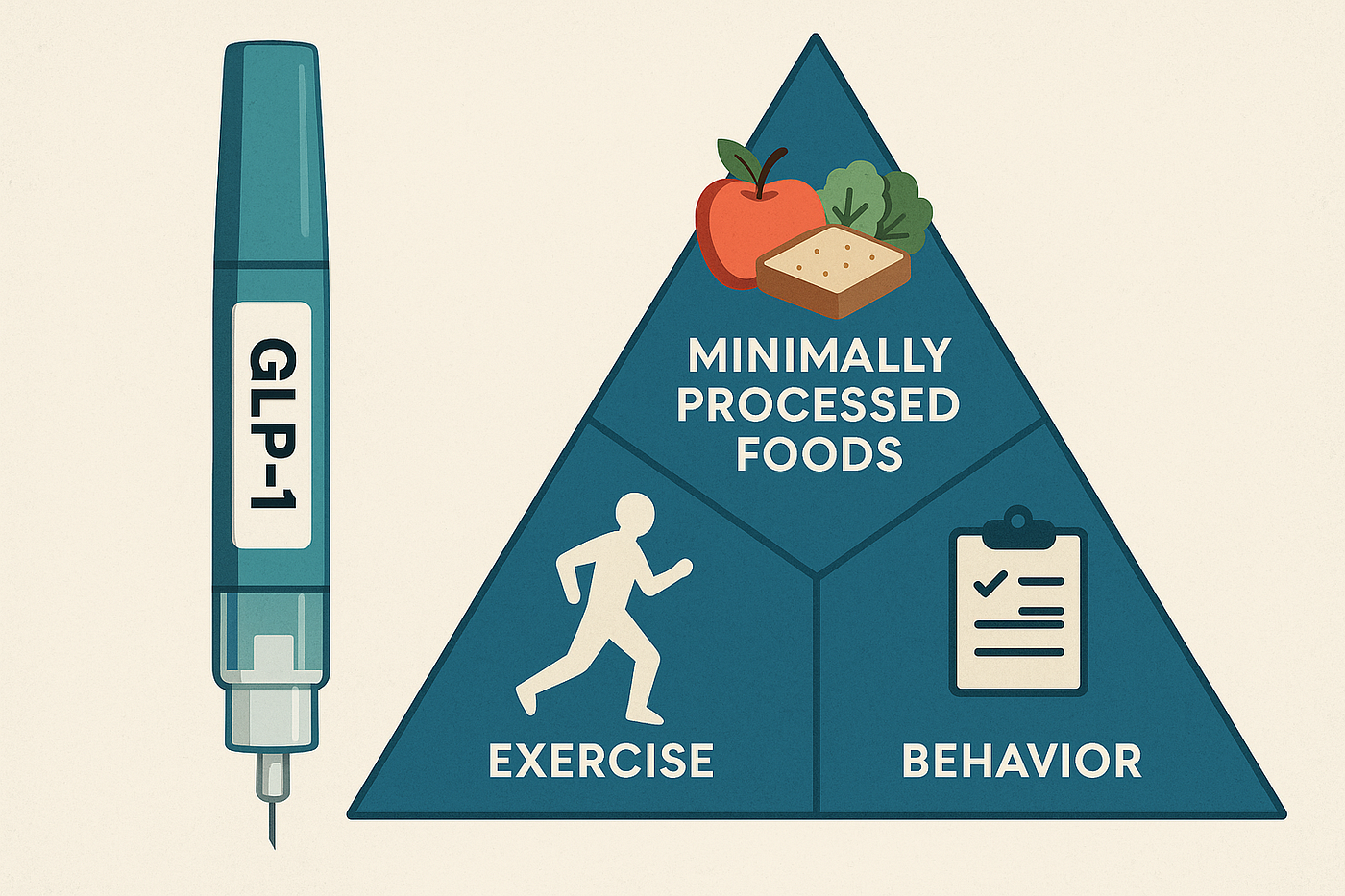
GLP-1 medications help regulate appetite — but lasting success depends on what you build around them: real food, movement, and daily habits.
GLP-1 receptor agonists were originally developed to treat type 2 diabetes, improving blood-sugar control and metabolic health. But researchers soon noticed an added benefit: many patients were also losing weight. This discovery led to higher-dose versions of these drugs being approved specifically for obesity.
Semaglutide was first introduced as Ozempic for diabetes and later as Wegovy for chronic weight management. Likewise, tirzepatide, initially approved as Mounjaro for diabetes, is now available as Zepbound for obesity.
For many people, these medications have transformed the landscape of weight management. By calming appetite, slowing digestion, and improving glucose regulation, they make lasting progress feel achievable — sometimes for the first time.
Still, medication alone is rarely enough. Experience and research consistently show that GLP-1 therapy works best when combined with the timeless foundations of metabolic health. The medication can start the process — but lifestyle change is what makes it last.
Why Lifestyle Still Matters — Even on Medication
The GLP-1 agonists semaglutide (Wegovy) and tirzepatide (Zepbound) mimic natural gut hormones that help regulate appetite and blood sugar. They slow stomach emptying, enhance insulin release, and act on brain centers that reduce hunger and cravings.
In clinical trials, participants taking these medications lost an average of 10–20% of their body weight over about 68 weeks.
But the success story doesn’t end there. When these drugs are combined with structured nutrition, regular movement, and behavior support, weight loss is not only greater — it’s also more likely to last. Lifestyle changes help preserve lean muscle, stabilize metabolism, and make progress sustainable.
Without those changes, much of the lost weight tends to return after treatment ends. A recent meta-analysis confirms that participants who stopped GLP-1 therapy regained a significant portion of their weight — proof that medication can open the door, but only new habits keep it open.
That’s why every major medical society — from the American Diabetes Association to The Obesity Society — recommends combining pharmacologic therapy with nutrition, physical activity, and behavioral strategies. In their words: Medication is a tool, not a cure. Understanding these pillars turns a short-term intervention into a long-term transformation
The Three Pillars That Turn a Tool into Transformation
Medication can help lower appetite and reset metabolism, but it cannot replace the choices and routines that sustain health. The people who achieve the best — and most lasting — results with GLP-1 therapy tend to focus on three pillars: food quality, movement, and behavior.
- Food Quality and Structure GLP-1s create a rare opportunity to rebuild eating habits from the inside out. When appetite quiets, attention can shift from how much to what we eat. Meals centered on real, minimally processed foods — vegetables, lean proteins, legumes, nuts, and whole grains — provide the nutrients and satiety needed to support weight loss and protect muscle.
Rapid weight loss from GLP-1 therapy can lead to loss of lean muscle if protein intake and activity are inadequate.
Protein becomes particularly important during this period, as it helps preserve muscle tissue and keeps metabolism steady. Likewise, fiber-rich foods slow digestion naturally and enhance fullness, reinforcing the drug’s effects. Replacing ultra-processed foods with simple, home-prepared meals amplifies the benefits and sets the stage for long-term change.
- Movement and Muscle Physical activity during pharmacologic treatment does far more than burn calories. It helps preserve muscle — a critical concern during rapid weight loss — supports cardiovascular health, and improves insulin sensitivity.
Even modest movement — brisk walks, light resistance training, or structured exercise — can counteract the natural decline in resting metabolic rate that often accompanies weight loss. In other words, movement keeps the metabolic “engine” active while the medication helps quiet appetite.
- Behavior and Mindset Medications can suppress hunger, but they don’t manage emotion, stress, or daily routines. That’s where behavior comes in. Simple strategies — regular self-monitoring, planning meals ahead, and staying accountable to a partner or coach — help turn early progress into lasting identity.
Small, consistent actions build confidence. Over time, these routines stop feeling like effort and start feeling like normal life — the hallmark of sustainable change.
When the Medication Stops — What Remains
Many patients wonder what happens after treatment ends. The answer depends less on the medication and more on what’s been built around it.
GLP-1 agonists can quiet appetite and reset metabolic signals while they’re in use. But once the drug is withdrawn, those signals gradually return — hunger increases, energy expenditure declines, and the body often tries to restore its previous “set point.” This isn’t failure; it’s biology. The medication lowers the body’s defenses against weight loss temporarily, but it doesn’t erase them.
That’s why the habits formed during treatment are so critical. People who use that period to establish new patterns of eating, movement, and self-monitoring are far more likely to maintain their results. Studies consistently show that the combination of medication plus lifestyle support leads to better long-term outcomes than medication alone.
Think of pharmacologic therapy as scaffolding: it provides structure and support while you rebuild the foundation underneath. Once the structure is strong — rooted in real food, daily movement, and consistent behavior — the scaffolding can come down without collapse.
Without that foundation, however, the weight almost always returns, often accompanied by frustration and loss of confidence. That’s why experts now describe GLP-1 medications not as a cure, but as part of a continuum of care — a bridge toward sustainable change rather than a lifelong crutch.
The Bigger Picture
GLP-1 medications have changed what’s possible in obesity care. They quiet appetite, steady blood sugar, and give people a head start toward better health. But the ultimate goal isn’t just weight loss — it’s restoring control, confidence, and metabolic balance.
Medication can open the door, but lifestyle determines what happens after you walk through it. Real food teaches the body to respond to hunger and fullness again. Movement keeps metabolism awake. Behavior — the daily structure of choices and routines — turns both into lasting patterns.
In the end, progress depends on what you build while the medication is working. Those who use that time to practice sustainable habits discover that when the drug stops, the change doesn’t have to.
💡 Want to spot ultra-processed foods at the grocery store or in your own kitchen? Try the free **UPF Detector** — a quick guide to help you recognize hidden additives and reclaim real food habits.
📬 The Natural Diet builds on this principle — combining real food, natural movement, and practical behavioral tools to help sustain the progress that medication begins. Learn more at **andresdigenio.com**.
References
- Wilding JPH, et al. Once-weekly semaglutide in adults with overweight or obesity. N Engl J Med. 2021;384(11):989–1002. → STEP 1 trial: ~15% mean weight loss with semaglutide 2.4 mg over 68 weeks.
- Jastreboff AM, et al. Tirzepatide once weekly for the treatment of obesity. N Engl J Med. 2022;387(3):205–216. → SURMOUNT-1 trial: up to ~21% mean weight loss with tirzepatide over 72 weeks.
- Wilding JPH, et al. Weight regain and cardiometabolic effects after withdrawal of semaglutide: The STEP 1 trial extension. Diabetes Obes Metab 2022 Aug;24(8):1553–1564. → Demonstrated significant weight regain after discontinuing semaglutide, supporting the need for lifestyle integration.
- American Diabetes Association. 8. Obesity and weight management for the prevention and treatment of type 2 diabetes: Standards of Care in Diabetes — 2025. Diabetes Care. 2025;48(Suppl 1):S167–S191. → Endorses combining pharmacologic therapy with nutrition, physical activity, and behavioral strategies.
- Wing RR, Phelan S. Long-term weight loss maintenance. Am J Clin Nutr. 2005;82(1 Suppl):222S–225S. → Identifies self-monitoring and accountability as key behaviors for sustaining weight loss.
메타데이터
- post_id
- e0eb1d27698e
- slug
- when-medication-meets-lifestyle-why-glp-1s-work-best-with-real-change-e0eb1d27698e
- url
- https://medium.com/@andres.digenio/when-medication-meets-lifestyle-why-glp-1s-work-best-with-real-change-e0eb1d27698e
- canonical_url
- https://medium.com/@andres.digenio/when-medication-meets-lifestyle-why-glp-1s-work-best-with-real-change-e0eb1d27698e
- author_url
- https://medium.com/@andres.digenio
- status
- ok
- fetched_at
- 2026-07-23 18:19:11