The Shocking Reason Smart People Stay Stuck.
The War Inside Your Head (And Why You Keep Losing It)
The Shocking Reason Smart People Stay Stuck.
The War Inside Your Head (And Why You Keep Losing It)
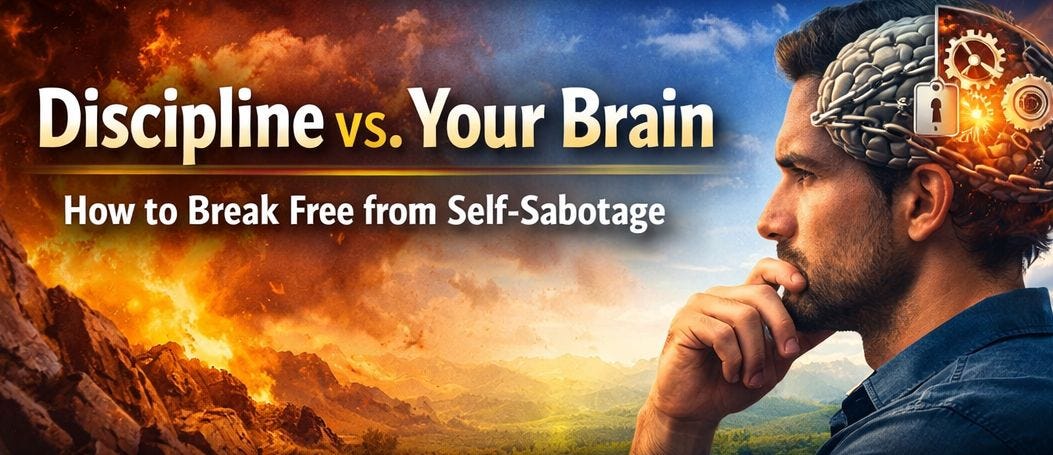
Every morning, somewhere in the world, a smart, capable person hits snooze on their alarm — and their dream at the same time.
It’s not laziness. It’s not weakness. It’s something far more sinister — and it’s been running your life from the shadows since before you were old enough to question it.
What you’re about to discover will make you uncomfortable. It should. Because once you see it, you can’t unsee it — and that’s exactly where your freedom begins.
***Not a yet a member? View the entire article for free Click here.***
Meet Dave.
Dave is smart. Dave is capable. Dave has set the same goal seventeen times in the last two years.
He’s going to wake up at 5am. He’s going to finish the business plan. He’s going to have that conversation with his boss.
And every single morning, Dave hits snooze. Every single week, the business plan sits unopened. Every single month, the conversation doesn’t happen.
Dave thinks he’s lazy.
Dave is wrong.
The Enemy You Never Knew You Had
Here’s the thing nobody tells you about self-sabotage.
It’s not a character flaw. It’s not weakness. It’s not some deep moral failing that separates the winners from the losers.
It’s your brain doing exactly what it was designed to do.
Your ancient, primitive brain — the same one that kept your ancestors alive on the savannah — has one job. Keep you safe. And to that part of your brain, safe means *familiar.
- Same job. Same relationships. Same problems. Same life.
Change isn’t opportunity to your primitive brain. Change is danger.
So every time Dave tries to grow, something deep and invisible slams the brakes. Not because Dave is broken. But because Dave’s brain loves him so much it’s slowly destroying him.
The Shadow in the Room
Carl Jung — one of the greatest minds in psychology — called it the shadow.
The hidden part of you that quietly runs the show while you’re busy making plans.
Think about this for a second.
Have you ever been this close to something important — a promotion, a relationship, a breakthrough — and then somehow, inexplicably, blown it? Forgot the deadline. Picked a stupid fight. Suddenly got sick the night before the big presentation.
Jung would say that’s not bad luck. That’s your shadow protecting you from a success it secretly believes you don’t deserve.
Because success means responsibility. Success means people will see you. Success means they’ll expect things from you. And somewhere in the basement of your psychology, that terrifies you more than failure ever could.
It sounds crazy. Until you start watching yourself honestly. Then it sounds exactly right.
Why Your Brain Is Addicted to Misery
Here’s where it gets genuinely strange.
Your brain is literally addicted to your current life. Even if your current life makes you miserable. Even if you hate it. Even if you lie awake at night knowing something has to change.
Neuroscientists have found that every repeated behavior — good or bad — carves a physical pathway in your brain. The more you repeat it, the deeper it gets. Like water cutting through rock over decades until the canyon is so deep the water has no choice but to follow the same path forever.
That’s your habits. That’s your patterns. That’s the reason willpower alone never, ever works.
You’re not just fighting a bad habit when you try to change. You’re fighting millions of years of evolution. You’re fighting a nervous system that genuinely cannot tell the difference between emotional discomfort and physical danger.
When Dave thinks about waking up at 5am, his brain reacts like he’s being asked to walk through fire. When he considers having that difficult conversation, his nervous system responds like he’s facing a predator.
So he hits snooze. And his brain rewards him with a little hit of dopamine for avoiding the danger.
He feels relief. He feels safe.
But that relief is a lie dressed up as comfort.
The Story That Becomes Your Prison
Psychologist Alfred Adler had a sharp, uncomfortable insight about why we do this.
We sabotage ourselves, he said, to avoid feeling inferior.
The logic is brutal in its simplicity. If you never really try, you never really fail. If you always have an excuse, you never have to face your limits. It’s far easier to say “I could have succeeded if I really wanted to” than to try your absolute hardest and discover that maybe, just maybe, you’re ordinary.
Adler called this the life lie.
We build elaborate stories. I’m too busy. I’m too tired. The timing isn’t right. The economy is bad. My childhood was difficult. And slowly, quietly, these stories stop being excuses and start being identity. They feel more real than reality itself.
Because admitting the truth — that we’re scared — would shatter the image we’ve spent years carefully constructing.
Dave doesn’t tell people he’s scared. Dave tells people he’s busy.
Sound familiar?
The Smoke Alarm Going Off Over Toast
Here’s the most useful image I can give you for understanding what’s happening inside your head.
Your amygdala — the brain’s fear center — is like a smoke alarm. Sensitive, loud, urgent. Designed to save your life in genuine emergencies.
But it can’t tell the difference between a house fire and burnt toast.
So when you sit down to do the hard thing — start the project, make the call, have the conversation — the alarm goes off. Full volume. DANGER. THREAT. ABORT.
And you react. You check your phone. You make a coffee. You suddenly remember seventeen other things that need doing first.
The tragedy is that every time you respond to that false alarm, you make it worse. You teach your brain that toast really is dangerous. That change really is a threat. That growth really is something to run from.
Martin Seligman called this learned helplessness. In his research, animals who learned they couldn’t escape pain eventually stopped trying — even when the door was wide open. They’d learned that effort was pointless.
Humans do exactly the same thing.
After enough failures, enough disappointments, enough times of trying and falling short, we stop trying. Not consciously — we still set the goals, still make the plans, still tell ourselves this time will be different. But somewhere deeper, in a place we don’t talk about at dinner parties, we’ve already given up.
We go through the motions of trying while quietly ensuring we fail.
The Hardest Truth of All
Viktor Frankl — a psychiatrist who survived the Nazi concentration camps and came out the other side with his humanity intact — said something that has stayed with me.
“Between stimulus and response, there is a space. In that space is our power to choose.”
But here’s what most people miss about that space.
It’s not empty.
It’s packed with your history. Your parents’ voices are in there. Every failure you’ve ever had is in there. Every time someone told you that you weren’t good enough is in there. And all of those voices vote before you even realize a decision is being made.
This is why change is so genuinely hard. You’re not just changing a behavior. You’re challenging every story you’ve ever told yourself about who you are. You’re asking your brain to abandon the very patterns it believes have kept you alive.
And your brain, bless it, fights back with everything it has.
What You Actually Do About It
Here’s the part that matters.
The answer isn’t more willpower. It isn’t more motivation. It isn’t another productivity system or a better morning routine.
It’s understanding.
Because once you see the pattern — really see it — something shifts. The sabotage starts to lose its grip. Not all at once. Not dramatically. But the smoke alarm gets a little quieter when you realize you’re just making toast.
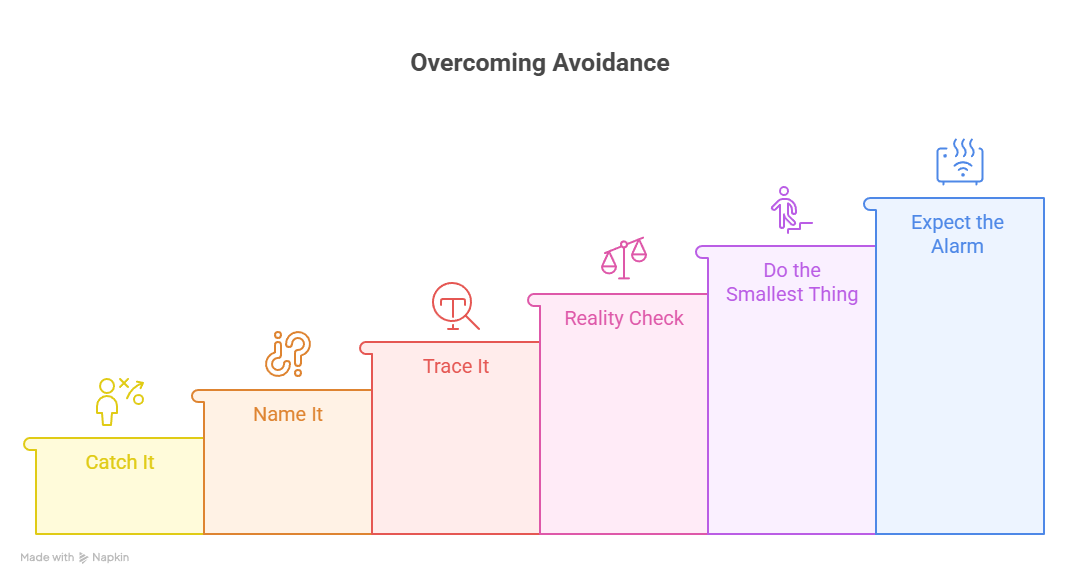
Start by asking one question every time you catch yourself avoiding, procrastinating, or making excuses: What am I protecting myself from right now?
Don’t judge the answer. Just find it.
Maybe you’re protecting yourself from judgment. Maybe from responsibility. Maybe from the terrifying possibility that you might actually succeed and then have to keep succeeding.
Whatever it is — name it. Because you cannot fight an enemy you refuse to see.
Then take the smallest possible action. Not the whole plan. Not the complete transformation. Just the next smallest thing. Open the document. Put on the shoes. Send the first message. Small actions rebuild the one thing self-sabotage destroys most completely — your trust in yourself.
And when the resistance comes — and it will come, loud and urgent and convincing — remember the smoke alarm. Acknowledge it. Thank it for trying to keep you safe. And then make the toast anyway.
The Real Work
Dave eventually figured this out.
Not through motivation. Not through a better alarm clock. But through the uncomfortable, unglamorous work of watching himself honestly and asking why instead of just why not.
He’s still not perfect. He still hits snooze sometimes. But now he knows what’s happening when he does. And that knowledge — that small, hard-won awareness — is the beginning of everything.
You’ve been fighting the wrong war.
You’ve been trying to defeat yourself when you should be trying to understand yourself.
Treating yourself like an enemy when you need to treat yourself like a frightened kid who needs guidance, not punishment.
The story you’ve been telling yourself is just that — a story.
And stories, when you finally pick up the pen, can be rewritten.
5 Questions People Always Ask About This
Why do I keep sabotaging myself even when I can see myself doing it? Seeing it and stopping it use different parts of the brain. Awareness is the first step — but the unconscious patterns run deeper than conscious observation. Keep watching. The gap between seeing and changing closes slowly, then suddenly.
Is this just an excuse to avoid taking responsibility? The opposite, actually. Understanding why you self-sabotage is what makes genuine responsibility possible. Blaming yourself without understanding changes nothing. Understanding without blame changes everything.
Can these patterns actually be changed, or am I just wired this way? They can be changed. The brain is more adaptable than we used to think. New neural pathways form with consistent repetition. The old ones don’t disappear — they just get quieter as the new ones get stronger.
What if my self-sabotage is actually protecting me from something real? Then you need to find out what that something is before you try to remove the protection. Ask yourself honestly: what problem is this behavior solving for me? The answer is usually more revealing than uncomfortable.
Where do I actually start? With one question, asked honestly, every time you catch yourself avoiding: What am I protecting myself from right now? That question, practiced consistently, is worth more than any productivity system ever invented.
You might also find this helpful: The Ultimate Guide to Beating Tiredness. Why You’re Always Tired (and how to fix it)
메타데이터
- post_id
- e0ee3763fe96
- slug
- the-shocking-reason-smart-people-stay-stuck-e0ee3763fe96
- url
- https://medium.com/@ameritor/the-shocking-reason-smart-people-stay-stuck-e0ee3763fe96
- canonical_url
- https://medium.com/@ameritor/the-shocking-reason-smart-people-stay-stuck-e0ee3763fe96
- author_url
- https://medium.com/@ameritor
- status
- ok
- fetched_at
- 2026-06-09 15:37:30