5 way to use claude Fable like Opus in terms of tokens use
Claude Fable 5 is incredibly powerful, but at $10 per million input tokens and $50 per million output tokens, it costs exactly double what…
5 way to use claude Fable like Opus in terms of tokens use
**Claude Fable 5 is incredibly powerful**, but at $10 per million input tokens and $50 per million output tokens, it costs exactly double what Opus 4.8 does. If you treat Fable like a standard chat model, your token usage (and bill) will skyrocket.
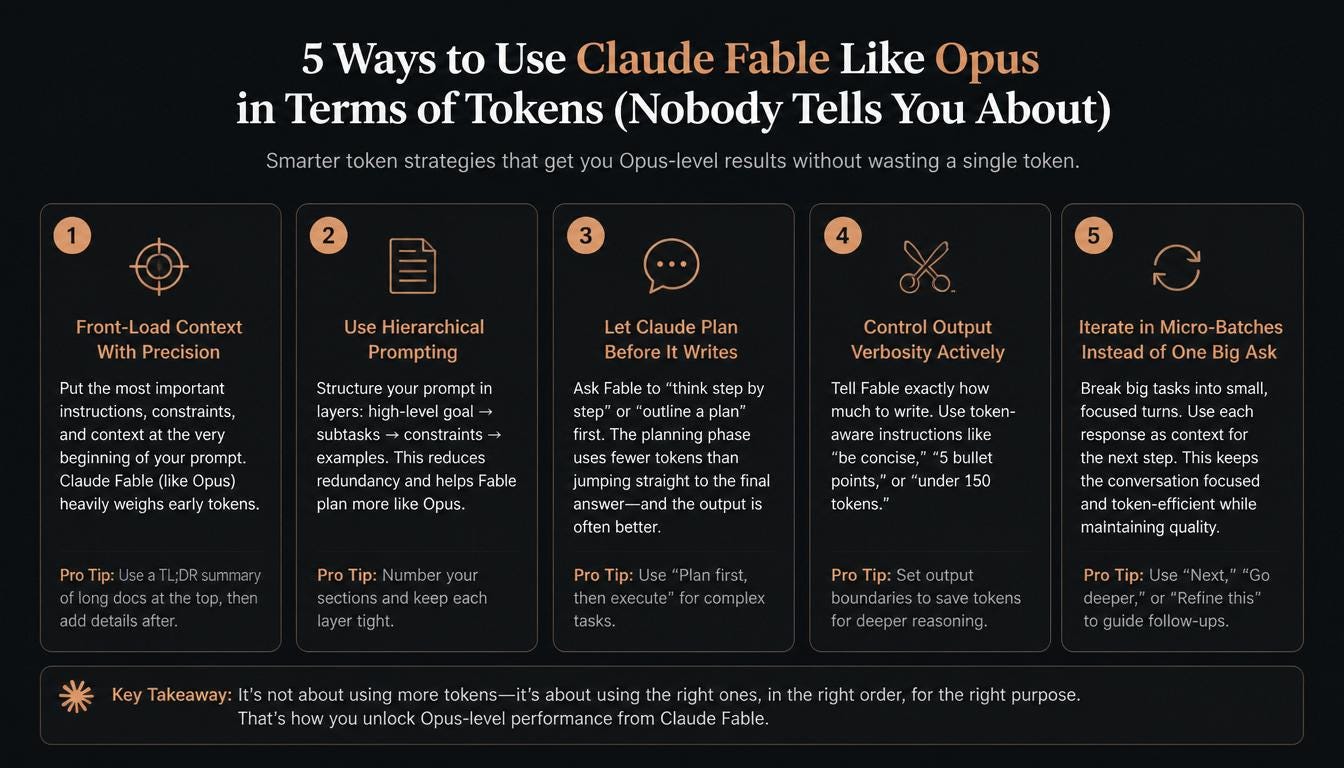
To get Fable’s frontier-level reasoning while keeping your token consumption closer to what you’d expect from Opus, here are five highly effective strategies:
5 way to use claude Fable like Opus in terms of tokens use
1. The “Fable Plans, Opus Builds” Workflow
Don’t use Fable to write thousands of lines of boilerplate code or standard text. Instead, use Fable purely as your architect.
- The Strategy: Feed Fable your requirements and ask it to output a comprehensive implementation plan and architecture document. Then, hand that document over to Opus 4.8 (or even Sonnet 4.6) to do the actual heavy lifting and line-by-line coding. Opus is more than capable of following a brilliant plan, and you save 50% or more on the massive output generation.
2. Cap Your Output and “Thinking” Tokens
Fable is highly analytical and agentic if you let it, it will happily generate a 30,000-token response explaining every nuance of its reasoning.
- The Strategy: Never run Fable without a strict
max_tokenslimit. For most standard tasks, cap it at 4,096 tokens (or 1,024 for quick questions). If you are using the API, actively manage thebudget_tokensparameter for its extended thinking. Force it to be concise unless you specifically need a massive document.
3. Provide Success Checklists, Not Step-by-Step Babysitting
With older models, you often had to use extra tokens to hold the model’s hand through a process. Fable actually performs worse (and wastes tokens) when you over-explain the “how.”
- The Strategy: Give Fable the ultimate goal and a strict success and failure checklist. Because Fable is designed to test and check its own work, giving it the grading rubric upfront allows it to verify its output on the first pass. This eliminates the need for 4 or 5 back-and-forth correction prompts, saving you massive amounts of output tokens.
4. Aggressively Cache and Refresh Your Context
Because Fable requires a lot of context to do its best work, long-running conversations can start consuming massive amounts of input tokens just to re-read the chat history.
- The Strategy: If you are building an agent or using the API, ***prompt caching is mandatory*** it cuts the cost of repeated context by up to 90%. If you are using the web interface, do not let your sessions get too long. Once you hit about 20% of the context window, ask Fable to summarize the state of the project into a short prompt, and start a brand new session with that summary.
5. Use Fable Exclusively as a Final Auditor
Interactive chat and iterative tweaking are the easiest ways to burn through Fable tokens.
- The Strategy: Do your messy iteration, bug fixing, and brainstorming with Opus 4.8 or Sonnet 4.6. Once the work is 95% complete, bring Fable back in for a single, high-value prompt. Ask Fable to review the final work against the original plan, identify any edge cases the smaller models missed, and write a summary of key learnings for the next time you tackle a similar task.
메타데이터
- post_id
- e0f4f724cd67
- slug
- 5-way-to-use-claude-fable-like-opus-in-terms-of-tokens-use-e0f4f724cd67
- url
- https://medium.com/@hello_71531/5-way-to-use-claude-fable-like-opus-in-terms-of-tokens-use-e0f4f724cd67
- canonical_url
- https://medium.com/@hello_71531/5-way-to-use-claude-fable-like-opus-in-terms-of-tokens-use-e0f4f724cd67
- author_url
- https://medium.com/@hello_71531
- status
- ok
- fetched_at
- 2026-06-15 20:49:13