How to Pick the Right Database at Scale: Real Architecture Lessons
A few years ago, I worked on a project that was growing faster than anyone expected.
How to Pick the Right Database at Scale: Real Architecture Lessons
A few years ago, I worked on a project that was growing faster than anyone expected.
At the beginning, everything felt simple.
A few users.
A handful of API requests.
One database.
Life was good.
Then traffic started growing.
The product became popular.
New features arrived every week.
And suddenly something strange happened.
The database became the bottleneck.
Pages slowed down.
Queries became expensive.
Engineers started adding indexes everywhere.
And nobody could agree on the next step.
That’s when I learned one of the most important architecture lessons of my career:
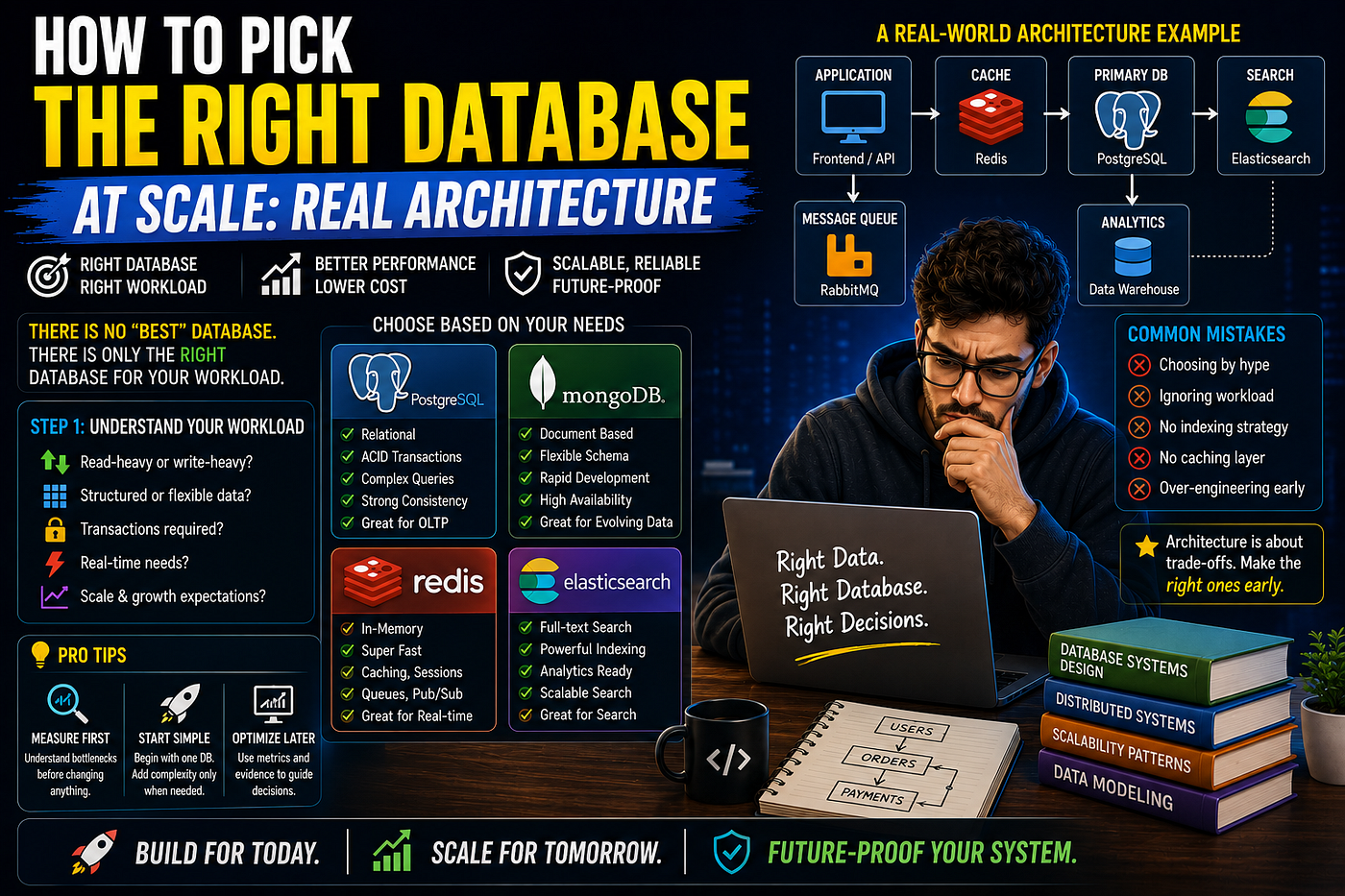
There is no “best” database.
There is only the right database for your workload.
Yet many developers choose databases the same way people choose programming languages:
By hype.
By Twitter threads.
By YouTube videos.
By what everyone else is using.
Real architecture doesn’t work like that.
At scale, database decisions become business decisions.
And choosing the wrong one can become incredibly expensive later.
The Biggest Mistake Developers Make
Most beginners ask:
Should I use PostgreSQL or MongoDB?
That’s the wrong question.
The real question is:
What kind of data am I storing?
Because databases are optimized for different problems.
Trying to force one database to solve every problem usually creates pain later.
Before choosing a database, understand:
- Read-heavy or write-heavy?
- Structured or flexible data?
- Real-time requirements?
- Analytics workload?
- Transaction requirements?
- Expected scale?
Those questions matter far more than database popularity.
Start With The Simplest Option
Many engineers over-engineer too early.
A startup with 500 users does not need five databases.
A side project does not need distributed architecture.
Most applications can go surprisingly far with PostgreSQL.
Example:
CREATE TABLE users (
  id SERIAL PRIMARY KEY,
  name VARCHAR(255),
  email VARCHAR(255)
);
Simple.
Reliable.
Battle-tested.
Many billion-dollar companies started with a relational database.
And honestly…
most applications should too.
Why It Matters
Complex architecture solves complex problems.
Not future imaginary problems.
When PostgreSQL Is Usually The Right Choice
If your application needs:
- Transactions
- Relationships
- Reporting
- Reliability
- Consistency
PostgreSQL is often an excellent choice.
Think about:
- SaaS platforms
- E-commerce stores
- Booking systems
- Financial applications
- CRM systems
Example:
SELECT users.name,
       orders.total
FROM users
JOIN orders
ON users.id = orders.user_id;
Relational data shines here.
The structure becomes your advantage.
Not a limitation.
When MongoDB Makes Sense
MongoDB gets criticized sometimes.
Usually by people using it for the wrong problems.
MongoDB works beautifully when data structures evolve frequently.
Example document:
{
  name: "Muhammad",
  skills: [
    "React",
    "Node.js",
    "TypeScript"
  ]
}
Perfect use cases:
- Content platforms
- Rapid prototyping
- User-generated content
- Flexible schemas
The mistake is assuming flexibility automatically means scalability.
They’re not the same thing.
The Database Most Developers Forget: Redis
Redis is one of the highest-impact technologies I’ve ever used.
Not because it’s fancy.
Because it’s fast.
Example:
await redis.set(
  "user:123",
  JSON.stringify(user)
);
Common uses:
- Caching
- Sessions
- Rate limiting
- Queues
- Real-time leaderboards
Pro Tip
Many database performance problems disappear when you add a good cache layer.
Not when you replace your primary database.
That’s a lesson many teams learn too late.
Real Architecture Usually Uses Multiple Databases
This surprises beginners.
Large systems rarely rely on one database.
Instead:
PostgreSQL → TransactionsRedis → CacheElasticsearch → SearchData Warehouse → AnalyticsEach system solves a specific problem.
This architecture is common because specialized tools perform better than one giant solution trying to do everything.
When Search Becomes A Problem
Search is often the first feature that exposes architectural weaknesses.
Developers start with:
SELECT *
FROM products
WHERE name LIKE '%phone%';
Works fine initially.
Terrible at scale.
As datasets grow, search becomes more complex.
Users expect:
- Typo tolerance
- Ranking
- Filters
- Fast results
That’s where search engines become valuable.
The lesson?
Don’t force your primary database to become a search engine.
Understanding Read vs Write Workloads
One of the most overlooked architecture concepts.
Imagine two products:
Product A
Instagram-like application.
Millions of reads.
Relatively fewer writes.
Product B
IoT platform receiving sensor data every second.
Millions of writes.
Different workloads.
Different bottlenecks.
Different database decisions.
The database isn’t chosen by preference.
It’s chosen by behavior.
Why Scaling Changes Everything
Most database tutorials focus on features.
Real architecture focuses on limits.
Questions become:
- What happens at 10 million users?
- What happens during traffic spikes?
- What happens when one region fails?
- What happens when data doubles?
These are scaling questions.
And scaling eventually forces architectural decisions.
Not because developers want complexity.
Because reality demands it.
A Lesson From A Real Production System
Years ago, I saw a team spend months migrating databases.
They believed a new database would solve performance issues.
It didn’t.
The actual problem?
Missing indexes.
Poor query design.
No caching strategy.
The migration consumed months.
The fix would’ve taken days.
That experience taught me something valuable:
Architecture should solve measured problems, not assumptions.
Always profile first.
Always measure first.
Always understand the bottleneck first.
3 Rules I Follow Before Choosing A Database
1. Understand the workload
Data patterns matter more than trends.
2. Start simple
You can always add complexity later.
Removing unnecessary complexity is much harder.
3. Optimize after evidence
Never redesign architecture based on guesses.
Use metrics.
Use monitoring.
Use facts.
The Hidden Truth About Database Architecture
Most successful systems don’t start with perfect architecture.
They evolve.
Slowly.
Carefully.
Based on real usage.
The best architects aren’t predicting every future problem.
They’re creating systems that can adapt when those problems eventually arrive.
That’s a completely different mindset.
And honestly…
it’s what separates scalable systems from expensive mistakes.
Final Thoughts
Choosing the right database at scale is not about finding the most popular technology.
It’s about understanding your workload.
Your users.
Your traffic patterns.
Your business requirements.
PostgreSQL isn’t always the answer.
MongoDB isn’t always the answer.
Redis isn’t always the answer.
The right choice depends on the problem you’re solving.
And that’s the real architecture lesson.
Great engineers don’t choose databases based on hype.
They choose them based on evidence.
Follow me for more developer stories and code breakdowns.
메타데이터
- post_id
- e0f86e91cf6a
- slug
- how-to-pick-the-right-database-at-scale-real-architecture-lessons-e0f86e91cf6a
- url
- https://medium.com/skillstuff/how-to-pick-the-right-database-at-scale-real-architecture-lessons-e0f86e91cf6a
- canonical_url
- https://medium.com/skillstuff/how-to-pick-the-right-database-at-scale-real-architecture-lessons-e0f86e91cf6a
- author_url
- https://medium.com/@muhammadshakir4152
- status
- ok
- fetched_at
- 2026-06-09 15:37:30