Facilitation Guide: Active Management and Making Assignments
Use this detailed blueprint for your training session
The Facilitator’s Toolbox
Facilitation Guide: Active Management and Making Assignments
Use this detailed blueprint for your training session

Photo by AnnaStills on Shutterstock
Note: The content in this article is derived from a workshop I facilitated on Active Management. Active Management prescribes how managers and supervisors can efficiently manage the operations they are in charge of by strategically engaging with their team members. The terms “participants” and “learners” are used interchangeably and refer collectively to the employees attending the session.
Background
Active Management consists of seven distinct behaviors:
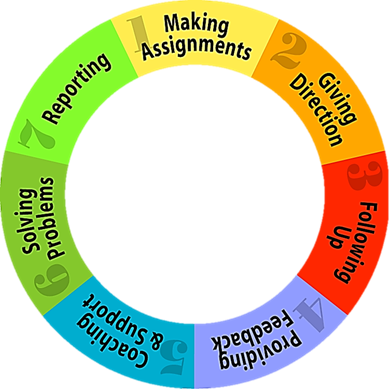
Active Management Behaviors
By consistently displaying these behaviors with their team members, managers increase their own effectiveness, thereby enabling them to lead an effective operation that meets or exceeds its goals. Additionally, managers who exhibit these behaviors develop more engaged and motivated teams and contribute toward driving a culture of continuous innovation and improvement in their organizations.
Making Assignments is the first Active Management behavior. It encompasses clearly describing tasks, setting specific expectations, and checking for understanding and commitment to enable their employees to perform their roles effectively.
How to Use this Guide
This facilitation guide provides a detailed blueprint for you to successfully lead a 2-hour session on the Making Assignments behavior. It is divided into three sections: session logistics, session objectives, and session agenda.

Photo by khak on Shutterstock
You’ll find helpful instructions and prompts to explain key concepts, orchestrate impactful activities, and lead meaningful discussions with your learners. Use the guide as-is. Or customize the session for your unique audience and specific business needs by incorporating relevant scenarios, substituting questions, modifying the activities, or developing company-branded session materials.
Though originally designed as an in-person learning experience, you can easily repurpose the session for an effective virtual delivery. Leverage the interactive functionality of your collaboration platform to incorporate breakout rooms, virtual whiteboards, chat, annotation tools, and polls for your learners.
New to facilitation? Click these links for valuable tips and practical strategies to inform, engage, entertain, and inspire your learners.
Session Logistics
Photo by Hyundai Motor Group on Unsplash
- Duration: 2 hours
- Target Audience: Early career managers and supervisors; mid-career professionals who could also benefit from using Active Management behaviors
- Recommended Class Size: 18–30 participants
- Recommended Setup: Round or rectangular tables seating 4–6 learners to promote peer interaction and support small group activities
Materials Needed
- Whiteboard
- Flipchart stand with paper, markers, and masking tape
- Dry erase markers
- Projector to display presentation
- Participant Guide and/or handouts
- Facilitator Guide
Session Preparation
- Participant Guide: Create a Participant Guide or handout to distribute to learners for instantaneous note-taking and post-session reference. At a minimum, the Participant Guide should include the key concepts introduced throughout the course, the opening activity, the Making Assignment Steps to Success, and the action planning grid.
- PowerPoint Presentation: Create a presentation capturing the key concepts, Steps to Success, and action planning grid.
- Personal Story #1: Prepare a personal story about a time when you made an assignment in the workplace and failed to clearly describe the task, set specific expectations, or check for understanding and commitment. Explain how that failure resulted in an unexpected outcome.
- Personal Story #2: Prepare a personal story about a time when you effectively made an assignment to a team member or to someone else. As you recount your story, highlight each corresponding step in the Making Assignment steps to success ladder.
- Role Play: For the closing role play activity, learners should work in groups of three, with each taking a turn acting as the manager, acting as the team member, and acting as an observer who provides feedback afterwards.
- Ground Rules Flip chart: Prepare a flip chart with ground rules for the session. These might include being present by disconnecting from technology, communicating respectfully, staying on topic, and starting and ending on time.
- Session Agenda: Review the session agenda section to familiarize yourself with activity flow, key talking points, steps, etc.
Session Objectives
Photo by Aline de Nadai on Unsplash
By the conclusion of this session, your learners will be able to:
- Describe the specific actions they can display with their team members in support of the Making Assignments behavior
- Assess their current skill level in exhibiting the Making Assignments behavior with their teams based upon the Steps to Success ladder
- Develop and execute an action plan to strengthen their effectiveness in demonstrating the Making Assignments behavior with their teams
Session Agenda
Photo by Bundo Kim on Unsplash
Segment 1 — INTRODUCTIONS AND ICEBREAKER (15 minutes)
WELCOME participants to the session, stating the course name. Introduce yourself, briefly describe your credentials/professional background, and explain your role within your L&D department.
EXPLAIN that this session is designed to be highly interactive and participants will be engaging with you as the facilitator and with one another.
ENCOURAGE participants to ask questions, offer their insights, and contribute to the group discussions and activities.
ASK participants to take turns and briefly introduce themselves. Participants should state their name along with an adjective beginning with the same letter as their first name, e.g., Hilarious Helen. You may also want to ask them to provide another piece of fun information such as their favorite flavor of ice cream, color, sports team, or musical artist.
REVIEW the ground rules for the session and gain commitment.
REVIEW the session objectives listed in the Session Objectives section.
ASK learners what comes to mind when they hear the phrase “active management.” RECORD their responses on the whiteboard or flipchart, noting consistent themes. Thank learners for their participation.
EXPLAIN that Active Management prescribes how managers and supervisors should behave to efficiently manage the operations they are in charge of. Continue your explanation of Active Management with the information included in the Background section (above) of this Facilitation Guide.
EXPLAIN the “What’s in it for me?” by articulating how using the Making Assignments behavior will help learners become more effective managers:
- Ensures team members fully understand the assignment before they begin work thereby creating valuable buy-in
- Allows team members to own their work processes, resulting in higher commitment to achieving goals
- Reduces likelihood of rework because team members have greater clarity around their manager’s expectations and work requirements
- Promotes efficient project planning and resources allocation as the quantity of work and timeframe for completion are determined by the time the assignment is made
TRANSITION to the opening activity.
Segment 2 — OPENING ACTIVITY (15 minutes)
SAY: “To illustrate the importance of Making Assignments, let’s do an activity.”
Photo by Josh Olalde on Unsplash
REFER participants to the “Making Assignments Activity” in their Participant Guides.
STATE that the purpose of this activity is to get learners to think about how to make assignments.
INSTRUCT the participants to listen carefully as you provide them with the assignment instructions.
SAY: “I will give you instructions on how to complete a short assignment. You may not ask any questions about my instructions.”
**ATTENTION: If a participant asks a question about the instructions, repeat word-for-word the instructions just given.
SAY: “Using the blank square provided in your Participant Guide, please draw the following items.”
***ATTENTION: Read items one at a time. Allow participants up to 10 seconds to draw the item before reading the next item on the list.*
- A large rectangle
- A triangle
- A small rectangle
- Four small squares
- Three straight lines
NOTE: Participants will typically draw the items listed as separate objects.
***ATTENTION: DO NOT advance to the next slide in your presentation until everyone has finished drawing.*
ADVANCE to the next slide when you are certain all participants have completed their drawings.
DISPLAY the next slide showing the drawing below.

ASK: “How many of you drew a picture like the one shown here?”
POINT OUT each item on the slide as you read the list of items, if necessary.
- A large rectangle (house)
- A triangle (roof)
- A small rectangle (door)
- Four small squares (window)
- Three straight lines (chimney)
ASK: “Why are your drawings different from this one?”
Anticipated Responses:
- We lacked adequate context. If you told us at the beginning we were drawing a house, we could have figured out how to put the parts together.
- You told us the parts, but not where to put them.
- We were not permitted to ask questions, so we were unsure of what you expected.
- You didn’t provide details about the shapes, so it was unclear what “large” or “small” meant.
ASK AND DISCUSS: “How does this activity relate to making assignments actively and effectively?”
SHARE a personal story about a time when you made an assignment in the workplace and the outcome or result was not what you expected.
ASK the participants to think of a time when they made an assignment and the outcome or result was not what they expected. Time permitting, ask for one or two volunteers to briefly share their stories.
TRANSITION to the next segment: “Let’s discuss how we can prevent unexpected outcomes from happening by using the Making Assignments Active Management behavior.”
Segment 3 — MAKING ASSIGNMENTS ACTIONS (10 minutes)
Photo by Vitaly Gariev on Unsplash
EXPLAIN: In making assignments, it is important to:
- Clearly describe the task(s)
- Set specific expectations about the quantity of work, quality of work, timeframe for completing the work, and applicable safety guidelines
- Check for understanding and commitment
REVIEW each bullet above and relate back to the previous activity. Did I clearly describe the task? Did I set specific expectations? Did I check for your understanding and commitment? Pause for participant response to each question.
SAY: “Because I did not properly make the assignment, I essentially set you up for failure. How does that make you feel?”
ACKNOWLEDGE RESPONSES
ASK: “Can you understand how your team members may have a similar experience if you don’t properly make assignments?”
ACKNOWLEDGE RESPONSES
EXPLAIN that an assignment is not considered “made” until:
- You are confident the team member knows what to do;
- You have heard the team member commit to getting it done; and
- The team member knows you have committed to a specific follow-up
Photo by Christina @ wocintechchat.com M on Unsplash
EMPHASIZE that commitment is a two-way process. It flows from the team member to the manager (the commitment to getting the assignment done) and from the manager back to the team member (the commitment to a specific follow-up).
EXPLAIN that Active Management is more than simply telling your team members what you expect.
ASK if there are any questions on the actions involved in Making Assignments.
ANSWER any questions.
TRANSITION: “Now, let’s take a look at the Steps to Success for this behavior.”
Segment 4 — MAKING ASSIGNMENTS STEPS TO SUCCESS (15 minutes)
REVIEW the following steps in the Making Assignments behavior, beginning at the bottom. Explain that each step builds upon the previous and corresponds to the color-coded skill ratings depicted in the diagram.
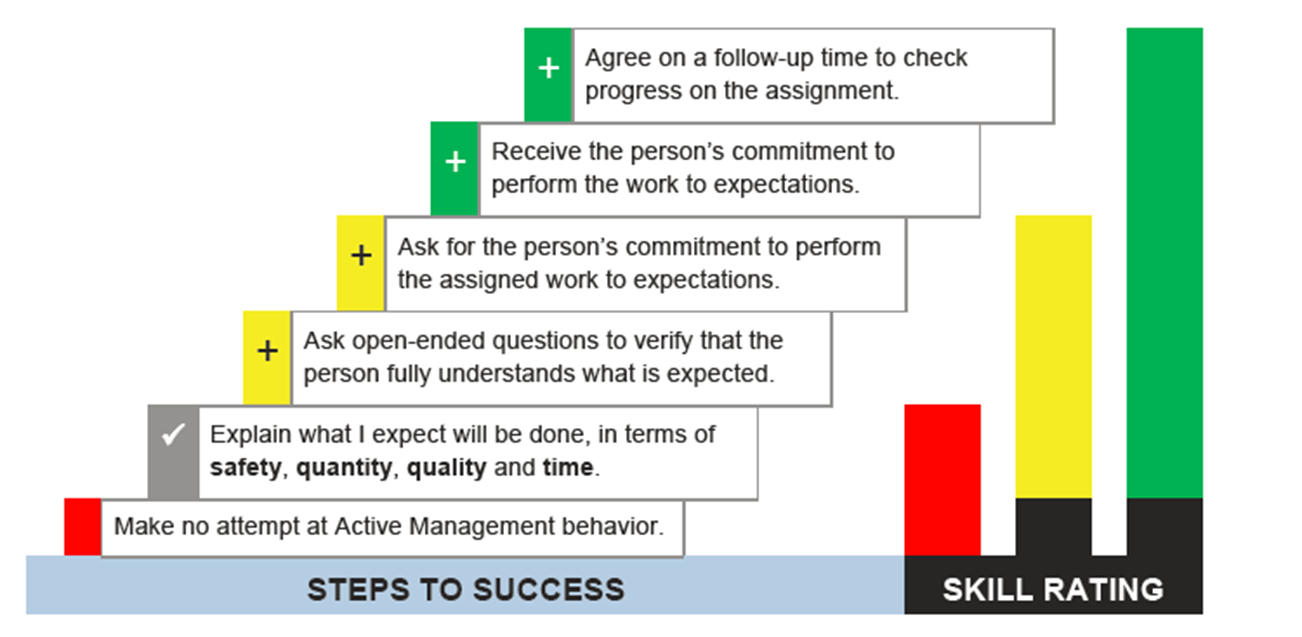
DO: Share a personal story about a time when you effectively made an assignment at work or in some other setting, e.g., instructing your teenager to complete a household chore. As your walk through your story, be sure to highlight each step in the Making Assignments Steps to Success ladder.
ASK if there are any questions on the Making Assignments Steps to Success ladder.
ANSWER any questions.
TRANSITION: “Now, let’s return to the Steps to Success to see how you would rate yourself on the Making Assignments behavior.”
Segment 5 — LEARNER SELF-ASSESSMENT (5 minutes)
Photo by Vitaly Gariev on Unsplash
ASK learners to rate themselves on the scale for the Making Assignments behavior based upon the highest behavior they consistently exhibit when making assignments. And then write that number in the Self-Rating box in their Participant Guide. For example, if Wendell consistently exhibits behaviors 1 and 2, he would enter a “2” as his score in the self-rating box. Give them 2 minutes to do this.
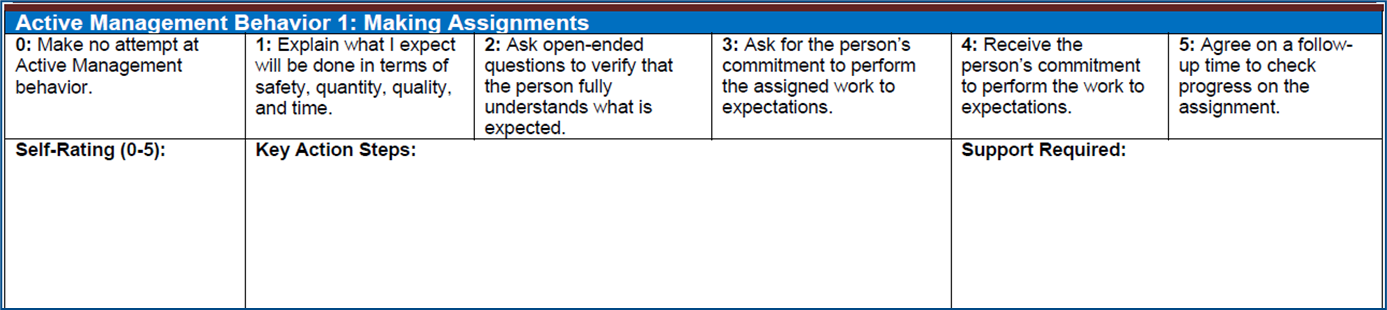
ASK 1 or 2 volunteers to share their self-rating and briefly explain why they rated themselves the way they did.
TRANSITION to the role play activity.
Segment 6 — CLOSING ACTIVITY (40 minutes)
SAY: “Let’s put the Making Assignments behavior into practice.”
Photo by The Jopwell Collection on Unsplash
Making Assignments Role Plays
- Time: 34 minutes for prep and role play (facilitator to track time)
- Time: 6 minutes for group debrief
- Work in groups of 3
REVIEW the following activity instructions:
- Think of a recent instance when you made an assignment that did not satisfy all the steps in the Making Assignments success ladder. Now is your opportunity to revisit that conversation based upon what we’ve discussed today. OR, think of a work conversation you plan to have within the next two weeks during which you will make an assignment.
- Jot down notes for your conversation in preparation for a role play activity with your partner who will play the role of your team member. You will have 10 minutes to script your conversation.
- During the role play rotation, learners will take turns playing the role of manager, team member, and observer. The observer should offer feedback on what the manager did well and why. And what the manager might have done differently and why.
- Take 8 minutes to conduct the first role play with your partner. Using their prepared notes, the person playing the manager should make an assignment to their scene partner (the team member). The person playing the role of team member should ask questions as necessary to ensure their understanding of the task. Afterward, the person acting as observer will give feedback.
- Switch roles and take another 8 minutes to conduct the second role play, with the new person acting as the team member offering feedback afterwards.
- Switch roles for the final 8-minute role play.
DEBRIEF the activity by asking 1 or 2 volunteers to briefly share their insights from the role play.
TRANSITION: “Let’s return to the self-assessment for action planning.”
Segment 7 — ACTION PLANNING (15 minutes)
Photo by Hadis Malekie on Unsplash
ASK participants to consider their self-rating and think about an action step they can take to move up to the next step on the success ladder.
DIRECT participants to write their response in the Key Action Steps box or in the space provided in their Participant Guide.
ASK participants to think about the support they may require to accomplish their action step.
DIRECT participants to write their response in the Support Required box or in the space provided in their Participant Guide.
GIVE participants 8 minutes to reflect and work quietly to complete the above tasks.
FACILITATE discussion by asking for 2–3 volunteers to share their ratings and briefly describe their action step.

Photo by Jacob Lund on Shutterstock
ENCOURAGE participants to spend time to build out a more detailed plan, if necessary, when they return to work.
EMPHASIZE the importance of participants taking their action steps. They must be purposeful about implementing the steps as they seek to improve their effectiveness in this behavior.
Segment 8 — SESSION CLOSE (5 minutes)
SAY: “We’ve reached the end of today’s session.”
Photo by Wyron A on Unsplash
DO: Quickly recap the major points including the definition of Active Management, the benefits of employing it in the workplace, and the Making Assignments steps to success.
ASK for 1 or 2 volunteers to briefly describe their biggest takeaway from the session and how they will use what was discussed in their day-to-day work.
ENCOURAGE learners to complete their action plan and then discuss it with their manager during an upcoming one-on-one.
ANSWER any remaining questions.
THANK everyone for actively participating in the session and dismiss.
Have questions about this Facilitation Guide? Contact us.
**4N Learning Consultants** provides comprehensive Learning & Development services. As your trusted instructional design partner, we will work closely with your team to provide original content for your sessions. We facilitate interactive in-person and virtual learning experiences for groups of all sizes, focusing on leadership development, talent management, and power (soft) skills. Use our end-to-end strategy consultation services for guidance on everything from alignment with strategic priorities to training program design, launch, and implementation. Finally, use our training program evaluation services to receive a detailed analysis of its strengths and opportunities and a blueprint with specific recommendations to help close gaps in employee performance. Contact us to schedule a free consultation today.
메타데이터
- post_id
- e105e1ea3ab6
- slug
- facilitation-guide-active-management-and-making-assignments-e105e1ea3ab6
- url
- https://medium.com/4n-learning-consultants-the-facilitators-toolbox/facilitation-guide-active-management-and-making-assignments-e105e1ea3ab6
- canonical_url
- https://medium.com/4n-learning-consultants-the-facilitators-toolbox/facilitation-guide-active-management-and-making-assignments-e105e1ea3ab6
- author_url
- https://medium.com/@lisa.newman_82156
- status
- ok
- fetched_at
- 2026-06-16 19:09:56