What Vehicle Designers Can Learn from Airplane Cockpits: Five Key HMI Lessons from Aviation and…
By Julian Scaff
What Vehicle Designers Can Learn from Airplane Cockpits: Five Key HMI Lessons from Aviation and Aerospace
By Julian Scaff
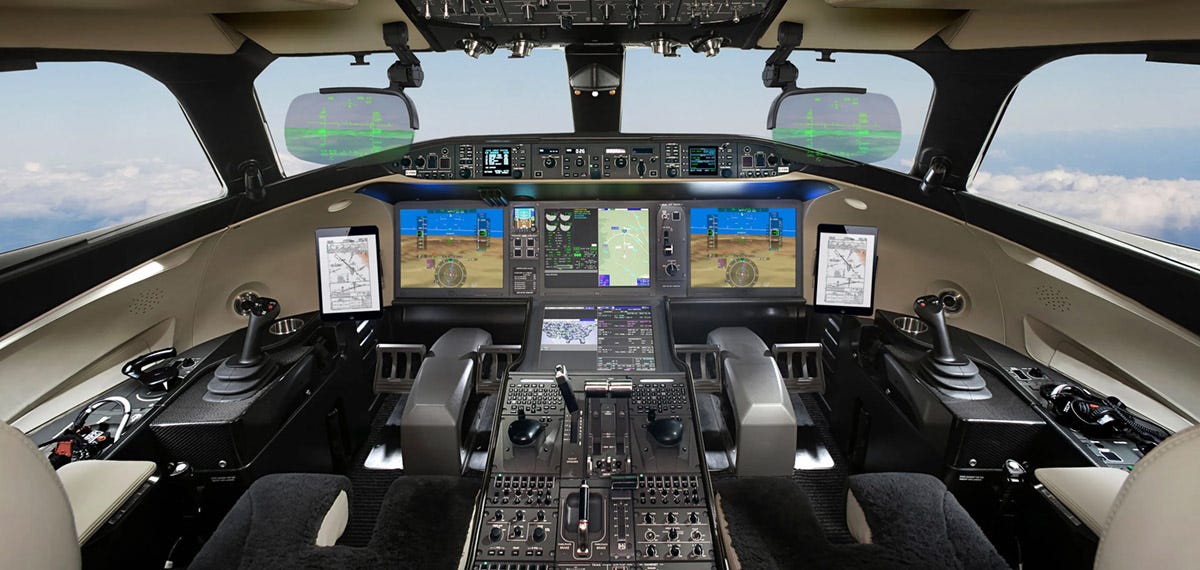
The Bombardier Vision flight deck is hailed for its intuitive design and enhanced situation awareness. (Image courtesy of Bombardier: https://bombardier.com/en/bombardier-vision-flight-deck)
As cars, scooters, and rickshaws become increasingly digital, connected, and in some cases semi-autonomous, designers face new and complex challenges in how humans interact with machines. In the high-stakes world of aviation and aerospace, Human-Machine Interaction (HMI) and Human-Computer Interaction (HCI) have long been studied, refined, and regulated with meticulous care. The cockpit, in many ways, is a masterclass in designing for safety, clarity, and performance under pressure. Mission control software for aerospace also offers valuable lessons for vehicle interaction designers by demonstrating how to manage complex, high-stakes information environments through intuitive interfaces, clear visual hierarchies, and robust support for decision-making under pressure.
My work designing aerospace systems, from spacecraft command and control interfaces to off-world vehicle control environments, has deeply informed my understanding of interaction design under extreme conditions. In these contexts, clarity of system state, situational awareness, error recovery, alert prioritization, and collaborative automation are not just design preferences; they are mission-critical requirements. Developing interfaces for ground-based controllers and astronauts in space operating under heavy cognitive load, time pressure, and physical constraint taught me that good HMI must anticipate failure modes, adapt to dynamic context, and earn user trust through transparency and responsiveness. These same principles now guide my approach to designing human-centered mobility systems on Earth, whether for autonomous cars, micromobility platforms, or digitally augmented public transit.
Designers of ground vehicles can, and should, borrow from this domain. While the contexts are different, the underlying human limitations, cognitive patterns, and ergonomic needs are universal. The following five principles from aviation and aerospace HMI provide a practical, research-backed foundation for improving vehicle design across platforms and markets, from luxury EVs to shared e-rickshaws.
1. Clarify System Modes and States
One of the most critical lessons from aviation is the danger of mode confusion. In aircraft accidents involving autopilot systems, pilots often misunderstood whether the plane was being controlled manually or automatically, and what the system was doing at any given moment. This lack of clarity can have fatal consequences.
The same issue now arises in cars equipped with advanced driver-assistance systems (ADAS). Is the car steering itself, or just helping? Is lane-keeping active? Has cruise control disengaged? Without clear, unambiguous indicators, drivers may over-trust automation or become confused in moments that require immediate response.
Designers must therefore make system modes visually, audibly, and tactilely clear. Mode transitions (e.g., from manual to autonomous driving) should be accompanied by distinct feedback, such as dashboard icons, voice prompts, or steering wheel resistance, so that users always understand who is in control.
2. Support Situational Awareness
Dr. Mica Endsley is widely recognized for her pioneering work on situation awareness in complex systems, particularly in aviation, aerospace, and automotive design. Her work emphasizes the importance of designing interfaces that support users in perceiving critical information, comprehending its meaning, and projecting future states, key for safe and effective decision-making under time pressure.
In aviation, situational awareness refers to a pilot’s ongoing understanding of aircraft position, system status, and environmental context. Interfaces are designed to help pilots “stay ahead of the airplane,” anticipating problems before they become critical. In aerospace mission control centers, maintaining high situation awareness is essential, as operators must continuously monitor dynamic system states, anticipate anomalies, and coordinate rapid responses across teams to ensure mission success and crew safety. For astronauts operating highly automated spacecraft, situation awareness remains critical, as they must monitor system behavior, understand automation intent, and be prepared to intervene quickly in the event of unexpected conditions or system failures.
The same principle applies to Earth-based transportation. Whether a person is driving a car, riding a scooter, or operating a rickshaw, their attention is limited. Bombarding them with too much information can lead to overload; hiding too much can leave them unprepared.
Vehicle designers can gain valuable insights from aviation and aerospace, industries where situation awareness is critical to safety and performance. In cockpit design, for example, decades of human factors research have led to interfaces that prioritize clarity, reduce cognitive load, and support rapid decision-making under stress. These lessons can be applied to automotive HMI by emphasizing hierarchical information structures, tactile feedback, and minimal distraction. Concepts such as heads-up displays, redundant systems, and clear affordances help drivers maintain awareness of their surroundings, anticipate hazards, and respond effectively. By adopting aerospace principles of SA, such as designing for perceptual cues, task predictability, and error recovery, vehicle designers can create smarter, safer, and more intuitive driving experiences.
3. Design for Error and Recovery
In aviation, human error is anticipated and built into the design of systems. Redundant controls, error-resistant workflows, and clear recovery paths are standard features of cockpit interfaces. In aerospace systems such as mission control software, where even minor human or system errors can have catastrophic consequences, requiring interfaces that anticipate failure modes and support rapid, reliable recovery are essential. Designers know that mistakes will happen, it’s the system’s job to mitigate their consequences.
This philosophy should guide HMI design for ground vehicles as well. Instead of assuming that users will always follow instructions or operate within expected norms, interfaces should help users recover from mistakes with grace. If a driver tries to navigate while a vehicle is moving, or a scooter is turned on without proper authentication, the system should guide them toward correction rather than simply blocking the action.
For example, in a shared micromobility system, an app that detects improper parking might not just issue a fine, it could provide real-time guidance to help the user find a compliant location and avoid penalties altogether. In automobiles with assistive driving technologies like lane correction and collision detection, Design for Error and Recovery ensures that systems can detect driver lapses or misjudgments, intervene appropriately to prevent accidents, and provide clear feedback that helps drivers regain control safely and confidently.
4. Manage Alerts to Prevent Fatigue
Alert fatigue is a well-documented problem in aviation, healthcare, and increasingly, vehicles. When everything triggers a warning, beeping seatbelts, pop-up messages, incessant notifications, users begin to tune them out. In aviation and aerospace, this has led to a structured approach to alarm hierarchy, where critical alerts are separated from informational ones, both in tone and priority.
Designers of ground vehicle HMIs must do the same. Not all alerts are equally urgent. A system should distinguish between low-priority reminders (e.g., low tire pressure) and high-priority dangers (e.g., imminent collision), using different modalities and escalation protocols.
Smart alert design includes timing, frequency, and tone. For example, an e-rickshaw might provide a gentle vibration or soft tone when the user drifts into an unsafe lane, escalating only if the behavior continues. This approach minimizes distraction while maintaining attention where it matters most.
5. Treat the Vehicle as a Partner, Not a Tool
Aviation has embraced a model known as Crew Resource Management (CRM), which treats human-machine interaction as a form of teamwork. Pilots are trained to communicate and collaborate with their co-pilot, ground control, and onboard systems. The goal is shared understanding and coordinated decision-making.
Ground vehicle designers can adopt a similar mindset. Instead of treating the vehicle as a passive tool, they can design it as an active collaborator, one that informs, advises, and supports the driver or rider. This is especially important in partially autonomous systems, where control passes back and forth between human and machine.
For instance, a car that detects drowsiness might not just sound an alarm, it might suggest a rest stop, reroute to a safer route, or engage partial automation temporarily. The interface becomes not just a controller, but a co-pilot.
Conclusion
As transportation technologies evolve, so too must our approach to designing how people interact with them. While aviation and aerospace operate in the sky and beyond, and ground vehicles on streets and sidewalks, the human behind the interface remains remarkably consistent. By adopting lessons from decades of aviation and aerospace HMI, designers of ground-based vehicles can build safer, smarter, and more humane systems, ones that communicate clearly, reduce error, support awareness, and build trust.
In an age of increasing complexity, good design isn’t just about aesthetics or technology, it’s about aligning machines with the humans who use them, under pressure, in motion, and in real life.
메타데이터
- post_id
- e12470187de3
- slug
- what-vehicle-designers-can-learn-from-airplane-cockpits-five-key-hmi-lessons-from-aviation-and-e12470187de3
- url
- https://medium.com/@jscaff/what-vehicle-designers-can-learn-from-airplane-cockpits-five-key-hmi-lessons-from-aviation-and-e12470187de3
- canonical_url
- https://medium.com/@jscaff/what-vehicle-designers-can-learn-from-airplane-cockpits-five-key-hmi-lessons-from-aviation-and-e12470187de3
- author_url
- https://medium.com/@jscaff
- status
- ok
- fetched_at
- 2026-06-12 07:40:50