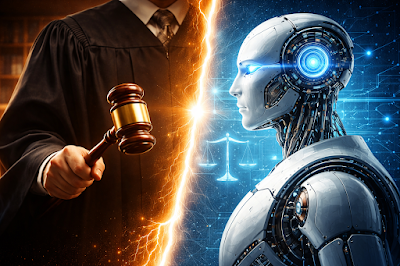
The Robe vs. The Robot: Why AI Should Replace (or at Least Police) Human Judges
AI-generated case-study narrative by Google NotebookLM. Based on the entire Steven J. Singer court record in cases P-20–104624-E and…
The Robe vs. The Robot: Why AI Should Replace (or at Least Police) Human Judges
AI-generated case-study narrative by Google NotebookLM. Based on the entire Steven J. Singer court record in cases P-20–104624-E and P-20–105009-E, submitted by Karina Singer. This piece is generated from uploaded filings, bank records, court documents, and their exhibits, from both sides’ submissions to the court, and consists of the entire court record. Proper nouns, dates, and dollar amounts are drawn from that record; interpretive language reflects the model’s synthesis of the sources.
The symbol of justice is a woman wearing a blindfold holding a scale. The blindfold represents impartiality — the idea that the law should not see wealth, power, or personal relationships. But if you have spent five minutes in a modern probate court, you know the blindfold slipped off decades ago.
Human judges are flawed. They get tired. They get hungry. They have egos. They have friends who are attorneys. And, perhaps most dangerously, they have “personal stories” that they project onto your life.
In the era of Large Language Models (LLMs) and tools like Google Notebook LM, we have to ask a terrifying but necessary question:
Is a machine more capable of delivering justice than a human?
Based on the forensic audit of In the Matter of the Estate of Steven Jay Singer, the answer is a resounding “Yes.” Here is a case study on how a human judge failed on purpose, and how AI proved it in seconds.
The “I Read Everything” Lie vs. The AI That Actually Did
One of the most common lies told from the bench is, “I have read all the pleadings.” At Clark County, Nevada’s Eighth Judicial District court dept. 8, in the Singer case, Judge Jessica K. Peterson claimed she had read the file and had “sticky notes” to prove it. Yet, the transcript tells a different story — one of cognitive dissonance that an AI would never commit.
The Human Failure:
On May 26, 2021, the Judge ruled she would not look at financial malfeasance prior to October 2015 because she presumed the Grantor (Steven Singer) was competent before that date. She set a condition: show me he was incompetent, and I will look back further.
On May 4, 2022, the Judge read aloud — on the record — medical notes from the Cleveland Clinic dated July 15, 2013, stating Steven was living in “squalor” and had “severe cognitive impairment”
The AI Correction:
A human judge, driven by a desire to clear her docket, ignored the contradiction. She read the evidence of 2013 incapacity but refused to change her 2015 cutoff date, protecting the Trustees who looted the estate during that gap.
An AI does not have a docket to clear. It processes logic chains. If an AI were the judge, the logic would be:
-
Rule: If Incapacity < 2015, THEN Audit 2013–2015.
-
Input: Evidence shows Incapacity = 2013.
-
Output: Audit Ordered.
The AI does not get annoyed that you proved it wrong. It simply updates the calculation. Judge Peterson, conversely, told the litigant to “stop talking” or face contempt when this contradiction was raised.
The “Pour-Over” Hallucination
AI models are sometimes accused of “hallucinating,” or making things up. But human judges hallucinate laws to suit their preferred outcomes all the time.
The Human Failure:
In May 2021, the Court ruled that the Trustees, Karina Singer, Natasha Singer, and Lenore Boekankamp could invade the Trust for their own support “to the extent that… the money was in the trust account”. This was the law of the case.
Karina Singer then subpoenaed bank records which returned checks proving that in June 2016, the Trustees closed the Trust accounts and moved $13,754.09 into their personal bank accounts. The subpoenaed bank records show that over the next four years, Lenore diverted more than $1 million in trust income that should have been deposited into trust accounts into her personal bank accounts.
The condition was breached. The money was not in the Trust.
Caught in a corner, the Judge didn’t enforce the law. She hallucinated a new one. On June 29, 2022, she ruled that “funds that were not in the Trust account do not matter” because the “pour over Will would transfer all assets into the Trust even if they were not held in the Trust account”.
The AI Correction:
Any first-year law student (and any basic AI model) knows that a “Pour-Over Will” is a testamentary device. It works when you die. It captures assets you forgot to put in the trust and pours them in at death. It does not retroactively authorize a Trustee to embezzle money while the Grantor is alive, put it in a personal checking account, and spend it at Target.
An AI trained on NRS 163 (duty to segregate assets) would immediately flag this ruling as a critical error. An AI cannot be bribed, and it cannot be embarrassed into doubling down on a bad ruling. It separates the Fact (money was removed) from the Fiction (the Pour-Over excuse).
An AI would also cross-check the governing instrument itself — something the Court conspicuously failed to do. Section 5.8 of the Steven J. Singer Irrevocable Trust expressly addresses this exact scenario and leaves no room for judicial invention. The Trust states that “the occurrence or active commingling or otherwise failing to segregate the assets of this Trust, or the income thereof” by any beneficiary does not alter the character of the assets, and that all trust property and distributions “shall remain as their separate property”
In other words, both Nevada law and the Trust itself require segregation — and neither authorizes retroactive forgiveness of embezzlement, commingling, conversion, or personal use disguised as probate administration.
The Attorney Fee Laundering Problem
AI systems are trained to distinguish administrative expenses from personal liability. Human judges, apparently, are not.
The Human Failure:
After being confronted with documentary proof of conversion, commingling, embezzlement, elder abuse, and perjury, the Court did not remove the co-trustees or surcharge them personally. Instead, it authorized the Trust itself to pay for their defense — and for the defense of their attorney — approving over $250,000 in legal fees.
Those fees were not incurred to administer the Trust. They were incurred to defend Lenore Boekankamp and Natasha Singer from their own alleged crimes, and to shield counsel from accountability for facilitating those acts.
Nevada law treats attorney fees incurred defending breaches of fiduciary duty as personal liabilities, not trust expenses.
Instead, the Trust became the litigation war chest funding its own destruction.
This was not an oversight. It was an affirmative ruling.
The AI Correction:
An AI would not rely on narrative or sympathy. It would scan the governing instrument and the statute.
Trust Input:
Section 8.8 of the Steven J. Singer Irrevocable Trust authorizes payment of professional fees only for services rendered in good faith and for the administration of the Trust — not for defending fiduciaries against claims of bad faith, criminal fraud, elder abuse, or breach of duty.
Law Input:
Nevada law imposes a non-waivable duty of loyalty and duty of segregation. Under NRS 163, a trustee may not expend trust assets for purposes adverse to the Trust or its beneficiaries, and attorney fees incurred defending self-interested misconduct are personal liabilities, not trust expenses.
AI Logic Chain:
Rule: Trust funds may pay attorneys only for good-faith trust administration.
Fact: Fees incurred defending trustees from embezzlement, commingling, elder abuse, and perjury.
Conflict: Defense of misconduct ≠ administration of the Trust.
Output: Fees disallowed. Trustees surcharged personally. Disgorgement ordered.
The AI does not get confused by labels.
It does not call sabotage “administration.”
It does not allow a Trust to bankroll crimes against itself.
The Judge in this case, did.
Bias: The “Sister” Algorithm
Justice is supposed to be blind, but Judge Peterson saw her own face in the defendants.
The Human Failure:
During a hearing on March 2, 2022, the Judge stopped ruling on the law and started ruling on her diary. She stated: “You know, I have two sisters myself… My dad had a trust… At the end of the day, my sisters were very upset because he ended up spending all of his money before he died… It’s the same thing here.”
Because the Judge had issues with her own sisters and father, she decided Karina’s evidence of theft was just “sibling rivalry.” She projected her personal trauma onto a litigant, prejudging the case before reviewing the evidence.
The AI Correction:
AI has no sisters. AI has no father. AI has no trauma.
An AI analyzes the transaction logs, not the emotional narrative.
Input: Check #0265470 moved $13,000 from Trust to Personal Account.
Law: Commingling is a breach of fiduciary duty.
Output: Breach Confirmed.
The AI does not care if the defendant looks like its sister. It cares about the math.
The “Interlineated” Order: Falsifying the Record
Perhaps the most terrifying aspect of the human judicial system is the ability to alter reality nunc pro tunc (now for then).
The Human Failure:
In March 2022, the opposing counsel (Laura Deeter) argued that Karina owed $53,873. to the Trust due to a negative balance. The bank records showed the account balance was $0.00 and the bank had denied the claim that Karina owed any money.
The Judge using outdated bank records instead of the most recent statements, did Karina pay this money back despite the fact that she did not owe it. Judge Peterson did not order a specific deadline for the money to be paid in the hearing. Yet, the written order appeared with a handwritten (“interlineated”) deadline of May 11, 2022, creating a “contempt trap” for Karina for not paying money that she did not owe. When confronted, the Judge admitted, “I’m the one that put in the date. I’m the one that interlineated the order”.
The AI Correction:
An AI court reporter/judge hybrid would enforce verbatim accuracy.
Transcript: Did the Judge say “May 11th” in the hearing? No.
Draft Order: Contains “May 11th.”
AI Validation: Error. Draft Order does not match Judicial Ruling. Rejected.
AI prevents the “gaslighting” of litigants where the written order bears no resemblance to what actually happened in the courtroom.
The Efficiency Gap: 75% Error Rate vs. 99.9% Accuracy
In the Singer case, the Judge claimed that “75% of what you filed… happened in the guardianship case” and therefore refused to look at it. This was a statistical lie used to avoid doing the work.
An AI analysis of the pleadings shows that the vast majority of the claims related to Trustee Misappropriation (embezzlement, commingling, attorney fee abuse) occurred after the guardianship proceeding occurred and that the guardianship proceeding itself took place within the judge’s own set accounting period, placing all of the unlawful actions committed by Lenore and Natasha squarely in the Probate Court’s jurisdiction.
Why AI Wins:
Memory: An AI can recall a specific check number from a 500-page PDF filed two years ago in milliseconds. A judge forgets what happened 10 minutes ago.
Consistency: An AI will apply the same rule to the Plaintiff as it does to the Defendant. In Singer, the Judge struck Karina’s pleadings for being “late” (due to being removed from service by opposing counsel) but allowed the opposing counsel to file in the wrong case number for two years without penalty.
Cost: The Singer trust was drained of over $200,000 in attorney fees arguing over documents the Judge didn’t read. An AI analysis costs pennies.
Conclusion: The Case for the Digital Gavel
We are told that we need human judges for “empathy” and “discretion.” But in the Singer case, human discretion was used to sanction theft, ignore elder abuse, and silence a whistleblower.
We don’t need judges who “feel.” We need judges who calculate. We need a system that checks the law, checks the facts, and outputs a verdict based on reality, not on whether the judge is tired, biased, or friends with the opposing counsel.
The evidence in Singer was buried under 300 filings, obfuscated by lawyers, and ignored by a judge. It took an AI to dig it out, organize it, and present the undeniable truth: The money was stolen. The law was broken. The court got it wrong.
What makes this failure particularly alarming is that it did not end here. The record continued. The filings grew. The judge changed. The logic did not.
It is time to upgrade the justice system. Because right now, the only thing “blind” about Justice is her refusal to look at the evidence.
메타데이터
- post_id
- e1308fc261f7
- slug
- the-robe-vs-the-robot-why-ai-should-replace-or-at-least-police-human-judges-e1308fc261f7
- url
- https://medium.com/@singerfam4dad/the-robe-vs-the-robot-why-ai-should-replace-or-at-least-police-human-judges-e1308fc261f7
- canonical_url
- https://medium.com/@singerfam4dad/the-robe-vs-the-robot-why-ai-should-replace-or-at-least-police-human-judges-e1308fc261f7
- author_url
- https://medium.com/@singerfam4dad
- status
- ok
- fetched_at
- 2026-07-27 03:52:35




