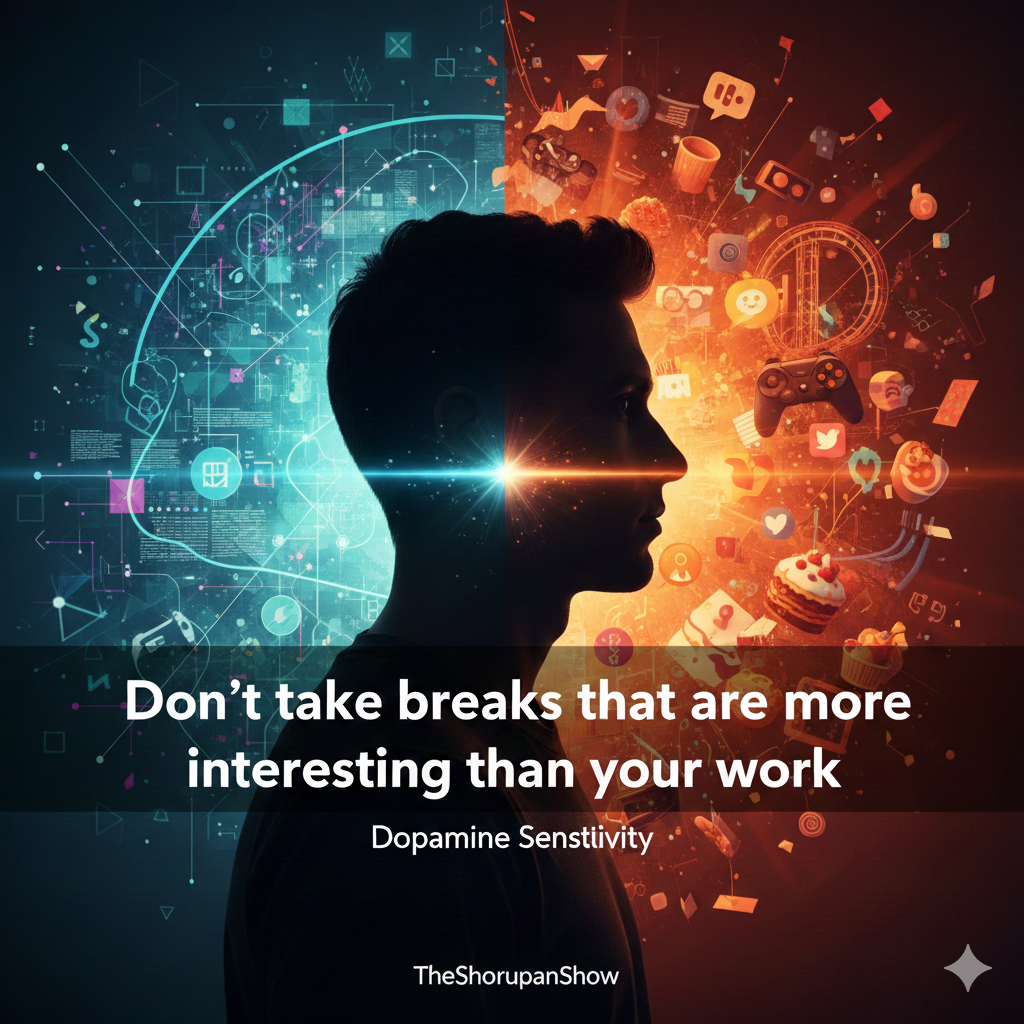
Don’t take breaks that are more interesting than your work
Recently, I came across Rían Doris's work. In his video, “How to Reprogram Your Dopamine to Crave Hard Work,” he outlines three ways to…
Don’t take breaks that are more interesting than your work
Recently, I came across Rían Doris's work. In his video, “How to Reprogram Your Dopamine to Crave Hard Work,”** **he outlines three ways to reprogram yourself. This video inspired me to reflect on my own bad habits.
Understanding The Neuroscience
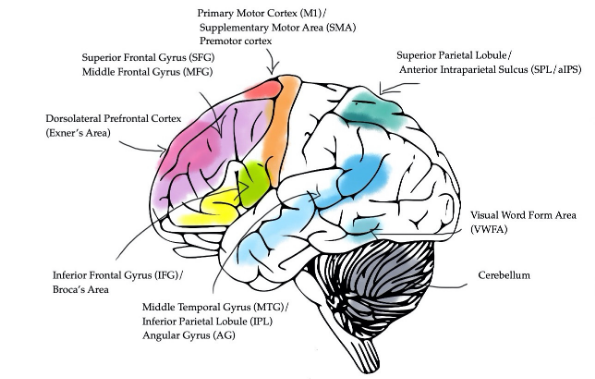
Our dopamine system plays a critical role in effortful decision-making.
Effortful decision-making is the mental process of choosing between actions by weighing the amount of effort required against the potential reward.
The brain tasks dopamine with figuring out how much we “want” something. Many people, including me, incorrectly thought that dopamine is how much we like something, which is not the same thing at all, as we will soon find out.
Stimuli are attended to because they trigger dopamine release. It is not the stimuli you crave, but rather the dopamine they release. Dopamine is the reward we get for engaging in certain activities. Through overstimulation, we become desensitized to dopamine. When this happens, dopamine is still signalling, but fewer receptors receive the signals.
Low reward sensitivity means you need a lot of stimulation to capture your attention.
High sensitivity to rewards means you need less stimulation to capture your attention.
Think about it like your ROI on dopamine. How much stimulation do you need to get rewarded by dopamine, resulting in your attention focusing on the present moment?
Through resensitizing, you can boost your impulse control and delay gratification. You must make the boring rewarding.
Modify how we take breaks.
I work for myself 10 to 12 hours a day and genuinely enjoy my work. However, I realized how much time I waste and, more importantly, how I make it harder for my brain to focus, even during time set aside for work.
Here is a list of activities that justify an intentional break. There are countless examples of breaks that I do not consider necessary, yet I still take them without thinking. I will discuss those in another post.
- Going to the bathroom with my phone
- Eating while watching a YouTube video
- Speaking to someone
- Taking a nap with my phone
All four of these activities are far more interesting than my previous work. I have practiced these types of breaks for at least 10 years, seven days a week, at least once per workday. Naps are the exception, since I do not take them every day. Therefore, I have told my brain about 3,650 times that the most rewarding thing it can do is take a break.
Most people take dopamine-fueled breaks. The critical mistake here is taking a more stimulating break than the work you are taking a break from. Imagine trying to read a research paper after scrolling social media. Compared to the infinite novelty of social media, the research paper will seem unbearable. But if you spend the break staring at a wall, going back to reading the research paper will make you salivate. We want to make our work as easy as scrolling social media. That requires us to drop the bar to what bores us to the floor and make the boring rewarding.
The dopamine-seeking cage rat that is your mind is going to have its way, so you might as well let it suck you back into work rather than keep you stuck on the thing you are doing during the break.
Inhabit the in between.
We all have moments in a day that are classifiable as “in between” activities. “In between” activities can be while you are in the bathroom, waiting in line or travelling. Typically, we reach for our phones for a quick dopamine hit to fill this time. Inhabitting the inbetween means LEVERAGING these moments by allowing ourselves to settle and cut out the overconsumption of unintentional information, which fractures our attention and further desensitizes our dopamine receptors. Get comfortable with the uncomfortable silence, and instead of filling the void, embrace it; your baseline for what is boring will begin to shift.
Do everything one thing at a time.
You get heightened reward sensitivity by doing things one at a time with singular focus. A positive indicator that you are heading in the right direction with your reward sensitization is that you should become much worse at multitasking because multitasking requires us to stay within our default mode network.
Default mode network — when you are not engaged in a task (disengaged attention)
Task positive network — When you need to focus on a task (engaged attention)
Switching between the DNM and the TPN becomes a tunnel for your awareness, which then becomes attention, which then makes you oblivious to things outside the task-positive network.
Rapid shifting between the DMN and the TPN is a burden when you are trying to multitask; it is a superpower when you are trying to focus. Because the faster you can switch, the quicker you can engage focus and the higher your reward sensitivity, the easier it is to make this shift. To train this ability, do one thing at a time.
Embrace life as a sequence of singular activities rather than a series of scattered efforts to secrete dopamine through artificial novelty seeking.
메타데이터
- post_id
- e154cba98a85
- slug
- dont-take-breaks-that-are-more-interesting-than-your-work-e154cba98a85
- url
- https://medium.com/@shorupan/dont-take-breaks-that-are-more-interesting-than-your-work-e154cba98a85
- canonical_url
- https://medium.com/@shorupan/dont-take-breaks-that-are-more-interesting-than-your-work-e154cba98a85
- author_url
- https://medium.com/@shorupan
- status
- ok
- fetched_at
- 2026-06-29 01:02:39