40% of AI Policies Are Paper, Shadow AI Costs $670K — AI Acceptable Use Policy
Why rules alone aren’t enough and what must be built into the architecture to enforce them.
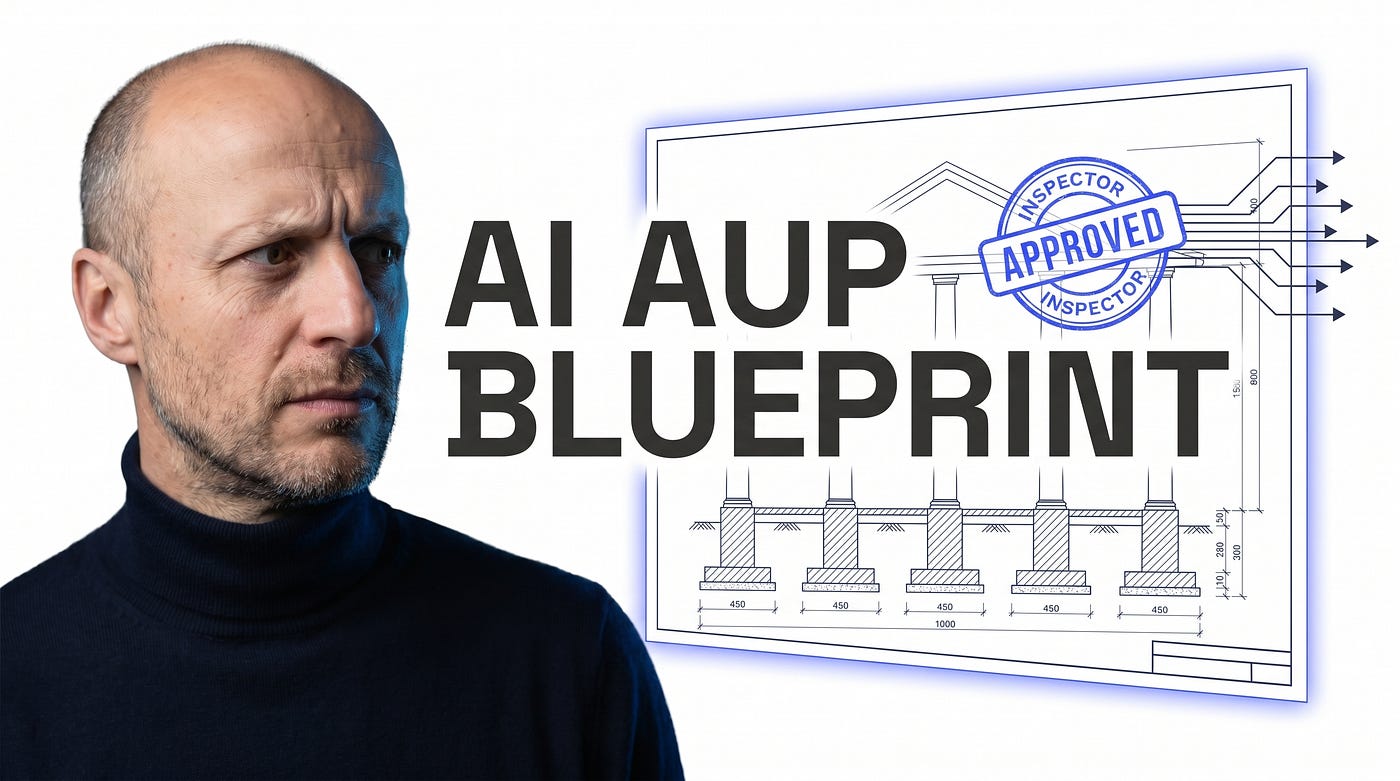
40% of AI Policies Are Paper, Shadow AI Costs $670K — AI Acceptable Use Policy
Why rules alone aren’t enough and what must be built into the architecture to enforce them.
I’m an AI Architect, and over the past two years, I’ve watched the same film play out in a dozen different organizations. A company publishes an AI Acceptable Use Policy — AUP, the document defining which AI tools employees may use, with what data, and under what controls. The file lands on the intranet, the CISO signs off, the audit checks “done.” Six months later, shadow AI is flourishing, and the board is asking how it happened.
The Sprinto CISO Pulse Check 2026 frames the entire conversation with a single number: nearly 40 percent of organizations have an AI policy in place but enforce it inconsistently. Add the IBM Cost of a Data Breach 2025 — shadow AI accounts for 20 percent of breaches and adds an average of $670,000 to the cost of each incident — and the picture becomes unambiguous. The AUP has stopped being a legal problem. It’s a systems engineering problem.
What’s Ahead
- Why an AI policy becomes paper — three failure patterns and their cost in numbers
- The AUP as a building code — six structural blocks and four data tiers as load-bearing classes
- Building permits — three-tier risk classification, workflow, and evidence artifacts
- Four control cadences — from Fully Automated to Human-Must-Approve and the automation bias trap
- Inspector at the gate — LLM gateway as Policy Enforcement Point and the shadow AI registry
- The rigor paradox — why organizations with governance deploy AI faster, not slower
Paper That Doesn’t Hold — Why Nearly 40 Percent of AI Policies Go Unenforced
Samsung, March–April 2023. Three independent leaks in twenty days: an engineer pastes source code from a semiconductor measurement tool into ChatGPT, a second employee uploads optimization code, and a third shares the transcript of an internal meeting. The response: a full ban and a 1,024-byte prompt limit. Three years later, according to the Netskope Cloud and Threat Report 2026, 47 percent of employees who use AI at work do so from personal accounts — the ban eliminated visibility, but not the behavior.
Samsung is a template, not an exception. In practice, I see three repeatable failure modes in AUPs written like a code of conduct.
Three AUP Failure Modes
Policy Theatre is a policy that exists solely as a PDF. 78 percent of employees bring their own AI tools to work, and the UK Information Commissioner’s Office is unequivocal: possessing a governance document does not satisfy GDPR requirements.
IT Mismatch is a clock conflict. IT operates on procurement cycles of 12 to 16 weeks; the business needs a tool by Friday. ArmorCode calls this the two-week breaking point — beyond that threshold, shadow AI grows mechanically.
Reactive Symptom-Chasing is governance that kicks into action only after the first security questionnaire from a client. Always a few months behind actual adoption.
Each of these failure modes is a symptom of the same design flaw. A policy without architectural enforcement is a rumor. Allie Mellen of Forrester: “If you can’t show governance in action, it doesn’t exist.” A SOC 2 auditor in 2026 doesn’t ask for a PDF. They ask for gateway logs, ticket approvals, and a Model Inventory record.
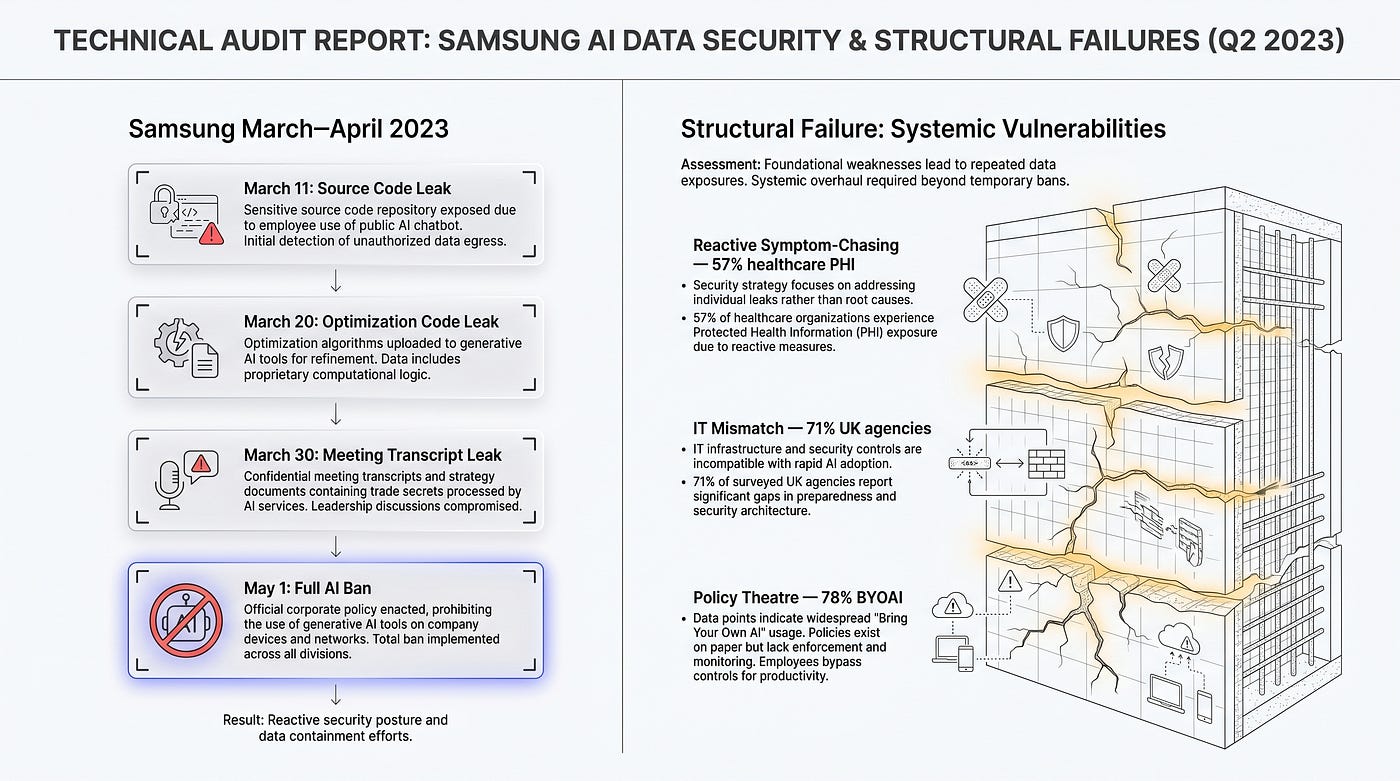
Samsung in 20 days: three code leaks, one ban. And three failure patterns triggered by any policy written like a code of conduct rather than a building code.
AUP as Building Code — Foundations and Data Load Classes
“Architecture is the thoughtful making of space.” — Louis Kahn, Architect
A building code isn’t aspirational text sitting on a shelf. An inspector comes, reviews, issues a permit. A building that violates the code doesn’t get an occupancy certificate. An AI AUP should work identically: as an active system with inspectors and final inspections.
Six Structural Blocks
An effective AUP consists of six blocks whose order cannot be rearranged.
- The subject scope must cover not just ChatGPT but also AI embedded in Zoom, Gmail, Grammarly, and Copilot — plus employees, contractors, and third parties.
- Data classification is the load-bearing element of the rest of the architecture (I’ll return to it in a moment).
- The approved tools list must be active, not annual. A quarterly review plus a 72-hour SLA for new requests — otherwise we’re back at the breaking point.
- The prohibited uses list — in my practice, around thirty items: from PII in public tools, to malware, to social scoring prohibited by Article 5 of the EU AI Act.
- Accountability — a RACI matrix specifying who owns which layer. Without assignment, “everyone and no one” is the same role.
- Technical enforcement — a clause providing the legal basis for logging and blocking. Without it, the gateway is an architecture without a mandate.
Four Data Load Classes
The second block deserves special attention, because everything else rests on it. Data classification isn’t labeling for labeling’s sake — it’s the definition of handling procedures. The sharpest framing comes from StackAware: tiers differ by procedures, not by abstract sensitivity. Three to four tiers is more than enough.
- Tier 1 — Public: public content, open-source documentation. No AI restrictions.
- Tier 2 — Internal: non-sensitive internal documents. Enterprise tools only.
- Tier 3 — Confidential: source code, financial forecasts, credentials. Requires strict tenant isolation and a contractual no-training guarantee.
- Tier 4 — Regulated: HIPAA-covered PHI, EU personal data under GDPR, PCI payment data. Dedicated deployments only with a BAA — the HIPAA contract allowing a vendor to handle protected health data — or a DPA, the EU equivalent for GDPR.
In practice, the architect’s job is one thing: to ensure every record has an assigned tier, and that the gateway can read and enforce that tier. Without that, the rest of the policy hangs in mid-air.
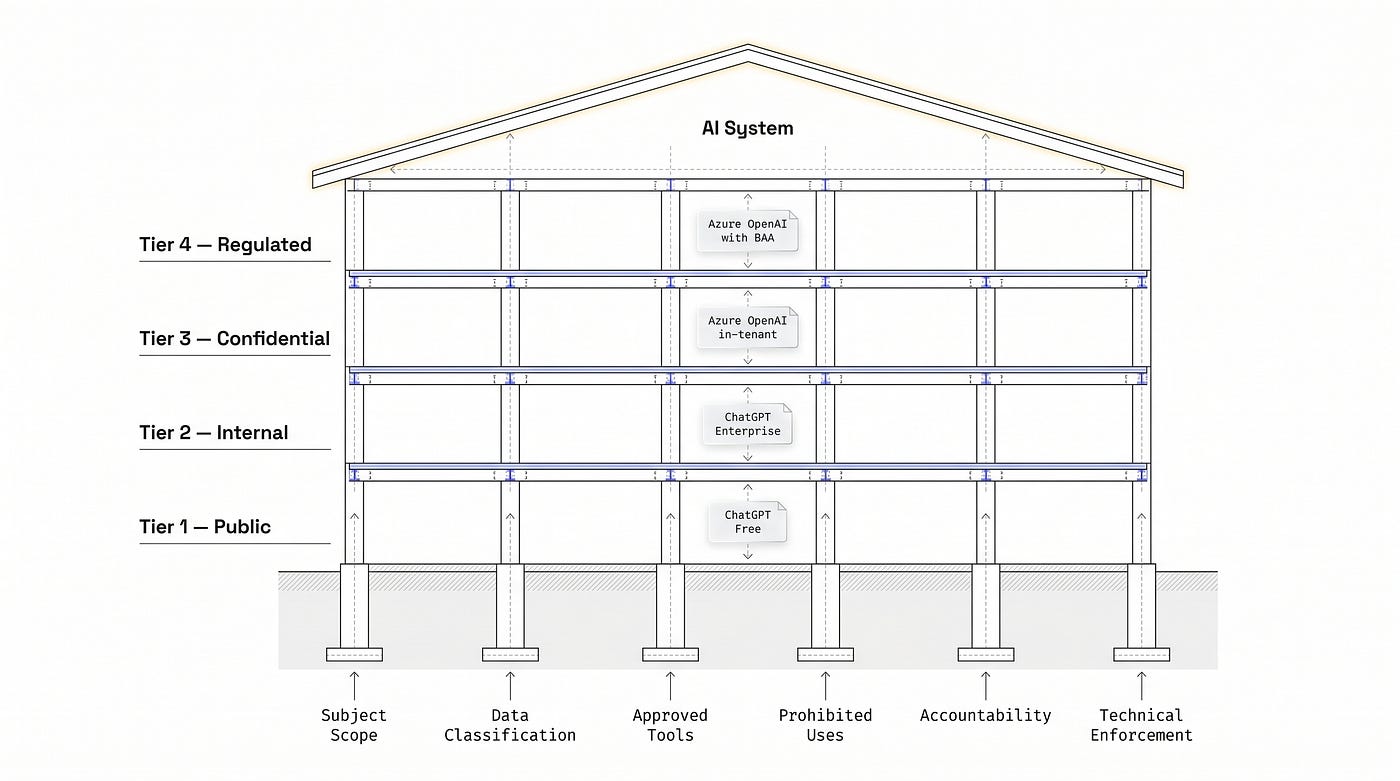
Six foundation blocks, four floors of load-bearing classes. Rearrange or skip any one of them — and the whole structure collapses.
Building Permits — Risk Framework and Approval Workflow
“Perfection is achieved not when there is nothing more to add, but when there is nothing left to take away.” — Antoine de Saint-Exupéry, Writer and Pilot
Not every building requires a permit like a nuclear power plant. The art of AI governance works the same way: match the weight of the process to the actual risk. Organizations that treat everything as High Risk produce governance fatigue. Those that classify nothing as High live with open regulatory exposure.
Three Levels and Their Owners
A three-tier framework with concrete timelines:
- Low Risk: grammar checking, summaries of public content, code completion in sandboxes. Department Head, 24 to 48 hours, self-attestation plus vendor privacy policy.
- Medium Risk: AI in customer service, HR tools, Tier 2 document summarization. IT Security plus Governance, 5 to 10 days, SOC 2 Type II, DPA, data flow documentation.
- High Risk: credit scoring, clinical decision support, autonomous agents. AI Governance Committee, CISO, Legal, 20 to 30 days, DPIA (Data Protection Impact Assessment required by GDPR), FRIA (Fundamental Rights Impact Assessment required by Article 27 of the EU AI Act for public bodies and organizations delivering public services such as healthcare, education, and justice), model card, human oversight plan.
The NIST AI RMF (a voluntary standard defining four governance functions: Govern, Map, Measure, Manage) maps directly onto these levels. ISO/IEC 42001:2023 (the first global AI Management System standard) adds 9 Annex A control groups. The EU AI Act imposes fines of up to €35 million or 7 percent of global turnover for prohibited practices.
At the center of the workflow sits the AI Use Case — a business-facing description of intent, not an engineering document. Without it, Legal, Security, and Architecture are talking about different things under the same name.
Exception Handling as an Early Warning Signal
ArmorCode is explicit: two weeks is the breaking point. Beyond that threshold, even legitimate requests start bypassing the workflow. That’s why exception request volume isn’t paperwork — it’s a leading indicator of governance health. Four actions: Allow, Warn, Block, Route-or-Tokenize. Never Block-without-alternative.
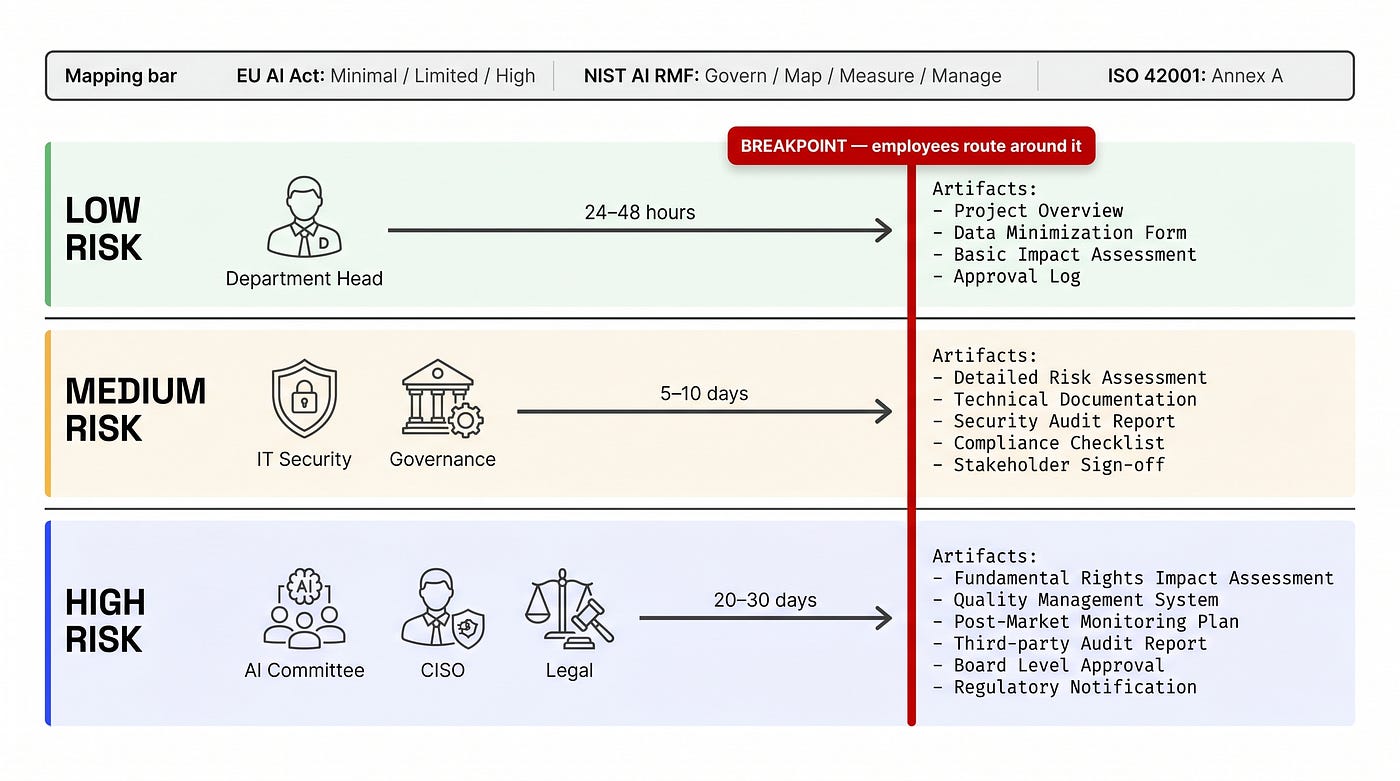
Three lanes, three timelines, one breaking point. Under two weeks — governed adoption. Over two weeks — shadow AI.
Four Control Cadences — HITL, HOTL, and the Automation Bias Trap
The four levels of operational AI control aren’t a new idea. Thomas Sheridan and William Verplank described a ten-level automation taxonomy in 1978, in an MIT Man-Machine Systems Lab report. Today’s four cadences are a distillation of that theory, now explicitly addressed by Article 14 of the EU AI Act.
Four Levels from Sheridan to EU AI Act
Fully Automated is Gmail’s spam filter with 99.9 percent accuracy and Stripe Radar responding in 100 milliseconds. Human-on-the-Loop (HOTL — humans supervise, and intervene only by exception) is HSBC processing 1.35 billion transactions per month with AI flagging and analyst oversight. Human-in-the-Loop (HITL — AI recommends, a human decides on every decision) is radiology: Lunit INSIGHT CXR achieves 86.8 percent concordance. Human-Must-Approve (HMA — every action requires explicit consent) is the two-person rule under Article 14 of the EU AI Act for remote biometric identification and CFPB credit decisions.
That’s the easy part of this section. The harder part starts here, because the greatest risk isn’t too little oversight. It’s ceremonial oversight that degrades into a rubber stamp under production pressure.
Automation Bias — Why HITL Degrades Under Pressure
The phenomenon is called automation bias — the human tendency to defer to an automated recommendation even when the evidence points elsewhere. Architects think they’ve solved oversight by choosing HITL. They haven’t — they’ve only started designing. The Parasuraman and Manzey 2010 meta-analysis, cited over a thousand times, shows that automation bias occurs in both novices and experts and cannot be eliminated through training.
Zillow is the best case study here. The company didn’t lose HITL on day one of deployment. It lost it gradually — under pressure from growth targets, pressure from overconfidence in the model, pressure to remove friction. By the time the program was shut down, Zillow had absorbed losses exceeding $500 million in write-downs — and technically, a human-in-the-loop existed at every purchase decision. Operationally, somewhere along the way, it had become a rubber stamp.
Control Level and Data Tier — Default Mapping
In practice, I map cadences to data tiers: Tier 1 → Fully Automated, Tier 2 → HOTL, Tier 3 → HITL, Tier 4 → HMA. But that mapping isn’t sufficient without health metrics for the control layer. Three key ones: override rate, confidence score distribution, and decision time per reviewer. When the override rate drops below a defined threshold, HITL stops being HITL — regardless of what the policy says.
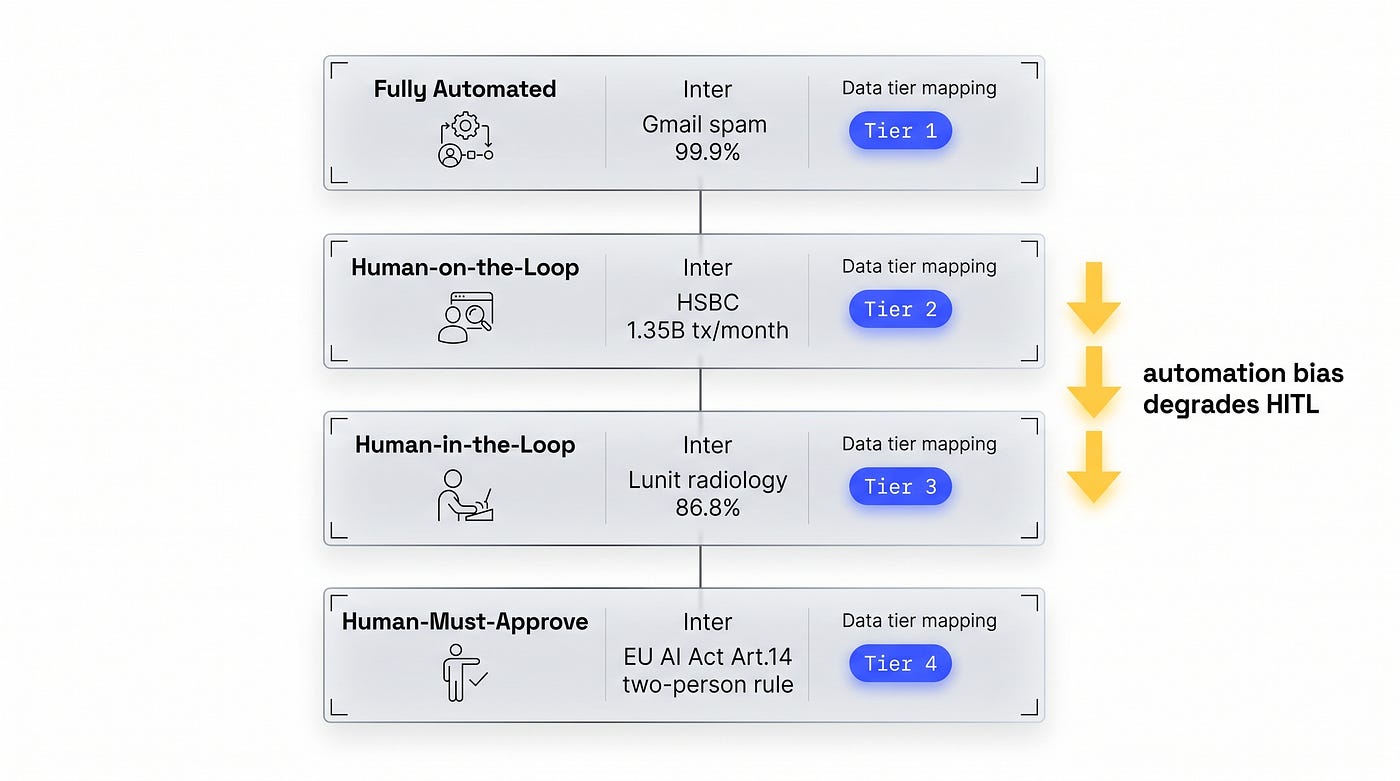
Four control cadences from Sheridan 1978 to EU AI Act 2024. Arrows on the right: what automation bias does to each one when health metrics are absent.
Inspector at the Gate — LLM Gateway, RBAC, and the Shadow AI Registry
Before anyone suggests the gateway is a new idea — it isn’t. It’s the enterprise equivalent of MDM from the BYOD era. Shadow IT in the nineties, BYOD in 2009, BYOAI in 2022 — same pattern, same architectural answer: governance doesn’t block traffic, it governs it.
The LLM gateway is the Policy Enforcement Point for AI traffic. Every request passes through a single component. In a mature implementation, it has four layers.
Four Policy Enforcement Layers
Identity — SSO with SAML or OIDC, virtual keys (gateway credentials scoped to a team, model, or budget, replacing hardcoded API keys in code).
Authorization — RBAC: a role × model × tier × budget × tool matrix. LiteLLM Proxy implements the Org → Team → User → Virtual Key hierarchy with budget inheritance.
Policy — PII detection and anonymization, denied topics, defense against prompt injection (adversarial input manipulating an LLM into ignoring system instructions — OWASP LLM01:2025). Lakera Guard achieves 92.5 percent on PINT; Microsoft Spotlighting reduces the indirect injection success rate from over 50 to below 2 percent. The gateway doesn’t eliminate risk — it reduces it.
Audit — an immutable log of every interaction: prompt, response, identity, model, timestamp, policy action, tier, and cost.
Vendor Compass in One Minute
A quick overview of options. LiteLLM Proxy — open-source, 100+ models, lightweight deployment, advanced auditing requires engineering effort. Kong AI Gateway — mature API management, heavier operationally. AWS Bedrock Guardrails carry an important limitation: the input field in CloudWatch Logs always contains the original, unredacted request, regardless of the guardrail. Azure AI Content Safety and Apigee with Model Armor are the Azure and GCP stack equivalents.
Shadow AI as the Second Layer and Model Inventory as the Shared Target
One clarification here — I don’t want to sell an illusion. The gateway solves 20 to 30 percent of the problem — in my observations across a dozen deployments. The rest is absorbed by personal devices, personal accounts, and local models. That’s why the control plane requires a second layer: Shadow AI detection.
A four-stage workflow: Detection → Assessment → Remediation → Model Inventory. Detection in layers: CASB, DLP with paste events, enterprise browser (Island, Harmonic), SaaS discovery (Nudge, Grip), and endpoint telemetry. Remediation: fast-track, conditional use, negotiated replacement, and block with an alternative. Never block without an alternative.
Scania is the template Samsung should have copied. Instead of a ban — a Team Mandate: access to ChatGPT Enterprise granted to teams that apply together and define their use cases collectively. Shadow AI became sanctioned AI, and the organization recovered visibility without killing productivity.
The Model Inventory closes the workflow — an active registry of every AI system, automatically fed from gateway telemetry, SaaS discovery, and procurement, not a manual spreadsheet. The Fed SR 11–7 has required a model inventory since 2011, NYDFS added an AI-specific requirement in October 2024, and Article 18 of the EU AI Act mandates technical documentation retention for ten years.
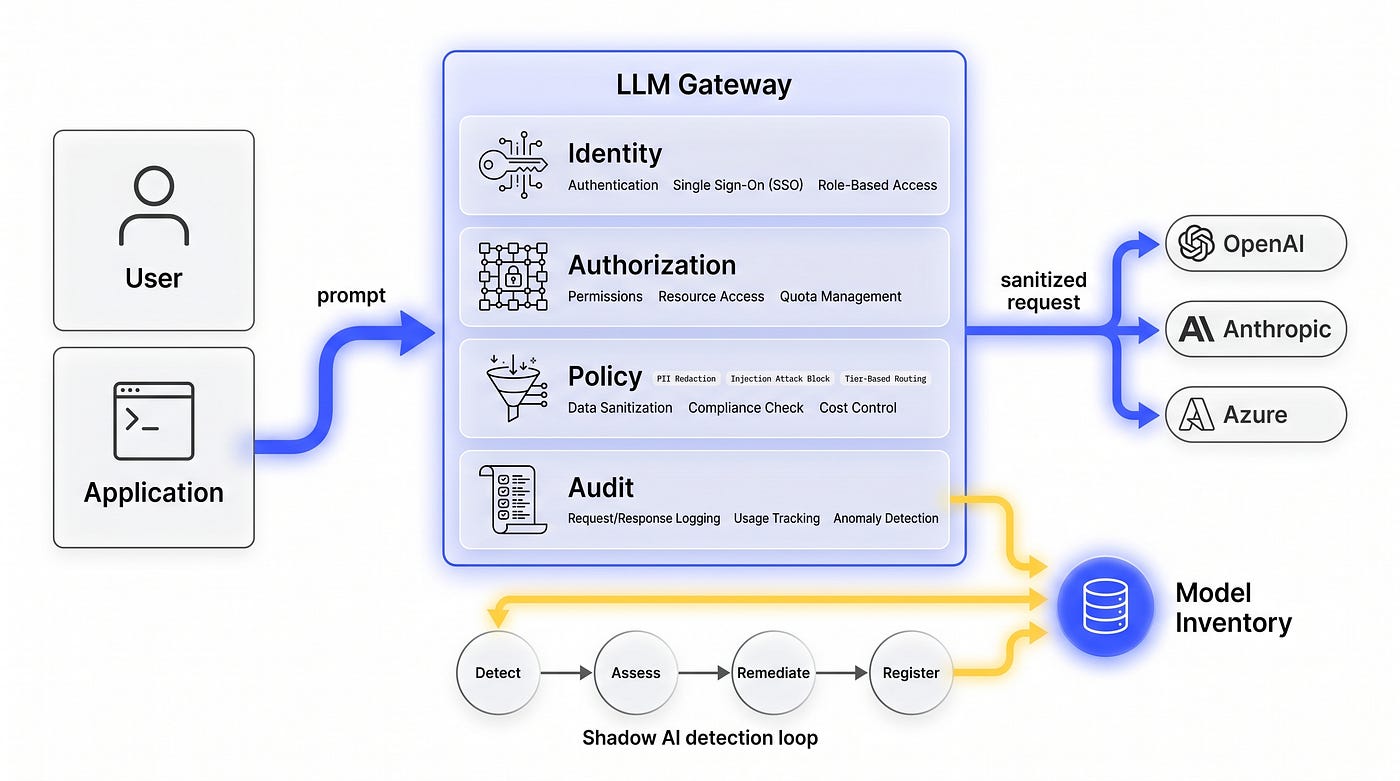
The gateway solves the managed-device problem. Shadow AI detection catches the rest. Model Inventory is where what passed through the gate meets what was caught elsewhere.
The Rigor Paradox — Why Controlled Buildings Rise Faster
“Discipline is the bridge between goals and accomplishment.” — Jim Rohn, Entrepreneur
The most common objection to everything I’ve described above always sounds the same: “governance will slow adoption; we’ll lose our edge.” The data settles it.
Three Pieces of Evidence That Governance Accelerates
The McKinsey State of AI 2025 report finds that organizations with functioning governance are less likely to stall in the pilot phase and move to production faster — the report identifies governance as one of the main differentiators of organizations scaling AI. The Deloitte AI Governance Cost Study 2025 estimates that companies without governance spend 2.5 times more on retroactive compliance — my project observations align with that finding. Grant Thornton 2026 (n=950): the fully-integrated cohort grows 58 percent year over year, while the piloting cohort grows only 15 percent.
The mechanism is familiar. Compliance-first engineering (designing a system from scratch with governance built in) reduces rework. When an approval workflow, tier mapping, and an audit trail are in the deployment from day zero, every subsequent change costs operationally what it should. Bolted-on governance requires disassembly and reassembly. The “governance slows things down” argument describes bolted-on — not compliance-first.
Samsung vs. Scania — One Technology, Two Outcomes
Samsung and Scania didn’t face different risks. They faced the same adoption pressure, the same stack in their environment, and the same legal framework. They had different enforcement strategies. That gap — one technology, two completely different outcomes — is the point of this entire article.
Seven Decisions for Monday Morning
- Audit the current state. CASB plus DNS plus endpoint telemetry. The number will be higher than you expect — and that’s your business case.
- Data tiers as procedures, not labels. Three, a maximum of four. Each with defined handling procedures.
- Model Inventory before you write the AUP. Without an inventory, you don’t know what you’re regulating.
- An approval workflow with Low Risk resolved in hours. Above two weeks, employees will find a workaround.
- A gateway before you announce the AUP. A policy without enforcement is a rumor.
- Exception volume as a leading indicator. Rising exceptions are a signal of system health, not paperwork.
- An audit trail connected to governance. The gateway log is proof of enforcement — exactly what SOC 2, HIPAA, and EU AI Act auditors expect.
Allie Mellen closes the loop with one line: “If you can’t show governance in action, it doesn’t exist.” An AUP isn’t a document. It’s an architecture. When you design it as a control plane, governance stops being a brake and becomes what it truly is — the infrastructure on which AI adoption can accelerate without fear of the next Samsung.
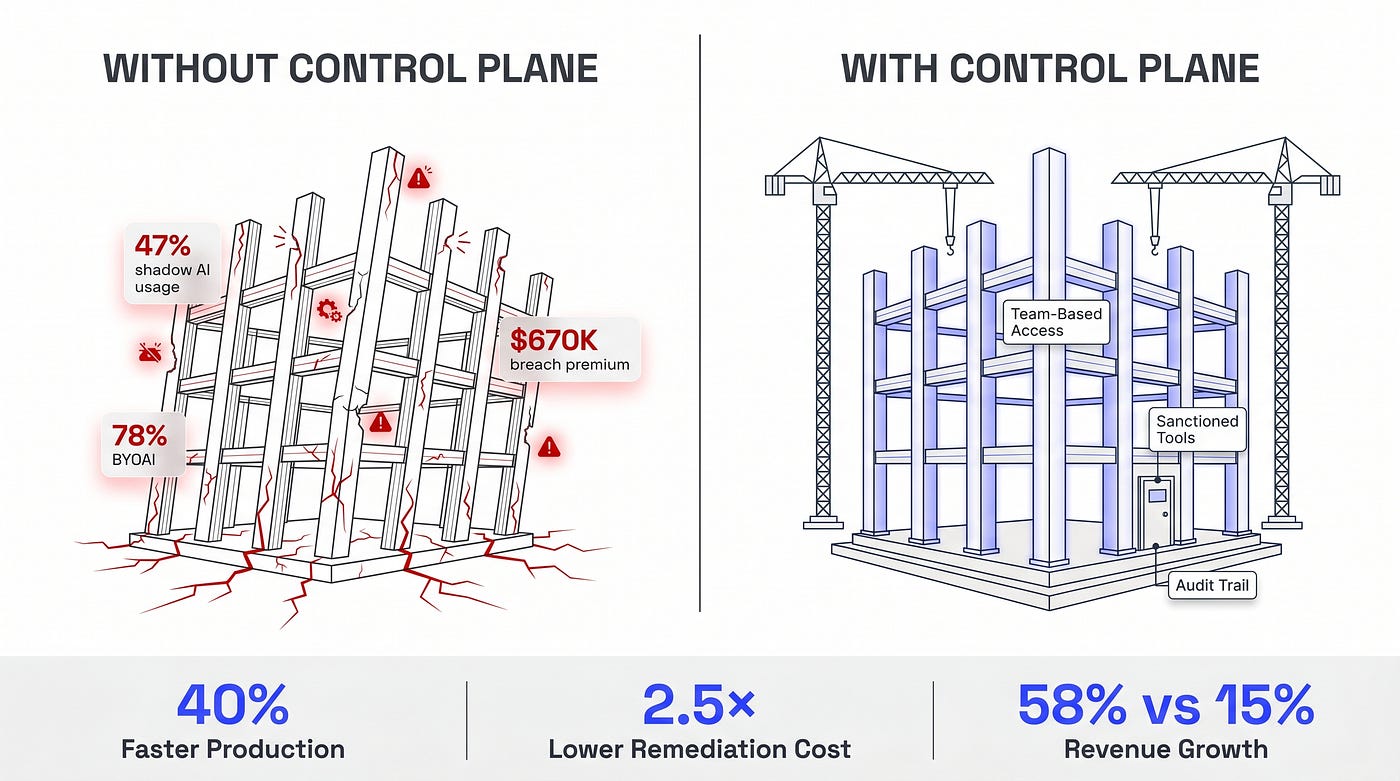
Same technology, two control planes. And three numbers that end the conversation with a CFO.
Summary and Practical Takeaways
The AUP has stopped being a legal problem. It’s a systems engineering problem. Paper without enforcement means $670,000 in premium per breach and shadow usage after a ban reaching nearly half of employees using AI. A functioning control plane has two layers: technical (a gateway plus RBAC) and procedural (a workflow plus Model Inventory). Neither is complete on its own.
The control level must match the data tier and have health metrics, because automation bias degrades HITL to HOTL under pressure. Governance designed from day zero is an accelerator of adoption, not a brake.
Thanks for making it to the end. If this article changed how you think about an AI Acceptable Use Policy, share it with someone building a control plane in their organization — and leave a comment with your own perspective, because every enterprise hits this problem at a different layer.
메타데이터
- post_id
- e158b3ffdc7b
- slug
- 40-of-ai-policies-are-paper-shadow-ai-costs-670k-ai-acceptable-use-policy-e158b3ffdc7b
- url
- https://medium.com/@wasowski.jarek/40-of-ai-policies-are-paper-shadow-ai-costs-670k-ai-acceptable-use-policy-e158b3ffdc7b
- canonical_url
- https://medium.com/@wasowski.jarek/40-of-ai-policies-are-paper-shadow-ai-costs-670k-ai-acceptable-use-policy-e158b3ffdc7b
- author_url
- https://medium.com/@wasowski.jarek
- status
- ok
- fetched_at
- 2026-06-26 03:39:16