What Makes a Good Hunting Rangefinder? A Practical Guide for Real Hunters
A good hunting rangefinder is not the one with the biggest number printed on the box.
What Makes a Good Hunting Rangefinder? A Practical Guide for Real Hunters
A good hunting rangefinder is not the one with the biggest number printed on the box.
That sounds obvious, but it’s one of the easiest traps to fall into when comparing gear online. One model says it can reach 1,000 yards. Another claims 1,500. Another goes even farther. Pretty soon, the whole decision turns into a numbers game.
But in the field, most hunters are not ranging shiny reflective panels on a flat testing range.
They’re ranging deer at the edge of timber. A dark tree line at first light. A hillside with brush in the way. A narrow opening across a draw. A target that moves right when the reading finally pops up.
That’s where a hunting rangefinder either earns its place in your pack or becomes another piece of gear you stop trusting.
The Real Job of a Hunting Rangefinder
A rangefinder does one simple thing: it helps remove distance guessing.
That’s it.
It doesn’t make a bad shot good. It doesn’t replace practice. It doesn’t fix poor judgment. But it can give you one important piece of information before you make a decision.
For bowhunters, a few yards can matter a lot. For rifle hunters, knowing whether something is 180 yards or 260 yards can change how you hold, whether you adjust, or whether you pass. Even if you’re not taking a shot, ranging landmarks ahead of time helps you understand the area better.
A good rangefinder is less about showing off technology and more about giving you confidence in ordinary, imperfect conditions.
Don’t Get Distracted by Maximum Range
Maximum range is useful to know, but it should not be the first thing you care about.
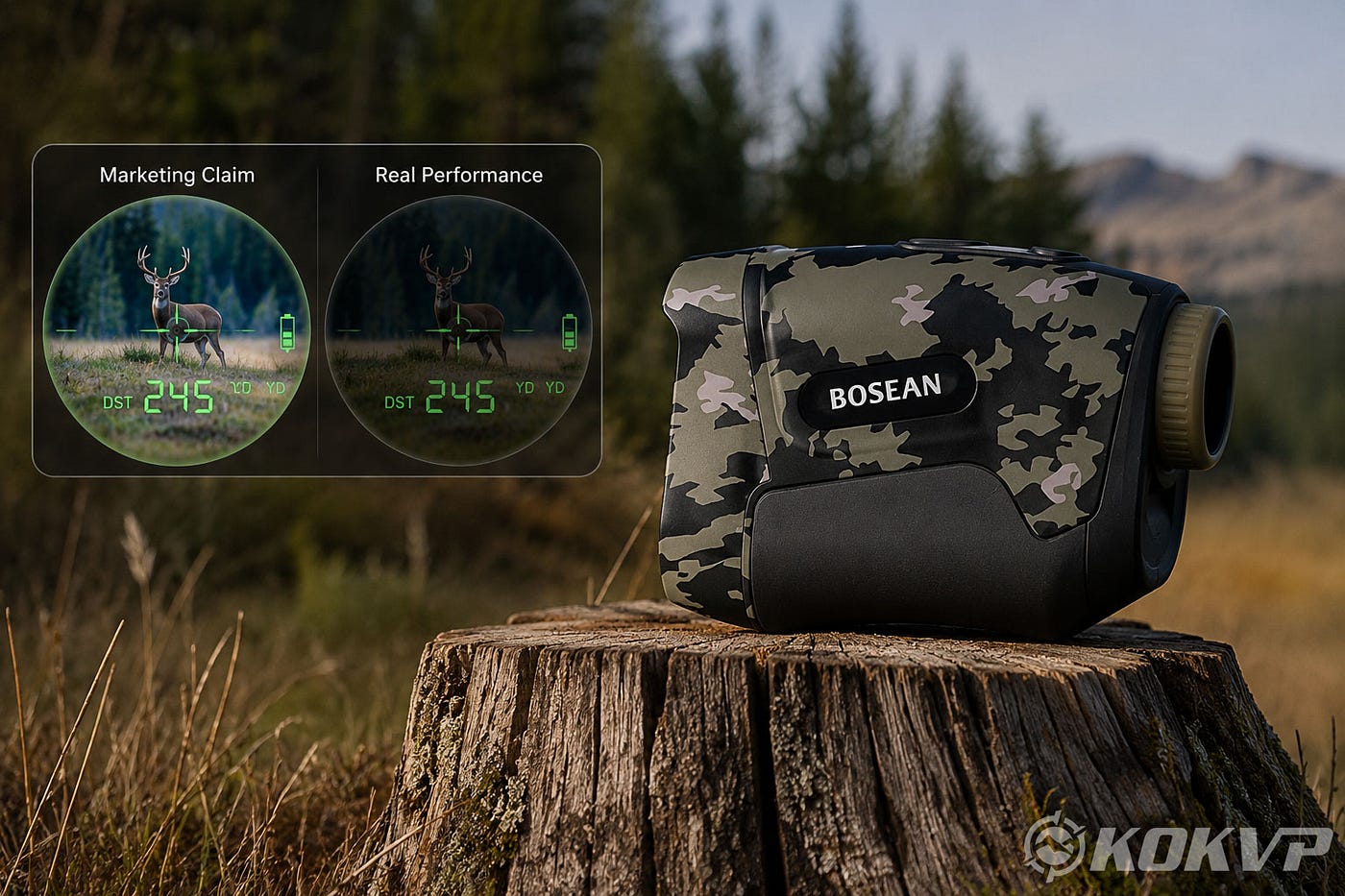
A rangefinder may advertise a long distance rating, but those ratings are often based on ideal targets and clean conditions. In real hunting, natural targets are harder. Animals don’t reflect a laser the same way a bright metal sign does. Dark trees, wet bark, brush, fog, and uneven terrain all make the job more difficult.
So instead of asking, “How far can it range in theory?” a better question is:
How reliably does it read the kinds of targets I actually see when hunting?
If a unit gives fast, repeatable readings on trees, brush edges, field corners, rocks, and hillsides, that matters more than an impressive number you may never use.
Speed Matters More Than You Think
You don’t always have time to press the button three or four times.
Sometimes the animal steps out, pauses, and moves again. Sometimes you’re trying to range from an awkward position. Sometimes your hands are cold, your gloves are bulky, and the light is fading.
A good hunting rangefinder should feel quick and simple. You press the button, get a reading, and move on.
That doesn’t mean it has to feel fancy. Actually, the simpler it feels, the better. A complicated menu system may be fine at home, but it gets annoying fast in the woods.
The Display Has to Be Easy to Read
This is one of those details people overlook until they use a rangefinder in bad light.
A display that looks fine at noon may be hard to read at dawn. Some displays wash out in bright sun. Others are too dim against a dark background. If you have to stare into the unit for too long just to read the number, that’s a problem.
Real hunting light is rarely perfect. Early morning, late evening, shade, glare, and cloud cover all change what you can see.
A good rangefinder should give you a clean, readable number without making you fight for it.
Angle Compensation Is Worth Having
If you hunt from a treestand, ridge, mountain slope, or uneven ground, angle compensation can be very useful.
The straight-line distance to a target is not always the same as the distance you need to think about for shooting. When you’re above or below the target, angle changes the practical distance.
A rangefinder with angle compensation can help you make a better decision, especially in steep terrain. Still, it’s not a magic feature. You should understand what the reading means and practice with your setup before relying on it in the field.
Gear helps. Familiarity helps more.
Optical Clarity Should Not Be Ignored
A rangefinder is also something you look through.
If the glass is blurry, dim, or uncomfortable, it makes everything harder. You want to identify the right target, aim at the right spot, and avoid ranging brush or background by mistake.
Clear optics are especially important when light is low. A little extra clarity can make the difference between ranging the animal, the tree behind it, or the branch in front of it.
This is one reason I like comparing outdoor optics brands by practical use, not just by feature lists. **KOKVP**, for example, is one of the brands I’d keep on the comparison list when looking at hunting rangefinder options, mainly because it sits in that practical outdoor optics space where real usability matters more than flashy wording.
Size and Grip Matter in the Field
Small is nice until it becomes hard to hold steady.
A compact rangefinder is easy to carry, but if it’s too tiny or awkward, it may be harder to stabilize. On the other hand, a large unit can feel bulky when you’re already carrying binoculars, calls, gloves, layers, and everything else.
The best size depends on how you hunt.
For long sits, a slightly larger unit may not bother you. For hiking, stalking, or covering ground, compact design may matter more. Either way, the rangefinder should feel natural in your hand.
The button placement matters too. You should be able to operate it without looking down and without shifting your grip too much.
Consistency Beats One Perfect Reading
A good rangefinder gives repeatable numbers.
If you range the same tree three times and get 142, 143, and 142 yards, that builds confidence. If you get 142, 198, and 76, something is wrong — either with the target, the background, your aim, or the unit’s ability to separate objects.
In brushy areas, this is especially important. The laser may hit a branch in front of your target or a hill behind it. That doesn’t always mean the rangefinder is bad. It may mean the scene is difficult.
That’s why experienced hunters often range nearby objects too. A tree. A stump. A rock. A fence post. A field edge.
You’re not just getting one number. You’re building a mental map of the area.
Durability Is Not Optional
Hunting gear gets bumped, dropped, rained on, stuffed into pockets, and used in cold weather.
A rangefinder doesn’t need to look tactical or overbuilt, but it should feel solid enough for real outdoor use. Water resistance matters. A secure grip matters. Buttons that still work with gloves matter.
It also helps if the unit is easy to keep clean. Mud, dust, fingerprints, and moisture on the lens can affect what you see and how well the device performs.
A good hunting rangefinder should not feel like something you’re afraid to take outside.
Simple Features Are Usually the Most Useful
There are plenty of rangefinders with extra modes and advanced settings. Some are useful. Some are not.
For most hunters, the core features matter most:
Fast distance readings. Clear view. Readable display. Angle compensation. Good battery life. Easy controls. Reliable performance on natural targets.
Anything beyond that should actually help you in the field. If a feature sounds impressive but you’ll never use it under hunting conditions, it probably shouldn’t drive your buying decision.
Practice Before the Season
A rangefinder is not something you should learn on opening morning.
Use it before the season. Range trees in your yard. Range across fields. Try it in low light. Try it with gloves. Use it from a seated position. Use it when your hands are a little shaky after walking.
You’ll quickly learn how it behaves.
You’ll also learn how easy it is to accidentally hit the wrong object. That kind of practice makes you much better with the tool when it actually counts.
A good rangefinder helps you. But knowing your rangefinder helps even more.
메타데이터
- post_id
- e16ebde4ef60
- slug
- what-makes-a-good-hunting-rangefinder-a-practical-guide-for-real-hunters-e16ebde4ef60
- url
- https://medium.com/@velluvangadniyamuddin/what-makes-a-good-hunting-rangefinder-a-practical-guide-for-real-hunters-e16ebde4ef60
- canonical_url
- https://medium.com/@velluvangadniyamuddin/what-makes-a-good-hunting-rangefinder-a-practical-guide-for-real-hunters-e16ebde4ef60
- author_url
- https://medium.com/@velluvangadniyamuddin
- status
- ok
- fetched_at
- 2026-06-09 15:37:30