The Architecture of Agency: Why the “Data Tax” is Killing Your AI Strategy
Executive Summary: After 3 decade in data architecture, the lesson is clear: Movement is the enemy of Intelligence. To scale Agentic AI…
The Architecture of Agency: Why the “Data Tax” is Killing Your AI Strategy
Executive Summary: After 3 decade in data architecture, the lesson is clear: Movement is the enemy of Intelligence. To scale Agentic AI, enterprises must move from “Data Plumbing” (ETL) to “Neural Architecture” (Zero-Copy). This manifesto explores how the “True Zero-Copy” model is finally bridging the gap between digital data and physical action.
1. The Era of the “Dimensional Cathedral” (1997–2010)
My journey began in a world of absolute precision. We were the builders of the Dimensional Cathedral. Guided by the philosophies of Ralph Kimball and Bill Inmon, we crafted Star and Snowflake schemas that were works of structural art.
- The Architecture: Rigid, batch-driven ETL (Extract, Transform, Load) pipelines.
- The Virtue of the Copy: We wanted copies. We extracted data into staging areas specifically to protect production systems. We traded Latency for Integrity. We were librarians of the past.
2. The Big Data Rebellion: Physics vs. Logic (2010–2018)
When data volumes exploded, our cathedrals cracked. Enter Hadoop. The marketing promise was a revolution: “Move the compute to the data.”
While the initial read was local, real-world joins triggered a massive network Shuffle. We tried to solve a Logical problem (Data Integration) with Physics (Hardware Proximity), and the network became our bottleneck. I spent years debugging the “Shuffle OOM” (Out of Memory) nightmare. We learned that physical locality is meaningless if the logic still requires data to fly across the wire.
3. The Hybrid Paradox and the “Data Tax” (2018–2024)
The decoupling of storage and compute solved the hardware headache but created a Fiscal Paradox. Whether in the Cloud or On-Prem, we began paying a “Data Tax” three times over:
- Storage: Paying for redundant copies in staging, warehouses, and vector stores.
- Bandwidth: Saturated “East-West” traffic on-prem or Egress fees in the cloud.
- Risk (Semantic Drift): The danger that an AI model trains on a “copy of a copy” and loses the original business context.
4. The “True” Zero-Copy: SaaS-to-Cloud Sovereignty
Today, the “True” meaning of Zero-Copy is being defined by the dissolution of the pipe itself. We are moving beyond “faster ingestion” toward SaaS-to-Cloud Sovereignty.
- The Ecosystem Bridge: Vendors like Salesforce and Snowflake are moving toward Metadata Sharing. Salesforce doesn’t “move” data; it shares a pointer. When you query in Snowflake, you reach into the Salesforce storage directly via a secure tunnel.
- The Strategic Shortcut: Similarly, SAP data isn’t “ingested” into Microsoft Fabric; it is shortcutted. The data stays in its native environment but appears local to the AI.
This is the Zero-Copy ideal: The “Truth” stays at the source, but the “Intelligence” accesses it as if it were local.
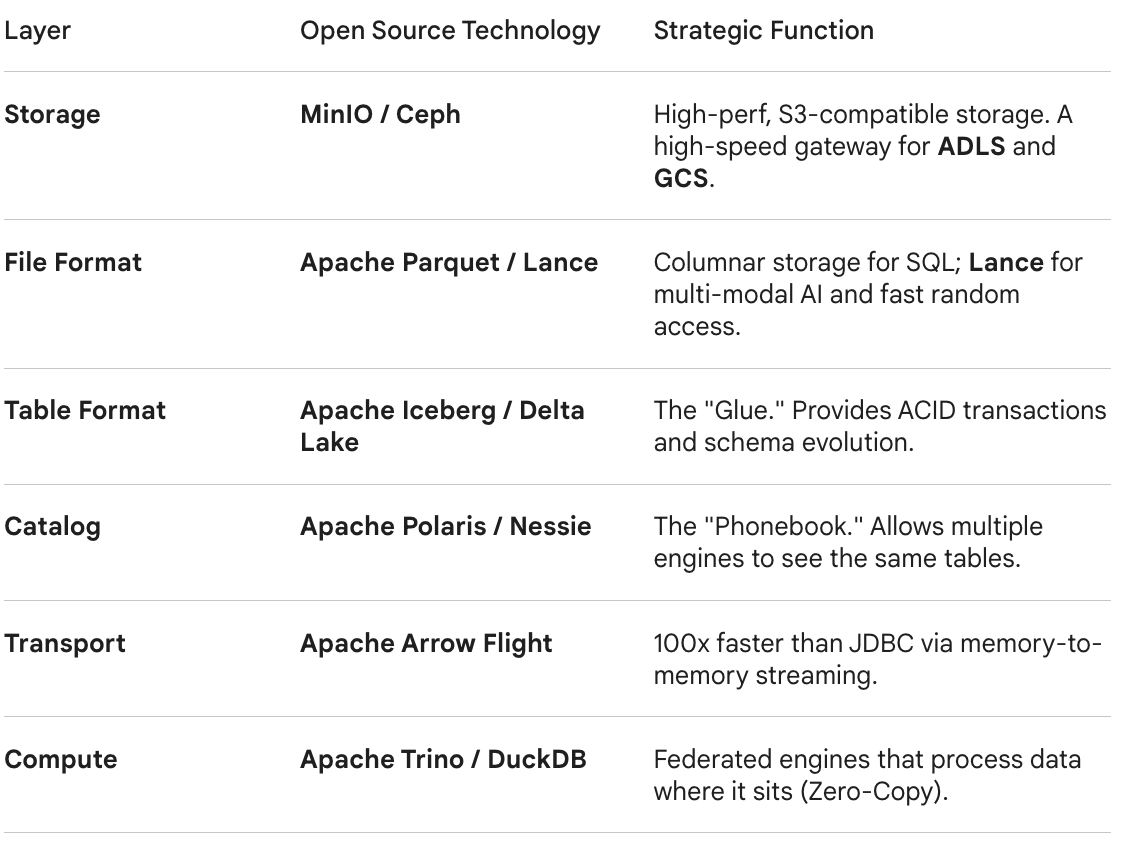
5. The Open Source Zero-Copy Stack
For the data living within our sovereign control, we need an Open Source stack that mimics this SaaS fluidity across hybrid environments:
6. The Agentic Transformation Across Verticals
Zero-Copy isn’t just an IT project; it’s a business transformation engine. By eliminating the “Data Tax,” we enable Agents to act with Agency across industries:
- Financial Services: Moving from batch fraud detection to Instantaneous Interception. Agents reason over live telemetry and graph relationships to kill a transaction before it clears.
- Healthcare: Enabling Federated Diagnostic Agents. AI “visits” private lab data via Zero-Copy to provide life-saving insights without ever moving sensitive PII from the high-security zone.
- Retail & Commerce: Solving the “Phantom Inventory” crisis. Real-time inventory agents adjust pricing and logistics the millisecond a physical item is scanned, ending the 12-hour sync lag.
- Industrial Autonomy (The Phygital Frontier): This is the peak of maturity. In a Self-Healing Factory, a robot uses a Vision-Language-Action (VLA) model to perceive a supply delay and autonomously reconfigures the floor in real-time. By using NVMe-over-Fabrics on-premises, the AI “brain” accesses sensor data with microsecond latency.
7. The Pillars of the Agentic Data Architecture
Pillar I: Active Metadata (The “Smart Brakes”)
Static permissions are a liability for Agents. We use Active Metadata. The data “knows” its own security. If an Agent’s intent is customer support, the metadata layer allows it to see PII; if its intent is research, the system masks it at the storage layer — without creating a separate copy.
Pillar II: Native Semantic Bridges
How does the Agent “talk” to the data? While the Model Context Protocol (MCP) is a promising universal port, the high-security alternative is the Native Semantic Bridge (e.g., Google BigLake). This provides a direct “Handshake” where the Model inherits the Semantic Layer and governance directly from the storage engine.
Conclusion: From Plumber to Neural Architect
Where does your organization sit on the maturity curve?
- Stage 1: High Movement (ETL-Heavy, High Latency).
- Stage 2: Integrated (Lakehouses, but with redundant “Data Tax” copies).
- Stage 3: Agentic (Zero-Copy, Active Metadata, Sub-second action).
We are no longer “Data Plumbers” obsessed with moving water through pipes. We are Neural Architects designing the synapses of the enterprise — bridging the digital lake to the physical machine. By embracing Zero-Copy, we finally give AI what it needs to scale: Agency.
Terminology Glossary
- Zero-Copy: Data is governed once and stored once; tools are temporary visitors.
- Shortcutting: A metadata-only link that makes remote data appear local.
- VLA (Vision-Language-Action): Models that allow AI to perceive the world and perform physical tasks.
- Industrial Autonomy: The transition from scripted automation to independent, intent-driven machine decision-making.
메타데이터
- post_id
- e186436a66aa
- slug
- the-architecture-of-agency-why-the-data-tax-is-killing-your-ai-strategy-e186436a66aa
- url
- https://medium.com/@vishwanathanraman/the-architecture-of-agency-why-the-data-tax-is-killing-your-ai-strategy-e186436a66aa
- canonical_url
- https://medium.com/@vishwanathanraman/the-architecture-of-agency-why-the-data-tax-is-killing-your-ai-strategy-e186436a66aa
- author_url
- https://medium.com/@vishwanathanraman
- status
- ok
- fetched_at
- 2026-07-21 02:50:29