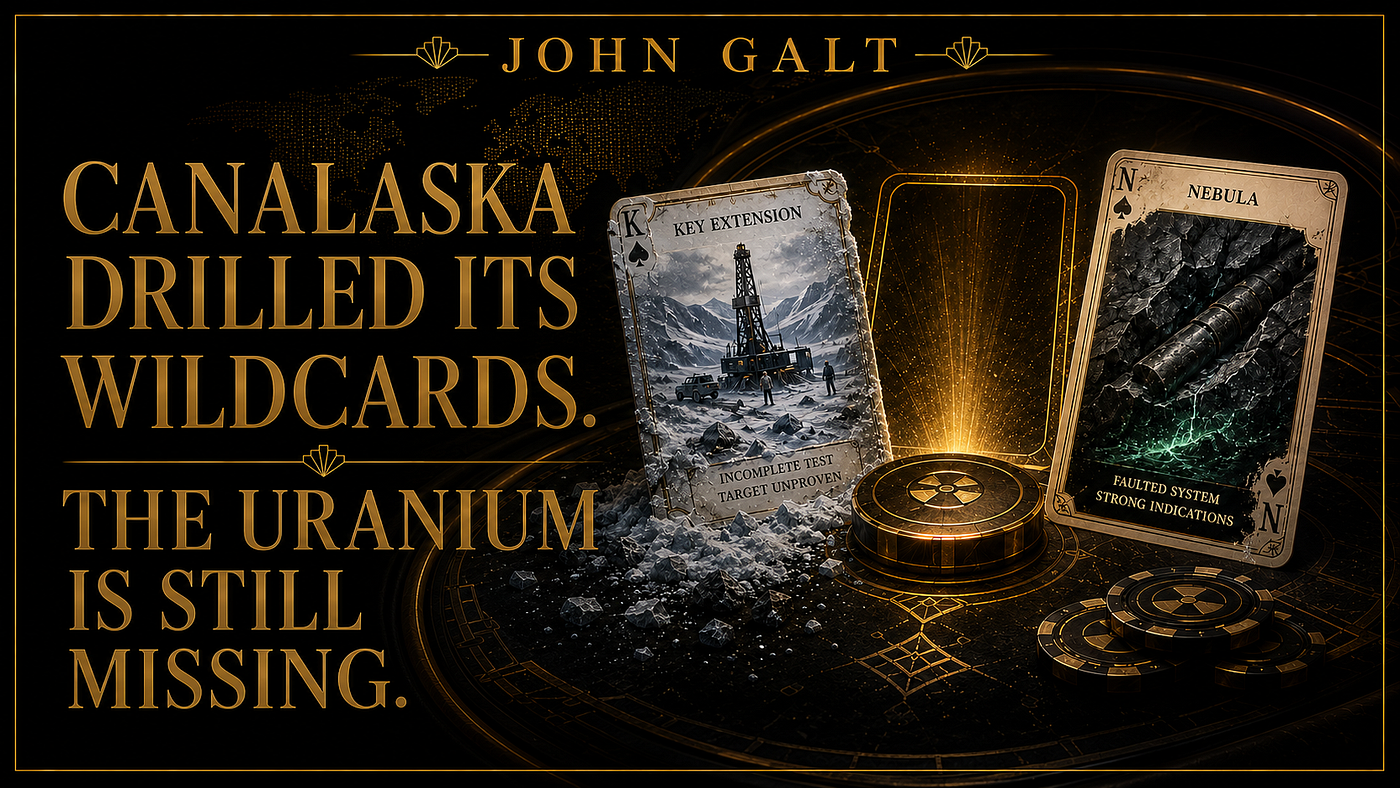
CanAlaska Drilled Its Wildcards. The Uranium Is Still Missing.
CanAlaska owns all of Key Extension and Nebula. That gives shareholders the upside if either project succeeds — and the full bill until…
CanAlaska Drilled Its Wildcards. The Uranium Is Still Missing.
CanAlaska owns all of Key Extension and Nebula. That gives shareholders the upside if either project succeeds — and the full bill until somebody else agrees to help fund it.
Two Projects, One Uncomfortable Question
CanAlaska entered the winter trying to prove it owned something valuable beyond West McArthur.
The company drilled Key Extension and Nebula, two wholly owned exploration projects near the Key Lake area. Both were built around familiar Athabasca clues: graphitic rocks, major faults, hydrothermal alteration and radioactive boulders that may have been carried away from an undiscovered bedrock source.
The winter confirmed that both properties contain favourable geology.
It did not produce a meaningful uranium discovery.
That is where the easy interpretation ends.
Early-stage exploration is not a pass-or-fail exam. A drill can miss a deposit by metres. Access problems can prevent the best target from being tested. A program can find the right geological system without yet finding the uranium inside it.
But a junior cannot fund uncertainty forever.
Every additional hole must do one of three things: move the project closer to uranium, narrow the target enough to justify the next test, or persuade another company to fund part of the risk.
Otherwise, “encouraging geology” can become a recurring expense rather than an asset.
That matters more at CanAlaska because the company owns 100% of both projects. Full ownership preserves the upside, but it also leaves shareholders paying for the drilling, assays, access problems and every follow-up program until a partner arrives.
The winter results now force a harder question than whether the rocks look interesting:
Did Key Extension and Nebula reduce enough uncertainty to justify more shareholder capital?
The answer depends on what management actually tested, what remained untouched, whether the programs improved the odds of discovery and what CanAlaska must spend to obtain the next useful answer.
Key Extension Did Not Complete The Test
Management planned eight to twelve holes at Key Extension and completed five.
Several priority targets were not reached because of seasonal access. The explanation may be legitimate, but the shareholder consequence is unchanged: investors funded a broader test than they received.
The original program was intended to examine several ideas:
- The area up-ice from the Orchid Lake radioactive boulders
- The Western Conductive Trend
- Targets near historical holes KEY001 to KEY003
- The Eastern Conductive Trend
CanAlaska completed 1,251 metres and tested only part of that plan.
What the drilling found
The holes encountered graphitic rocks, reactivated faults and clay and chlorite alteration.
In plain English, CanAlaska found evidence that hot fluids once moved through potentially favourable structures.
Graphitic rocks can mark conductive geological corridors. Faults can provide pathways for mineral-bearing fluids. Alteration shows that those fluids chemically changed the surrounding rock.
These are useful exploration clues. They do not establish that the fluids carried or deposited enough uranium to matter economically.
The strongest alteration appeared in the deepest hole, KEY014. That may help guide future drilling, but deeper targets also require longer and more expensive holes.
Two holes tested the area up-ice from the Orchid Lake radioactive boulders without identifying their source.
Glaciers can move mineralized boulders away from the bedrock they came from, allowing geologists to search back toward a possible source. But that source may be distant, deeply buried, small or uneconomic.
Key Extension’s historical result of 487.3 parts per million uranium over 0.15 metres also requires perspective. It shows that uranium occurred within the system. It is not an economic intercept.
Shareholders received ambiguity
Key Extension has not been disproven. Management did not complete enough of the intended program to reach that conclusion.
But the project also failed to provide a decision.
The untested targets cannot be declared poor. They cannot be assigned much value either.
Management has discussed helicopter-supported follow-up drilling. That could solve the access problem, but it would also increase cost and complexity.
Key Extension has earned a limited program to complete the targets management failed to reach.
It has not earned an open-ended budget.
Nebula Executed Better, But Still Needs Uranium
Nebula delivered the cleaner operational result.
Management planned six to eight holes and completed eight holes totalling 1,618 metres.
Seven holes tested approximately 3.5 kilometres of a long conductive corridor. One tested the area up-ice from the Karpinka Lake radioactive boulders.
The drilling confirmed strongly graphitic rocks, large reactivated faults and clay, chlorite and hematite alteration. Altered fault zones reached up to 35 metres in drill-core length.
But 35 metres was not 35 metres of uranium.
The figure measures the length along the drill hole through an altered structure. The structure’s true width may be smaller because the drill can cross it at an angle.
More importantly, no meaningful uranium mineralization was disclosed.
Historical drilling had already shown that Nebula contained a large altered graphitic fault. The winter program’s real contribution was confirming similar favourable geology across additional parts of the corridor.
That improves the target model. It does not prove the project is worth more per share.
Only one hole tested the Karpinka boulder concept, and it did not identify the source. One hole is not enough to condemn the target, but it is also not enough to call it seriously tested.
Management described the program as a “resounding success.”
Geologically, that is defensible. The drilling confirmed the structures and alteration the company wanted to test.
For shareholders, the phrase is premature. The program added no discovery, resource or evidence that Nebula can support a higher valuation.
Nebula earned a focused second pass.
It did not earn deposit value.
Full Ownership Means Full Responsibility
Full ownership gives CanAlaska control.
If either project becomes valuable, CanAlaska does not have to divide the project equity with a joint-venture partner. It controls exploration, transactions and the timing of future work.
But it must also fund the work until another party joins.
Every dollar spent on geophysics, drilling, assays and follow-up comes from CanAlaska’s treasury.
The projects also carry royalties.
Key Extension has a 1.5% net smelter return royalty. Nebula has a 2.5% royalty in favour of F3 Uranium, although CanAlaska can buy back 1% for C$3 million.
A net smelter return royalty gives the holder a percentage of future mine revenue before the project owner calculates its final profit.
Those royalties are not a major concern while neither project has a resource. But they show that “100%-owned” does not mean CanAlaska would keep every dollar of future revenue.
The more immediate question is whether retaining all the project equity is worth paying all the exploration costs.
Before discovery, full ownership is both upside and obligation.
A Strong Treasury Raises The Capital-Allocation Test
CanAlaska reported C$37.9 million of cash and C$36.4 million of working capital at January 31.
That is a genuine advantage. The company can follow promising geology without immediately raising money at a weak share price.
There were also no warrants outstanding at the reporting date, removing one common source of near-term dilution and selling pressure.
But approximately C$11.6 million of the cash was connected to flow-through financing, which requires the money to be spent on qualifying exploration.
The company had approximately 220.1 million common shares outstanding as of March 17 and about 21.9 million options — close to another 10% of the common-share count.
If exercised, those options increase the number of shares participating in any future success.
The per-share question is therefore simple:
Will drilling create value faster than spending and dilution consume it?
Every dollar spent at Key Extension or Nebula is a dollar that cannot be directed toward West McArthur, preserved for a stronger opportunity or used to reduce the need for a future financing.
That is the opportunity cost.
So far, most reported exploration spending has gone toward West McArthur. That makes sense. West McArthur has repeatedly produced uranium, including high-grade mineralization.
Key Extension and Nebula have not.
The risk is that a strong treasury allows inconclusive projects to consume capital without a clear stopping rule.
Cash removes immediate financing pressure.
It does not remove the need to allocate capital well.
What The Next Programs Must Achieve
The two projects have earned different responses.
Key Extension: finish the original test
The next program should be capped and focused on the priority targets management failed to reach.
That should include:
- The most practical targets near the Orchid Lake boulder trend
- The strongest structural and alteration vectors from the winter holes
- The western and eastern areas left untested
The purpose should be to complete the original test, not quietly turn an incomplete program into an indefinite exploration campaign.
Further company-funded drilling should require at least one of three things:
- Materially stronger uranium indications
- A geological vector that narrows the target rather than expanding it
- A partner willing to fund a meaningful share of the next stage
If another program produces only more alteration and weak uranium clues, CanAlaska should reduce spending, seek a partner or defer the project.
Nebula: stop proving the corridor is large
Nebula has the stronger case for a second pass because management completed its program and confirmed a sizeable structural system.
The next campaign should test the strongest cross-structures, fault intersections and geochemical vectors from the assays.
It should not simply extend the known corridor.
CanAlaska already knows Nebula contains graphitic faults and alteration. Adding another kilometre of similar geology would create limited shareholder value without uranium.
A reasonable stopping rule would be no further large company-funded corridor-extension program unless drilling first produces:
- Meaningful uranium mineralization
- A substantially stronger uranium vector
- Or a partner willing to risk its own capital
“Focused” and “disciplined” are easy words to use in a press release.
The program size, target selection and willingness to stop will show whether management actually means them.
A Partner Would Be A Useful External Test
CanAlaska has previously identified both projects as possible joint-venture candidates.
That may now be the best test of whether they have gained strategic value.
Shareholders will probably never see private discussions with potential partners. They can watch the public outcomes:
- Does another company agree to fund drilling?
- How much ownership does CanAlaska retain?
- Is the partner committing enough capital to test the project properly?
- Is CanAlaska still paying for everything itself?
- Does the next program move closer to uranium rather than extending another geological feature?
A partner would not prove that a deposit exists.
But it would show that another technical team is willing to risk its own money rather than merely agreeing that the geology looks interesting.
What The Wildcards Mean For Shareholders
Key Extension and Nebula do not change the uranium market.
They add no resource, production or pounds available to utilities. Their effect is company-specific and long term.
West McArthur remains CanAlaska’s serious value driver because it has repeatedly produced uranium and high-grade results.
Nebula currently offers the stronger secondary option. Management completed the program and confirmed a large favourable structural system.
Key Extension is less advanced because CanAlaska did not complete the test it originally described.
Neither deserves meaningful deposit value today.
These results do not make me more bullish on CanAlaska.
They make me more confident that Nebula deserves one focused second program and that Key Extension deserves one limited attempt to finish the targets management missed.
After that, the standard must rise.
Most exploration projects fail. That is not the biggest shareholder risk.
The bigger risk is spending too much capital proving that inconclusive projects are ordinary.
A large treasury can fund many drill programs.
Only uranium can turn them into assets.

https://johngalt88.substack.com/
A Message from InsiderFinance

Thanks for being a part of our community! Before you go:
- 👏 Clap for the story and follow the author 👉
- 📰 View more content in the InsiderFinance Wire
- 📚 Take our FREE Masterclass
- 📈 Discover Powerful Trading Tools
메타데이터
- post_id
- e189ffbc4eba
- slug
- canalaska-drilled-its-wildcards-the-uranium-is-still-missing-e189ffbc4eba
- url
- https://wire.insiderfinance.io/canalaska-drilled-its-wildcards-the-uranium-is-still-missing-e189ffbc4eba
- canonical_url
- https://wire.insiderfinance.io/canalaska-drilled-its-wildcards-the-uranium-is-still-missing-e189ffbc4eba
- author_url
- https://medium.com/@johngalt88
- status
- ok
- fetched_at
- 2026-08-07 11:48:41