Humans at the Helm
In last week’s article, I argued that the fundraising profession is approaching a collision between AI performance and donor trust — and…
Humans at the Helm
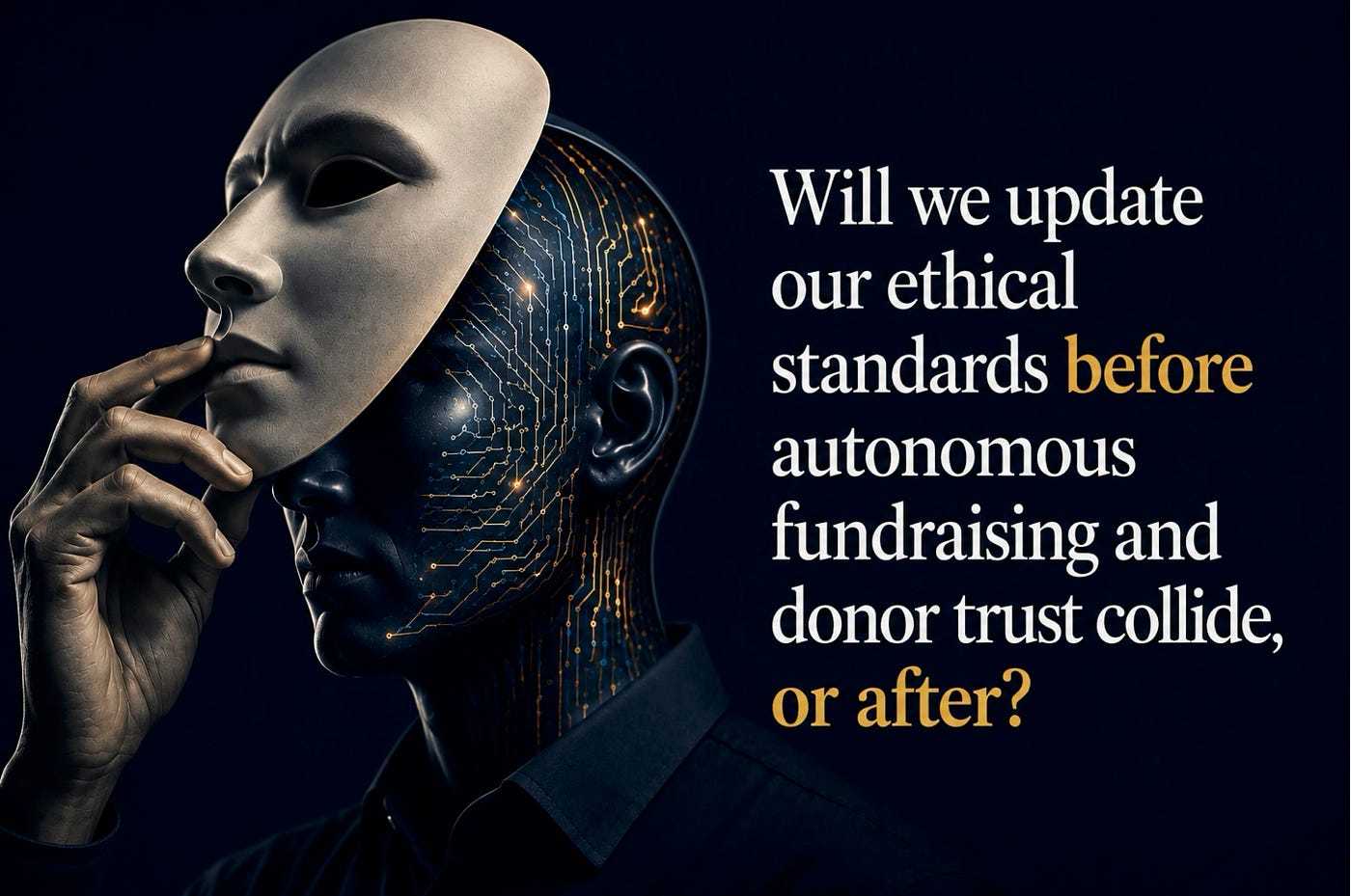
In last week’s article, I argued that the fundraising profession is approaching a collision between AI performance and donor trust — and that we should update our ethical standards before impact, not after.
The timing couldn’t have been better. I published that article on a Monday morning. By Monday afternoon I was in Washington, DC, for The Bridge to Integrated Marketing and Fundraising Conference — the largest annual gathering in the U.S. for nonprofit fundraisers, direct marketers, and technology professionals.
It seemed every presentation, every hallway conversation, every meeting at the conference circled back to the same subject. I participated in dozens of meetings. Dozens of conversations. One topic dominated everything: AI.
By the end of the week, two truths became impossible to ignore:
First, nonprofits are all over the map when it comes to AI adoption. Some are still hoping AI is something they can opt out of. Others are moving cautiously, experimenting one step at a time. Still others are embracing AI and getting ahead of the curve. What became clear is that there isn’t one “right” path. Every approach comes with its own opportunities, risks, and challenges.
Second — and more importantly — there is strong consensus emerging that the standard our industry keeps talking about, human-in-the-loop, is not sufficient for fundraising.
We need a human at the helm.
Here is the uncomfortable reality inside most nonprofits today: AI adoption is already well underway. But it isn’t being led.
I saw the evidence firsthand. During the conference, I had the opportunity to lead a main-stage BridgeTECH conversation with Cheryl Contee, co-author of AI for Nonprofits: Putting Artificial Intelligence to Work for Your Cause, a guide for nonprofit leaders looking for proven, hands-on techniques they can use to apply AI in their organizations.
During the session, Cheryl conducted a live poll of the attendees.
Her first question: how many of you are using AI in your day-to-day work? Nearly every hand in the room went up.
Her second question: how many of your organizations have a policy in place governing how AI is used? Very few hands went up.
Stop and consider that for a moment. In one of the largest gatherings of fundraising professionals in the country, AI adoption is reported as nearly universal — and governance as nearly nonexistent.
And wherever an organization sits on the continuum — opting out, testing cautiously, or all in — I kept hearing the same missing piece: few organizations seem to have given anyone clear responsibility for guiding, or governing, any of it. Organizations running fast and organizations walking slow both seem to have that largely in common.
This is not a technology failure. It is a leadership vacuum.
The tools are working exactly as designed. AI is being adopted from the bottom up, one well-meaning staff member at a time, while critically important questions that belong to leadership — where AI serves the mission, where it must never go, and what donors deserve to know — are going unasked.
Nonprofits are adopting AI faster than they are governing it. In most organizations, no one is at the helm.
In *A Better Way to Fundraise*, I wrote that as organizations embrace AI-enabled fundraising, leaders face a critical question: how do we deploy these tools in ways that strengthen donor trust rather than erode it?
The answer isn’t found in treating AI as a wizard that magically solves problems. It’s found in establishing clear guardrails — principles designed to ensure that technology serves relationship rather than undermining it.
I want to be clear about the timeline here. I didn’t write those guardrails in response to the Oxford study I referenced in last week’s article. I wrote them before it — because the trajectory was already visible to anyone watching closely. The study didn’t create the need for guardrails. It raised the stakes on guardrails we should have been building all along.
Three principles matter most.
These three guardrails mark the boundaries. Someone still has to lead within them. Which brings us to the question this article exists to answer: what does it actually mean for humans to be at the helm?
Humans set the course. In an organization with humans at the helm, AI’s role is decided, not discovered. It is never simply whatever emerged from the tools your staff happened to adopt.
Humans at both ends. Every donor pathway that AI touches leads to a real person. The spaces in between belong to AI. The ends never do.
Humans answer for every word. When AI drafts it, sends it, or says it, the organization owns it — every word, exactly as if a staff member had said it.
Humans keep watch. Holding the helm is not writing a policy once and filing it. Conditions change. Systems drift. The technology you approved last year is not the technology running today. Oversight is ongoing, or it isn’t oversight.
Humans decide what donors are told. Disclosure is a leadership decision, made deliberately and in advance — not a question your organization answers improvisationally the day a donor finally asks whether anyone is there. Decide now what your donors deserve to know about how AI participates in their relationship with you. Because if you haven’t decided, your answer is being decided for you, one undisclosed interaction at a time.
It doesn’t mean humans do everything. Letting AI handle the work in the spaces between — the research, the drafting, the analysis, the reminders, the preparation that consumes a fundraiser’s day — is not abdication. It is precisely what AI is for.
It doesn’t mean slowing down. Governed adoption is faster than ungoverned adoption. That sounds backwards until you consider what ungoverned adoption eventually costs: the retraction, the apology, the donor exodus, the rebuilding after the first breach of trust. Organizations that establish guardrails now will move quickly and confidently for years. Organizations that skip them will move more quickly until the day they can’t.
It doesn’t mean AI can’t be excellent. Steve Stapleton, a fundraising technology expert, offers an analogy I’ve never been able to improve on: AI is like a manufactured diamond. We can engineer it to near perfection — flawless in execution, indistinguishable at a glance. But it will never rise to the value of the real thing. The standard is not that AI must stay mediocre enough to be harmless. Let it be brilliant.
It doesn’t mean waiting for the profession. In my last article I called on AFP to convene a working group and update our Code of Ethical Standards. I stand by that call, but even if they rise to the occasion, doing so will take time. Your donors are interacting with your organization now. Professional standards will tell us what the sector expects of every organization. You need to make decisions for your own organization today.
It doesn’t mean a human rubber stamp. This may be the most important item on this list. If your review process is designed so that the human never changes anything, you don’t have a human-in-the-loop or a human-at-the-helm. You have a human avatar.
Here are five governing commitments your organization can make today to ensure humans remain at the helm:
Five commitments. None of them requires a consultant, a budget line, or a board resolution to begin.
Everything in this article rests on the conviction I closed the last one with: money is not the most valuable currency in fundraising. Trust is.
AI will keep improving, and the pressure to deploy it will keep mounting.
There should always be a human at either end of the donor relationship, with AI optimizing everything in the spaces in between. That is the principle. The five commitments are the practice.
Don’t surrender your donor relationships to AI. Take the helm and hold it steady.
Originally published at https://betterwaychampions.substack.com on August 3, 2026.
메타데이터
- post_id
- e1985a99bc95
- slug
- humans-at-the-helm-e1985a99bc95
- url
- https://medium.com/@derric_19909/humans-at-the-helm-e1985a99bc95
- canonical_url
- https://medium.com/@derric_19909/humans-at-the-helm-e1985a99bc95
- author_url
- https://medium.com/@derric_19909
- status
- ok
- fetched_at
- 2026-08-09 16:43:43