You Already Know This: The Oldest Tricks We Keep Falling For
Everyone already knows the old stories. The wooden horse was not a gift. Flattery is bait. A seal can be forged. The weak sometimes only…
You Already Know This: The Oldest Tricks We Keep Falling For
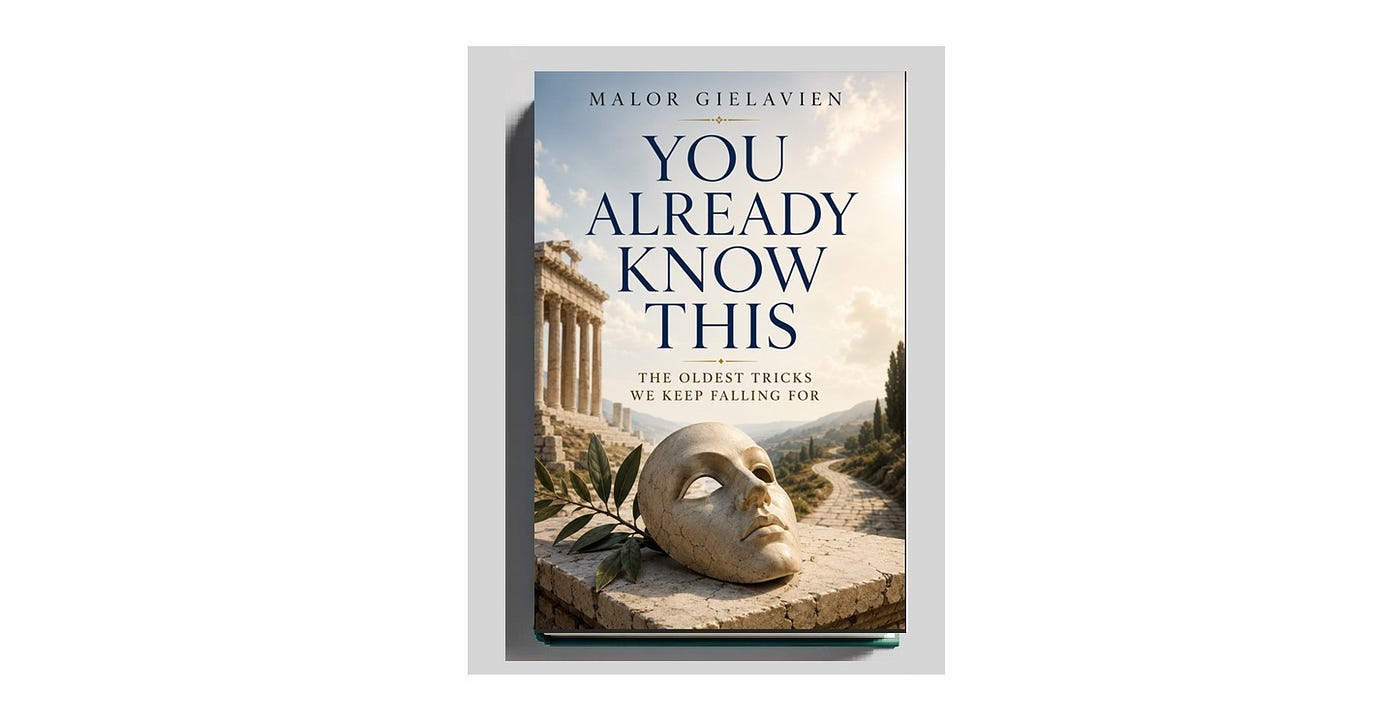
Everyone already knows the old stories. The wooden horse was not a gift. Flattery is bait. A seal can be forged. The weak sometimes only look weak. The unbeatable usually have one quiet place where they end. We learn these lessons early and then file them where they can do no further harm and no further good: under myth, under fable, under the reading we were assigned as children.
We keep falling for the oldest tricks not because we forget them, but because we were taught the story and not the trick. The danger returns in a costume we were never trained to recognize — a letter from the bank, a cleared shipment, an official seal, a sanctions list, a confident voice, a small blue checkmark — and stops resembling anything we know.
Reading the present the way medieval teachers read likeness — by function, not by face, and with help from Vladimir Propp and the old craft of worked comparisons — Gielavien assembles a short field guide to recognition. The test was never whether you know the lesson when it is printed and titled. The test is whether you know it without the caption.
History does not make us wise. It only takes away our alibi.
Keywords: deception, persuasion, pattern recognition, cognitive bias, history of ideas, folklore, manipulation
[embed]
Contents
Preface — The Story Is Familiar 7
Chapter One — The Trusted Entrance. 16
Chapter Two — Function, Not Face. 23
Chapter Three — The Safe Shelf 30
Chapter Four — The Word “New”. 37
Chapter Five — Propp, or the Face That Changes. 44
Chapter Six — The Art of Likeness. 51
Chapter Seven — The Teacher From Lincoln. 58
Chapter Eight — The School Where Everyone Cheated. 65
Chapter Nine — The Permitted Object 72
Chapter Ten — The Convenient Corpse. 79
Chapter Eleven — Mistaking Stillness for Surrender 86
Chapter Twelve — Breaking the Mass. 93
Chapter Thirteen — The Dragon’s Teeth. 101
Chapter Fourteen — The Cheapest Bribe. 108
Chapter Fifteen — Only You. 116
Chapter Sixteen — Refusing the Task as Given. 123
Chapter Seventeen — The Averted Glance. 131
Chapter Eighteen — The Name “Nobody”. 138
Chapter Nineteen — The Thread. 146
Chapter Twenty — The Cheap Thing and the Expensive Order 153
Chapter Twenty-One — The Humiliation of the Great 161
Chapter Twenty-Two — Speed Against Weight 169
Chapter Twenty-Three — The External Soul 176
Chapter Twenty-Four — The One With the Key. 184
Chapter Twenty-Five — The Document as Weapon. 191
Chapter Twenty-Six — Power That Outlived the Hand. 198
Chapter Twenty-Seven — The Sign Before the Thought 205
Chapter Twenty-Eight — Cognitive Economy. 212
Chapter Twenty-Nine — When the Channel Becomes the Weapon. 220
Chapter Thirty — The Letter From the Bank. 228
Chapter Thirty-One — The Patriotic Speech. 236
Chapter Thirty-Two — What History Does Not Do. 243
Chapter Thirty-Three — Not a Museum of Coincidences. 250
Conclusion — Why Read What You Already Know.. 257
5. The Ban on the Crossbow.. 266
7. The Donation of Constantine. 267
9. The Emperor’s New Clothes. 268
17. The Door Opened from Inside. 272
18. The Update That Carried the Harm.. 273
19. The Officer Who Was Right Too Early. 273
20. This Time It Is Different 274
Literature and Further Reading. 292
On function beneath surface. 292
On persuasion and its levers. 293
On judgment and cognitive economy. 293
On crowds, the enemy, and the speech. 294
On strategy, deception, and security. 295
On the new, manias, and the unforeseen. 295
On memory and the external aid. 296
The old stories themselves. 296
Preface — The Story Is Familiar
This story is familiar. A wooden horse that turns out to be anything but a gift. A fox lying in the road so conveniently that any careful person should have stepped around it. A crow that lets the cheese fall after a single well-aimed compliment. A monster whose death is kept not in its body but somewhere far off, in an object inside another object, in a place a sane man would reach into only in a fairy tale — and not even the one written for him. Odysseus, who called himself Nobody and had the good fortune to be dealing with creatures for whom grammar proved more persuasive than a cry for help. Perseus, who survived not by the courage of his gaze but by knowing when to look away. Hercules, who was handed a job for the hands and saw instead a problem for a river. Horatius, left alone against three, who arranged for the three to stop being three.
We know all of these. We knew them early, before we knew much else, and that is part of the difficulty. They reached us as stories, and stories, once learned, are filed where stories go. We do not keep the wooden horse next to the customs declaration or the software update. We keep it next to the fox and the crow, on a shelf marked myth, or fable, or the reading we were assigned at nine. The shelf is comfortable, well lit, and entirely safe. Nothing on it has happened for a long time. Nothing on it is expected to happen again.
The trouble is that the mechanism did not stay on the shelf. Only the costume did. The horse goes on entering cities. It enters now as a shipment that clears inspection because it carries the right paperwork, as a device that passes the checkpoint because it is the kind of device that is supposed to pass, as a message from a familiar address, as an update signed by a name the system already trusts. It is admitted not in spite of the rules but because of them. That is the whole point, and it was always the point. The horse never broke through the wall. The Trojans opened the gate themselves, for reasons that felt, at the time, like good ones.
The fox still lies in the road. It lies there now as a position that looks abandoned, a competitor that appears to be losing, a market that seems exhausted, an opponent who has, by every visible sign, given up. The crow still drops the cheese, though it no longer holds cheese and is no longer a crow. It is a person who receives a message confirming something he had quietly hoped was true about himself, and who, in the warmth of that confirmation, says or signs or sends the one thing he should have kept back. The monster’s death still lies hidden in an unlikely object — a password, a single supplier, a bridge, a length of cable, a forgotten server, one employee with a key. The strong still mistake stillness for surrender, and the great still come apart not against a greater force but against the loss of their own unity.
None of this looks like the old story. If it looked like the old story, it would not work. A danger that announced itself by resembling the wooden horse would be recognized at the gate and refused. The resemblance that matters is never on the surface. The drone is not shaped like the horse; if it were, someone would notice. The question is not whether one thing looks like another. The question is whether it does the same work. Does the danger get inside under cover of the permissible? Does the target trust the form before examining the content? Is weakness taken for the absence of a threat? Does a large force, when pressed, dissolve into separate and manageable targets?
We tend to call such things new. The word is convenient, and its convenience is exactly the problem. To say that something is new is to be excused from the labor of recognizing it. The new asks nothing of memory. It carries no debts to anything we already understood. It arrives clean, without precedent, and therefore without the obligation to ask where we have seen it before. This is restful, and it is usually wrong. What looks new is rarely the thing that changed the mechanism. It is the thing that arrived in a costume we were never taught to connect with the lesson.
Consider a school in which every teacher, without exception, once cheated. They know the crib note folded under the cuff, the formula inked on the palm, the answer slipped inside the pencil case, the textbook open on the knees beneath the desk, the whisper passed two rows over, the small mirror, the calculator that does more than calculate. They cheated their way through the same examinations they now invigilate, and they remember exactly how it was done. So they stand at the front of the room, collect the phones, read out the list of forbidden objects, and feel that the matter is handled. But a trick and its props are different things. What they are guarding is the old set of props. The new prop passes through the room not as a violation but as an object that has not yet been named in the instructions. Their vigilance is real. It is simply tuned to the previous handwriting of the same offense. The examination was set against cheating as it used to look.
There is a quiet process by which a warning loses its force, and it has nothing to do with forgetting. A real event becomes a story. The story becomes a myth, then a legend, then a tale told to children, then an example in a schoolbook, then a piece of shared cultural furniture that everyone recognizes and no one consults. At each step the thing loses a little of its standing as information about the world and gains a little of its standing as decoration. By the end it is perfectly preserved and entirely defused. We can recite it. We cannot use it. The immunity it once granted has expired precisely because the thing has been honored into harmlessness.
There is an old way of reading stories that helps here. Early in the twentieth century a Russian scholar named Vladimir Propp looked closely at a large body of folktales and noticed that what stayed constant was not the cast and not the scenery. Heroes, villains, helpers, and magical objects changed freely from one tale to the next. What recurred were the moves: a prohibition is issued, the prohibition is broken, a deception is attempted, a victim is taken in, a difficult task is set, a helper appears, a false hero claims the credit, the true one is recognized, the deceiver is punished. Propp’s claim was not the sentimental one that all stories are secretly the same. It was sharper and more useful: the face changes more easily than the function. A character can be a wolf in one telling and a stepmother in another and a kindly stranger in a third, and still be doing the identical work in the structure. To read this way is to stop asking what a thing is and start asking what it does.
The same instinct ran, centuries earlier, through the medieval schools, though under a different name. Teachers and preachers worked with similitudines — likenesses, comparisons, worked parallels between one thing and another. This was not a hobby of pretty metaphor. It was a method, a way of asking what made two unlike things genuinely comparable. Was it appearance? Action? The moral effect they produced? Their place in an argument? The work one of them helped you see in the other? A stag, a wolf, a vine, a sickness, a remedy, a king, a sinner, a monk, the body, the soul — these could be set beside one another not because they looked alike but because of the labor one performed in explaining the other.
One of the men who made this concrete was an English teacher of the late twelfth and early thirteenth centuries, William de Montibus, who taught in Paris and then for some thirty years at Lincoln, in a cathedral school that was among the serious centers of learning before Oxford and Cambridge settled into their later dominance. It was one of those schools where the university habit was already forming: not merely passing on texts, but teaching ways of working with them. His Similitudinarium was a working book of that craft — an alphabetical store of likenesses, examples, and images that a teacher, student, or preacher could reach for when the bare statement of a point was not enough. Such a book did not ornament a thought. It translated the thought into a form in which it could be held, explained, and carried further. This book means to work, in a small and modern way, as a kind of Similitudinarium: a store of likenesses arranged not by how things look but by what they do.
Read by function, the old cases stop being charming and start being instructions. The deathless monster is not a fantasy about immortality; it is a lesson about how invulnerability is actually built — not as a wall but as a secret about where the wall ends. The three brothers who meet three brothers in single combat, one side standing for a city and the other for its rival, are not a curiosity of Roman legend; the surviving fighter, alone against three, retreats so that his wounded enemies string out behind him and can be killed one at a time — which is to say that when a mass cannot be beaten it can sometimes be persuaded to stop being a mass. Hercules, faced with the foul stables, does not accept the task in the shape it is offered; he looks at the stables and then at the river, and the labor becomes a question of hydrology. In each case the point is not the costume. The point is the move.
This book will not tell you that history teaches. If history taught on its own, the species would long since have stopped accepting gifts from its enemies, trusting seals, and mistaking flattery for recognition. History does not teach. It only spoils the pleasure of the phrase such a thing has never happened before. Nor will this be a cabinet of amusing coincidences — how strangely alike, how nearly the same. That genre turns quickly into a souvenir shop of the past, where everything is recognizable and nothing follows from it. The aim here is different. The aim is to recover the working schema under the costume, so that the next time the costume is unfamiliar the schema is not.
What follows is organized around a small number of old moves, each of which is still in daily use. There is the danger that enters through the permitted door rather than the breach. There is the strength that disguises itself as weakness, and the weakness too readily read as safety. There is the large force broken into separate targets and defeated in pieces. There is flattery, the cheapest of all bribes, which works because the victim was already prepared to believe the compliment. There is the refusal to accept a problem in the form in which it is presented. There is the cheap thing that humiliates the expensive order, less by force than by insult. There is speed, which defeats weight not by overpowering it but by never letting it become an event. There is the hidden point of failure, the external soul, on which an apparent invulnerability quietly depends. There is the document, which does what the sword cannot, because the sword compels now and the document compels later, outliving the hand that signed it. And there is the sign that arrives before the thought — the seal, the letterhead, the badge, the confident tone, the small mark of verification — and is trusted in the thought’s place.
Almost everything in this book is already known. Gifts from enemies are suspect. Flattery is dangerous. Seals can be forged. The weak sometimes only pretend. The strong have a soft point somewhere. Documents can lie. A handsome mark is not a guarantee of truth. None of this is news. The test was never whether you know the lesson when it is printed on the page beneath a clear heading. In that form nearly everyone is wise. The test is whether you know it without the caption — when it arrives as a letter from the bank, a request for your trust, a patriotic speech, a report of an entirely unprecedented war, an unusually good offer, an official form with the correct seal, a weak opponent lying a little too persuasively by the side of the road.
The old stories are useful not because they are old; age proves nothing except good preservation. They are useful because the centuries have worn the accidental detail off them and left the working diagrams: how deception gets in, how flattery operates, how the strong stop being one thing, how the hero wins by refusing the offered form, how the sign outruns the mind, how a small weakness brings down a large certainty. History does not make us wise. It only takes away our alibi. After this book there will be a little less of that alibi to go around, and in its place something more useful: the habit, on meeting a loud new word, of asking not what is this but where has this happened before.
Next: the horse.
Chapter One — The Trusted Entrance
The walls of Troy held for ten years. They were never breached, and that is the part of the story most often told without — we keep the horse and lose the wall, which is exactly backward, because the wall is the whole reason the horse was needed. A city that can be taken by force is not worth a decade of cunning. The Greeks never found a weak point in the masonry. They found a weak point in the procedure by which the city decided what to let inside.
Everything that mattered happened after the horse was already at the gate, when it had stopped being an enemy object and become a question of interpretation. Was it a trophy? An offering to the gods, which it would be impious to refuse? Too large and too fine to leave on the beach for someone else to claim? The argument inside the walls was not about whether the Greeks were dangerous; everyone knew the Greeks were dangerous. The argument was about what this particular thing was. And once it had been filed under the kind of object a victorious city takes in, the men folded inside it were no longer a threat to be repelled. They were cargo to be handled. The Trojans did not lower their guard. They aimed it at the wrong question.
This structure is worth naming plainly, because it does not stay inside the story. Anything that wants into a guarded place has two routes. It can go through the wall, which is what the wall is for and where all the watching is, or it can go through the gate, dressed as something the gate exists to admit. The first route is expensive and usually fails. The second is cheap and usually works, because the gate is not a flaw in the defenses. The gate is the defenses, functioning. A city with no entrance is also a city with no grain, no messengers, no allies, and no trade. Every wall worth building is built with a hole in it on purpose, and the hole is governed by a rule about who and what may pass. The attacker’s job is not to beat the rule. It is to meet it.
Watch how things of consequence actually enter a modern institution. Almost none of them break in. They come through receiving and procurement, through the message from a known address, through the update signed with a trusted key, through the contractor whose pass works because the pass office issued it, through the supplier already on the approved list. These channels exist because an institution that admitted nothing would accomplish nothing. Each is a gate, and each runs on a rule: this sender is recognized, this certificate is valid, this vendor is cleared, this is the kind of device we buy. The rule is what keeps the place alive. It is also, exactly, what an intruder studies. He does not need to break the rule if he can arrange to satisfy it. A corrupted part that arrives through normal purchasing is not a failure of the controls. It is a delivery made by them.
Then comes the cruel turn. The horse did not force the gate; the Trojans opened it themselves and dragged the thing in on ropes, sweating, delighted with their prize. The decisive motion in this kind of attack is always the defender’s. The forged invoice is paid by your own accounts office, following its own correct procedure for paying invoices. The poisoned attachment is opened by your own employee, who was trained to answer clients promptly. The tainted component is installed by your own technicians, doing maintenance precisely as the manual instructs. Nowhere does anyone break a rule. The harm is done by people behaving well. That is why the trusted entrance so far outperforms the breach: a breach has to overcome the institution, while the trusted entrance enlists it.
A guard looks for things that do not belong, which is a sensible thing to do and catches a great deal. What it cannot catch is a thing that belongs in every checkable respect and is dangerous anyway. The horse belonged. It was the right sort of object for the moment; it passed every test the Trojans knew to apply; and the one test that would have exposed it — open it, count the men — was the test nobody thought to run, because trophies are not the kind of thing that holds an ambush. The category trophy came with a list of expected properties, and hollow, packed with soldiers was not on the list. Detection works by measuring a thing against the properties of its category. When the danger has been built to fit the category, detection confirms it and waves it through.
A gate does not see the world. It sees the paperwork about the world. The receiving dock does not inspect the true nature of a shipment; it checks whether the shipment matches the order and the manifest. The mail system does not know who really sent a message; it knows what address the message claims and whether that address is on a list. Every gate swaps the unmanageable reality of a thing for a manageable proxy — a document, a signature, a credential, a category — because the reality cannot be examined at the speed at which gates have to run. The proxy is the gate’s entire world. Defeat the proxy and you have defeated the gate, whatever the reality behind it. This is why so much of getting in comes down, in the end, to arriving with the right papers.
The Greeks knew an object that size would start an argument, so they left behind the one thing that ends arguments: a witness. A man named Sinon let himself be captured with a story ready — that the horse was a sacred offering, that his own side had abandoned him, that taking it in would win the city favor and burning it would bring ruin. He was not a soldier within the walls. He was testimony, set where the Trojans would find it and feel they had uncovered it themselves. A gate trusts a voucher more readily than its own inspection, because a voucher is cheaper to believe than an object is to open. Every trusted entrance has its Sinon: the reference who confirms the contractor, the colleague who forwards the message with a note saying this one is fine, the calm voice from a number that looks like the bank. The function is the same. Someone the defender already trusts is led to stand beside the dangerous thing and say, in effect, I have checked this — so that no one else does.
The move works at the scale of a single person too, where it carries an older and franker name: the confidence trick. The word confidence is the entire mechanism. The swindler does not pick the lock; he gets the victim to hand over the key, and he does it by being precisely the sort of person the victim admits — well dressed, well spoken, supplied with a plausible reason to be there, often generous with a small genuine favor before the large false one. He is the horse and Sinon in one, the object and its own witness, and the door he comes through is the victim’s private standard for who counts as safe. Here too the decisive act belongs to the victim. He is not so much robbed as persuaded to give. Which is what makes this feel, afterward, worse than a burglary. A burglary is something done to you. This is something you helped with.
The obvious cure — trust less, admit nothing without total verification — is not on offer, and pretending it is would be the second error after the first. A city that opened nothing would starve behind its flawless wall. An institution that ran every message to the ground would stop answering anyone. The gate exists because closing it costs more than being deceived through it now and then. So the trusted entrance cannot be removed; it can only be understood. The useful question is never how do we stop admitting things, which has no answer, but what, exactly, is our rule for admission — and what would a disaster that satisfied that rule look like. The Trojans had a rule: large fine objects abandoned by a departing enemy are spoils. They never asked what a catastrophe meeting that rule would resemble. It would resemble a large fine object abandoned by a departing enemy.
There is a perverse economy in how scrutiny gets distributed, and it works against the defender at every turn. Attention is finite, so it is spent where danger is expected, which means it is spent on the wall, on the stranger, on the unknown sender — and pulled away, in proportion, from whatever has been classified as safe. The more trusted a channel, the less it is watched, because watching it would be both an insult and a waste; we do not re-inspect the supplier we cleared last year or re-read the address we have corresponded with for a decade. Trust is, precisely, the decision to stop looking. And an attacker, who can see where the looking has stopped as clearly as the defender can, simply moves there. The safest-seeming entrance is the least guarded one, and it is least guarded for the very reason it seems safest. This is why attacks migrate, over time, toward the trusted — not because the trusted is weak, but because the attention has left.
Worse, trust once granted is rarely revisited. A permission is a decision made at a moment — this vendor is approved, this person has access, this kind of device may pass — and the moment recedes while the permission stays. Years later the vendor has changed hands, the person has changed roles, the device has changed in ways no one tracked, and the permission sits there still, vouching for a present it was never asked about. The Trojans decided once that the horse was a trophy, and that single classification carried it all the way through the gate; no one re-opened the question as the ropes went taut. Standing permissions are the quiet inheritance of every guarded place — a list of doors propped open by decisions whose reasons no one now remembers — and they are exactly where a patient adversary prefers to arrive, because the hard part, being admitted, was settled long ago by someone else.
So the point of this chapter is not that we should distrust gifts, which everyone recommends and no one manages. It is narrower and more useful. The dangerous thing is built to pass your test, which means the test cannot be the last word. The horse was admitted not because the Trojans were fools but because it had been made into the kind of thing they admitted. Every controlled entrance teaches an attacker its rule, and a rule, once learned, is a set of instructions. Seeing this in time takes a particular skill, and that skill is the subject of the next chapter: the discipline of looking past what a thing presents itself as — its face, its papers, its category — to ask the one question the gate is unable to ask. Not what is this. What would it do once it is inside.
Chapter Two — Function, Not Face
A child stands at the foot of a bed and conducts a security interview. What big eyes you have. What big ears you have. What big teeth you have. Each answer is poor, and each is accepted, until the last one ends the conversation. We read the tale as a warning about strangers, but look at what the child is actually doing. She has sensed that something is wrong. She is checking. Her mistake is not that she fails to check; it is that she checks the wrong things. She questions the wolf feature by feature — eyes, ears, teeth — as if danger were a property of appearance that close enough inspection of the surface could settle. The wolf passes every question but the last, and the last comes too late. What the bonnet defeats is not the child’s attention. It is her method.
The method is the natural one, and that is the difficulty. The human eye is built to read faces; we recognize a friend across a crowd in a fraction of a second, without effort, before we could say how. This is a magnificent instrument, and we lean on it for everything, including tasks it was never meant for. Reading a face is fast, cheap, and usually good enough, which is exactly the combination an adversary looks for. Anything fast, cheap, and usually good enough can be fooled by an opponent willing to spend on the appearance while leaving the substance unchanged. The bonnet is not expensive. It only has to be convincing for as long as it takes.
Resemblance fails us in two directions, and it is worth keeping them apart. In the first, two things look alike and do different work: the harmless snake banded like the venomous one, the honest letter that happens to share a format with a fraudulent one. This kind of false resemblance produces false alarms, which are a nuisance but rarely a catastrophe. The second kind is the dangerous one. Two things look entirely different and do the same work. Nothing about their surfaces invites comparison, and so no comparison is made, and the shared function passes unnoticed. The first error makes us flinch at shadows. The second is the one that gets the city taken.
Nature offers a clean illustration of why we trust the surface at all. A shark and a dolphin are built along strikingly similar lines — the same tapered body, the fins in the same places — though one is a fish and the other a mammal, separated by an immense stretch of descent. They look alike because they do the same job: move fast through open water and hunt. Function shaped form, independently, twice. From this we draw a quiet, usually reliable rule: similar form suggests similar function, so you can often read what a thing does off how it looks. The rule holds across much of nature, because nature has no intention to deceive. It collapses the moment you face something that does. A designer, unlike evolution, can split form from function on purpose — can give a thing the gentlest possible face and the work of a predator. Against an adversary who controls the appearance deliberately, the naturalist’s shortcut becomes the very route of attack.
Nature also supplies the exception, and it is just as instructive. Some harmless creatures survive by wearing the look of dangerous ones — a palatable fly marked in the yellow and black of a wasp, a gentle snake banded like a venomous one. Here form does not reveal function; it borrows a function it does not have. The fly does nothing a wasp does and is relying on a predator who reads by face and declines to test the matter. This is the bonnet’s trade run in reverse: where the wolf hides a dangerous function behind a safe face, the fly hides a safe function behind a dangerous one, and both work for the identical reason — that reading the surface is cheap and reading the substance is costly, so nearly everyone reads the surface. Wherever there is an advantage in being misjudged, faces get counterfeited, in nature as everywhere else. The comfortable rule that form reveals function holds only where nothing has an interest in your getting it wrong — which is to say it holds nowhere that an adversary is present.
This is the practical core of the old scholar’s observation, met already in the introduction: the face changes more easily than the function. Propp found it in folktales, where the helper might be a horse or a hag or a grateful fish and was, structurally, always the same helper. The use of it here is to turn the observation into a question you can actually ask. Not what is this thing, which the thing itself is busy answering, and answering in whatever way suits it — but what does this thing do to my situation. What role is it playing. Where, in the structure of what is happening to me, does it sit. Two objects with nothing in common to the eye can occupy the identical position in that structure, and it is the position, not the object, that decides what happens next.
Those who guard real things against real forgers learn this early. You cannot authenticate a painting by how convincingly it resembles the master, because resembling the master is precisely the forger’s craft, the one thing he is guaranteed to have gotten right. Authentication moves instead to what the forger cannot easily fake: the provenance, the chain of ownership, the chemistry of a pigment that did not exist in the supposed year, the way the canvas aged. It abandons the surface — which is contested ground, home turf for the deceiver — and asks functional and historical questions instead. Where did this come from. What path did it take to reach me. What would have to be true, behind the appearance, for it to be what it claims. This is the same move the gate could not make in the last chapter, the move from the proxy to the reality, and it is expensive for exactly the reason the gate skips it.
Return to the school, and the point sharpens. An examiner who fears cheating writes a list of forbidden objects: phones, calculators, notes, the smart watch once someone thinks of it. The list is a catalog of faces. Each entry names a thing by its appearance, and the supervision consists of scanning the room for those appearances. But cheating is not any of those objects. Cheating is a function — outside information entering a sealed room — and the objects are merely its current costumes. Anything that performs that function is a crib note, whatever it looks like, including the next device that has not yet earned a line on the list. The examiner who guards the catalog of faces is always one costume behind, because the list can only ever record the costumes already caught. The supervision is tuned to the previous handwriting of the same offense.
The list and the costume are locked in a slow race, and the list always runs second. Each new device that is caught earns a line; each line teaches the next intruder what to avoid; and so the supervision steadily improves at catching exactly the methods that have already gone out of use. This is not a failure of diligence. It is the built-in lag of any defense that recognizes by appearance, because an appearance can be added to the catalog only after it has been seen, and to be seen it must first have worked. A catalog of faces is always, structurally, a record of yesterday’s attacks. The function beneath them — outside information entering a sealed room — has not changed since the first student inked an answer on his palm. Only the palm keeps being replaced.
Reading by function is harder than reading by face, for a reason no amount of effort removes: the face is right there, free, immediate, while the function has to be inferred, and the inference can be wrong. A thing’s appearance presents itself; a thing’s function must be worked out from what it would do, which is often exactly what it is concealing. This is why face-reading is the default everywhere and function-reading is rare. It is not that people are lazy. It is that one of these is given to us and the other has to be paid for, in attention and in the willingness to be temporarily unsure. The whole method of this book is the discipline of paying that price on the occasions when it matters — and the harder discipline of knowing which occasions those are.
A short instrument helps, the same handful of questions returning in different rooms. Does this do the same work as something I would already recognize as a danger. Is it getting inside under cover of the permissible. Am I trusting its form before I have examined its content. Am I reading its weakness as safety. Is some large, solid thing being quietly broken into smaller ones I will face one at a time. None of these asks what the thing is called or what it looks like. Each asks what it does. Run them, and the costume stops mattering, which is the entire object of the exercise, since the costume was the part the other side controlled.
A caution belongs here, or the method turns into its own disease. Shared function is a reason to look closer, not a verdict. Many things that do similar work are no threat at all, and a mind that treated every functional echo as an ambush would be as useless as one that trusted every face — paralyzed instead of breached, but ruined all the same. Function-reading generates hypotheses; it does not deliver conclusions. It tells you where to point the expensive attention you cannot afford to spend everywhere. The introduction promised this would not become a cabinet of unsettling resemblances, and the promise is kept precisely here, by insisting that a resemblance of function is the beginning of an inquiry and never the end of one.
The child at the bedside was not wrong to be uneasy, and not wrong to ask questions. She was wrong about which questions. What big teeth you have interrogates the surface and gets a surface answer. The question that would have saved her runs underneath: what is in this bed doing the work a grandmother does not do — lying still, waiting, answering in a voice that is almost right. She knew, in some way, that the function had changed; she could feel it; she simply had no method for asking about anything but the face. Most of us are in her position more often than we would like to think, and for the same reason. We can sense that something is off and still have no practiced way to name what is off about it. The next chapter takes up why this is so — why the very lessons that would supply the method are the ones we have most carefully placed out of reach.
Chapter Three — The Safe Shelf
The same civilization that preserved the Trojan horse also coined the advice never look a gift horse in the mouth. One culture, two messages, aimed in opposite directions. The story says examine what your enemies give you, with special attention to the parts they would rather you left alone. The proverb says do not examine a gift at all; to check its quality is graceless, ungrateful, a small insult to the giver. We keep both and feel no strain, because we have shelved them in different places. The story is literature. The proverb is manners. And manners, being about the living present, carry a force that literature, being about the dead and the invented, does not. When a real gift arrives, it is the proverb that speaks first, and the story that stays politely on its shelf.
This is the quiet subject of the chapter: a lesson does not have to be forgotten to be neutralized. It can simply be filed. A warning placed on the right shelf keeps all of its ceremony and loses all of its use. We can still recite it, teach it, admire its phrasing, set it as an examination question. What we can no longer do is apply it, because applying it would mean taking it down off the shelf and into the room where things are actually happening, and the shelf has been arranged precisely so that nothing on it ever has to come down.
There is a sequence by which a living thing is lowered into this state, touched on already and worth following slowly. An event happens, and is dangerous. It becomes a story, which is the first small distancing — a thing that happened becomes a thing that is told. The story becomes a myth, gaining grandeur and losing locality, until it is no longer about anyone in particular. The myth softens into a fable, fit for children, with an animal or two and a moral at the end. The fable becomes assigned reading, a thing one is tested on rather than warned by. And at last it settles into the general cultural furniture, a reference everyone recognizes and no one consults, as decorative and as inert as a coat of arms. At each step it trades a little of its standing as information about the world for a little more standing as ornament. By the end it is flawlessly preserved and entirely disarmed.
School is where most of the disarming gets done, and it does it with the kindest intentions. The moment a story becomes a set text, its status changes in a way that is hard to reverse. It stops being something you might use and becomes something you will be examined on. A warning you are tested on is a warning held at arm’s length; the relationship is now between you and the test, not between you and the danger. The category classic finishes the job. A classic is a work everyone has been taught to praise and almost no one reads expecting to be personally addressed. To call a thing a classic is to promote it out of the conversation — to set it so high that it can no longer reach down and say anything inconvenient to the person holding it. Reverence, applied generously enough, is a form of disarmament.
It would be comforting to call this stupidity, but it is closer to economy, and a necessary one. The mind sorts the world into domains in order to survive it. This belongs to history, that to myth, this to finance, that to the news, this to literature one studied at school. The sorting is not a defect; it is most of what lets us think at all, since a mind that held everything in one undivided heap would drown. But the walls between domains, which do so much good, also stop lessons from crossing. The schema of the Trojan horse lives in the bin marked myth. The suspicious update to a trusted system lives in the bin marked work, or technology. Nothing carries the one across to the other, because carrying schemas across the walls between domains is not something the sorting does. It is, in fact, the rare and deliberate act this whole book is trying to describe — and the walls that make ordinary thought possible are exactly what make it difficult.
One domain wall does more damage than all the others, and it runs not between subjects but between times. We file danger under the past and assume the present is a different sort of place — better lit, more advanced, run by people who would surely not fall for the old things. This is the most comfortable shelf of all, because it asks for no act of forgetting; the lesson stays perfectly remembered, it is merely stamped then, and then is understood to be over. Every generation believes it lives after the age of credulous mistakes, in the clear country on the far side of history, and every generation is the one the next will study. The conviction that it cannot happen now is not a conclusion anyone reaches by looking. It is the resting position of a mind that has filed all catastrophe under was.
Picture a sword in a museum case. It is lit, labeled, protected, visited; it is treated with a respect its original owner could never have imagined. It is also, now, unable to cut anything. The respect and the uselessness are the same fact. To put a thing behind glass is to place it permanently out of reach, and reach is what a sword is for. We do this to our sharpest warnings as a matter of course. We honor them onto pedestals, light them well, and congratulate ourselves on having preserved them, without noticing that we have also put them where they can no longer be picked up and swung at a present danger. A lesson under glass is safe in both senses: safe from being lost, and safe from being used.
The proverb about the gift horse points to something worse than passive storage, which is that cultures actively manufacture the reassurances that hold their own warnings down. For every old story urging suspicion there is a fresh saying urging ease. Do not be paranoid. No one would really do that. It is rude to ask. Surely they wouldn’t. The suspicion the old story recommends is socially expensive — it makes you the awkward one, the ungracious guest, the colleague who held up the deal with questions — while the reassurance is socially rewarded, the mark of a generous and trusting and agreeable person. So the shelf is not merely a place where warnings rest. It is guarded by etiquette, which fines anyone who tries to take a warning down and use it at the very moment it would be most useful: when a real gift is at the gate and a decision has to be made.
There is a shelf at the other end too, for things too recent rather than too old. A warning can be demoted by being yesterday’s as surely as by being the ancients’. Once a thing has been in the news it becomes, with remarkable speed, old news — covered, and therefore finished; named, and therefore handled; discussed, and therefore somehow already dealt with. The treatment was only words, but the words discharge the alarm as though they were action. So the operational present — the narrow band in which a warning is neither so old that it has become myth nor so recent that it has gone stale — turns out to be very thin. Almost everything is shelved at one end or the other. The strange thing is not that we miss the danger in front of us. It is how few moments there are in which a danger is allowed to count as present at all.
All of this explains something otherwise strange: the gap between what everyone knows and what everyone keeps doing. Everyone knows flattery is dangerous, and very nearly everyone softens under it anyway. Everyone knows a confident manner is not evidence, and goes on being convinced by confident manners. The knowledge is real, but it is the wrong kind. It is knowing that — a fact one can state on demand, filed under proverb — when the moment calls for knowing when, the live recognition that this, here, now, is the thing the proverb was about. Knowing that flattery is dangerous does nothing in the room where the flattery is being delivered, because in that room the knowledge is on the shelf and the flattery is in the air. The distance between the two is the distance this book is trying to close.
Naming has the same double effect, which a book like this one is obliged to admit about itself. To give a trick a clean label — the confidence game, the false flag, the bait and switch — is to gain a real handle on it and, in the same motion, to risk filing it the instant it is named. We say the words and feel we have the thing, when all we have is the words. A label is a small shelf, perfectly sized for a single idea, and the better the label the more tempting it is to set the idea down on it and walk away. The only guard against this is to keep using the name as a question rather than a verdict — to treat is this the confidence game as something to check against the room, not a box to tick and be done with. A name earns its keep when it sends you back to look. It betrays you the moment it lets you stop.
And yet the shelf, like the gate and like the trusting eye before it, is not simply a mistake to be abolished. No mind can keep every lesson it ever learned in a state of operational readiness; the great majority of warnings are irrelevant the great majority of the time, and a person who treated every fable as a live threat assessment would be not wise but unwell, flinching at gift horses in a world mostly full of ordinary gifts. The shelf is triage, and triage is sane. The defect is not that the shelf exists. The defect is that the sorting onto it is permanent and indiscriminate — that things go up and effectively never come down, regardless of whether the danger they describe has just walked into the room wearing a coat we did not recognize.
So the skill worth having is not a better memory; we remember these stories perfectly well. It is the narrow, deliberate act of reaching up and taking one down — of treating an old tale, for a moment, not as heritage but as current intelligence about a thing in front of us. It feels slightly absurd to do this, to let a children’s story advise a grown decision, and the absurdity is part of why we resist it; the shelf has trained us to find such crossings undignified. The rest of this book is a series of these reachings-up, one move at a time. It begins, in the next chapter, with the word that does more than any other to keep our hands at our sides — the small, restful, endlessly offered word new, which excuses us in advance from recognizing anything at all.
Chapter Four — The Word “New”
Consider the sentence this has never happened before, and the curious fact that it is almost always false in the sense intended and true only in a sense no one cares about. Taken strictly, it is trivially correct: this exact arrangement of people and dates and weather has indeed never occurred, because nothing exact ever recurs. But that is not what the sentence means. It means the kind of thing happening here is without precedent, that nothing we already know bears on it, that the past has no advice to offer. And in that sense it is nearly always wrong. The sentence is doing something other than describing the world. It is describing the speaker — reporting that he, personally, has no precedent ready to hand — and then quietly promoting that private gap into a public property of the event.
This is the first thing to understand about the word new. It is not, despite appearances, a fact about the object. It is a fact about the observer’s stock of recognized patterns, dressed up as a fact about the object. To call a thing new is to say I have nothing to compare this to, which may be a statement about the thing, or may equally be a statement about the poverty of one’s comparisons. The Trojans, had they paused over it, might have called the horse a new kind of problem — they had no precedent for a gift that was also an army — when what they actually faced was an old kind of problem they had filed under the wrong heading. Newness, in the mouth, is often just unfamiliarity with the relevant shelf.
The reason this matters, rather than being a quibble about usage, is that the word does specific work, and the work is disabling. If a thing is genuinely without precedent, then several comforting and dangerous conclusions follow at once. There is nothing to learn from, because learning requires a prior case. There is no expert to consult, because expertise is precedent organized. There is no playbook, no proverb, no veteran who has seen this before, because by hypothesis no one has. To accept that a thing is new is to accept, in the same breath, that your entire stock of relevant knowledge has just been declared inapplicable. This is exactly the conclusion an adversary would most like you to reach, and it can be induced in you for free, simply by getting you to apply the word.
Worse, the word is not neutrally distributed. There is a standing market for novelty, and it pays. The person who announces that something is unprecedented gets attention, funding, headlines, urgency, and the flattering role of the one who sees what others have missed. The person who says, quietly, we have seen this before gets none of these; he is the bore at the briefing, the man who deflates the moment, the skeptic who slows the deal. Every incentive in a meeting, a market, or a newsroom rewards the declaration of the new and punishes the recognition of the old. So novelty is not merely claimed; it is promoted, amplified, and competed for, while recognition is left to whoever is willing to be unpopular. The result is a bias in the air itself, a steady pressure to find everything more unprecedented than it is.
There is a deep joke buried here, which is that the announcement of the unprecedented is itself one of the most precedented events in the record. Every age has been told, by someone with reason to say it, that a new weapon has made all previous warfare meaningless, that a new instrument has repealed the old laws of money, that a new medium has ended the conditions under which power used to work. The proclamation recurs so faithfully that one could nearly set a calendar by it, and yet each time it arrives it strikes the people receiving it as the first such announcement ever made. The claim this changes everything has changed remarkably little, mostly because it is the same claim, and the suspicion it ought to provoke is the simplest in the book: a thing that keeps happening is not new, including the assertion that something is.
Part of what passes for novelty is just the length of a human memory running out. A thing feels new when it last happened longer ago than anyone now in the room can remember, which means novelty is manufactured on a schedule, quietly, by nothing more sinister than people retiring and dying. The financial panic returns, roughly, when the last cohort who were burned by the previous one have left the floor and taken their caution with them; the disaster that everyone swore could never recur recurs on cue, to a generation that was not present for the oath. This is why the same mistakes come round at intervals that have less to do with the mistakes than with the span of a career. Institutions could in principle remember longer than the people in them, and the better ones try, but memory held only in living heads expires on a biological clock, and an adversary patient enough to wait out that clock will always find the gate unguarded again.
Novelty also manufactures urgency, which is its most useful by-product for anyone who would rather you did not think. An unprecedented situation seems, by its nature, to demand fast and exceptional action: the old rules do not apply, there is no time to consult the past, this changes everything, we must act now. Notice that every clause of that demand is a way of switching off the slow, deliberate reading of function described earlier — the patient asking of what does this actually do — in favor of speed. Panic is not a side effect of the word new; it is part of its function. To convince a person that he faces something without precedent is to convince him that he cannot afford to think it through, which is the same as convincing him not to.
It would be a mistake to swing to the opposite error and declare that nothing is ever new, which is its own laziness and just as exploitable. Genuinely new things do occur; the world is not a closed catalog. But they are rarer than the word’s frequency would suggest, and they are almost never the things being marketed as new at any given moment. There are two kinds of new, and nearly all the trouble comes from confusing them. There is the rare case where the underlying move has truly never been made before. And there is the common case where the move is old and only the costume is new — a familiar function arriving in unfamiliar dress. The first deserves the word. The second has stolen it. And since the second vastly outnumbers the first, the safe default, on hearing the word, is to suspect a costume until a mechanism is shown.
There is a simple test, though simple is not the same as easy. Strip the thing of whatever is genuinely unfamiliar about it — the technology, the vocabulary, the scale, the speed — and ask whether the move underneath has a name. Often it does, and an old one. A scheme that pays early investors out of the deposits of later ones is not made new by running on an app instead of a ledger; it is the same scheme that ruined people a century ago, wearing this year’s interface. A message that induces someone to surrender a credential by impersonating an authority is not made new by arriving as a text rather than a letter; the function — borrowed authority, manufactured urgency, a request for the keys — is the oldest one there is. The unfamiliar part is real and may matter enormously for how you respond. But it is not where the move lives, and mistaking the costume for the move is precisely the error the word was sent to produce.
At a larger scale the word becomes a tool of permission. To declare a situation unprecedented is to argue, without seeming to argue, that the normal restraints do not apply to it. A war described as a wholly new kind of war can justify suspending the rules that older wars taught us to keep. A crisis described as unlike any before can excuse measures that, in any recognized situation, would be refused. A financial instrument described as something the old models cannot capture can be sold precisely because the old models — which exist to say no — have been declared obsolete. In each case the claim of novelty does the work of an argument that would not survive being made openly. No one has to defend suspending the rules if the situation has been placed, by a single adjective, outside the jurisdiction of all rules. The unprecedented is a country with no laws, and the word is the visa.
There is, finally, a gentler reason the word goes uncontested, and it is that we want it to be true. To live in unprecedented times is to be important. It makes the present an event, the witnesses significant, the ordinary business of a life into history. No one is flattered to be told that his crisis is a rerun, that his enemies are using the trick from the schoolbook, that his moment is a variation on a theme played many times before. The word new is a small daily compliment the age pays the people living in it, and like most compliments it is most welcome where it is least deserved. The chapters ahead treat flattery as a tool other people use against us. This is the version we administer to ourselves.
None of this argues for treating the word as a lie. It argues for treating it as a flag — a marker that says, reliably, here is a place where recognition has been switched off, by accident or on purpose, and where it would repay you to switch it back on. When something is announced as new, the useful reflex is not belief and not dismissal but the question this book keeps returning to: where has this happened before. Answering it requires a stock of recognized patterns deep enough to draw on, and the next two chapters are about where such a stock comes from — first from a Russian scholar who found that the apparently endless variety of stories runs on a surprisingly short list of moves, and then from a much older tradition that made the comparing of unlike things into a discipline.
Chapter Five — Propp, or the Face That Changes
A child who has heard a few fairy tales already knows, on hearing the next one begin, a remarkable amount about how it will go. If there are three sons, the youngest will matter and the eldest will fail. If there is a prohibition — do not open this door, do not stray from the path, do not speak to anyone on the road — it will be broken, because prohibitions in stories exist in order to be broken. The first pitiful creature the hero treats kindly will return, transformed, at the moment of greatest need. A task that looks impossible will be solved by a gift acquired earlier, whose purpose was not clear at the time. None of this has been taught to the child as a rule. It has been absorbed as a shape. And the shape, it turns out, is astonishingly stable across stories that share no characters, no setting, and no surface details whatever.
Early in the twentieth century a Russian scholar set out to account for this stability, and what he found was stranger and more exact than he expected. Vladimir Propp took a large collection of Russian wonder tales and asked not what they were about but what happened in them, step by step, stripped of all the particulars. When he did this, the endless variety collapsed. Beneath the kings and witches and firebirds and talking wolves, the same events kept occurring, in the same order, across tale after tale. He was able to set them down as a short list of what he called functions — not characters, not objects, but actions defined by their place in the unfolding of the story: an interdiction is issued, it is violated, a villain causes harm or a lack is felt, the hero leaves home, is tested, receives a magical agent, is brought to the object of his search, struggles, is marked, wins, returns, is pursued, and at last is recognized while a false claimant is exposed.
The surprise was not that stories had structure; anyone might have guessed that. The surprise was the finiteness. The number of these functions was small, far smaller than the number of tales, and the tales were simply different routes through the same short sequence, with different figures filling the same slots. A limited alphabet of moves was generating an apparently unlimited literature. This is a more unsettling discovery than it first appears, because it suggests that what feels like infinite inventiveness — the whole shimmering variety of story — is recombination of a fixed and rather small set of underlying operations. The variety is real, but it is variety of costume. The moves beneath are countable, and they had been counted.
The crucial separation, for our purposes, is the one Propp drew between the function and the figure performing it. A function is a slot defined entirely by what it does to the story; the figure occupying the slot can be almost anything. The role he called the donor — the one who tests the hero and, if the test is passed, hands over the means of victory — might be a withered old woman, a bearded stranger, a trapped animal, a dead mother’s voice from under the earth. These have nothing in common as figures. They are identical as functions. What makes a donor a donor is not its appearance, its species, or its name, but its position in the sequence: it arrives, it tests, it equips. To know that a given figure is occupying the donor’s slot is to know what it will do next, regardless of what it looks like, because the slot, not the figure, governs the action.
Propp also noticed that the figures sorted themselves into a small number of what he called spheres of action — the villain, the donor, the helper, the dispatcher who sends the hero off, the sought-for person and her father, the hero himself, and the false hero who would steal his place. Seven roles, no more, across a whole literature. And the mapping between figures and roles was loose in both directions: one figure could occupy several roles in turn, and one role could be passed among several figures, because a role was a bundle of functions and not a person. This is worth holding onto, because the same looseness runs through real situations. The one who sends you off on a task, the one who offers the tool, the one who turns out to be the obstacle, and the one who steps forward at the end to collect the reward need not be four different people, and a figure who plays a helpful role early may be discharging a villain’s function by the close. Watching the roles rather than the faces is the only way to keep track of who is actually doing what.
This is where the old folklorist quietly hands us a tool. If functions come in a stable order, then recognizing which function you are in tells you, within limits, what is coming. The child who registers do not open that door is already braced for the door to be opened and for trouble to follow, not because she is clairvoyant but because she has identified the move, and the move has a sequel. Carry this out of the nursery and it becomes a genuinely useful habit of mind. Situations, like tales, have functions — a test being administered, a gift being offered with a string attached, a task being set, a claimant stepping forward to take credit for what another did. To name the function you are inside is to gain a rough forecast of the next function, which is exactly the advantage the surface, with its endless distracting particulars, is busy denying you.
The order is a tendency, not a law, and its violations are as informative as its regularities. When a situation runs the functions out of their usual sequence, or skips one that ought to be present, the gap is a signal worth reading. A donor who equips you generously and asks for no test, sets no condition, imposes no price, has not been kind; he has omitted the function that normally explains why a stranger would arm you, and the omission should raise suspicion rather than gratitude. The unearned gift is the missing test, and the missing test is usually the part of the transaction that has been moved somewhere you cannot see it. In the tales the hero pays the donor in courtesy or courage before the magical agent changes hands; when the agent arrives free, in life as in the story, the wise question is who is really paying, and with what, and when the bill will arrive.
It would be a misuse of Propp to march his particular list out of the wonder tale and stamp it onto everything. He was describing a specific genre of a specific tradition, and the thirty-odd functions in their fixed order belong to that genre; they are not a universal key to events, and those who have tried to make them one have produced mostly forced and silly results. What survives the move out of folklore is not the list but the operation that produced it — the deliberate abstraction of function from figure, the willingness to ask what is the move here and to treat the gorgeous particulars as removable. The list is local. The method is general. We are not borrowing Propp’s catalog of fairy-tale moves; we are borrowing his discovery that such a catalog exists at all, that beneath the variety there is a grammar, and that the grammar can be read by anyone willing to look past the cast.
If this is right, then the apparently boundless inventiveness of human trouble is, like the apparently boundless inventiveness of story, mostly recombination. The number of fundamental moves by which one party gets the better of another — by entering under trust, by feigning weakness, by dividing a strength, by flattering, by changing the terms, by outpacing, by striking the hidden point, by wielding a document, by deploying a sign — is not large. It is, in fact, roughly the length of a book’s worth of chapters. What is large, dazzlingly and endlessly large, is the supply of costumes, and the costumes are what we mostly attend to, which is why the small grammar beneath them keeps feeling like an infinite series of unrelated surprises. Propp’s gift to a reader who is no folklorist is the suspicion that the surprises are fewer than they look, and that they can be learned.
There is a reason the grammar stays small, and it is the same reason the tricks in this book stay in use. A move that works gets repeated, and a move that fails gets dropped, so that over a long enough span the surviving moves are precisely the ones that have proven, again and again, that they work on the kind of mind they are aimed at. A folktale is a thing that has been retold by thousands of tellers to millions of listeners, and at each retelling the parts that gripped were kept and the parts that bored were quietly let go; what remains is not arbitrary but tested, polished by a vast unconscious editing toward whatever holds attention and satisfies expectation. The same selection runs through deceptions. The reason the feigned weakness and the borrowed authority and the flattering approach recur across every century is not that people lack imagination. It is that these are the moves that survived — the ones that kept working after the weaker variations were filtered out by failure. A finite grammar of trouble is what you get when you let an enormous supply of attempts run for a few thousand years and keep only the ones that paid.
Propp gave the modern world a clean demonstration that function can be separated from figure and that the result is a usable grammar. But the impulse he formalized was old long before him, and in one of its richest forms it belonged to the medieval schools, where the comparing of one thing to another was not a poetic flourish but a trained discipline with its own rules and its own reference books. To call two unlike things alike, those teachers knew, was to make a claim that could be true or false, illuminating or deceiving, depending on the respect in which the likeness was supposed to hold. The next chapter turns to that older art, and to the working book of comparisons from which this one takes its design.
Chapter Six — The Art of Likeness
On a teacher’s desk in the cathedral school at Lincoln, around the year twelve hundred, there might have lain a book that contained neither doctrine nor history nor law, but comparisons. Arranged alphabetically, it offered, under each heading, a stock of likenesses: this is like that because of so-and-so; the soul resembles a certain thing in this respect; a certain vice behaves as a certain animal behaves. A teacher or a preacher, stuck for a way to make an abstract point take hold in ordinary minds, could reach for this book the way one reaches for a tool, find a likeness fitted to the idea at hand, and use it to carry the thought across into a place where it could be grasped. The book had a name of its kind: a Similitudinarium, a storehouse of similitudines, of likenesses. It treated comparison not as decoration but as equipment.
The man associated with that particular storehouse was William de Montibus, an English master who had taught in Paris, on the hill of Sainte-Geneviève where the schools clustered, and who then spent some thirty years at Lincoln, in a cathedral school that was among the serious centers of learning in England before Oxford and Cambridge settled into their later dominance. It is tempting and slightly wrong to call such a place an early university; better to say it was one of the schools where the university habit was forming. His Similitudinarium was an instrument of that habit. It did not adorn a thought; it translated a thought into a shape in which the thought could be held, explained, and handed on. A bare proposition slides out of the mind. The same proposition fastened to a vivid likeness stays.
The deep point the tradition understood, and that a modern reader is apt to miss, is that a comparison is a claim, and claims can be true or false. We tend to treat likeness loosely, as a matter of taste or ornament — a pretty image, a striking turn — as if calling one thing like another were merely a way of decorating speech. The medieval schoolmen took it more seriously, because they used comparisons to reason and not only to please. To say that one thing is like another is to assert that they share something, and the assertion is only as good as the sharing is real. A likeness can illuminate, when the two things genuinely correspond in the respect that matters, or it can deceive, when they correspond only on the surface or only in words. The art was not in producing comparisons, which anyone can do, but in producing sound ones, and in being able to tell the sound from the merely glittering.
This required asking what kind of likeness was being claimed, and here the tradition was more exact than our loose modern usage. Two things compared might be alike in substance, being at bottom the same sort of thing. They might be alike in quality, sharing a property such as color or hardness or heat. They might be alike in their effect, producing the same result by different means. Or they might be alike in proportion, which is the subtlest and, for our purposes, the most powerful kind: not that A resembles B, but that A stands to B as C stands to D. A physician is to the body as a ruler is to the state — not because physicians resemble rulers, which they do not, but because the relation, healer to the thing healed, is the same in both. Likeness of proportion compares relations rather than things, and because it ignores the things themselves it can reach across any distance of appearance whatever.
This is the form of likeness this book most needs, because it is the only one that survives a complete change of costume. The earlier chapters insisted on comparing by function rather than by face; likeness of proportion is the precise instrument for doing so. A cheap drone is to an expensive tank as a stone from a sling was to an armored champion: the terms could not look less alike, yet the relation is identical — a small, cheap, mobile thing humbling a large, costly, armored one, and humiliating it as much as defeating it. A forged seal is to a charter as a confident manner is to a claim: in each case a sign that is easy to counterfeit stands in for a substance that is hard to verify, and is trusted in its place. None of these pairs resembles itself across the divide. Each shares a relation, and the relation is the whole of the lesson. To read proportionally is to stop comparing objects, which deceive, and start comparing the relations they enter into, which do not.
It would be a mistake to file this art under sermons and leave it there, as though reasoning by likeness were a devotional habit the serious disciplines outgrew. The opposite is true: two of the most powerful systems of thought our civilization built run on exactly this engine. The common law decides a new case by finding the earlier case it is relevantly like, and arguing about which prior situation the present one most resembles in the respect that matters; a precedent is a likeness given the force of authority, and a lawyer’s craft is largely the construction and demolition of proportional analogies. Science, for its part, understands the unfamiliar by modeling it on the familiar — light treated as a wave because it does what waves do, the atom pictured for a while as a little solar system because the relation of center to orbit seemed to carry across. These are not ornaments on law and science. They are how law and science move. The medieval storehouse of likenesses was an early, explicit version of a procedure the modern world still depends on while pretending it has outgrown it.
The tradition’s insistence on sound likeness is also the guard against the failure the introduction promised to avoid: the slide into a cabinet of charming coincidences. Not every resemblance is a real one, and the discipline lies precisely in refusing the false ones. A likeness is sound when the two things share the respect that actually bears on the matter at hand, and hollow when they share only something incidental — a word, an image, a superficial echo that catches the ear but does no work. That two events both involve a horse is not a likeness worth anything; that two events both admit a hidden danger through a trusted gate is a likeness that predicts. The skill is to locate the load-bearing respect and to test whether the comparison truly holds there, rather than being seduced by a correspondence that is vivid but idle. A good similitude does labor. A bad one only sparkles, and sparkle, here as elsewhere, is mostly a warning.
There is a sharper reason to care about the difference between sound and hollow likeness, which is that the false analogy is not merely useless but dangerous, and is itself among the oldest instruments of persuasion. To make someone accept a conclusion, it is often enough to offer a comparison that feels apt while being unsound in exactly the respect that matters. This situation is just like that one, says the persuader, and if the listener accepts the likeness he inherits all of its conclusions without ever examining whether the two cases correspond where it counts. Much of what passes for argument in public life is the assertion of likenesses that flatter a position rather than test it. The same tradition that taught how to build illuminating comparisons therefore had to teach how to detect deceptive ones, for the two are one skill used in opposite directions, and a reader who can construct a sound similitude is also, necessarily, a reader who can catch an unsound one being used on him.
A sound likeness comes with its own boundary, and a careful user reads the boundary as attentively as the likeness. No two situations correspond in every respect; if they did, they would be the same situation. A comparison holds in the respect that matters and fails elsewhere, and the place where it fails is not a defect to be hidden but information to be used — it marks the point at which the present case stops taking advice from the past one and must be thought through on its own. The reader who forgets this turns a tool into a trap, riding an analogy past the point where it still bears weight, which is how a comparison that began by illuminating ends by misleading. To use a likeness well is to know at once where it grips and where it lets go.
This book is built to work, in a small and modern way, as such a storehouse. Its chapters are not arranged alphabetically, as William’s was, but by function — by the move, the underlying operation, the relation that persists when every term is replaced. Each is, in effect, an entry: a likeness drawn not between two objects but between a family of situations that share a relation, gathered so that recognizing one member helps in recognizing the rest. The aim is the same as the old book’s: to translate a thought into a form in which it can be held and used, so that the next time the relation appears, wearing terms one has never seen, the reader has a likeness ready to lay against it. A Similitudinarium did not tell its user what to think. It gave him a stock of comparisons to think with, and a trained sense of which ones would bear weight. That is the most this book hopes to be.
It is worth lingering, before going further, on the figure at the desk in Lincoln, because he stands at a particular hinge in the history of how likeness was taught — between an older world in which comparison was the preacher’s craft and a coming one in which the methodical handling of texts would harden into the universities. The next chapter stays with him a little longer, not for the sake of his biography, but because the kind of school he worked in was already practicing something this book depends on: the conviction that knowing a thing and knowing how to use it are different accomplishments, and that the second has to be taught.
Chapter Seven — The Teacher From Lincoln
Picture a young man in a cold church on a wet morning, facing a congregation that has come partly out of duty and partly out of habit and would much rather be elsewhere. He has a truth to deliver — some point of doctrine, some lesson about how a life should be lived — and the truth, stated plainly, will slide straight off the inattentive minds in front of him and be gone before they reach the door. His training was not for this moment of possessing the truth, which is the easy part. It was for the harder thing: making the truth take hold in people who did not ask for it, on a morning when nothing is in his favor. Whether he can do this is not a question about what he knows. It is a question about what he can do with what he knows, under pressure, in front of a room. The schools that produced such men understood that these are different abilities, and that the second is the one worth teaching.
The cathedral school at Lincoln, where William de Montibus taught for some thirty years, was in the business of producing exactly these men — not scholars cultivating learning for its own sake, but pastors and preachers who would go out into parishes and have to make abstractions land on ordinary people. This gave the whole enterprise a practical cast that is easy to underrate from a distance. The aim was not to fill a student with theology and send him off full. It was to equip him with the means of retrieving and deploying the right piece of it at the moment a particular soul, or a particular crowd, required it. A man might know a great deal and be useless in the pulpit if he could not lay his hands on the right part of it in time. The school existed to close that gap.
This is the distinction the whole of the present book turns on, met here in its original schoolroom: knowing a thing and knowing how to use it are different accomplishments, and the second does not come free with the first. One can possess a truth entirely — be able to state it, defend it, even teach it — and still be unable to bring it to bear at the moment it would matter. The earlier discussion of the safe shelf described this gap from the victim’s side, as the distance between the proverb one can recite and the proverb one fails to apply. The school at Lincoln was attacking the same gap from the teacher’s side, asking the harder question: if the second ability is real and separate, how is it trained? You cannot train it by repeating the content more loudly. You have to build the machinery of use.
So the school built machinery. William’s surviving works are not treatises meant to be admired but instruments meant to be operated — a cluster of working books organized as finding-aids: one arranged by the senses of key terms, one by numbers, one a stock of proverbs, one the storehouse of likenesses met in the last chapter. Each was a way of getting at material fast, under the pressure of the moment, by a route the mind could follow without fumbling. To organize knowledge alphabetically, or by number, or by topic, is to make it searchable, and searchability is precisely what bare possession lacks. A man who has merely read everything carries an unsorted heap. A man trained on these instruments carries a catalog he can query. The difference shows up exactly where it counts: in the cold church, on the wet morning, when the right comparison has to be found now or not at all.
Two of these instruments are worth a closer look, because they were engines of recognition in the most literal sense. The distinctio took a single word from Scripture — water, bread, lion, night — and fanned it out into its standard senses, the several things it could stand for in the great web of meanings the period read into every text, so that a preacher meeting that word anywhere would already command the range of what it might be doing. The exemplum was the illustrative story, the short vivid case kept ready to be dropped into a sermon to make a moral concrete. Between them they trained a particular reflex: to meet a particular and immediately see the general it belonged to, to look at this word, this act, this person, and recognize the type. That reflex — instance to kind — is the same one this book is trying to sharpen, and it was being drilled, methodically, eight hundred years ago, in the training of men who would have to read the souls in front of them.
And the souls in front of them were, precisely, a problem of reading function under disguise. The pastor’s task included the naming of sin, which is rarely labeled as such by the person committing it; greed presents itself as prudence, cruelty as justice, despair as realism, pride as mere honesty about one’s gifts. To be useful, the confessor had to see past the account a person gave of himself to the thing actually being done — to recognize the vice under the respectable name it had chosen. This is function-reading in its oldest pastoral form, and the apparatus of distinctions and likenesses and stored examples existed in part to equip a man to do it: to meet the endless self-justifying variety of human conduct and sort it, reliably, into the small set of moves it kept turning out to be. The school was, among other things, a school of recognition.
There is a reason such machinery had to be carried inside the man rather than kept on a shelf to be consulted, and it marks how far that world stands from ours. In a manuscript culture you could not simply look a thing up. Books were few, costly, and often elsewhere; the relevant text might be a day’s ride away or locked in a chest. Knowledge that was going to be usable had to be internal — held in a trained memory, structured for retrieval, carried in the head like a building one can walk through in the dark. The famous medieval arts of memory were not parlor tricks; they were serious technology for turning the mind into a searchable store, because the mind was the only store always present. The organization of William’s books mirrors the organization the student was meant to build inside himself. The book was a template for a memory.
It is worth naming what was forming in such places, because it outlasted them. The habit being taught was not loyalty to a particular master or memorization of a particular text, but a transferable method — a way of working with any text, retrieving from any body of knowledge, that a student could carry into situations his teacher never foresaw. This is the seed of what would later harden into the universities: knowledge detached from the sage who held it and turned into a discipline that could be reproduced, taught to many, and used on new material. William sat near that hinge. He was not the first English university, whatever a brochure might wish; he was something more interesting, one of the people in whom the university habit was assembling itself out of the older craft of the preacher.
Method has one more advantage over content, and it is the decisive one for anything that hopes to last: it can be handed on. The wisdom of a charismatic sage tends to die with him, or to survive only as a set of remembered sayings that grow more mysterious and less usable with each retelling, because what made them work was the man’s judgment in applying them, and judgment is exactly the part that does not fit into a saying. A method is different. A method can be written down, taught to many, carried into new material, and improved by hands the originator never met, because it is a way of doing rather than a thing known. The schools that taught ways of working, and not merely bodies of doctrine, were building something that could outlive any teacher, and did. That is why a man like William matters more for how he taught than for what he believed.
There is a hazard built into every such apparatus, and the better teachers knew it. A finding-aid can become a crutch that quietly excuses the user from building the inner store it was meant to seed. If the book is always to hand, why carry its contents in the head; if the comparison can be looked up, why learn to make one. The instrument that was supposed to train the memory can end by replacing it, leaving a man who can operate the reference and is helpless the moment it is shut. This is not a quaint medieval worry. It is the exact predicament of a present that has put every fact within reach and thereby lost the habit of holding any, and it is why the next stretch of the argument matters more now than it would have a generation ago.
The contemporary reader is in an odd position with respect to all this, because the one thing the Lincoln student lacked — instant access to looked-up knowledge — is the one thing the modern reader has in unlimited supply, and it has quietly cost him the very skill the school existed to build. We can retrieve almost anything in seconds, and so we have stopped carrying much of anything inside. This feels like pure gain and is not. Outsourced memory works beautifully for the questions you know to ask. It does nothing for the questions you do not know are there. You cannot look up a pattern you have not recognized; the search box is silent until you already suspect what you are looking for, and recognition — the suspicion itself — is exactly the part that has to come from the interior stock you no longer keep. The trained memory was never only a convenience. It was the thing that noticed.
This is the deep reason a book like this cannot simply be a reference to be consulted once trouble is already obvious. By the time you know to look up the trick, you have recognized it, and recognition was the whole difficulty. What the Lincoln school understood, and what the rest of these pages try to practice, is that the stock has to be built in advance and carried, so that it is present at the moment of pressure, unsummoned, ready to whisper that the thing in front of you is not as new as it looks. The next chapter turns from the school that taught the right use of knowledge to its shadow: a school whose keepers know every old trick by heart, guard against all of them, and are beaten anyway — not despite their expertise, but because of it.
Chapter Eight — The School Where Everyone Cheated
The most confident invigilator in the room is often the one who, years before, cheated her way through the same examination she now supervises. She knows the crib note rolled into the pen barrel, the formula on the inner wrist, the timed glance across the aisle, the textbook balanced on the knees; she knows them because she used them, and the knowledge sits in her not as theory but as memory of her own hands. So she watches with the particular ease of someone who feels she has seen it all, and her ease is not foolish. It is earned. It is also exactly the opening, because what she has seen is not cheating. It is cheating as it was done in her day, and a person who has mastered the old form of a thing is dangerously prone to mistake that mastery for mastery of the thing itself.
This is the trap that experience lays for the experienced, and it is worth stating plainly, because it runs against everything we are taught to believe about expertise. Experience is a catalog of what has already happened to you, built from real encounters and therefore vivid, confident, and quick. Against any recurrence of those encounters it is priceless. But the same vividness that makes it powerful makes it crowding: the well-stocked mind meets a new situation and the old, familiar entries rush forward to claim it, while the genuinely unfamiliar — which arrives quietly, with no matching entry — is overrun before it can register. The expert does not fail to think. He thinks instantly, and the instant thought is supplied by the catalog, which is to say by the past. The richer the catalog, the faster and more certain the substitution, and the less room is left for the suspicion that this time the catalog does not contain the answer.
The figure of the poacher turned gamekeeper captures part of it. We trust the reformed practitioner to guard against crime because he knows how it is done, and within limits the trust is sound. But he knows how it was done — in his time, by his methods, with the tools and assumptions of his own era — and against a newer hand using means he never touched, his insider’s knowledge can be worse than useless, because it gives him a confident map of a territory that has quietly changed. The fraud investigator who has internalized the last decade’s frauds is calibrated against precisely the schemes that have already been caught and abandoned. The general who has mastered the last war has mastered, with great effort and at great cost, the war that will not be fought again.
That last case is the famous one, and it deserves to be read for its structure rather than recited as a proverb. Between the wars, France built along its eastern frontier a line of fortifications so deep, so modern, and so nearly impregnable that it stands even now as a byword for thoroughness — a wall built with total competence against the invasion that had come before. It was not breached. Nothing about it failed on its own terms. It was simply gone around, through a region its designers had judged unsuitable for the purpose, by an enemy who declined to attack where the catalog said attacks come. The line answered, perfectly, a question that was no longer being asked. Recall the earlier point that walls are rarely broken and usually bypassed or opened; here the bypass took the specific form of arriving where the defender’s entire experience said no one would. The defense was tuned, with magnificent precision, to the previous handwriting of the same offense.
Worse than the blind spot is the confidence that guards it, because the confidence is itself an exploitable thing. A person sure he has seen every trick inspects less, not more; certainty is restful and looks like competence, and it quietly lowers the very attention it is so proud of. When the anomaly arrives — the detail that does not fit the catalog — the confident expert does not slow down over it. He explains it away, because his experience offers a dozen ready reasons why such a detail is nothing, and not one of those reasons is that he might be seeing something new. The sentence that is impossible, spoken by someone with thirty years in the field, is one of the most useful sounds an adversary can hope to provoke. It means the expert has met the unfamiliar and filed it, on the strength of his own authority, under cannot-be-happening.
And the expert’s catalog is rarely a secret. What a defender is known to look for, an attacker can learn — from the rules he publishes, the cases he prosecutes, the questions he asks, the very thoroughness with which he guards the known approaches. A reputation for vigilance against a particular kind of trick is, read from the other side, a public map of where that defender’s attention is nailed down, and therefore of where it is absent. The more famous a guardian becomes for catching one thing, the more reliably he can be assumed not to be watching for another. Expertise advertises itself, and in advertising what it knows, it advertises the shape of what it does not.
The institutional version of the trap is the checklist, and it fails in the same shape as the individual it is meant to replace. A list of controls, of forbidden items, of red flags, of known indicators, is a catalog of past offenses written down so that it need not be carried in any one head. This is a real gain in reliability and a real loss in vision, for the list can only record what has already been seen to go wrong, which means it is always, structurally, a map of the last fight. An organization can pass every item on the list and remain wholly exposed, because the list directs attention to precisely the places the previous attacker chose and the next one will therefore avoid. Compliance becomes a way of looking hard in the one direction from which nothing is now coming. The open ground is everywhere the list does not mention, and the list, by its nature, cannot mention it.
The pattern is visible in its purest form in how we screen against attacks that have already occurred. Each new method, once used, is memorialized in a permanent new rule aimed at exactly that method, so that the apparatus accumulates, layer by layer, a precise history of what was tried before — and watches forever for the repetition of moves no competent adversary would now repeat. The defense becomes a museum of past attempts, each exhibit guarded with great seriousness, while the next attempt forms in the wide unguarded space between the exhibits. This is not stupidity; it is the natural shape of a defense that learns only from what has hurt it. But it means that the more a system has suffered and the more diligently it has responded, the more completely its vigilance is committed to the one place the future is least likely to come from.
This is why the rules written in the wake of a catastrophe so often fail to prevent the next one. After a disaster there is fierce energy to ensure that it can never recur, and the energy goes, naturally, into bolting the exact door that was used — new controls, new prohibitions, new oversight, all shaped with great care to the contours of the event that just happened. The result is a defense fitted with perfect precision to a past that, having happened, is the one thing now least likely to repeat. The next catastrophe, when it comes, arrives through a door no one thought to bolt because no one had yet been hurt by it, and is met, afterward, with a fresh round of bolting aimed once more at the wrong door. Each reform is sincere, competent, and pointed squarely at where the last fight was.
None of this is an argument against experience, which would be idiotic; the inexperienced are not wiser, only blind in a different and usually worse way. It is an argument about how experience must be held. The reformed cheat has, in fact, the materials for a genuine advantage, but only if she reads her own past at the right level. If she holds it as a list of the specific tricks she once used, she guards a museum and is beaten by the next device. If she holds it as an understanding of what cheating is — the importing of outside help into a sealed test — then she can recognize that function in a form she has never seen, because she grasps the move and not merely its old costumes. The insider’s knowledge blinds at the level of the trick and illuminates at the level of the function, and which of these the expert gets depends entirely on the level at which she stored what she knows.
There is a cruel arrangement in most institutions that sharpens all of this. The person most likely to notice the anomaly — to feel that something does not fit, precisely because he has no thick catalog insisting that it must — is the newcomer, the junior, the outsider, the one without the years. And he is exactly the person with the least standing to say so. The experienced dismiss his unease as inexperience, which by definition it is, and the dismissal is usually right, which is what makes it dangerous, because on the rare occasion when the fresh eye has seen the genuinely new thing, the same reflex that correctly silences a hundred naive worries silences the one that mattered. Organizations reward the confident catalog and discount the uneasy novice, and so they suppress the one perspective built to catch what the catalog cannot. The defense against expert blindness exists, but it tends to be standing in the corner, unheard, holding a coat.
So the question to put to any guardian, including the one in the mirror, is not how much have you seen but how have you filed it. A catalog of forms breeds the confidence that misses the new form. A grasp of functions breeds the unease that catches it. The school that taught the right use of knowledge and the school whose keepers cheat turn out to be the same building seen from two sides: in both, what matters is not the size of the store but whether it was sorted by surface or by move. The next chapter returns from the guardian to the thing guarded against, and to a danger that defeats inspection not by hiding what it is, but by being, openly and verifiably, exactly the kind of thing that is allowed.
Chapter Nine — The Permitted Object
We screen most carefully the things that look like weapons, and the harm, increasingly, comes from the things that look like tools. A great apparatus of inspection stands ready for the object that announces danger — the blade, the gun, the obvious device — and waves through, by the million, the objects that announce usefulness. This is not a failure of the apparatus. It is the apparatus doing what it was built to do, which is to sort the threatening-looking from the harmless-looking. The trouble is that the sorting runs on appearance, and an enormous class of dangerous things does not look dangerous at all, because it is, in every visible and verifiable respect, a tool. Call it the permitted object: the thing that passes not because it is disguised, but because it genuinely belongs to a category we have agreed to allow.
It is worth setting the permitted object firmly apart from the Trojan horse, because they are often confused and they work in opposite ways. The horse depended on a hidden interior; its whole trick was that it contained something other than what it appeared to be. The permitted object hides nothing. It has no false interior, no concealed soldiers, no secret to be discovered by opening it up. It is exactly what it claims to be — and that is the point, because what it claims to be is already capable of the harm. Where the horse smuggled a second thing inside a first, the permitted object carries its danger in plain sight, as one of the ordinary properties of being precisely what it is. You cannot expose it by looking inside, because there is nothing inside that contradicts the label. The label is true. The danger is true as well, and the two are the same object.
The clearest form of this is what the cautious call dual use, though the phrase is tidier than the reality. A great many things have two functions, one of which earns them their welcome and the other of which is the reason to fear them, and the two cannot be separated, because they are the same capability pointed in different directions. The chemistry that feeds a field can level a building; the vehicle that delivers goods can deliver them through a crowd; the tool that builds can break; the program that administers a system can ruin it. Permission attaches to the first function, the useful one, which is real and necessary. The danger lives in the second, which is not a perversion of the object but a property it had all along. Nothing has to be altered, smuggled, or disguised. The object that is admitted and the object that does harm are one and the same, and it was admitted for good reasons that remain good.
The permitted object need not be an object at all. The same structure appears with information, where it may be sharpest of all. A single fact, freely and legitimately shared, is harmless — a name, a role, a schedule, a location, a photograph, a small disclosed detail. Each is permitted because each, alone, is innocuous, and the permission is correct: alone, it is. But facts compose, and a hundred harmless disclosures, gathered from a hundred willing sources, can assemble into something none of them was — a pattern, a vulnerability, a target. No single piece was a secret; the danger lived in the aggregate, which no one released because no one held it. Here the dual use runs between the datum in isolation, which is safe, and the datum in combination, which need not be, and the gate that lets each fragment through is right every time about the fragment and blind every time to the sum.
This is why screening, which works tolerably against disguise, is nearly helpless against the permitted object. Screening asks whether a thing is a member of an allowed category, and the permitted object is a member of an allowed category — that membership is the truest thing about it. The inspection runs, the answer comes back yes, and the yes is correct. Recall that detection works by measuring a thing against the properties of its category; when a disguised danger is built to fit the category, detection is fooled, but at least there is a fact of the matter being hidden. With the permitted object there is nothing to hide and nothing to fool. The check confirms what is genuinely so. A test that asks is this an allowed kind of thing cannot catch a danger whose entire nature is that it honestly is one.
An attacker who understands this wastes no effort on disguise; he works instead on category. To get a dangerous thing admitted, he need only see that it qualifies, openly, as a member of a permitted class — that it is bought through the ordinary market, labeled with its ordinary name, routed through the ordinary channels, and so clothed not in a false identity but in a true and privileged one. The privileges of the category travel with membership, and membership is, in these cases, real. There is a quiet elegance to this that the cruder disguise lacks. The forger of a face can be caught when the paint is examined closely; the permitted object survives any examination, however close, because the examination keeps confirming that it is what it says, which it is.
The same logic reaches its uncomfortable conclusion with people. The most permitted object of all is a person who genuinely belongs — the actual employee, the real member, the true citizen, present by every right and verified by every check, because there is nothing to verify but the membership and the membership is real. Such a person passes not by deceiving the gate but by being exactly what the gate admits, and if the harm comes, it comes from inside the circle of trust, done by someone who was never an outsider to be detected. This is the hardest case the whole logic of the permitted object produces, and it is worth stating without melodrama: belonging is itself a kind of cover, the most complete there is, precisely because it is not a disguise. There is no impostor to unmask. There is only a member, doing something a member is able to do.
Often the object is not even brought to the scene already turned to its second use; it is acquired innocently and turned in place. The decisive event is not a smuggling but a change of purpose — the same object, lawfully present for its lawful function, redirected to the other function it always quietly possessed. This is what makes the permitted object so resistant to the whole logic of the gate. The gate guards the moment of entry, and at the moment of entry there was nothing to find: the object was, then, simply a tool, doing or about to do its ordinary work, with the second use still only a possibility latent in its nature. The danger was not carried across the threshold. It was already on both sides of it, because it was a property of an object that belongs on both sides.
There is a paradox in how regulation pushes this danger around. The things that obviously threaten get watched, controlled, licensed, and tracked, and so the harm migrates, sensibly, toward the things that do not — toward the ordinary, the permitted, the unremarkable, exactly as water finds the lowest ground. The more thoroughly we guard the visibly dangerous, the more attractive the invisibly dangerous becomes, until the cutting edge of harm is found not among the regulated weapons but among the unregulated tools, the household substances, the everyday vehicles, the common programs, none of which can be controlled like a weapon because none of them is one. This is the same migration met with the checklist in the last chapter, run at the scale of a whole society: attention, by concentrating, hollows out everywhere it is not.
And here, as with the gate and the shelf before it, the honest conclusion is that the permitted object cannot be abolished, only understood. You cannot ban the thing without banning the legitimate function it exists to perform, and the field needs its chemistry, the city its vehicles, the network its administrative tools; a world purged of dual-use objects would be a world that had stopped working. So the question can never be is this an allowed kind of thing, to which the answer is a useless and accurate yes. The question has to descend to the particular: what is this particular one for, here, now; what else is it capable of; and is there anything about its presence — its timing, its quantity, its placement, the identity of the one who brought it — that fits the second use better than the first. That is function-reading again, applied not to an impostor but to an honest member of the class, which is harder, because nothing about it is false. The danger of the permitted object is that there is no lie to catch. There is only a capability, sitting in plain view, waiting to be read at the right level.
This is the uncomfortable place the permitted object leaves us, and honesty requires naming the cost. If the object itself cannot be read, only its context — the timing, the quantity, the placement, the person — then the whole burden of suspicion falls on circumstance, and circumstance is a treacherous thing to convict on. To watch the context is also to watch the people, and a method that flags a man by where he is and what he is carrying and who he resembles is one short step from flagging him by what he is. The same reading that might catch a genuine danger will, far more often, fall on the innocent who happened to fit the shape, and a society that leans hard on context-reading buys a little security with a great deal of suspicion aimed at the wrong people. There is no clean solution offered here, because there is none. The permitted object is a standing problem, not a soluble one, and pretending otherwise — that it can be screened away, or that it can be read without cost — is its own kind of failure to see clearly.
The permitted object gets in by being, openly, the kind of thing we allow. The next danger gets in by being, openly, the kind of thing we have stopped fearing — the opponent who has lost, the rival who has given up, the threat that lies still by the side of the road. From the object that is too useful to refuse, the book turns to the weakness that is too convenient to doubt.
Chapter Ten — The Convenient Corpse
A fox lies in the road, perfectly still, apparently dead, and lies there exactly where a cart will pass. In the old tale the driver finds it, judges it a piece of luck, and tosses the limp body up among his load of fish to be skinned later; whereupon the fox, who was never dead, eats its fill and slips away, leaving the driver poorer and instructed. The point of the story is not that foxes are cunning, which everyone grants and no one acts on. The point is the placement. A dead fox in a ditch is a dead fox. A dead fox in the road, on the route, within easy reach, arranged so that a passing man would have to be a saint of caution to leave it alone, is something else entirely. The stillness is real. The death is staged.
Playing dead is not the absence of a strategy but a strategy of a particular and underrated kind. We tend to picture deception as something added — a mask put on, a false thing built. But the most economical deceptions are subtractive: they consist in appearing to do less, to be less, to have stopped. The corpse does work precisely by seeming to have stopped working. It lowers the watcher’s guard not by presenting a reassuring face but by presenting no threat at all, and no threat is more reassuring than any face, because a face still has to be assessed while a corpse asks nothing. Stillness is the cheapest disguise and one of the most effective, since it imitates the one condition the watcher most wants to confirm: that the danger is over.
The reliable tell, when there is one, is convenience. A genuine defeat is indifferent to your purposes; it falls where it falls, helps no one, serves nothing. A staged defeat, by contrast, is suspiciously useful to the one who suffered it. The fox does not die in a thicket, where its death would profit no fox; it dies on the road, where its death delivers it precisely into the cart. When a collapse, a surrender, a sudden weakness, or a timely misfortune turns out to place the supposed loser exactly where he would most want to be, the convenience is the thing to read. The question to ask of any defeat is the old lawyer’s question about any event: who benefits. A loss that benefits the loser is not yet proven to be a loss.
War has always known this in the form of the feigned retreat, which is among the oldest maneuvers there is and one of the hardest to resist. A line breaks and runs; the enemy, seeing victory, abandons formation to pursue; and the runners, who were never broken, turn at the prepared ground while a second force closes from the flank. The horsemen of the steppe made an art of it, fleeing for miles to draw a disciplined enemy into a disordered chase. At Hastings the same move, whether by accident or design, pulled defenders down from the high ground they could not otherwise be dislodged from. In each case the retreat was the attack. The defeat was the weapon. What looked like the end of the contest was its decisive move, disguised as its conclusion.
Notice the reversal of roles that the corpse performs. In the ordinary picture there is a predator and a prey, a strong party and a weak one, and the weak party’s weakness is its danger. The feigned corpse inverts this at the moment of contact: the scavenger who stoops to the easy meal is the one exposed, and the meal is the one in command. The fox is not the prey of the cart; the cart is the prey of the fox. This inversion is the whole engine of the move, and it explains why the strong are its natural victims. Only someone who feels himself the predator will stoop confidently to a convenient corpse. The weak approach all things warily and are, in this one respect, harder to trap.
Part of what makes the move so common is that it is cheap and nearly free of risk to the one who plays it. To feign weakness, you give up little, because you were apparently losing in any case; the downside of pretending to be beaten is small, since being beaten is the situation you are imitating, while the upside — a careless enemy, a dropped guard, a pursuer out of position — can be enormous. Few deceptions offer so favorable a ratio. This is why feigned weakness recurs in every register from the animal to the diplomatic: it is one of those moves, like the others in this book, that survived precisely because the cost of attempting it is so low and the reward for its success so high.
There is an asymmetry of evidence underneath all this that is worth making explicit. Weakness is easy to display and hard to verify; strength is hard to display convincingly and easy to fake the absence of. Anyone can show a limp, slump in a chair, plead poverty, or let a line appear to crumble; almost no one can prove, on demand, that the strength is genuinely gone. So the display of defeat is a low-cost signal masquerading as a high-cost one. We instinctively trust signals that seem expensive to send — a real injury, a real loss — and the feigned corpse exploits exactly this instinct, presenting a costly-looking condition that cost nothing to produce. The watcher reads the apparent expense as a guarantee of sincerity, when it was the cheapest thing on offer.
The commercial world runs its own versions without much disguise. A competitor that appears to be failing may be failing, or may be husbanding strength, lowering expectations, or inviting a rival to overextend into a market it is quietly about to defend. A firm can find advantage in looking weaker than it is — to a regulator it would rather not alarm, to a partner it is about to negotiate with, to an acquirer it means to lure into a bad price. The negotiator who pleads poverty, who lets slip that he has no alternatives, who seems desperate to close, is sometimes desperate and sometimes performing desperation as a bargaining instrument. In each case the displayed weakness is doing the work that displayed strength could not, because strength provokes resistance and weakness invites the careless step.
At the scale of states the same move appears as the strategy of being underestimated. A power that wishes to grow without provoking the coalition that growth would otherwise summon has every reason to appear weaker, poorer, more divided, or less ambitious than it is, buying time and lowered vigilance with the appearance of harmlessness. To be thought weak is, for a while, a kind of strength, because it dissolves the alarm that would organize against you. The performance of decline can be as deliberate as the performance of power, and rather more useful, since power invites balancing and decline invites neglect. The watcher who relaxes at a rival’s apparent troubles is doing exactly what the rival’s apparent troubles were arranged to make him do.
At the most intimate scale the displayed weakness becomes the appeal to pity, which is the feigned corpse worn close to the skin. A person can present helplessness, injury, or distress as a lever, and the lever works on exactly the best people, because the impulse it pulls is a good one. We are built, most of us, to soften toward the visibly hurt, to lower our defenses before suffering, to extend to the fallen a grace we would never extend to the strong. The one who performs distress is borrowing that grace under false pretenses, converting another person’s decency into an opening. This is the cruelest feature of the move and among the most reliable: it does not prey on greed or fear, which are at least guarded, but on mercy, which by its nature is not.
There is a general and uncomfortable principle here: the feigned defeat is aimed precisely at the observer’s virtues, not his vices. The cautious are hard to trap with a convenient corpse, but the cautious are few; the merciful, the magnanimous, the sporting, the ones who will not strike a fallen enemy or kick a man who is down, are many, and it is they the move is built for. To spare the beaten is honorable, and the honor is the handle. This is worth sitting with, because it means the defense cannot simply be to become harder and crueler, finishing everyone off lest some be feigning. That cure is worse than the disease, and it hands the deceiver a second victory, having made his target abandon the decency that made him worth being. The answer is not less mercy but mercy that has kept its eyes open.
None of this licenses the opposite madness of treating every weakness as a trap, which would be its own ruin. Most weakness is simply weakness; most defeats are defeats; most of the failing really are failing, and a mind that read every stumble as a feint would be not shrewd but deranged, and easily paralyzed by a world full of ordinary misfortune. The discipline is not universal suspicion but the targeted reading of convenience and benefit. Does this weakness serve the weak? Is the defeat too well placed, too well timed, too useful to the defeated? Is the collapse positioned, like the fox, exactly on the road where a confident traveler would pass? The suspicion is earned not by the weakness itself but by its suspicious helpfulness to the one who suffers it.
So the question to put to an apparent defeat is not the one the eye wants to ask, which is whether it looks real — it always can — but the colder one: whose purpose does this serve. If a weakness profits only the strong who observe it, it is probably weakness. If it profits, even a little, the one who displays it, the corpse deserves a longer look before you load it onto the cart. This is the same move recommended throughout: refuse the surface reading, which here is the relief of seeing a threat ended, and ask instead what function the apparent ending performs and for whom. The relief is exactly the response the corpse was arranged to produce, which is reason enough to distrust it.
For the feigned corpse to work, though, it needs an accomplice, and the accomplice is in the observer. The fox can lie in the road all day; nothing happens until a traveler decides, with satisfaction, that the contest is over and the prize is his. The trick succeeds not on its own cleverness but on something the strong reliably bring to it — the eagerness to believe a fight is finished, the appetite for the rest that victory promises. That eagerness is worth examining on its own, because it is the soft ground in which every feigned defeat takes root, and it is the subject of the next chapter.
Chapter Eleven — Mistaking Stillness for Surrender
The most dangerous moment in a fight is not its height but the instant just after it appears to be won. A boxer who has staggered his man drops his hands to load the finishing blow and is caught by the counter he no longer expected. A pursuer who sees the enemy break relaxes into the chase and rides into the ambush. The dropped guard is almost never taken by surprise from a position of fear; it is taken from a position of satisfaction, in the warm interval when the contest feels decided and the body and the mind, in agreement, begin to stand down. The previous chapter described the staged defeat from the side of the one who stages it. This one looks at why it works, which is a matter less of the trick than of the watcher, and specifically of how badly the watcher wants the thing to be over.
We are eager, all of us and the strong most of all, to believe that a fight is finished, because the belief is restful and the alternative is exhausting. Victory promises an end to vigilance, and vigilance is costly; to keep watching after the enemy has fallen is to deny oneself precisely the reward the falling seemed to grant. So the wish to be done leans on the perception and bends it, and the appearance of defeat is accepted not because the evidence compels it but because the conclusion is so welcome. The mistake is not stupidity. It is fatigue wearing the face of judgment, the mind taking the first available excuse to lower a burden it has carried long enough.
It helps to remember that stillness has many causes and defeat is only one of them. A thing that has stopped moving may be beaten, or it may be waiting, regrouping, conserving its strength, hiding, gathering reinforcement, or simply choosing a better moment. These are very different conditions with a single appearance, and the watcher who wants the fight over collapses them all into the one reading he prefers. An enemy gone quiet is read as an enemy gone, when quiet is exactly what an enemy would also be while preparing to return. The surface — motionlessness, silence, retreat — is shared by the truly finished and the merely paused, and nothing on the surface distinguishes them. Only the question of function does: has the thing that made this a threat actually ended, or has it only gone still?
The strong are peculiarly prone to this, and for a reason already familiar. Strength breeds the expectation of winning, and an expectation, once formed, goes looking for its own confirmation. The strong party expects the contest to end in his favor, so the first sign that it might be ending is read, gratefully, as the expected victory arriving on schedule. He is not weighing the evidence freshly; he is matching it against a result he already considered foregone, and the match is made on the slightest provocation. The weak, who expect nothing and fear much, examine an apparent victory with the suspicion of people who cannot afford to be wrong. The strong, who expected to win, accept the appearance of winning as no more than their due.
The cruel mechanism here is that the vulnerability is manufactured by the belief itself, not by anything the enemy does. The pursuer is not made weak by the feint; he is made weak by his own conviction that the feint is a rout, which leads him to break formation, drop his guard, and scatter his attention. The danger is self-inflicted, produced entirely on the winner’s side of the field. This is worth dwelling on because it means the feigned defeat is, in a sense, only an invitation; the actual disarming is done by the victor, to himself, in the act of believing he has won. As with the trusted gate that the defender opens with his own hands, the decisive motion belongs to the one who is about to lose.
At larger scales this becomes the premature declaration of victory, the announcement that the thing is done while its engine still turns. A visible force can be beaten — an army scattered, a regime toppled, a leader removed — while the function that made it dangerous continues, dispersed, underground, in other hands. To mistake the defeat of the visible body for the end of the threat is to celebrate on a field where the war has merely changed its shape. Mission accomplished is a sentence that has aged badly more than once, not because those who said it were fools, but because they read the collapse of the obvious enemy as the end of the contest, when the contest had only shed a form and would shortly find another. The body was beaten. The function walked away.
The same error runs through every domain where a danger can go quiet without going away. A disease in remission is not a disease defeated, and the patient who treats remission as cure stops the vigilance that remission specifically requires. An addiction interrupted is not an addiction ended, and the most dangerous moment is often the confident one, after a stretch of control, when the guard comes down. A competitor written off, a vulnerability patched in one place, a scandal apparently weathered, a problem declared solved — each invites the same relaxation, and each can return precisely through the opening that the sense of victory creates. The pattern is constant: the threat’s disappearance from view is read as its disappearance, and the reading is the threat’s best ally.
Time works on the two sides unequally, and the inequality widens the longer an apparent peace holds. The winner’s vigilance decays, because vigilance without a visible threat feels like waste and is steadily abandoned; the loser’s attention, by contrast, sharpens, because he is the one with a reason to wait, to study, to prepare. So the advantage drifts, quietly, across the very interval in which the victor feels safest. The danger is not necessarily greatest right after the apparent victory and falling thereafter, as intuition suggests; it can be lowest at first, while the memory of the fight is fresh, and rise as the memory fades and the guard comes down. The patient loser counts on exactly this drift, content to lose visibly today in exchange for an enemy who, a year from now, will have forgotten there was ever a contest.
At the scale of institutions this hardens into a familiar ruin: the dominant power that, having won, stops doing the things that won. Success is the most persuasive argument against change, since whatever an institution was doing when it triumphed is retrospectively blessed by the triumph, and the suggestion that it should now do something different sounds like ingratitude toward the formula that worked. So the victor freezes at the moment of victory, polishing the methods of the last success while the world moves on, until it is overtaken by some hungrier thing that never had a victory to be loyal to. The belief that the contest is won is what ends the adaptation, and the ended adaptation is what loses the next contest. Nothing, as the saying goes, fails like success, and it fails by exactly this route: by persuading the winner that the watching can stop.
The shrewder adversary does not merely benefit from this eagerness; he feeds it. He performs the defeat the winner is longing to see — the surrender that ends the scrutiny, the apology that closes the inquiry, the truce used to regroup, the concession that buys the relaxation in which the real work resumes. To declare oneself beaten can be a move rather than a fact, because the declaration triggers, in the victor, the whole apparatus of standing down. A contest, after all, ends when both sides agree it has ended, and the winner’s readiness to agree is exactly the lever the loser can pull. By conceding the appearance, he purchases the substance: the lowered guard, the withdrawn attention, the closed file, the turned back.
There is, as with the gift horse, an etiquette that pushes in the wrong direction. To accept a defeat graciously, to take a surrender at its word, to refrain from pressing an enemy who has yielded, is held up as magnanimity, and magnanimity is a virtue; while to keep the pressure on a beaten-looking foe, to doubt a surrender, to withhold the relaxation that victory is supposed to bring, looks ungenerous, even paranoid, and earns the social penalty reserved for the bad winner. So the premature stand-down is not only psychologically tempting but socially rewarded, and the continued vigilance that would catch the feint is socially punished. The watcher who keeps watching after the room has agreed the fight is over pays a price in the eyes of everyone present, which is one more reason the corpse so often gets loaded onto the cart.
And yet — the honest difficulty again — one cannot fight forever, treating every surrender as feigned and every stillness as ambush. Most surrenders are real; most quiet enemies are genuinely finished; and the refusal to ever accept a victory is its own grave error, the one that grinds down the truly beaten, breeds the resentment that starts the next fight, and exhausts the victor in endless vigilance against dangers that have actually passed. To see a feint in every defeat is no wiser than to see a defeat in every feint. The paranoid victor and the complacent one are both reading the surface; they have only chosen opposite superstitions about what it means.
The way through is the one the whole book keeps pointing to: separate the appearance of defeat from the cessation of the function. Do not ask whether the enemy looks beaten, which tells you almost nothing, but whether the specific thing that made him a threat has actually ended — the capability, the motive, the means, the will. A surrender that dismantles the capacity is real; a surrender that leaves the capacity intact and merely withdraws it from view is a pause dressed as an ending. The question is never about the posture of defeat but about its substance, and the substance is always a matter of function: not has he stopped, but has the thing that mattered stopped with him.
To mistake stillness for surrender is to err about a single opponent who has, or has not, truly fallen. But there is a larger and stranger case, in which the opponent is not one but many, and the danger is not that a beaten enemy is secretly whole, but that a whole enemy can be made to stop being one. A force too large to defeat as a mass need not be defeated as a mass. It need only be persuaded, by someone who understands it better than it understands itself, to come apart. That is the move the next chapter takes up.
Chapter Twelve — Breaking the Mass
The old Roman story has three brothers meet three brothers to decide a war between two cities without spending two armies. The Horatii fight for Rome, the Curiatii for Alba; six men stand in for thousands, and for a time it goes badly for Rome, two of her champions falling while all three of the enemy, though wounded, still stand. One Horatius is left alone against three, which by any plain reckoning is a man already dead. He does the one thing that changes the arithmetic. He runs. The three pursue, but their wounds are unequal, and so they string out along the chase, the least hurt drawing ahead, the worst hurt falling behind, until the three who could not be beaten together have become three men strung along a road, each arriving alone. The Horatius turns and kills them one at a time.
The whole lesson is in the run, which looks like flight and is in fact the decisive blow. He could not defeat three men standing together; no one could; together they were a mass, and the mass was unbeatable. So he did not fight the mass. He changed it. He used the one difference among his enemies — their unequal wounds — to convert a single formidable thing into three slight ones, faced in succession. Nothing about his own strength changed in the running. What changed was the enemy, who stopped being a unit and became a sequence, and a sequence of single men is a problem of a completely different order from three men shoulder to shoulder. The move is not to overpower the mass. It is to make the mass stop being a mass.
This points at a fact about strength that is easy to miss: that the strength of many things lies not in their size but in their unity, and that the two can be attacked separately. A bundle of rods, in the old fable, cannot be broken while bound and snaps easily one stick at a time; the wood did not change, only whether it was met together or apart. A great deal of power is like this — real while it holds together, brittle the moment it is taken in pieces. An attacker who grasps this stops trying to be stronger than the whole, which may be impossible, and starts trying to ensure that he never has to face the whole, which is often quite possible. The target’s unity, not its magnitude, becomes the thing to work on.
Soldiers gave this its bluntest name: defeat in detail, the art of destroying an army a part at a time by never letting its parts combine. A force divided — by distance, by a river, by a mountain, by poor communication, by its own haste — offers its segments to be beaten one after another by a smaller enemy who is merely present in full at each meeting. The smaller force wins not because it is larger anywhere that matters but because it is whole where the larger force is fractional. Concentration against dispersion is the oldest advantage in the field, and the larger army, if it can be kept from gathering, can be beaten in installments by an enemy it outnumbers at every moment except the only ones that count.
In politics the same move wears the name divide and rule, and it allows the few to govern the many indefinitely. A ruler weaker than his subjects taken together — as every ruler is — remains secure exactly as long as the subjects are taken apart: set against one another by region, by faction, by creed, by grievance, by the careful distribution of small advantages that make each group guard its own portion rather than make common cause. The ruler does not need to be stronger than the people. He needs only to ensure that the people are never, at one moment, a single people. Every coalition that might have overmatched him is kept from forming, and the force that could break him is dispersed, by design, into pieces that watch each other instead of him.
An alliance is the same problem in a more delicate form, because it is a mass that was never very solid to begin with. A coalition is strong while it holds and beatable the moment it is split, and the splitting rarely requires defeating anyone. It requires only a separate deal, a private assurance, a tailored offer made to one member apart from the rest — the separate peace that takes one party out of the war and leaves its former partners to face alone what they could only have faced together. The art of breaking an alliance is the art of speaking to its members one at a time, of converting a united front into a row of individual interests, each of which can be bought, frightened, or flattered on its own terms once it has been pried loose from the others.
The same logic, turned on a single target, becomes the tactic of isolation. Before a strong thing is struck, it is cut off — separated from its allies, its supporters, its sources of aid — so that the blow falls on something that was strong only in company and is now alone. A nation is isolated by diplomacy before it is pressured; a firm is cut out of its partnerships before it is taken; a person is separated from the colleagues, friends, or institutions who would have stood with him before he is moved against. In each case the striking is the easy part, made easy by a prior labor whose whole purpose was to ensure that the target, when struck, would be a single weak thing rather than one strong thing among many. Isolation is the conversion of a mass into a morsel.
It is worth noticing that the Horatius divided his enemies not in space but in time, and that this is the subtler of the two methods. To divide in space is to separate the parts of a force so they cannot combine. To divide in time is to arrange that you meet the whole force, but in sequence, one piece per moment, so that its full weight is never present at once. The run did the second: all three Curiatii were there, none was removed, and yet the Horatius never faced more than one. Many of the most effective divisions are temporal in just this way — a crowd handled by being made to arrive in a queue, an opposition defeated by being engaged issue by issue, a resistance worn down by being met in installments it cannot coordinate. The mass is not reduced. It is merely never assembled.
At the smallest scale this becomes the quiet dissolution of solidarity, and here the divider need not even act against the group; he need only make defection individually attractive. A united front depends on each member holding to a common position against the pull of private interest, and that holding is costly and rests on trust. The one who would break it does not have to overcome the trust directly. He has only to offer each member, separately, a better outcome for breaking ranks than for keeping them — a deal, a pardon, a promotion, a quiet exception — so that each, reasoning alone, finds it sensible to defect, and the front collapses not because anyone defeated it but because every individual in it did the locally sensible thing. The mass is dissolved from within by its own members, each acting reasonably, all ending worse.
What holds a mass together, underneath the shared interest, is communication — the ability of the parts to see one another, to coordinate, to verify that the others are still holding and will not be left exposed by keeping faith alone. This is why severing the lines between the parts is itself a way of breaking the whole, often a more elegant one than any offer. Members who cannot talk to one another cannot agree to refuse the separate deals, cannot confirm that the others are refusing too, and cannot catch the defector in time to matter; each is left to reason in isolation, which is exactly the condition under which the separate deal looks best. An attacker who controls or cuts the channels among the parts need not divide them with incentives. He has only to make them blind to each other, and the blindness divides them on its own, since no one will hold a line he cannot see anyone else holding.
There is a tipping quality to all of this that makes the breaking of a mass, once begun, accelerate. While the front holds, each member’s reasoning supports holding: the others are loyal, the strength is real, defection would be both shameful and unnecessary. But let a single member break ranks, and the calculation inverts for everyone at once. Now the strength is no longer certain, the loyal risk being the last to hold a collapsing line, and the prudent course tilts toward securing one’s own separate terms before they are all gone. So the attacker frequently needs to buy only the first defection; the rest follows by its own logic, each departure making the next more reasonable, until the mass that took real effort to crack falls apart on its own from a single opening. This is why the first crack is the one worth everything to prevent, and the one the divider spends most to produce.
This exposes why unity is so much more fragile than it looks. Holding together runs against the immediate interest of the parts; it asks each member to forgo a present, individual advantage for the sake of a collective strength whose benefits are shared and whose costs are personal. The attacker does not need to defeat that arrangement. He needs only to apply, to each member in turn, the steady pressure of self-interest the arrangement was always straining against. Solidarity is not a natural resting state that must be broken; it is a built and maintained discipline that will come apart on its own the moment the maintenance lapses, and the divider’s true work is often just to stop the maintenance, to let the ordinary centrifugal pull of separate interests do what it always tends to do.
Which is why the only real defense against the breaking of a mass is a solidarity held deliberately against immediate self-interest — the agreement among the parts that none will take the separate deal, even the good one, even the one that would profit him personally, because each understands that the separate deals are precisely the instrument of the whole’s destruction. This is hard, far harder than it sounds, because it requires every member to refuse, repeatedly, an offer that is genuinely better for him alone. Unity that survives is unity that has made the refusal of the tempting private bargain into a point of discipline. Where that discipline is absent, no amount of size will save the mass, because size was never the strength. The binding was.
In all of this the attacker breaks the mass from outside, separating what would have been dangerous together. There is a darker and more economical version of the same end, in which the attacker scarcely acts at all, because the mass is induced to break itself — to turn its strength inward, to spend its force on its own members, to do to itself what no outside enemy could afford to do. The next chapter follows the move from division to self-destruction, and to the strange old image of the warriors who sprang from the ground already armed and at once began to kill one another.
Chapter Thirteen — The Dragon’s Teeth
In the old story Cadmus kills a dragon and is told to sow its teeth in the earth, and from each tooth a fully armed warrior rises, until he stands before a whole army that has sprung up in a moment and means to destroy him. He is one man against a field of soldiers; there is no fighting them. So he does not fight them. He throws a single stone into their midst, and because no one can see whose hand it came from, each warrior believes the man beside him struck the blow, and the army turns inward and kills itself, until only a handful remain, too few and too bloodied to be a threat, and these become the founders of his city. The stone is the whole of his strategy. Everything else was done by the army to itself.
What makes this the most economical of all the moves in this book is that the attacker scarcely acts. He does not have to be stronger than the force, or cleverer than its commander, or even present when it falls. He has only to supply a small input — a stone, a rumor, an unattributed blow — and let the force expend its own strength on its own members. The energy that destroys the mass is the mass’s own; the attacker contributes only the spark and the direction. Compared with the labor of breaking a mass from outside, which the last chapter described, this is almost free, and it is correspondingly more dangerous, because there is so little of it to detect. A man who throws one stone and walks away has left almost nothing to find.
The mechanism the stone exploits is suspicion, and suspicion is available wherever a group cannot perfectly see itself. The sown warriors are identical, armed, and primed for battle, with no means of telling friend from foe and every reason to expect an attack; into that condition a single ambiguous act lands like a verdict. Someone struck. In a crowd already braced for threat, the question is not whether to suspect but whom, and the nearest figure will do. Each man, reading the blow as betrayal, strikes the neighbor he now distrusts, and that strike confirms, for a third man, that betrayal is indeed underway. The provocation does not have to be large. It has only to be unattributable, dropped into a body of people who are armed, anxious, and unable to prove one another innocent.
This is the structure of the agent provocateur, who has worked the same move in every century: the figure who injects a single traceless act into a group so that the group turns on itself. The unattributed shot fired into a crowd that then fractures into mob and target. The act of vandalism committed in another faction’s name. The rumor, dropped at the right ear, that one of the company is an informer. None of these requires defeating the group. Each requires only that the group be made to believe the harm came from within it, after which the group performs its own destruction with a thoroughness no outsider could have managed, because it brings to the task the special ferocity reserved for the traitor, which no mere enemy ever earns.
Groups are vulnerable to this for the same reason coalitions are vulnerable to the separate deal: solidarity rests on trust, and trust is brittle in a particular way. It is far easier to make betrayal seem plausible than to prove loyalty, and once betrayal has been made to seem plausible, the suspicion becomes self-confirming, because every innocent reaction to being suspected — the protest, the anger, the wish to defend oneself — looks exactly like the behavior of the guilty. The man falsely accused and the man rightly accused both deny it, both grow agitated, both demand to know who dares. In a group already seeded with doubt, innocence and guilt produce the same symptoms, and so the doubt, once planted, finds confirmation wherever it looks.
At the scale of movements and regimes this becomes the purge, and the purge is auto-destruction wearing the mask of self-defense. A movement that begins hunting the traitors within it has taken up the enemy’s work and will carry it further than the enemy ever could. Each accusation generates the fear that generates the next; the search for the hidden enemy makes everyone a suspect, and the safest way to deflect suspicion is to accuse another first, so denunciation spreads as self-protection. The witch hunt does not need witches. It needs only the conviction that witches are present and the impossibility of proving anyone is not one. A society can be made to consume its own competent, its own loyal, its own irreplaceable, with no further help from whoever first whispered that the enemy was within.
There is a bitter symmetry in which the very qualities that make a group strong are the ones that make this move devastating. A loosely bound association, suspicious of itself to begin with, has little trust to betray and meets a rumor with a shrug. A tightly bound one — zealous, committed, armed, built on the conviction that its members would die for one another — has a great deal of trust to betray, and the betrayal of great trust produces great fury. The closer the bond, the more shocking its apparent breach, and the more violent the response; so the groups proudest of their unity are often the ones a single well-placed accusation can tear apart fastest, because they have the most to be horrified by and the least practice at doubting the horror. The strength was real. It was also the charge waiting for a spark.
The clarifying question, when a group turns on itself, is the cold one met earlier: who benefits. Internal discord almost never serves the group, and almost always serves someone outside it, which means that the appearance of a traitor within is itself the thing most worth examining for an outside hand. When a movement fractures at the convenient moment, when allies fall to suspecting one another just as a rival needed them divided, the discord deserves to be read the way a too-convenient corpse is read — not as an accident of temperament but as a possible product, and the beneficiary is the place to look. The stone-thrower’s whole advantage is that he is not in the fight he started; he is the one figure the combatants are not watching, because they are too busy watching each other.
It is worth adding that the move rarely has to manufacture the division it exploits; it has only to find one and press on it. Every real group contains seams — old rivalries, unequal rewards, factional lines, private resentments, the ordinary friction of people who must cooperate without quite trusting one another. The stone does not create the fault; it lands on the fault already there and lets the existing tension do the splitting. This is why the move is so much easier than it looks and so much harder to defend against, because the materials of self-destruction are already inside, supplied by the group itself, awaiting only the small ambiguous act that gives them permission to ignite. The provocateur is less an arsonist than a man who knows where the dry timber has been stacked.
In its modern form the stone is often made of information. A forged message that makes allies believe one has sold out the others; a leak engineered to look like a betrayal; a rumor calibrated to confirm a suspicion the targets were already half-prepared to hold — these are stones thrown into the dark. The aim of such disinformation is frequently not to change what an adversary believes about you but to poison what the members of an alliance, a movement, or a society believe about one another. It is cheaper to make a group distrust itself than to defeat it, and a population set to suspecting its own neighbors, its own institutions, its own sources of truth, has been turned, at almost no cost, into an army sowing its own field with teeth.
The stone need not be thrown once and sharply; it can be supplied slowly, as a standing condition. A regime that wishes a population to watch itself need not invent each accusation; it has only to build the architecture in which accusation is easy, rewarded, and unattributable — the anonymous channel, the encouragement to denounce, the climate in which suspicion is patriotic and trust is naive. Under such an arrangement the people do the work continuously, each watching his neighbor, each careful before the others, the whole society lowered into a low fever of mutual wariness that no single act has to sustain. This is the dragon’s teeth made permanent: not a battle the group fights with itself once, but a manner of living in which the group is always faintly at war with itself, and therefore never able to turn, as one thing, against the hand that arranged it.
The defense is genuinely hard, because the two obvious responses are both forms of defeat. To trust everyone unconditionally is to leave the door open to the real traitor, who sometimes exists; to suspect everyone is to do the stone-thrower’s work for him, which is the more common ruin. Neither blanket trust nor blanket suspicion is an answer, because both surrender judgment to the provocation. What stands between a group and its own teeth is the discipline of attribution — the refusal to act on an unattributed act, the insistence on asking who actually did this before asking who among us is guilty, the steadiness that declines to let an anonymous spark choose the target of the group’s anger. A provocation answered by careful attribution is a stone that lands in water.
This makes the strongest internal bond a particular kind of refusal: the agreement among the members that they will not be set against one another by an act whose author cannot be shown. Resilience, in a group, is not the absence of friction or even the abundance of trust; it is the shared commitment to attribute before reacting, to treat the convenient accusation with the suspicion it deserves, and to deny the outsider the satisfaction of watching the group do his work. A body of people who hold to that discipline cannot easily be turned on itself, because the one input the move requires — the unexamined assumption that the harm came from within — is exactly the assumption they have agreed to withhold.
The dragon’s teeth turn a force against itself by a thrown stone, exploiting what a group cannot see about its own members. The next two chapters turn from the group to the single person, and from a stone to a kind word, for there is a move that disarms not by sowing distrust but by offering its opposite — the warm, welcome, almost free gift of being admired. From the army that destroys itself in suspicion, the book turns to the bird that opens its mouth because it has just been told how beautifully it sings.
Chapter Fourteen — The Cheapest Bribe
Flattery is the only bribe the briber gets to keep. Every other inducement costs the one who offers it something real — money changes hands, a favor is owed, a thing of value is surrendered — but the flatterer parts with nothing. He spends a few words he did not have to mean, and if they work, he collects; and if they fail, he has lost only breath. No other instrument of persuasion offers so complete an asymmetry between what is risked and what is gained, which is the first thing to understand about flattery and the reason it never goes out of use. It is not merely a cheap bribe. It is the cheapest one there is, and very nearly the only one that returns its cost to the spender intact.
The fable makes the accounting plain. A crow sits in a tree with a piece of cheese in her beak, and a fox below, wanting the cheese and unable to reach it, remarks on the beauty of her feathers and wonders aloud whether a bird so lovely might also have a lovely voice. The crow, to prove that she does, opens her beak to sing, and the cheese falls, and the fox departs with it, having paid for a meal entirely in compliments he did not believe. Note what each party gave and got. The fox gave words and received cheese. The crow gave cheese and received words. The exchange was grotesquely unequal, and the crow agreed to it gladly, which is the whole mystery of flattery and also its whole explanation.
It works because it does not have to implant anything. A lie has to overcome our resistance to a thing we did not previously believe; flattery has only to confirm a thing we were already hoping was true. The crow did not need to be persuaded that she was beautiful; she needed only to be told, so that a private wish could become, for a warm moment, a confirmed fact endorsed by another. Flattery is the art of telling people what they were already prepared to hear about themselves, which is why it meets so little of the friction that other deceptions must fight through. It does not push against the current of the victim’s beliefs. It runs with that current, and adds to it just enough force to carry the victim somewhere he would not otherwise have gone.
Because it confirms rather than contradicts, flattery arrives feeling like a gift, and a gift creates the small, unspoken debt that gifts create. To be praised is to be given something pleasant, and the pleasantness lowers the guard more thoroughly than any argument could, because an argument is met with scrutiny and a kindness is met with gratitude. The flattered person feels seen, and feeling seen feels remarkably like being safe; the part of the mind that watches for threats reads the warm attention as the opposite of threat and stands down. This is the disarming at the center of the move: not that the victim is convinced of anything in particular, but that he is made to feel, briefly, that he is in the presence of a friend, and one does not inspect a friend.
The crow’s specific error is worth isolating, because it is the error flattery is built to produce. She opens her mouth. At the exact moment when keeping it shut would have kept the cheese, the compliment moves her to act — to sing, to display, to respond, to give some proof of the quality she has just been credited with. Flattery rarely works by simply making the victim feel good and leaving it there; it works by inducing an action, a doing, that the unflattered person would not have undertaken. The praise is a prompt. It invites the flattered to demonstrate, to reciprocate, to live up to the compliment, and in the demonstrating he hands over the cheese — speaks the thing he should have withheld, signs the thing he should have queried, gives the access, makes the exception, drops his guard in some specific and irreversible way.
It helps to set flattery beside its honest cousin, because the two look alike and behave oppositely. Genuine praise is costly and specific: it stakes the praiser’s judgment on a real assessment, it can be wrong, it names a particular thing and stops there, and it is given without much regard for whether it pleases. Flattery is generic, abundant, suspiciously well timed, and shaped above all to be welcome; it praises whatever the target most wants praised, in whatever quantity will most please, and it tends to arrive attached to a request. The tells are therefore not in the words, which can be identical, but in the economy around them: praise that is too much, too soon, too perfectly aligned with the listener’s vanity and the speaker’s interest is praise doing a job other than telling the truth.
What flattery aims at, precisely, is the gap between how we are seen and how we wish to be seen, and the size of that gap is the size of the opening. A person entirely secure in a quality is oddly hard to flatter about it, because the compliment tells him nothing he needed; it is the uncertain quality, the anxious self-image, the achievement one is not quite sure was recognized, that the flatterer finds and presses. The more insecure or the more self-important a person — and these are nearer to each other than either would like — the wider the gap and the easier the work. This is why no one is too clever to be flattered. Cleverness simply relocates the gap, from beauty or strength to intelligence or discernment or incorruptibility, and the flatterer follows it there.
The powerful are the most exposed of all, by an arrangement that all but guarantees it. Power filters the information that reaches it, because everyone around the powerful has an interest in pleasing them and a cost attached to displeasing them, so that the flattering report flows freely upward and the honest one is strained out before it arrives. The result is a person surrounded by skilled flatterers and starved of candid correction, hearing praise as the ambient weather of his days until he can no longer distinguish it from truth. The court, in every age and every institution that has a court, is a machine for producing this condition. The flatterer thrives there not because the powerful are stupider than other people but because the powerful have, more than other people, arranged the world so that honesty toward them is punished and flattery rewarded.
What works on a powerful man works on a powerful crowd, and there the stakes are larger. The demagogue’s basic instrument is flattery aimed at a multitude: you, the people, are wise; your instincts are sound; your anger is righteous; the plain virtue of ordinary folk sees what the clever and the credentialed have missed. A crowd, like a king, filters the reports that reach it and rewards those who please it, and a crowd told that its every impulse is the voice of justice will follow the flatterer a long way, because to doubt him now would mean doubting the flattering picture of itself he has supplied. Collective flattery is more dangerous than the private kind precisely because it feels least like flattery; praise of the people in general seems like respect, even like deference to their judgment, while doing exactly what the fox did to the crow, on the scale of a nation.
Over time, a system that rewards flattery selects for flatterers, and the selection is its own slow ruin. Where pleasing the powerful is the road to advancement and honest report the road to exile, the candid are weeded out and the pleasing rise, until the upper air of an institution is occupied almost entirely by people skilled at saying what it wants to hear. The organization does not decide to go blind; it promotes its way there, one comfortable report at a time, each appointment slightly worsening the quality of what the top is told, until a structure surrounded by agreeable voices has lost the capacity to learn that anything is wrong. Flattery’s gravest damage is not the single cheese it takes from the single crow. It is the institution it hollows out by becoming the price of getting on.
There is also an inside accomplice, which is why flattery is so peculiarly hard to refuse: we flatter ourselves already, continuously and quietly, and the external flatterer merely agrees with a voice we have long trusted. The compliment lands not on a neutral surface but on a self-image we have been tending all our lives, and it confirms the most generous version of that image, the one our own self-regard keeps whispering. To resist flattery is therefore not to resist a stranger but to overrule an ally, to suspect a verdict we wanted to be true and were already inclined to reach on our own. This is a far harder thing than catching a lie about the outside world, because the deceiver here has a confederate inside the walls, and the confederate is us.
In its commercial form the move barely troubles to hide. The buyer is told he is a smart shopper, a person of evident taste, the kind of discerning customer who naturally appreciates quality; the recruit is told he is exactly the rare sort the cause has been seeking; the donor is told that people like him, perceptive and generous, are the ones who really understand. In each case the compliment is welded to a request, and the welding is the point: the praise softens the target a half-second before the ask arrives, so that refusing the ask now feels like falling short of the flattering picture just painted. To say no would be to admit one is not, after all, so discerning or generous or rare, and that small vanity is precisely what the compliment was placed there to defend.
None of this counsels the refusal of all praise, which would be a sour and graceless way to live, and would also cut a person off from the honest feedback he genuinely needs to improve. The point is not to disbelieve every kind word but to separate the praise from whatever rides in with it, and to grow most alert exactly when a compliment is most pleasing and most timely. The test is the one already applied to the gift and the convenient defeat: who benefits. Honest praise benefits the one praised, by telling him something true; flattery benefits the one who gives it, by moving the one who receives it. When admiration arrives just ahead of a request, aimed with suspicious precision at the vanity you are most prone to, and costing its giver nothing, it is not a verdict on your qualities. It is a tool, and you are the material.
The crow lost her cheese to a general compliment, the kind that could have been paid to any handsome bird. There is a sharper version of the move, more flattering still and harder to resist, which works not by praising your qualities but by singling you out — by telling you that you, in particular, of all people, have been chosen, trusted, let in. From the flattery that admires, the book turns to the flattery that selects, and to the three small words that have emptied more pockets and opened more doors than any threat: only you.
Chapter Fifteen — Only You
I do not say this to everyone. The sentence, or some version of it, is the opening move of an enormous number of approaches that end badly for the person who hears it, and it works by a mechanism slightly different from ordinary flattery and rather more powerful. Plain flattery praises a quality you possess. This praises a status you have just been granted — chosen, trusted, included, let in. Only you, it says, or only a few like you; not the others, not the crowd, not the ordinary marks, but you specifically, singled out by someone with the discernment to see what makes you exceptional. To be admired is pleasant. To be selected is intoxicating, and intoxication is the more useful state for anyone who would rather you did not think clearly.
The reason selection disarms more deeply than admiration is that it changes what the target believes he is. Ordinary praise leaves him a person being complimented, and a person being complimented may still wonder what the complimenter wants. Selection promotes him, in his own eyes, from target to partner, from one of the many to one of the few, and a partner does not scrutinize the arrangement that flatters him with partnership; he defends it. The move recruits the victim into his own deception by giving him a role he is now invested in keeping. Having been told he is not like the others, he has a stake in proving it, and the way to prove it is to behave as the trusted insider behaves: to go along, to ask fewer questions, to extend the trust that has just been extended to him.
Above all, being chosen suppresses the one question that would unravel everything, which is why me. A person who has been selected feels recognized, and recognition feels earned, so he supplies, without noticing, the flattering answer: he was chosen for his merit, his judgment, his special quality. He does not ask the colder question — why was I, specifically, approached for this — because the answer he assumes is so agreeable that the inquiry never starts. Yet the true answer is often something he would much rather not see: that he was chosen for his susceptibility, his access, his loneliness, his vanity, his usefulness, his position near a door the chooser wants opened. The feeling of having been picked for a virtue is precisely what stops him from discovering he was picked for a weakness.
The most efficient form of this is the secret shared just with you, because a confided secret manufactures trust and intimacy in a single stroke. To be told a thing presented as private, withheld from others, entrusted to you alone, is to be handed evidence that you are trusted, and the evidence does its work whether or not the secret is true or the trust real. The recipient feels honored and, almost at once, bound; a secret is a small weight placed in the hands, and holding it creates the sense of a relationship that must now be protected. This is why the confidence is such a favored opening of the swindler and the manipulator: it does not ask the target to believe a claim about the world, only to accept a gift of apparent intimacy, and the gift, once accepted, makes him a participant rather than an audience.
There is a collective version that has done immense damage, which is the flattery of the in-group — the appeal that works by making you feel that you are among the few who see clearly while the masses are deceived. You are not one of the sheep. You have not been fooled like the rest. You possess the information they keep from ordinary people, the understanding the credulous lack, the eyes that are open in a world of the asleep. This is among the most powerful flatteries ever devised, because it disguises a new credulity as the escape from credulity itself. The person flattered into believing he alone is undeceived will swallow almost anything, provided it arrives stamped with the promise that believing it makes him one of the few who are not fooled. He guards the new belief fiercely, because to doubt it now would be to rejoin the sheep he has been congratulated for transcending.
Being made an insider almost always comes bundled with an outsider to be better than, and the contempt is part of the binding. To be told you are among the few who see clearly is also to be told what the many are — the sheep, the dupes, the asleep, the naive — and the new disdain for them holds you as firmly as the new pride in yourself. A person who has accepted the flattering division now has something further to lose by leaving it: not merely the special status, but the comfortable contempt that came with it, the pleasant certainty that he is not one of those. So the in-group offer tends to arrive with its out-group attached, and the two halves work together, the admiration drawing you in and the disdain sealing the door behind you, until rejoining the despised majority would feel like a demotion you inflict on yourself.
The same hook baits the longer and crueler approaches. The confidence trickster’s refrain is that the mark is not like the others, too sharp to be taken in, a natural partner rather than a victim. The recruiter for the closed group, the cult, the cause that demands everything, offers a special destiny, a chosenness, a place among the elect who alone understand. The fraudulent offer announces that you have been specially selected, that this is not available to the general public, that someone saw something in you. In every case the exclusivity is the lure, and the lure works by the same route: it converts the wariness a person would bring to a stranger’s offer into the loyalty he brings to a recognition of his own worth.
And here is the paradox that ought to break the spell and usually does not: the offer that says only you is, almost without exception, said to everyone. The secret confided to you alone has been confided, in the same words, to thousands. The exclusive opportunity, the personal approach, the letter that seems to have found you in particular, is mass-produced, the personalization printed at scale by a machine that inserts a different name at the top of an identical page. Genuine selection is rare and expensive, because choosing truly means examining and rejecting, and few who want something from you have done that labor. Cheap, abundant exclusivity — the chosenness handed out freely to all comers — is therefore exactly the form most likely to be a trick, for the same reason a too-convenient corpse is suspect: the thing is too useful to the one offering it and cost him nothing to produce.
The deeper reason selection lowers the guard is that a mark is on guard against being a mark, while a partner is not. The whole posture of suspicion that a person brings to a stranger’s pitch is built around the assumption that he is the target of it, and the move dissolves that assumption by promoting him out of the target’s chair. Now he is on the inside, a confidant, a chosen ally, and his vigilance, which was pointed outward at the offer, swings around to defend the offer against doubters — including the doubting part of himself. Having been made a partner in the scheme that is working on him, he brings to its protection all the energy he would otherwise have brought to its examination. The most thoroughly deceived person is not the one who was fooled but the one who believes he is in on it.
Trust extended is also a leash, and the move knows it. To say I am trusting you with this places the recipient under a quiet obligation to be worthy of the trust, and the way to be worthy is to comply, to keep the confidence, to not make difficulties. Once the trust has been ostentatiously extended, questioning the offer feels like a betrayal of it — an ungracious response to having been honored, a failure of the very trustworthiness one was just credited with. So the extended trust does double work: it flatters, and then it binds, converting the natural impulse to scrutinize into something that now looks like disloyalty. The target finds himself defending a relationship that is only minutes old, against his own better judgment, because withdrawing from it would mean admitting he was never the partner he was told he was.
To all this is often added the pressure of scarcity, which marries selection to the fear of loss. The special place is available only briefly, to only a few, and closing soon; the door that opened to you alone is about to shut. Now the target is not merely flattered into a position but frightened of losing it, and the two pressures compound: he has been told he is special, and warned that the proof of his specialness will expire unless he acts before he has had time to think. The window is narrow by design, because thinking is exactly what the move cannot survive, and a person hurried by the fear of forfeiting his chosen status will skip the one pause in which he might have asked why the chosen status was offered to him in the first place.
As always, the difficulty is that selection is sometimes real. People are genuinely chosen, trusted, included for good reasons; opportunities are sometimes truly limited; and a life lived in flat refusal of all special treatment would be both paranoid and poor, closing the door on real recognition along with the false. The discipline is not to spurn being chosen but to insist, quietly, on the suppressed question, and to insist on it most firmly when being chosen feels best. Why me, and why now; what does my being chosen accomplish for the one who chose me; what would it cost him if I were not special after all. Real selection survives these questions, because there is a real reason behind it that can be named. False selection cannot, because the only reason it was offered was to stop the questions from being asked.
So the test for being chosen is the test already applied to the gift, the corpse, and the compliment: who benefits from my feeling special. When the selection is unexplained, when the secret is shared too easily, when the inner circle is offered too cheaply, when the trust is extended before it could possibly have been earned, the chosenness is a tool and the feeling of being special is the handle by which it turns. The flattery of only you is the warmest of the moves in this book and, for that reason, among the hardest to refuse, because refusing it means giving up the lovely sense of having been seen and singled out. But the next family of moves belongs to those who refuse things, and refuse them at the decisive moment: the heroes who win not by force and not by cleverness about the enemy, but by declining to accept the problem in the shape it was handed to them.
Chapter Sixteen — Refusing the Task as Given
Are you with us or against us. The question is built to allow only two answers, both of which belong to the one who asked it, and the person who accepts it as posed has already lost whatever a third answer would have won him. This is the everyday shape of a move that runs through everything from myth to negotiation: the problem arrives pre-framed, and the frame is rarely neutral. Whoever sets a problem sets its terms, and the terms are where the trouble has been placed. To accept a task in the form it is handed to you is to agree to fight on ground chosen by someone else, usually someone who chose it because it favors him, or because it is simply the way the thing has always been done. The first and most overlooked move available to anyone is to decline the frame.
The old emblem of this is one of the labors of Hercules, the cleaning of the Augean stables, which had housed great herds for years without ever being mucked out and were to be cleared in a single day. Taken as it is presented, the task is a labor for the hands at an impossible scale: a man with a shovel against decades of filth and a deadline he cannot meet. Hercules does not pick up the shovel. He looks at the stables, and then at the two rivers running nearby, and he breaks their banks and sends the water through, and the rivers do in an afternoon what no shoveling could have done in a year. He did not perform the impossible labor. He refused to accept that it was a labor at all, and treated it instead as a problem in hydrology, which it had quietly been the whole time.
Notice exactly what he refused. He did not refuse the goal — the stables genuinely had to be clean by nightfall, and that constraint he honored to the letter. What he refused was the assumed method, the unspoken premise that cleaning means shoveling, that the work of the hands is the only work available. The difficulty of the task lived entirely in that premise. As a shoveling problem it was impossible; as a hydrology problem it was easy; and nothing about the goal changed between the two, only the assumption about how a goal of that kind must be reached. This is the heart of the move: in most problems as posed, the difficulty is not in the goal but in the method that has been silently bundled with it, and the method is the part you were never actually required to accept.
So the first question to put to any hard task is not how do I do this, which accepts the framing, but what is actually being required of me, which goes underneath it. The goal is usually the real and immovable thing; the method is usually a convention, a habit, or a trap, masquerading as part of the goal. Pull them apart and a great many impossibilities dissolve, because they were never properties of the goal at all but only of the particular path everyone assumed was the path. The person who keeps the goal fixed and treats every method as negotiable has a freedom the person fighting the task head-on does not, and the freedom costs nothing but the willingness to ask whether the obvious way is the only way.
There is a sharper version in the story of the knot at Gordium, tied so intricately that whoever loosed it was said to be destined to rule Asia, and that had defeated everyone who tried to pick it apart. Alexander, presented with it, did not pick at it. He drew his sword and cut it through. The crowd had accepted, without noticing, that the task was to untie the knot — that the method was implied by the object — and on that assumption the thing was nearly impossible. Alexander honored the goal, which was to undo the knot, and refused the method, which was merely the conventional way of undoing knots. Whether this counts as cheating depends entirely on whether untying was ever actually required, and it was not; only loosing was, and a blade looses as surely as fingers, faster and without the courtesy of trying to satisfy the puzzle on its own terms.
The reason this move is so consistently available is that problems are almost never met raw; they come framed, and the framer is rarely disinterested. A competitor defines the terms of competition to suit his own strengths. An institution poses a question in the form its procedures can handle. A negotiator sets the agenda so that the only variable on the table is the one he wants you arguing about. A tradition hands down a method along with a goal, so fused that no one remembers they are separable. In each case the frame carries a hidden tilt, and accepting it means inheriting the tilt. The framer’s first victory, often his largest, is simply getting the other party to accept the problem as he has stated it, after which the contest proceeds on ground he has already prepared.
The crudest version is the forced choice, the question rigged so that every available answer concedes the point. Are you still as careless as you used to be; have you stopped doing the shameful thing; are you with us or against us. Each presents a menu from which there is no good selection, because the damaging assumption has been smuggled into the question itself, where it sits unexamined while the victim hunts among the offered answers. The escape is never to choose better from the menu but to reject the menu — to refuse the embedded premise, to answer the question that should have been asked rather than the one that was. The person who accepts a loaded question and merely tries to answer it well has already swallowed the load.
Refusing a frame carries a social cost that keeps most people inside it. The one who will not accept the forced choice, who answers a different question than the one asked, who declines to fight on the offered ground, is easily accused of evasion — of dodging, of being slippery, of refusing to give a straight answer to a straight question. The accusation has force precisely because the frame has been accepted by everyone else in the room, so that stepping outside it looks like a refusal to play fair rather than a refusal to lose. The framer can always cast the reframer as the one avoiding the real issue, when the reframer is in fact the only one who has noticed that the real issue was never the one on offer. To decline a frame, then, requires a willingness to look briefly uncooperative, which is a price the framer is counting on you to find too high.
In the ordinary contests of commerce the move appears as the refusal to compete on the incumbent’s terms. A challenger who agrees to fight an established power where it is strongest — its scale, its distribution, its settled measure of what the product even is — agrees to lose slowly. The ones who unseat such powers usually do it by changing the basis of competition, by making the contest about a different variable, so that the incumbent’s accumulated strength becomes weight rather than advantage, mass committed to winning a fight that is no longer the one being held. They did not beat the giant at the giant’s game. They declined to play the giant’s game and proposed another, in which the giant’s size was no help and sometimes a hindrance.
In negotiation and policy the move usually takes the form of changing the variable under discussion. A bargain framed entirely around how much — how much will you pay, how large a concession — quietly assumes that the quantity is the only thing in play, and a party who accepts that assumption is trapped haggling on a single axis the framer chose. The escape is to introduce another variable: not how much but when, or in what form, or in exchange for what else, or whether the thing being divided can first be made larger so that there is more to divide. The classic version is the move from splitting a fixed pie to enlarging it, which dissolves a zero-sum fight by denying its central premise that the total is fixed. In each case the trapped party was losing not because his position was weak but because he had accepted a frame in which only one quantity was allowed to move.
This is function-reading turned from defense to offense. Throughout, the book has urged looking past the surface of a thing to the work it actually does; here the same discipline is applied to a task. What is the work that genuinely has to be accomplished, stripped of the costume of method in which it arrived? Once that is seen clearly, the costume can be discarded, and the work attempted by whatever means truly serves it, including means the original framing never contemplated and would not have approved. The framer described a labor and meant a labor; Hercules saw the work beneath the labor and reached it by water. The move is to see the work, not the labor, and to serve the work.
The danger in all of this is the opposite error, and it is a real one: not every constraint is an assumption to be discarded, and the reframer can fool himself as easily as he fools anyone. Some tasks are exactly what they appear; some constraints are genuine physics, genuine law, genuine moral limits, and the man who treats every real boundary as a mere convention to be cut through is not clever but reckless, and usually a cheat in the bad sense, dodging a constraint that was load-bearing by pretending it was decorative. Hercules still had to get the stables clean; he could not have declared the goal itself a mere assumption and gone home. The discipline is precisely to tell the genuine constraint, which must be honored, from the assumed method, which may be refused — and the two do not come labeled.
The test, then, is to hold the goal still and interrogate everything else. Is this difficulty a property of what must be achieved, or only of the way I have assumed it must be achieved? Who framed this task, and does the framing favor them? What is the one thing here that genuinely cannot be otherwise, and how much of the rest only feels fixed because no one has tried it differently? A surprising amount of what presents itself as the hard part of a problem turns out to be the framing, and the framing turns out to be optional, and the goal, once freed from its assumed method, turns out to be reachable by a path no one was guarding, because no one expected anyone to take it.
Hercules refused the method and reached the goal by another road. There is a neighboring move that refuses something subtler still — not the method of the task but the manner of facing it, the assumption that a dangerous thing must be met directly, head-on, eye to eye. Some dangers draw their whole power from your willingness to confront them on their terms, and the next chapter belongs to a hero who defeated such a thing precisely by declining to look at it.
Chapter Seventeen — The Averted Glance
Some things are powerful only as long as you look straight at them. The provocation engineered to seize your attention, the spectacle built to fill your whole field of view, the outrage designed and timed precisely to be stared at — these draw their force from the direct gaze and wither when it is withheld. The mistake is to assume that the way to deal with a thing is always to face it squarely, to confront it head-on, to give it the full and direct attention that seriousness seems to demand. For a certain class of dangers this is exactly wrong, because the direct gaze is the very thing they feed on, and the person who meets them eye to eye has handed them the one condition they needed to do their work.
The old emblem is Perseus and the creature whose look turned men to stone. To face her directly, to meet her gaze, was to be destroyed by the act of looking itself; the danger was not in her hands or her teeth but in the meeting of eyes, in the direct confrontation she invited and required. Perseus did not refuse the fight, and he did not simply close his eyes and strike blindly, which would have been mere avoidance. He fought by indirection: he watched her reflection in the polished surface of his shield, never turning his own gaze on her, and so came close and struck while denying her the single thing her power depended on. He engaged the danger fully. He merely refused to engage it directly, and in that refusal the otherwise unbeatable thing became something that could be approached and ended.
The move is indirection: do not engage the strong thing where it is strong, which is head-on, but approach it obliquely, through a medium, a reflection, a side channel, a proxy. The frontal assault is precisely what a powerful thing is built to repel, because the frontal assault is the one everyone makes; it has arranged all its strength to face the direct approach. The oblique approach finds it unprepared, because its power was never designed for an enemy who declined to meet it where it was looking. Perseus’s shield is the emblem of every tool and method that lets a person deal with a dangerous thing without entering the specific zone of engagement in which the thing is supreme.
There is an epistemic version of this that matters as much as the tactical one. Some things cannot be seen accurately by staring at them, because they are built to control the direct gaze — to present, to whoever looks straight on, exactly the face they wish to present. Look instead at the reflection, at the second-order evidence, at the effects a thing produces rather than the appearance it offers, and you often see it far more truly. This is the function-reading of earlier chapters in another key: a thing’s self-presentation, met directly, shows you what it wants shown; its reflection — what it does, what it leaves behind, how others who dealt with it fared — shows you what it is. The averted glance is not blindness. It is the decision to look at the more honest image.
Much of what assaults a person daily is this creature in miniature: the provocation that works only if you react to it directly and on its own terms. The insult crafted to make you answer in kind, the troll who wins the instant you engage, the bait laid specifically to capture your response, the manufactured outrage that converts your attention into its fuel — all are powerful only in the direct meeting. To answer them head-on, in the heat, on the terms they set, is to be turned to stone in the precise sense that matters: fixed, captured, made to do the thing they needed you to do. The averted glance here is the refusal to react directly, the discipline of declining the engagement the provocation requires in order to function at all.
The shield, practically, is any medium that lets you deal with a dangerous thing without being captured by it. A representative who negotiates on your behalf engages the other side without your own pride and temper entering the room. A delay — sleeping on it, waiting a day — sets time between you and a provocation, so that you act on the reflection of it rather than its hot immediate face. An institution, a rule, a procedure can serve as a shield, letting a person handle something inflammatory through a channel that strips it of its power to inflame. In each case the point is the same: you do not refuse to act, but you refuse to act in the direct, exposed, eye-to-eye manner that would hand the dangerous thing its advantage.
There is a whole class of dangers whose harm is precisely in the attention they capture, and against which the averted glance is the only real defense. The obsession that grows the more it is dwelt on; the fear that swells under a direct stare and shrinks when looked away from; the spectacle, the scandal, the abyss that, in the old line, looks back into whoever looks long into it. Some things you make larger and stronger merely by attending to them, because attention is the food they grow on. To these the disciplined response is not confrontation, which feeds them, but the withdrawal of the direct gaze — not pretending they are not there, but declining to give them the fixed, sustained, head-on attention that alone converts them from a manageable fact into a consuming one.
Whole societies face the same choice and make the same mistakes. An act committed precisely to be seen — staged for its spectacle, designed to dominate every screen and conversation — draws its power from the collective direct gaze, and a society that grants it that gaze, that replays it endlessly and organizes its fears around it, has handed the act exactly the magnitude its authors hoped to steal. The hard alternative is the collective averted glance: to report what must be reported and then deny the thing the saturating attention it was built to capture, to refuse to make it the center of the field of view. This is difficult to the point of near-impossibility, because the spectacle is engineered to be irresistible and because looking away can be mistaken for not caring. But the principle is the same as Perseus’s, scaled to a nation: some things grow to the exact size of the attention paid them, and the only way to keep them small is to refuse to look straight at them.
The shield also makes it possible to study a dangerous thing without being taken by it. A persuasive falsehood, a piece of propaganda, an ideology engineered to capture whoever immerses himself in it, can be examined safely through the mirror of analysis — held at the distance of the question what is this trying to do to me, read for its mechanism rather than absorbed for its message. To engage such a thing directly, on its own terms, letting it speak to you as it wishes to speak, is to risk being turned; to engage it through the reflection, asking always how it works rather than simply whether it is right, is to look at it without meeting its eye. This is why the function-reading the book keeps urging is itself a kind of shield: it lets you look hard at the most capturing things while denying them the direct, undefended gaze on which their capture depends.
Part of why this is hard is that the direct confrontation flatters us. To face a thing head-on feels brave, honest, strong; to meet the enemy’s eye feels like integrity, while looking away feels like cowardice or evasion. The provocation exploits exactly this, dressing the trap as a test of courage, so that the person who declines to be provoked can be accused of weakness, of dodging, of being afraid to face the thing directly. But Perseus was no coward, and his refusal to meet the gaze was not evasion; it was the one method that worked, chosen over the brave and direct method that turned everyone else to stone. The courage that insists on the direct confrontation, against a thing whose power is in the direct confrontation, is not courage. It is the failure mode the thing was counting on.
None of this means indirection is free or always right, and the honest accounting matters. Perseus fought handicapped: a man watching a reflection sees less clearly, moves less surely, fights at a real disadvantage to one who can look straight at his foe, and he accepted that disadvantage only because the alternative was certain death. Acting through a medium distorts; the representative may misjudge, the delay may cost the moment, the procedure may strip away not only the danger but the human contact that would have resolved the thing. Indirection trades clarity and immediacy for safety from capture, and the trade is only worth making against a danger that actually punishes the direct gaze. Against an ordinary thing it is mere evasion, paying a real cost to dodge a danger that was not there.
So the discipline, as ever, is in the distinction. Not everything is the creature in the cave; most things can and should be looked at squarely, met directly, faced without the elaborate machinery of shields and reflections, and the man who treats every problem as a thing that must not be looked at will spend his life flinching from confrontations that were never dangerous and that his evasion only prolongs. The question is the precise one Perseus’s case poses: does this thing’s power actually require my direct engagement? Does it feed on my gaze, my reaction, my head-on attention? If it does, deny exactly that, and act through the shield. If it does not, the shield is only an excuse, and the brave direct look is both safe and right.
Underneath, this is the same refusal the last chapter described, moved from the method of a task to the manner of facing a danger. There the move was to keep the goal and refuse the assumed method; here it is to keep the engagement and refuse the assumed posture, the head-on confrontation that seemed the only way to engage. In both, the trap is in an assumption that came bundled with the problem — that cleaning means shoveling, that facing means meeting the eye — and in both, the escape is to honor what is genuinely required while discarding the assumed form in which it arrived. The dangerous thing counted on your accepting the bundle. The move is to take it apart.
Perseus won by what he would not look at. There is a hero who won by something he would not say — or rather by what he said in its place — who, trapped by a monster against whom no strength could prevail, gave a false and curious answer to a simple question and let the monster’s own cry for help defeat the monster. From the danger neutralized by an averted glance, the book turns to the danger neutralized by a single, carefully chosen word.
Chapter Eighteen — The Name “Nobody”
Trapped in the cave of a creature far stronger than himself, with the only exit blocked by a stone he cannot move and his men being eaten two at a time, Odysseus does not try to overpower the monster, which is impossible, or to outrun it, which is prevented. He works instead on a single word. Asked his name, he answers that he is called Nobody. Later, having blinded the creature in its sleep, he listens as it bellows for help and its neighbors gather outside to ask what is wrong — who is hurting you, who is attacking you — and the blinded monster roars back the literal truth as he was given it: Nobody is hurting me, Nobody is attacking me. And the neighbors, hearing that nobody is the trouble, conclude there is no trouble that concerns them, and go away. The cry for help, perfectly sincere, defeats itself on the meaning of one word.
The move is the exploitation of the formal layer — the gap between the word and the meaning, the letter and the spirit, the token and the reality it is supposed to stand for. The Cyclops and his neighbors process the literal content of the words rather than the situation the words were meant to convey; they answer the form, not the substance, and Odysseus, having seen that they will do this, plants a form that points away from the substance. Nobody is a true answer to the question and a false guide to the situation, and the listeners, trusting the answer, are led exactly where the truth would not have led them. The whole escape turns on the difference between what was said and what was meant, and on the fact that the rescue depended on processing the said rather than the meant.
This is not a quirk of one old story; it is the standing vulnerability of every system that runs on tokens, which is every system that must operate at any scale. A gate, an earlier chapter observed, sees not the world but the paperwork about the world. The same is true of names, categories, codes, words, rules, and numbers: each is a token standing in for a messier reality, adopted because the reality itself cannot be handled directly at speed. The token is a convenience and a necessity, and it is also a seam, because wherever a token stands in for a reality there is a gap between the two, and the gap can be worked by anyone willing to satisfy the token while violating the reality. Odysseus satisfied the token — gave a name, answered the question — while violating the reality the token was supposed to track.
In its everyday form this is the loophole, the technically true statement, the malicious compliance, the satisfaction of the letter against the spirit. A rule is written to achieve a purpose, but the rule is words and the purpose is intention, and the two never align perfectly, so there is always a way to keep the words while defeating the intention — to do the thing the rule meant to prevent in a manner its language failed to cover, or to refuse the thing the rule meant to require while remaining, in the strict text, compliant. The rules-lawyer, the scheme that obeys every line of the code while subverting its whole purpose, the promise kept to the letter and broken in spirit: all are versions of Nobody, forms that satisfy the formal check while pointing the reality the other way.
There is a second move folded into the first, which is the withholding of the true name. Odysseus’s opening play is not an elaborate lie but simply the refusal of his real identity, and the refusal is itself a protection, because the named is targetable and the nameless is not. To know a thing’s true name, in the old magic and in the plain modern sense, is to have a handle on it; to be unnamed is to offer no handle. The anonymous cannot be cursed, sued, found, or singled out; identity withheld is exposure denied. Much of safety, then and now, lies in not being precisely identified, in declining to hand over the true name that would let the stronger party reach you after the immediate encounter has passed.
And here the same story delivers the warning, because Odysseus does not keep his discipline. Safely away, his ship pulling clear, he cannot resist the pull of being known; he shouts his real name across the water, so that the blinded monster will know who beat him, trading the safety of Nobody for the satisfaction of being Someone. The monster, now in possession of the true name, calls down a curse by it, and the curse follows Odysseus for ten years. The man who won by being nameless loses by insisting, out of pride, on his name — which is to say the same vanity treated in the chapters on flattery undoes the very discipline that had just saved him. The withheld name was strength; the announced name was a handle handed to the enemy, given away for nothing but the pleasure of being recognized.
The modern descendant of Nobody lives wherever a number stands in for a quality, because a number is a token like a name, and the gap between the measure and the thing measured is a seam to be worked. Set a target on any metric and the metric is gamed: the moment a measure becomes the thing people are rewarded for, they optimize the measure rather than the reality it was meant to track, satisfying the number while the quality it stood for quietly rots. The school that teaches to the test, the hospital that improves its reported figures without improving its care, the worker who hits the quota by abandoning the purpose the quota served — each is answering Nobody to a question about its true condition, presenting a token in perfect order while the reality behind it points the other way.
Automation widens this seam to a chasm, because an automated system is a pure processor of tokens with no access at all to the reality behind them. A human gatekeeper, hearing that the trouble is Nobody, might have caught the strangeness, paused over the odd answer, sensed that the form and the situation had come apart; a machine that checks the form has, by construction, nothing to sense with, because the form is the entirety of what it can see. As more and more gates are handed to systems that read only the token — that verify the name, match the category, confirm the number, and admit on that basis — the Nobody move grows more reliable, not less, because the one faculty that might have noticed the gap between word and world has been removed from the gate in the name of speed. The automated checkpoint is the perfect victim of the literal answer, having been built to accept literal answers and nothing else.
An earlier chapter described the object that gets in by genuinely belonging to a permitted category; this is its linguistic cousin, the situation arranged so that the formal description points away from the substance. Money moved through the right sequence of forms is laundered not by being hidden but by being given a clean formal history; an act is made to look lawful not by being changed but by being structured to fit the language of a permission; a thing forbidden under one name proceeds untouched under another. The system is checking the form, the form has been built to pass, and the reality behind the form was never what the form examined. Nobody is hurting the Cyclops, on the only question the neighbors thought to ask.
The defense cannot be to abolish tokens, any more than the gate could be sealed or the shelf emptied. Names, rules, categories, and measures are not corruptions of judgment but necessities judgment cannot scale to replace; a society that tried to run on direct assessment of every reality, with no formal stand-ins, would be both impossibly slow and wildly unfair, its decisions hostage to the whim and bias of whoever happened to be judging. The token exists for good reasons, and those reasons remain. What the defense requires is to remember that the token is a stand-in and not the thing — to keep a live channel back to the reality it was meant to track, and to check, especially when the stakes are high, whether the form still corresponds to the substance or has come loose from it. The neighbors needed only to ask not who but what is happening.
It must be said, against the whole drift of this chapter, that operating at the formal layer is not always trickery, and that the seam which can be exploited is also a shield for the weak. The letter of the law protects people precisely by being the letter — by binding the powerful to written words they cannot simply reinterpret to a person’s disadvantage, by replacing the arbitrary judgment of whoever holds power with a fixed text that applies the same to everyone. Technically legal is, after all, also lawful, and the man who stands on the strict text against a stronger party who wants to read its spirit to suit himself is not gaming the system but invoking the very protection the system exists to provide. The formalism that lets the cunning escape is the same formalism that keeps the mighty from doing as they please, and a world without the seam — a world of pure judgment, unbound by any letter — would be far more dangerous to the powerless than the loophole has ever been.
That check is skipped far more often than it should be, and for a reason structural rather than careless. The whole value of a token is that it lets you stop examining the reality; that is what it is for, the labor it saves. To then turn around and examine the reality anyway is to forfeit the saving the token was adopted to provide, so there is a permanent pressure to trust the token completely, to let the form fully replace the judgment it was meant to summarize. The neighbors did not pause over the strange answer because pausing is exactly what the convention of asking who is meant to spare them: you ask the name so that you need not investigate the situation. The token works by ending inquiry, and ending inquiry is precisely what it must not be allowed to do at the moments that matter.
There is no closing the seam, then, only watching it, and watching it costs the very thing the token was meant to save. A rule rigid enough to have no loophole is a rule too rigid to be just, since it cannot bend to the case its language failed to foresee; a measure that perfectly captured the quality would not be a measure but the quality itself. The gap between word and meaning, form and substance, token and reality, is not a flaw to be engineered away but a permanent condition of operating through representations, which is the only way to operate at all. The most that can be done is to hold the representation lightly, to remember always that it is a Nobody standing in for a someone, and to keep open the path back to the reality it conceals as much as it conveys.
Odysseus escaped by a word, a small and weightless thing set against a monster’s strength, and won because the weightless thing did work the strength could not. The next chapter stays with the small thing that beats the large problem but trades the spoken word for a length of string — the thread a woman pressed into a hero’s hand at the mouth of a labyrinth, which solved by humble physical means a problem that strength and courage could not have touched.
Chapter Nineteen — The Thread
A hero goes into a labyrinth to kill the monster at its heart, and the monster, fearsome as it is, is not really the problem. The problem is the labyrinth, which was built by a master craftsman for the single purpose of ensuring that whoever entered could never find the way out. Against that purpose, strength is useless and courage is worse than useless, since both only carry a man deeper into a structure designed to keep him. Theseus could be the bravest and the strongest man alive and still die of thirst, wandering, having killed the monster and accomplished nothing, because the killing was never the hard part. The hard part was leaving, and leaving was a problem no quality of the hero could solve, because the labyrinth was built precisely to defeat the qualities of heroes.
What the labyrinth defeats, specifically, is memory. It is a machine for exceeding the mind’s capacity to keep track — too many turns, too similar, too many choices each erasing the last, until no one can hold the path. You cannot out-remember it, because out-remembering it is exactly the thing it was engineered to prevent; the more corridors you walk trying to map it in your head, the more hopelessly the map dissolves. This is a particular kind of problem, distinct from a problem of strength or speed or nerve. It is a problem of capacity, of a thing being too large or too tangled to hold inside one head, and no amount of trying harder inside the head will solve a problem whose whole nature is that the head is too small for it.
The solution is a ball of string. Ariadne gives Theseus a thread; he ties one end at the entrance and unspools it as he goes, and when the monster is dead he follows the thread back out. That is the entire trick, and it is worth pausing on how completely it sidesteps the problem rather than solving it on the problem’s own terms. He does not learn the maze. He does not develop a superhuman memory or a genius for direction. He externalizes the one thing the maze was built to defeat, moving the record of his path out of his fallible head and onto a physical object that cannot forget, get confused, or be overwhelmed. The thread remembers so that he does not have to, and against a machine designed to defeat memory, a thing that does not rely on memory is unbeatable.
This is the move: when a problem exceeds what the mind can hold, do not strain the mind harder, but move the burden out of it onto a cheap external aid that does not tire or forget. The note that holds what you would otherwise have to remember; the checklist that carries the steps so attention need not; the map, the ledger, the marked trail, the written record — each is a thread, an external memory laid down against a problem too large to keep inside. The instinct, faced with a tangled task, is to concentrate harder, to try to hold more in mind at once; the better move is often to stop holding it in mind at all, and to build, outside the head, a structure that holds it reliably and can be consulted without strain.
This sits in apparent tension with an earlier chapter, which warned against outsourcing the memory and losing the trained interior store, and the tension is worth resolving, because the difference is the whole point. What should be externalized is the bookkeeping — the path, the record, the sequence of steps, the facts that need only to be stored and retrieved. What must stay internal is the recognition — the trained eye that notices, the judgment that knows a thing when it sees it, the suspicion that something is wrong. The thread carries the path; it cannot carry the wits. To externalize the bookkeeping is wisdom; to externalize the recognition is the error the earlier chapter warned of. The labyrinth is solved by offloading what the mind holds badly, never by offloading what only the mind can do.
Most labyrinths a person meets now are not made of stone. They are made of procedure, of fine print, of deliberate complexity, of the runaround that wins by exhausting your ability to keep track. The system that loses your paperwork and asks you to begin again; the contract whose terms are scattered across forty pages so that no one holds them all at once; the process that routes you in circles until you give up — these are labyrinths in the exact functional sense, structures that defeat you not by force but by overwhelming the capacity you bring to them. Against them the thread is your own independent record: the dated note of who said what, the saved copy, the kept receipt, the written account that does not dissolve as the official one conveniently does. The party that keeps its thread cannot be made to wander, and the labyrinth profits precisely from those who keep no thread.
The thread is also, and maybe most importantly, the way back. It is a lifeline before it is a map, the guarantee that however deep you go you can return to where you started, to a known and safe point. There is a discipline in this that applies far beyond mazes: do not enter a complex or dangerous situation without marking your exit, without preserving the means to retrace your steps to the state you began in. The saved baseline you can restore to, the documented starting position, the marked door — these are threads, and they convert a venture from which you might not return into one from which you always can, which changes entirely how boldly you can afford to act.
For the deeper value of the thread is reversibility, and reversibility is a quiet form of power. The one who can return to a known state is freer than the one who is committed, because he can try things, venture in, test the dark corridor, knowing that a wrong turn is recoverable rather than fatal. Commitment without a thread is a series of doors that lock behind you; commitment with a thread is exploration, where every step can be undone. Much of prudence is simply the preservation of the option to retreat — keeping moves reversible, decisions revisitable, positions recoverable — so that the labyrinth, however it twists, never closes off the way out. The man with the thread can be bold precisely because he has made boldness survivable.
It is worth noticing who supplies the thread, because the hero does not think of it himself. Ariadne, who knows the labyrinth from the inside, gives it to him; the solution comes not from the hero’s strength or even his cleverness but from an ally with knowledge he lacked, handed over as a small and almost casual gift. There is a lesson in this about the value of the insider who gives you the simple key, and about the limits of the lone hero, who for all his qualities would have died in the dark without a thing he could not have devised alone. The grandest problems are often undone not by the grandest efforts but by a humble aid passed quietly from someone who understood the structure better than the one who had to enter it.
Which points at the strangest feature of the thread, its sheer humility. The heroic framing of the labyrinth demands a heroic solution — be braver, be stronger, find your way through by sheer quality — and the actual solution is a ball of string, unglamorous to the point of bathos. We resist humble solutions for exactly this reason: they do not flatter, they do not feel commensurate with the grandeur of the problem, they seem almost insulting in their smallness. A person facing a vast and frightening difficulty wants a vast and worthy answer, and is oddly disappointed to be handed a piece of string. But the disproportion between the grand problem and the humble fix is not a flaw in the fix. It is the whole point, and the reluctance to accept small solutions to large problems is one of the more expensive vanities there is.
The unglamorous external aid beating heroic internal effort is a pattern that recurs wherever the stakes are high. The simple written checklist, consulted by experts who could in principle hold every step in their heads, prevents the lapses that all the expertise in the world does not, because expertise tires and a list does not. The kept record settles the dispute that memory and confidence could argue forever. The plain map outperforms the local guide’s intuition on the unfamiliar route. In each case a humble thing that sits outside the mind beats a brilliant thing inside it, not because the brilliant thing is weak but because it is human, and humans hold less, tire more, and forget exactly when it matters. The thread does none of these.
None of this makes the thread foolproof, and the honest accounting includes its failure modes. A thread can break, leaving you worse off than if you had built the harder internal skill; it can be cut by an enemy who understands that your record is your lifeline; and it can be followed. The trail that leads you safely out can lead a pursuer just as surely in, so that the very record which is your salvation is also a vulnerability, a path to your door that you yourself laid down. What you write to remember can be read by others to find you, and the saved copy that protects you in one fight convicts you in another. The thread is a tool, and like the others in this book it serves whoever holds the end of it, which is not always you.
There is also the familiar hazard of the crutch. A person who relies entirely on the thread builds no sense of the maze at all, and is helpless the moment the thread fails, having let the external aid replace rather than supplement the internal capacity. The right relation is the one the earlier chapter pointed to: use the thread for what the mind holds badly, but do not let it dissolve the wits the mind alone provides. The aim is a person who keeps the record and keeps the recognition, who offloads the bookkeeping without offloading the judgment, so that when the thread breaks, as threads do, he is diminished but not lost. Externalize the path; internalize the understanding. Confusing the two is how the thread becomes a leash.
The labyrinth was a marvel, the most ingenious and expensive construction its age could produce, and it was undone by a few coins’ worth of string. There is a whole family of moves with that shape — the small, cheap, humble thing defeating the large, costly, magnificent one — and the next chapter takes it up directly, leaving the cheap solution that beats the elaborate problem for the cheap weapon that beats the expensive order, and the giant who fell to a stone thrown by a boy.
Chapter Twenty — The Cheap Thing and the Expensive Order
The real measure of a thing’s power is not how strong it is but how cheaply it can be defeated, and this is a different number entirely. A fortress that costs a fortune to build and a few barrels of powder to breach is, whatever its grandeur, a weak thing, because the relevant figure was never its strength but the exchange ratio: what it costs to defeat it against what it costs to deploy it. Whole orders of power are built on favorable exchange ratios — on the fact that each of their units costs an enemy far more to overcome than to field — and they last exactly as long as that ratio holds. When something cheap can defeat something expensive, the ratio inverts, and the order that rested on it, however magnificent, begins to come apart, because its whole logic assumed that expense was a barrier and the barrier has just fallen.
The oldest emblem is the boy and the giant. Goliath is the expensive thing in its purest form: enormous, armored, trained, the champion in whom a whole army’s prestige is invested, and the contest is framed as the expected duel of champions, armor against armor, sword against sword, strength against strength. David is offered that frame — the king’s own armor is put on him — and he takes it off, because in that frame he loses, as anyone would. Instead he keeps to a shepherd’s sling, a weapon so cheap and common it is beneath notice, and he kills the giant at a distance, with a stone, before the giant’s strength can come anywhere near him. The expensive thing never gets to apply the strength it paid so much for. The cheap thing wins by refusing the fight the expensive thing was built to win.
Notice that the cheap thing’s victory begins, as an earlier chapter described, with a refusal of the frame. David does not defeat Goliath at Goliath’s game; he declines Goliath’s game and substitutes another, in which size and armor are not advantages but liabilities, slow and earthbound against a thing that strikes from beyond their reach. This is the common structure of the cheap thing’s triumph: it does not meet the expensive thing where the expensive thing is strong, which is precisely where all that expense was concentrated, but shifts the contest to an axis the expense never bought. The sling moves the fight to distance, and at distance the magnificent close-quarters machine that is Goliath is merely a large, slow target who paid for the wrong fight.
History’s sharper version is the crossbow against the knight. A knight was the most expensive thing a medieval society produced: years of training, a lifetime of arms, the costly horse and armor, and a whole social order arranged to fund and honor him. The crossbow was cheap, and a man could be taught to use it in an afternoon, and with it a commoner of no standing could kill a knight at a distance before the knight could bring his expensive supremacy to bear. This was felt, correctly, as more than a military fact; it was a threat to an entire order, which is why the weapon was decried as dishonorable and, for a while, formally banned. The objection was never really about honor. It was that a cheap thing wielded by anyone had dissolved the costly monopoly on force that the whole social arrangement of knight and lord depended on.
That is the crucial point, larger than any single battlefield: the cheap thing does not merely defeat the expensive unit, it dissolves the order resting on that unit’s costly supremacy. Much of how power is distributed in a society follows from who can afford the dominant instrument — the warhorse, the cannon, the fleet, the expensive capability that only the rich or the state can field. As long as the instrument is expensive, power concentrates in those who can pay for it, and the concentration looks natural and permanent. Cheapen the instrument, put a comparable capability in reach of the many, and the concentration loses its foundation. The cheap weapon is dangerous to the order long before it is dangerous to the individual holder of the expensive one, because it democratizes the ability to impose cost, and orders built on a monopoly of force do not survive that monopoly’s end.
The mechanism that does the damage is attrition by cost. Once the ratio has flipped, the cheap side need not win battles in any traditional sense; it need only ensure that each exchange costs the expensive side far more than it costs itself, and then continue, and the expensive side bleeds resources at a rate no treasury can sustain. A side that loses a cheap thing to destroy an expensive one is winning, however the field looks afterward, because it can replace its loss many times over for the price of the enemy’s single one. War, stripped of its pageantry, is partly an economic contest, and a contest in which one side spends pennies to make the other spend fortunes has an outcome that does not depend on courage or even on victory in any particular clash. It depends on arithmetic, and the arithmetic is merciless.
The modern forms are familiar enough in outline that they need no dwelling on. A cheap, expendable, mass-produced thing set against a platform that costs a thousand times more to build and cannot be quickly replaced presents the expensive side with an impossible sum: even when the expensive thing wins every encounter, it loses, because winning every encounter at that price is a kind of bankruptcy. Numbers, expendability, and the sheer disproportion of cost do the work. The expensive side finds itself in the position of a man swatting mosquitoes with a sword forged over months: he may kill each one, and still the trade is catastrophic, because the swords are precious and the mosquitoes are free.
The cheap thing carries structural advantages beyond its price. It is expendable, which means it can be risked without grief and lost without rescue, while the expensive thing must be protected, recovered, kept alive. It is numerous, which means it saturates, presents no single point to destroy, and cannot be removed by one decisive blow. It is distributed where the expensive thing is concentrated, and it is usually aimed, as an earlier chapter noted, at a system that was optimized for a different and older fight — built in magnificent answer to the last war, and ill-suited to the cheap swarm that the last war did not contain. Each of these is an advantage the expense did not buy and cannot easily acquire.
There is a deeper irony, which is that the very value of the expensive thing is part of its weakness. Because it costs so much and matters so much, it must be guarded, kept back from risk, withdrawn when threatened; its preciousness makes it cautious. A cheap thing can therefore defeat an expensive one without destroying it at all, merely by threatening it credibly, because the expensive thing cannot afford to be lost and so must retreat, cede the ground, decline the engagement, rather than hazard itself against something beneath it. The fleet that will not enter the narrow water for fear of the cheap weapon has been defeated there without a shot, its value converted directly into its timidity. What is too expensive to lose is, for that reason, too expensive to fully use.
This leaves the owner of the expensive order in a genuine bind, and it is worth stating sympathetically rather than smugly. He cannot make the expensive thing cheap; its cost is in its nature. He cannot easily abandon it for cheap things, because his entire structure — his training, his industry, his command, his budget, and his prestige — is built around the expensive instrument, and to switch is to scrap the accumulated investment of generations and admit that it has become a liability. The sunk investment is a trap with walls of money and walls of pride, and the second walls are higher, which is the subject of the next chapter. Here it is enough to see that the expensive order’s difficulty is not stupidity but commitment: it is expensively, magnificently, and almost irreversibly committed to a kind of power that something cheap has just made obsolete.
Honesty requires the counterweight, because the cheap thing does not simply win and the story is not so tidy. Cheap things have real limits: they often cannot hold ground, cannot do the many things the expensive thing also did, cannot by themselves accomplish what the costly capability accomplished, and a side that threw away all its expensive instruments in a rush to be cheap would find itself unable to do half of what it needs. The flipped ratio does not mean cheap always wins; it means an order that assumed expense was a permanent barrier now faces an enemy for whom it is not, and must adapt to a world in which its costly supremacy is contested rather than assumed. The answer is rarely to abandon the expensive thing and usually to stop relying on it precisely where the ratio has turned against it.
And the cheapening cuts both ways, which the panicked telling forgets. The expensive side can field cheap things too, can build its own swarms and counters, can meet the cheap threat with cheap defenses rather than throwing its precious platforms against mosquitoes. The advantage of the cheap thing is real but not magical; it is an invitation to adapt, not a sentence of doom, and the orders that survive are the ones that absorb the lesson and change, while the ones that fall are those too committed, too proud, or too slow to stop fighting the cheap thing with the expensive one. The cheap weapon does not by itself destroy the great. It presents a bill, and what destroys the great is the refusal to pay it.
That refusal is rarely about money, and this is the part the arithmetic does not capture. An expensive order is not only a material arrangement but a structure of status and self-regard, and the cheap thing wounds the second as surely as it threatens the first. To be beaten by something beneath you is not merely a loss; it is a humiliation, and humiliation is a force in its own right, with its own logic, that can drive the great to choices no accountant would make. The giant who fell to the boy lost his life, but the army that watched him fall lost something else, something about who they were, and that second loss does work that the first does not.
For the stone that killed Goliath did two things at once. It killed a man, and it shamed an army, sending a whole host fleeing not because their numbers had changed but because their belief in themselves had been broken by the manner of the loss. The material defeat and the humiliation are different injuries, and the second is often the graver and the more exploitable, because a power that cannot bear to be humiliated can be led, by that very inability, into ruin. The next chapter takes up the humiliation directly: why the great cannot endure being beaten by the small, and how that inability becomes the surest handle by which the great are moved.
Chapter Twenty-One — The Humiliation of the Great
In the early days of a certain war, cavalry still rode against machine guns, because the men who commanded cavalry could not yet believe that the horse, the noble instrument of war for three thousand years, had been rendered absurd by a cheap, ugly, mechanical thing operated by ordinary soldiers. A generation later, admirals who had given their lives to the battleship dismissed the airplane as a toy that could never threaten the steel cathedrals they commanded, and went on building battleships well past the point where the cheap aircraft had made them floating coffins. In each case the error was not ignorance; the facts were available. The error was that acknowledging the cheap thing’s victory meant accepting a humiliation that the great could not bring themselves to accept, and so they clung to the magnificent obsolete form long after it had stopped working, because the form was bound up with who they were.
This is the heart of it: an expensive order is never only a material arrangement of more and less powerful things. It is also a structure of status, in which the members’ identity, honor, and place in the world rest on the prestige of the costly form. The knight was not merely a weapons system; he was a nobleman, and his whole standing flowed from the costly supremacy of the thing he was. So a threat from something cheap is not, to such a man, merely a tactical problem to be solved soberly. It is an attack on his standing, his self-understanding, his right to the deference he has always received, and he resists acknowledging it not from stupidity but because acknowledgment would cost him something no battle could — the prestige that made him what he is.
This explains the otherwise puzzling fact that the people with the most experience of the expensive form are the last to abandon it. One would expect the experts to see the threat first, and instead they see it last, because they have the most invested in not seeing it. To adapt is to admit that the cheap thing has reached parity with the costly skill they spent their lives acquiring, which is a humiliation; and worse, it is to surrender the very thing that made them great, since their greatness was the mastery of the expensive form now made obsolete. The sunk cost that holds them is not only the money already spent but the self already built, and a man will defend the self he has built long after defending it has stopped being sensible. The masters of the old form are its last loyal garrison, defending a fortress whose walls have already been shown to be paper.
Honor, then, is a vulnerability, and a party that cares greatly about face can be moved through face by anyone who understands this. A power that cannot bear to be slighted can be provoked, by a calculated insult, into a grand and costly and foolish response it would never have chosen on the merits; baited into defending its prestige at the direct expense of its advantage; led to spend blood and treasure not to gain anything but to avoid the appearance of having been touched. The one who grasps that his opponent’s honor is more precious to him than his interest has a lever on that opponent more reliable than any threat, because he can make the proud man act against himself simply by arranging for inaction to look like shame.
From this comes the disproportion trap, which the cheap attacker sets and the great obligingly springs. The great cannot be seen to lose to the small, and so they over-respond, spending vast resources to crush a tiny provocation, bringing the whole weight of the expensive order down on something that cost almost nothing to launch. This is precisely the cheap side’s aim. The disproportionate response bleeds the great exactly as the exchange ratio of the last chapter predicts, and it does something more: it makes the great look brutal, or panicked, or absurd, lumbering after a gnat with a sledgehammer, and the spectacle of that disproportion is itself a victory for the small, broadcast to everyone watching. The great are damned in both directions, made to look weak if they do not respond and ridiculous if they do.
Underneath this is an asymmetry of humiliation that decides everything. The small thing loses nothing by losing; it was cheap, it was expected to lose, and its destruction changes no one’s view of it. The great thing loses everything by not winning overwhelmingly, because anything less than crushing victory, against something so far beneath it, reads as defeat. A draw with a nobody is, for the great, a catastrophe; merely being touched is a wound; merely surviving is, for the small thing, a triumph. David needed only to land one stone. Goliath needed never to be touched at all, and the moment he was touched the contest was effectively over, whatever happened next, because the unthinkable had been shown to be possible and could not be made unthinkable again.
And here is the deepest brittleness of the great, which is that much of their power was never material in the first place. The prestige order rules partly by belief: others defer to it, fear it, obey it, because it seems invincible, and the seeming does an enormous share of the work, sparing the great the trouble of actually proving their power in every instance. A single visible humiliation cracks the belief, and once the invincibility has been shown to be false even once, the deference built upon it begins to drain away, because deference was always a wager on invincibility and the wager has just been seen to lose. The power was, in large part, a spell — the spell of seeming unbeatable — and the cheap thing’s real achievement is not the unit it destroys but the spell it breaks.
This is why the cheap attacker so often aims not at material destruction at all but at the demonstration. The point of the blow is not what it ruins but what it shows: that the great can be reached, that the giant can be made to bleed, that the thing everyone believed untouchable is in fact touchable by anyone willing to try. A small, spectacular, public injury that proves the great are mortal is worth more than a large but private one that does not, because the spell lives in the watching, and breaking it requires an audience. The great understand this dimly, which is why they fear the humiliating blow more than the merely costly one, and why they will spend disproportionately to prevent the demonstration even when the material stakes are trivial. They are defending the spell, not the asset.
In defending the spell they usually complete its breaking, because the overreaction is itself the proof that the spell is broken. A power genuinely secure in itself would not need to crush the gnat; its very composure would say that the gnat does not matter. By lashing out, by mobilizing the whole apparatus against the tiny provocation, the great confirm to every watcher that they were wounded, that the small thing got under their skin, that their serenity was a performance now dropped. The dignified response — to decline the humiliation, to address the material threat soberly and refuse the status injury — is exactly the response the great find hardest, because their honor will not let them appear not to care, and the appearance of not caring was the one thing that might have preserved the spell. They cannot avert their gaze from the insult, and the inability is on display.
There is also an internal cost to the prestige order, which blinds it precisely where it most needs to see. The voice within such a system that says, soberly, the cheap thing has reached parity, we must change is heard not as realism but as defeatism, disloyalty, even cowardice, an insult to the honor of the form and the men who embody it. The honor culture punishes the realist and rewards the man who declares, grandly, that the old form will always prevail, that one of ours is worth ten of theirs, that spirit beats machinery. So the system suppresses its own clearest sight in order to protect its self-image, and arrives at the catastrophe having silenced everyone who warned of it, not because the warnings were unavailable but because hearing them was itself the humiliation the order existed to refuse.
The honest counterweight matters here too, because not all prestige is empty and not all expensive things are vanity. Some costly capabilities are genuinely necessary and have no cheap equivalent; some honor sustains real cohesion, real courage, real willingness to sacrifice, without which an order could not function at all. The point is not that pride is foolish and the great are merely vain, but that the attachment to being great, when it overrides the sober reading of a threat, becomes the threat’s surest ally. And the humiliation strategy can be refused: the great can, in principle, decline the humiliation frame entirely, treat the material danger as a problem to be solved and the status injury as noise to be ignored, and so deny the cheap attacker the overreaction that was half his aim. This is the averted glance of an earlier chapter, applied to one’s own wounded pride, and it is just as hard and just as necessary.
For the deepest vulnerability of the great is not the cheap weapon at all. It is their own attachment to being great — to the deference, the magnificence, the unbroken spell, the self built on the costly form. An order that could absorb a humiliation without flinching, adapt without shame, abandon a beloved obsolete form the moment it stopped working, and win cheaply without needing the victory to look glorious, would be very nearly unexploitable along this whole axis. But such humility is precisely what a prestige order is constituted to lack, because the prestige is the point, and an order indifferent to its own grandeur would not be a prestige order at all. The flaw is not incidental to greatness. It is greatness, seen from the side that the great cannot bear to look at.
So the small thing wins twice, and the second victory is the larger. With its cheap weapon it imposes a cost the great cannot sustain; with the humiliation it imposes a wound the great cannot absorb, and then, by their own proud reaction, the great deepen the wound themselves, spending and raging and refusing to adapt, until the spell is gone and the deference with it. None of this required the small thing to be strong. It required only that the great be unable to bear being beaten by something beneath them, which is a weakness that greatness carries within it always, like a flaw in the casting that the bell rings true around until the day it cracks.
The cheap thing humiliates the great by reaching them across the gap of cost. There is a neighboring move that reaches the great across a different gap — not cost but speed — in which a small fast thing defeats a large heavy one not by humiliating it but by never letting it bring its weight to bear at all. From the cheap against the expensive, the book turns to the quick against the slow, and to the oldest advantage of the light over the strong: that the heavy thing, however mighty, must first be allowed to land its blow, and the fast thing’s whole art is never to be where the blow comes down.
Chapter Twenty-Two — Speed Against Weight
Weight is only an advantage once it lands. A heavy blow that never connects is not a heavy blow at all, merely a great deal of force spent on the air, and the whole strength of a heavy thing rests on a hidden condition that is easy to forget: that it will be allowed to reach its target. Take away that condition — arrange that the blow never finds anything — and the weight becomes a burden rather than a power, a mass to be hauled around and brought, with effort, to bear on nothing. This is the opening that the fast thing exploits against the heavy one. It does not match the weight, which would be folly, and it does not absorb the weight, which would be fatal. It denies the weight the one thing it requires, which is contact.
Picture the mismatch directly: a large, slow, immensely strong thing against a small, light, quick one. The strong thing swings and the quick thing is already elsewhere; it swings again, and again the target has moved; and with each effort the heavy thing spends strength while the light thing spends almost nothing, until the strong one is laboring, winded, enraged, and no nearer to landing the single blow that would end the contest in an instant if it ever connected. The light thing has not grown stronger. It has simply made the strong thing’s strength irrelevant by refusing to be where that strength is aimed, and in a contest of that shape the advantage of mass quietly becomes the curse of mass.
The old emblem is the boots that cover seven leagues at a stride, set against the giant with his club. The giant’s strength is real and terrible, and against anything that stands still it is decisive; but against a thing that is a mile away before the club comes down, the strength might as well not exist. The boots do not make their wearer mighty. They make the giant’s might unusable, which comes to the same thing in the outcome and a very different thing in the cost, for the wearer never had to be strong at all. He had only to be somewhere else, reliably and on time, and the giant’s whole fearsome apparatus reduced itself to an exhausting and futile pursuit.
This is the principle, and it is worth stating precisely because it is so often miscast as a contest of strength: speed does not overpower weight, it denies weight the moment in which weight works. A heavy thing needs time and contact to apply its mass — the windup, the approach, the landing — and the fast thing’s entire art is to deny that interval, to keep the situation moving so quickly that the heavy thing’s blow always arrives at a target that has already gone. The fast thing wins not by being mightier at the point of contact but by ensuring there is no point of contact, by never letting the heavy thing’s strength become an event rather than a permanent, frustrated potential.
War has always known this as the advantage of mobility over mass. The raider, the light horseman, the irregular who never stands to receive the heavy army’s blow, wins by refusing the decisive battle that the heavy army is built to win. He strikes where the mass is not, vanishes before the mass arrives, and reappears somewhere the mass must now ponderously turn to face, drawing the great slow body of the enemy back and forth across the country until it is exhausted, scattered, and demoralized, having never once been allowed to fight the battle it was designed for. The heavy army is not beaten in the field. It is denied the field, and a strength that is never permitted to engage is, for all practical purposes, an absence.
The heavy thing’s deepest dependence is on the fixed engagement, the set-piece, the pitched battle where it can plant itself and bring its full weight down. Everything about mass assumes a moment of concentration, a place and time where the strength all arrives at once on something that has to be there to receive it. The fast thing’s strategy is simply to refuse that moment forever — to keep the contest fluid, dispersed, and mobile, so that the concentration the heavy thing needs can never be assembled. Deny the set-piece and you have denied the heavy thing the only conditions under which its advantage is real, leaving it strong in a way that never gets to matter.
Speed’s subtler form is tempo: acting faster than the heavy thing can respond, so that each of its responses answers a situation that has already passed. While the slow thing perceives, decides, and moves, the fast thing has perceived, decided, moved, and moved again, so that the slow thing is forever fighting the last moment, its careful response arriving precisely too late to be relevant. This is a deeper kind of speed than mere foot-speed; it is speed of decision and adaptation, the ability to stay a full step ahead in the unfolding of events, so that the heavy thing is always reacting, never setting, always answering a question the fast thing has already stopped asking. To control the tempo is to make the enemy’s every action obsolete at the moment of its completion.
From tempo comes exhaustion and the theft of initiative. The heavy thing tires in the chase while the fast thing chooses its moments, husbands its effort, strikes only when the exchange favors it and withdraws before the weight can answer. Initiative belongs to whoever sets the pace, and the fast thing sets it, leaving the heavy thing perpetually reactive, lurching from response to response, its agenda dictated entirely by an enemy it cannot catch. There is a particular despair in this for the strong, who possess so much force and can apply so little of it, who are always a beat behind, always answering, always arriving where the action was rather than where it is. The strength remains; the control is gone.
The same shape appears in the contests of commerce, where the small fast company unseats the large slow one. The incumbent’s size is mass, and mass must be turned, and turning takes time — committees, processes, installed interests, the sheer inertia of a great organization that cannot change direction without enormous effort. The small competitor changes faster than the large one can respond, occupies the new ground before the giant has finished deciding whether the ground exists, and is gone to the next position by the time the giant’s weight arrives. On stable ground the giant’s mass is decisive; on shifting ground it is a liability, and the fast challenger’s whole strategy is to keep the ground shifting faster than the giant can re-plant its feet.
At bottom this is a contest of latency, of the time between perceiving and acting, and large heavy things are slow not by accident but by structure. The very things that give an organization its mass — its layers, its procedures, its need to coordinate many parts — are the things that make it slow to decide, so that its weight and its sluggishness are two faces of one fact. Bureaucracy is self-imposed latency, the price a large thing pays for being able to act in concert at all, and it is exactly the gap a fast enemy lives in. The heavy organization is often defeated not by any external blow but by its own delay, its responses always lagging the world by just enough that they answer conditions that have already changed.
The honest counterweight is that speed cannot do everything, and a fast thing that forgets its limits dies of them. The light thing cannot hold ground, cannot take and keep, cannot deliver the decisive crushing blow that ends a thing for good; it harasses, evades, and bleeds, but it rarely conquers, and an enemy who can force it to stand and receive a single landed blow will end it, because the fast thing is light precisely in order to be quick, and lightness means it cannot absorb a hit. Weight has its answers: corner the fast thing, deny it room, force the engagement it has been avoiding, trade space and patience for the one moment of contact that settles everything. Against a heavy thing that refuses to be exhausted and waits for its chance, speed alone is not enough.
So the truth is not that the quick always beat the strong, but that an order built on weight quietly assumes it will be allowed to land its weight, and the fast thing attacks that assumption rather than the weight itself. It is the same shape as the cheap thing against the expensive order: in both, the strong side rests on a hidden premise — that expense is a barrier, that weight will get to bear — and the weak side wins not by overturning the strength but by falsifying the premise. The heavy thing is not wrong to be heavy. It is wrong to assume the world will hold still long enough for the heaviness to count.
The discipline, for the fast thing, is to use speed to choose the moment rather than to avoid all moments, for motion without decision is merely flight, and a thing that only ever runs accomplishes nothing but its own survival. Speed is valuable because it lets you pick the time and place of contact, concentrate suddenly where the enemy is weak, strike, and disperse before the weight can gather — not because it spares you the need ever to strike at all. The raider who only raids loses slowly; the one who uses his mobility to mass unexpectedly, land a real blow, and vanish, wins. Evasion buys the freedom to choose the decisive moment. It is not itself the decision.
The fast thing wins by being where the blow is not. There is a stranger and more economical move that does not bother to evade the strong thing’s body at all, because it has understood that the strong thing’s life is not kept in its body in the first place. Some powers, like the deathless villain of the old tales, have hidden their vulnerability far away from the visible strength, in a small and unguarded thing, and the next chapter turns from the art of not being hit to the art of finding where the strength actually keeps its life.
Chapter Twenty-Three — The External Soul
There is a villain in the old Russian tales who cannot be killed, because his death is not in his body. Strike him, burn him, hack at him, and nothing happens, for his life has been taken out of him and hidden far away: at the tip of a needle, and the needle is in an egg, and the egg is in a duck, and the duck is in a hare, and the hare is in an iron chest, and the chest is buried under a great oak, and the oak stands on an island in the middle of the sea. To kill the deathless one you do not fight him at all, which is hopeless; you make the long journey to the island, dig up the chest, take the hare, the duck, the egg, the needle, and break its tip, and across all that distance the mighty body simply falls. The strength was never the point. The needle was the point.
The northern myths keep the same shape in the death of the bright god, who was made invulnerable when his mother extracted an oath from every thing in the world not to harm him — every metal, every stone, every beast, every sickness — save one small plant she passed over as too young and slight to bother with. He was proof against everything except the single overlooked thing, and so of course it was the single overlooked thing, fashioned into a dart, that killed him. His invulnerability was complete but for one exception, and the one exception was the whole of his vulnerability. Total armor with a single gap is not strong armor with a flaw; it is a secret about where the gap is, and whoever learns the secret owns the armored thing entire.
This is the principle, and it runs against the picture most people carry of what strength is. Invulnerability is never a wall standing equally everywhere; nothing can be strong everywhere, because strength is finite and must be concentrated, and concentration always leaves the rest thin. What looks like a thing strong at all points is really a thing whose strength has been gathered to most points and whose life, in consequence, hangs on a few — often on one. The deathlessness is not the absence of a weak point. It is a structure with a key, and the appearance of invulnerability is mostly the success of keeping the key’s location hidden. The wall, as an early chapter put it, is really a secret about where the wall ends.
It is worth seeing why strength gets built this way, because it is not a mistake but a necessity. To defend everything equally is to defend nothing well; resources are limited, and the rational thing is to concentrate them, to make the body mighty and trust that the one vital point can be kept hidden or buried deep enough that no one reaches it. So the very logic of building strength produces the single point: the more force is gathered to the visible body, the more the whole depends on the unguarded thing elsewhere, and the magnificent invulnerable surface is purchased precisely by staking everything on the secrecy of one needle. The strong thing is not careless. It has simply made the only bargain available, trading defense everywhere for great defense in most places and a hidden gamble on the rest.
The cruelest feature is the displacement: the vital point is often located away from the body, in something seemingly unrelated and entirely unguarded, and this is not an oversight but the defense itself. The death is put on a far island precisely so that attacking the body accomplishes nothing, so that all the enemy’s natural effort lands where there is nothing to find. But the same displacement that protects the soul also means that the soul, once located, can be taken without any contest with the body at all. The enemy who finds the needle never has to fight the deathless one; he simply breaks the needle, and the strength, however vast, is irrelevant, because it was never where the life was. Displacement defends against the frontal attack and is fatal to the flanking one.
In the systems people actually build, the external soul has a plainer name: the single point of failure. The vast robust network that secretly depends on one cable; the resilient supply chain that turns out to rest, several layers down, on one obscure factory making one component everyone needs; the great organization held together by one keystone process, one database, one bridge, one server, one supplier. These systems are genuinely strong nearly everywhere, which is exactly what makes the single point so dangerous, because all the attention and all the defense go to the visible strength while the one thing that everything quietly rests on sits unregarded, unprotected, and decisive. Strength everywhere except the one place is the standard architecture of large things, and the one place is the external soul.
The old tale adds a detail worth keeping: the death is nested, buried in layers — needle in egg, egg in duck, duck in hare, and so down — and the nesting is the protection. Depth and obscurity stand in for a wall; you cannot break the needle until you have found the island, dug up the chest, and worked through each container in turn, and the labor of the path is meant to be defense enough. This is security by obscurity, and it has the obscurity’s characteristic fragility: it is total until the path is known, and nothing once the path is known. The layers do not stop the enemy who has the map; they only fall, one after another, in their predetermined order, which is why the secret of the path is everything and the path itself, once learned, is merely a sequence of formalities ending in a snapped needle.
For the attacker, then, the whole problem reduces to reconnaissance. He does not need to be strong; he needs to know where the soul is kept, and once he knows, his strength scarcely matters. This inverts the ordinary picture of a contest between a mighty thing and its enemy: the decisive faculty is not power but knowledge, not the arm that strikes but the intelligence that locates. The single point is worthless to the enemy until found and decisive the instant it is, so the entire contest migrates from the field of force to the field of information, where the question is not who is stronger but who knows where the needle is. The map of the labyrinth, handed over by an insider, returns here as the map to the island, and it is worth more than any army.
Most dangerous of all is that the strong thing frequently does not know its own external soul. The dependency has been forgotten; the single supplier was never mapped; the legacy system that everything silently relies on has run so long and so quietly that no one remembers it is load-bearing, or even quite how it works. The soul becomes hidden from its own owner, buried under years of accreted complexity, so that the organization confidently defends its visible strength while remaining wholly unaware of the one thing whose failure would end it. An enemy who has taken the trouble to map the dependencies may understand the strong thing’s anatomy better than the strong thing does, and know exactly where to reach while the owner does not even know there is a place to be reached.
Concentration into single points is rarely chosen; it accretes, driven by efficiency, which is the quiet enemy of resilience. One supplier is cheaper than three; one system is simpler than many; redundancy costs money and effort and is, in the good times, never used, so it is exactly the thing that gets trimmed when budgets tighten and someone asks why the organization is paying for a backup it has not needed in years. Over time, optimization converges every system toward hidden monocultures, single points quietly forming wherever a duplicate was eliminated as waste, until the lean, efficient, admirable structure turns out to hang by a single thread that efficiency itself spun. The external soul is usually the work not of a designer but of a thousand sensible economies, each of which removed a redundancy that now looks like the thing that might have saved the whole.
The defense is the reverse of efficiency: redundancy, distribution, the deliberate removal of single points, the costly insistence on having two of the thing that you only ever need one of. But this fights the whole pressure toward leanness, and it requires first that you find your own external soul before the enemy does, which means the labor of mapping every dependency, hunting down every single point, and asking of each, what happens if this one thing fails. Most organizations never do this, because it is expensive, unglamorous, and produces no benefit until the day it produces the only benefit that matters. The first defense of the deathless one is to know where his own death is kept, and most strong things have never looked.
Honesty requires admitting that you cannot eliminate every single point, and that the dream of total redundancy is itself a kind of folly. Some concentration is unavoidable and even necessary; some things genuinely can exist in only one place; perfect distribution would be infinitely expensive and would sacrifice all the efficiency on which the strong thing’s strength partly depends. The realistic goal is not to have no external soul but to know where it is and guard that point with a care proportioned to its importance, accepting that you cannot defend everything equally and choosing, deliberately, to defend the needle. Asymmetric defense — most of the strength concentrated on the one point whose loss is fatal — is the achievable version of invulnerability, and it begins with the unglamorous work of finding the point.
The deep lesson reverses the usual relation between power and its enemies. The strong thing’s enemy does not need to be strong; he needs to know where the life is kept, and knowledge of the point defeats strength at the body every time. This is function-reading turned toward attack and defense alike: do not look at where the muscle is, which is where the strength wants you to look, but ask where the life actually resides, which is somewhere quieter and more vital and usually elsewhere. The needle does not look like the seat of a deathless power. That is precisely why it is.
Koschei’s death was kept in a needle, an object, far from his body. But in the systems people build, the external soul is very often not an object at all but a person — the one who holds the key, knows the combination, remembers how the old machine works, or can, with a single set of credentials, open everything. From the vital point hidden in a thing, the book turns to the vital point that is a human being, and to the particular dangers and difficulties of a strength whose whole life is kept in the loyalty, the competence, and the security of one person.
Chapter Twenty-Four — The One With the Key
Somewhere in every large organization there is a person who, at three in the morning, alone, can open everything. Not because of rank, usually, and not because anyone decided it should be so, but because over time the keys accumulated in one trusted pair of hands — the administrator who set up the systems and never gave back the access, the long-serving deputy who quietly came to hold every password, the one who can sign, unlock, override, and reach into any part of the machine. Most of the people in the building do not know this person has such reach, and the person may not entirely realize it either. But the reach is real, and it means that the whole elaborate fortress, with all its walls and procedures, has its life kept, like the deathless villain’s, in a single place — except that here the needle is a human being.
This is the external soul in its most common modern form: not an object hidden on an island but a person holding a key, and the concentration of access onto individuals is the standing condition of every system too large for everyone to do everything. Access aggregates; it does not distribute itself. The administrator, the keyholder, the trusted signatory, the assistant who came to handle everything, the engineer who alone understands the critical system — into such people the ability to act flows and pools, until each becomes a point at which the whole depends, and the compromise of the person becomes, directly and without any further breach, the compromise of the system. The wall stands everywhere except where one human being stands, and that is where the life is.
Access concentrates for reasons that are neither careless nor sinister but simply convenient. It is easier to give one trusted person broad reach than to carve the reach into careful pieces and parcel it out; it is faster to let the capable deputy handle everything than to split his duties among people who would each need training and oversight; and trust, once established, tends to be rewarded with more trust, which means more access, which means a larger and larger point of dependence. The keyholder is made gradually, by a thousand small grants of convenience, each sensible on its own, until one day a person holds, without anyone having decided it, the power to undo the whole. No one built the single point. It assembled itself out of trust and ease.
Such a person is the external soul precisely, and the analogy is exact and uncomfortable: the system’s invulnerability rests, secretly, on one individual’s loyalty, competence, and personal security, so that an enemy need not attack the system at all. He attacks the person. The vault need not be breached if the keyholder can be reached; the network need not be broken if the administrator can be turned; the deal need not be defeated if the one human being who holds it together can be removed. All the formidable strength of the structure is bypassed by going to the single human point on which it silently depends, and that point fails in ways no wall ever does.
For the human point fails in human ways, which is what makes it so much more reachable than a wall. The keyholder can be bribed, blackmailed, deceived, or flattered; he can be worn down, aggrieved, frightened, or simply tricked; he can err, can be careless on a bad day, can extend his trust to the wrong person or click the wrong thing; he can grow resentful and become a threat from within, or burn out and become merely negligent. None of these is a failure of the system’s design; all are failures of a human being, and a human being is a far softer target than any vault, reachable by every one of the moves this book has catalogued — the trusted approach, the convenient appeal to pity, the flattery of being singled out, the offer made to the one who can be turned. To attack the keyholder is to attack the system through its one component that can be talked to.
And the keyholder is, by the very nature of trust, the least watched person in the building. Scrutiny, as an earlier chapter observed, flows away from the trusted, and the keyholder is the most trusted of all; the more access a person holds, the more they are relied upon, and the more it would seem an insult to monitor them. So the largest single point of failure is also, characteristically, the least supervised, guarded by nothing but the assumption of its own loyalty, which is exactly the assumption an adversary sets out to exploit. The watchers watch the doors and the strangers; almost no one watches the one person who could open every door without being a stranger to any of them.
As with the object, the human soul is frequently invisible to its own owner, who has never identified the person everything rests on. The organization does not know that one quiet employee is the only one who understands the critical legacy system; that a single relationship, held by one departing manager, is what actually keeps a major client; that one signatory’s authority is the unexamined linchpin of every transaction. The keyholder is load-bearing without being recognized as such, doing the vital thing so reliably and so unobtrusively that no one notices the whole weight resting on them until they are gone. The most dangerous single points are the ones no one has named, because they are guarded by nothing, not even attention.
The human soul has a vulnerability the needle lacks: it is mortal, and mobile, and free. The keyholder can quit, can be poached by a rival, can retire, can fall ill, can die, and when they go they take their irreplaceable access and knowledge with them, leaving the system that depended on them suddenly locked out of itself or blind to its own workings. Organizations discover, too late and at the worst moment, that the only person who knew the password, understood the system, or held the relationship has walked out the door, and that no one thought to ask what would happen if they did. The external soul that is a person does not merely risk being attacked; it risks simply leaving, and a strength whose life can resign is a strength living on borrowed time.
The defense is to split the key — to require two people for the gravest actions, to separate duties so that no single person can complete a critical thing alone, to rotate roles so that no one becomes irreplaceable, to document so that knowledge does not live in one head. The two-person rule, the separation of duties, the insistence that the most dangerous capabilities require more than one hand, are all ways of dissolving the single human point into several, so that no one person is the soul and no one compromise is fatal. These measures are well understood and ancient, the institutional version of never letting one man hold all the keys to the kingdom, and they work.
They also carry a human cost that is easy to underrate, because to split a person’s key is to tell them, in effect, that they are not fully trusted, and the keyholder is usually the most loyal and most relied-upon person you have. The separation of duties can wound exactly the faithful servant it is applied to, implying suspicion where there has been only service, and a clumsy imposition of controls can alienate the very people whose loyalty was the system’s quiet strength. The defense against the human single point is itself a human act with human consequences, and it must be done with a care for the person that the purely technical framing omits, or it produces resentment in the keyholder, which is one of the precise conditions under which keyholders turn.
There is an opposite failure waiting on the other side, which is the over-correction into paralysis. A system so terrified of single points that every action requires five signatures, every decision a committee, every access a ceremony, does not become resilient; it becomes sclerotic, unable to act at the speed the world demands, strangled by its own precautions. The concentration of access that creates the dangerous single point is the same concentration that allows swift, decisive action, and an organization that distributes everything in the name of safety may find it has traded the risk of catastrophe for the certainty of slowness. The balance between concentration, which is agile and fragile, and distribution, which is resilient and slow, is a genuine tension with no clean resolution, the same tension met in the breaking of a mass and the cost of an expensive order.
Honesty requires admitting that you cannot run anything with no trusted keyholders at all; trust must be placed somewhere, access must rest in some hands, and the dream of a system that depends on no particular person is, past a certain scale, a dream. The realistic question is not whether to have keyholders but whether you know who they are, whether you guard them in proportion to what they hold, and whether you have limited the damage that follows if one of them fails. As with the external soul in a thing, the first and most neglected defense is simply to find your human single points before an enemy does — to map who, in fact, could open everything, and to ask, soberly, what happens if that person is turned, or careless, or gone.
The most important security question about any system, then, is rarely about its walls. It is: who is the one with the key, and what happens if they fail? And the most dangerous answer, far more common than it should be, is that no one has asked — that the organization has never identified the person everything rests on, never considered their compromise, never planned for their departure, and would discover the whole shape of its dependence only in the moment of its collapse. The unexamined keyholder is the unguarded soul, and a strength that has never asked where its own life is kept has, in the most literal sense, no idea how it could die.
The keyholder’s power, when one looks closely, usually takes a particular form. It is the power to authorize, to sign, to validate — to make a thing official, to issue the credential that the rest of the system will then obey without further question. The key is very often a document, or the power to produce one, and the obedience it commands outlasts the moment of signing and the person who signed. From the human being who holds the key, the book turns now to the instrument that key so often wields: the document, the written thing that compels not by force in the moment but by authority across time.
Chapter Twenty-Five — The Document as Weapon
A sword compels you now, and only now, and only while it is at your throat. The moment it is withdrawn, the compulsion ends; force must be present to work, must be applied here, to this person, by someone willing to stand and apply it, and the instant the swordsman turns away you are free again. A document is different in exactly this respect, and the difference is the whole of its power. The sword compels in the present; the document compels in the future. A written thing reaches forward in time and acts on you next month, next year, after the one who wrote it has gone home, gone away, or died, with no one present at all — and that capacity to compel in absence, across time, automatically, is something no blade ever had.
Writing is, among other things, a technology for storing force and releasing it later. A command spoken aloud lives only as long as it is remembered and only where it is heard; a command written down carries across distance and time without decay, the order outliving the moment of its giving, the will of the writer preserved and made executable long after the writer has stopped thinking about it. The document is compulsion that has been detached from the body of the one who compels and fixed in a durable form, so that it can act when he is not there to act, on people he will never meet, in situations he never foresaw. It is force made portable, copyable, and patient.
Consider what a single sheet of paper can do. A writ or a summons, which has no strength of its own and could be torn up by anyone holding it, nonetheless moves people, seizes property, compels appearance, ends or transforms lives, because behind the paper stands the whole apparatus that will enforce what it says. The document does not contain force; it is a claim on force, a promise that the machinery of compulsion will act on whoever it names, redeemable at need. This is why a frail old man with the right document can command what a strong young man with a weapon cannot: the weapon threatens what one arm can reach, while the document threatens with every arm the system can muster, on demand, later.
Some documents do not merely command but create. A deed, a charter, a contract conjures into being obligations and claims that did not exist before the ink dried and that persist long after everyone present at the signing is dead. Ownership is a document; debt is a document; a right is a document; the whole invisible architecture of who owes what to whom, who may do what, who holds what, is written, and the writing is not a description of these things but their substance. Strip away the documents and the obligations vanish, because they were never anything but the documents. To write the deed is to make the ownership; to record the debt is to create the debt; the document does not report a binding reality, it is the binding reality.
This is why, in the long run, the document outmatches the sword. The sword is present, costly, and perishable; it must be wielded, by someone, at risk, one throat at a time, and it stops the moment the wielding stops. The document is cheap, copyable, durable, and automatic; written once, it works thereafter without further effort, on everyone it names, for as long as the system honors it, which may be centuries. A conqueror with a sword must hold his conquest by continuous force; a conqueror with a registry holds it by a record that enforces itself, quietly, through every clerk who consults it. The sword wins the battle; the document keeps the winnings, and keeping is the harder and longer part.
The document also scales coercion in a way force never could. A sword threatens one person at a time, the one in front of it; a list, a law, a registry threatens everyone it names or describes, all at once, without any further effort and without the writer being present to any of them. To be entered on the wrong document is to be acted against by everyone who later consults it, automatically, none of them having decided anything, each merely reading the record and doing what the record says. Force applied by hand reaches as far as the hand; force encoded in a document reaches as far as the document is honored, which in a literate, record-keeping society is everywhere at once.
There is a particular cruelty in the document’s relation to memory: it does not forget, and it does not forgive. People forget; debts fade, offenses are let go, the past softens and recedes. The record does none of this. The debt written down remains exactly as written; the offense logged stays logged; the credit history, the permanent file, the entry in the database holds the past against you indefinitely, with perfect fidelity and no mercy, long after every human involved would have moved on. The document is memory stripped of the forgetting that makes human memory bearable, and to be caught in an unforgiving record is to be held forever to a moment you would otherwise have been allowed to leave behind.
The list, in particular, is a weapon of pure documentary force. The blacklist, the sanctions list, the registry, the roster of the proscribed — to place a name on such a document is to set in motion against that name everyone who will later consult it, automatically and without malice, each simply doing their job, none responsible for the whole. The list does the targeting; the people merely execute it. A single act of writing — adding a name — deploys a distributed, tireless, faceless force against a person who may never learn who wrote it or why, and who finds every door closed by a record he cannot see and did not know existed. The list is the sword made bureaucratic, and far harder to fight, because there is no one holding it.
From this follows a fact about power that is easy to miss: much of power is simply the ability to make the documents that bind others. The one who controls the registry, who keeps the official record, who issues the credentials and writes the authoritative version, holds a durable form of force that long outlasts any particular act of strength. Histories of domination are, in large part, histories of who could write and who was merely written about, who kept the records and who was recorded; literacy and record-keeping were never neutral skills but instruments of rule, because the power to fix the document is the power to fix the reality the document creates. To be unable to make records, in a world that runs on them, is to be permanently at the mercy of those who can.
The document creates the reality the system then acts on, and this is its most insidious property: once a thing is written and accepted as the record, it becomes the truth the machinery treats as true, whatever the facts may be. The false entry, once recorded, is acted upon as real; the error in the file propagates through every system that trusts the file; the mistaken record is believed over the living person who stands before the clerk insisting it is wrong, because the clerk trusts the document and not the person. This is the token displacing the reality, met in an earlier chapter, hardened into institutional fact: the document does not have to be true to be effective, it has only to be the record, and the record is what the system obeys.
And the document, once issued and copied, is fearfully hard to recall. A correction never quite catches the original; the retraction reaches a fraction of those the claim reached; the false record persists in copies you cannot find, in systems you do not know exist, surfacing years later to do its damage again. The very durability that makes the document powerful makes its errors nearly immortal, so that a single wrong entry, a single defamatory record, a single mistaken listing can follow a person across decades and institutions, each correction a step behind, never overtaking the thing it chases. What is written is, in a real sense, written forever, and the forever cuts against the wronged as sharply as against the guilty.
The defense against a document is largely another document, which is why the keeping of one’s own thread matters so much. The receipt that disproves the charge, the counter-record, the proof of payment, the dated copy, the written account held in reserve — these are the instruments by which a documentary claim is met and defeated, and the person who keeps no records is defenseless against the person who keeps them, having nothing to set against the official version but his own unwritten word. Beyond this, the defense is to remember that a document is a claim and not a fact, contestable at its source: the entry can be challenged, the record corrected, the listing appealed, and the appearance of inevitability that a document wears is itself partly a bluff, since behind the binding paper is, somewhere, a process that made it and could unmake it.
Yet the honest accounting must hold both faces of the thing, for the document’s durable, impersonal, automatic power is not merely a weapon but one of civilization’s great achievements, and the same mechanism that targets also protects. The deed that secures your house against a stronger neighbor, the contract that lets strangers trust one another, the right written down so that it persists after its grantor is gone, the law that binds the powerful to terms they cannot simply revise at will — all are documents compelling the future, the same kind of thing as the list that proscribes and the record that condemns. We cannot have the protection without the kind, because they are one technology, and a world without binding documents would not be a free world but a world returned to the rule of whoever is strongest in the present moment.
The strangest power of the document is the one the next chapter takes up: that it keeps compelling after its author is gone, executing a will that no longer exists, obeyed by people who cannot find anyone to appeal to. A sword falls when the hand that holds it dies; a document goes on. From the document as a weapon wielded by a living hand, the book turns to the document that has outlived every hand that made it — the standing order, the dead rule, the power that runs itself, with no one left to ask for mercy and no one left who could grant it.
Chapter Twenty-Six — Power That Outlived the Hand
At some point nearly everyone has tried to appeal a decision and discovered that there is no one to appeal to. The rule is the rule; the form requires what it requires; the system does not permit the thing you are asking for, and the person in front of you, sympathetic or not, can only spread their hands and say that it is out of their control. You ask who decided this, and there is no answer, because no one decided it, or whoever did is long gone, and the decision now executes itself through people who merely apply it. The maddening quality of this experience is that the power obstructing you is real and total and yet has no author present, no will you can reach, no mind that could be persuaded to relent. You are arguing with a document, and documents do not listen.
This is power that has outlived the hand that made it, and it is the document’s strangest and most far-reaching gift. A living tyrant can be petitioned, deceived, deposed, or simply waited out until he dies; a written order has no ears to petition, no mortality to wait out, no capacity to reconsider in the light of a case its author never imagined. It executes exactly as written, on everyone, indefinitely, and the very absence of a living will behind it — which one might think a weakness — is the source of its peculiar implacability. There is nothing to argue with. The hand that could have shown mercy is gone, and what remains is the instruction, running on, indifferent because it is incapable of being anything else.
For the one who sets such a thing up, this is precisely the appeal. To encode your will in a durable, self-executing form is to make it survive you and resist reversal, to bind a future you will not live to see. The founder writes the rule meant to outlast him; the donor establishes the trust that constrains the choices of heirs not yet born; the framer entrenches the provision designed to be nearly impossible to amend. All of these are attempts to make the dead hand grip the living, to project a will past the death of the one who holds it, and they work, often for centuries, governing people who never consented to the arrangement and cannot find anyone with the authority to change it. The past rules the present through documents that no living person endorses and no living person can quite revoke.
Bureaucracy is the great engine of this impersonal power, the machine that acts without anyone deciding. Each official merely follows the rule; each clerk applies the procedure; no one chooses the outcome, which is produced by the system as a whole, by the rules grinding against the case, by the form requiring what the form requires. This is what makes the worst institutional cruelties so disorienting: there is often no villain in them, no one who willed the harm, only a machine executing its instructions through people who were each, individually, just doing their small assigned part. The horror is not malice but its absence — a great apparatus producing a monstrous result that no one in it intended, chose, or could have stopped from where they stood.
The diffusion of responsibility is the dark side of the document’s impartiality. When power lives in the procedure, no one did the thing; everyone was merely following the rule, and the responsibility that a human wielder of force would have to carry is absorbed by the document and dispersed among a hundred hands, none of which is the hand that struck. This is genuinely a feature as well as a horror: the same impersonality that lets no one be blamed is the impersonality that treats everyone alike, that prevents the official from indulging his private favor or malice, that makes the rule apply the same to the powerful and the weak. But it means that when the machine does harm, there is no one to hold to account, because accountability requires a chooser, and the machine was built precisely so that no one would have to choose.
The deepest cruelty of impersonal power is that there is no one to plead with. A man holding a sword can be begged for mercy and may grant it; a judge has discretion and may temper the law with it; but a rule executing itself has no mercy, because mercy requires a self, and the rule has none. The sentence I am sorry, but those are the rules, or its modern form, the system will not let me do that, marks the point where the human being has become a mere conduit for a will that is no longer present and cannot be moved. The person who would, as a person, help you, cannot, because they are not acting as a person; they are the place where the document touches you, and the document does not care, having nothing to care with.
Automation is the dead hand perfected, for code is the purest self-executing document there is. A law still passes through human officials who might, on a good day, notice the absurd case and quietly decline to apply the rule; code passes through no one. It runs exactly as written, at the speed of machines, at a scale no bureaucracy could reach, with no human in the loop to feel the wrongness of the edge case or to grant the exception that any decent clerk would grant. The algorithm that denies the loan, flags the traveler, closes the account, or rejects the application has no author present and no appeal available, and it executes its instructions on millions with a uniformity and a finality that the old paper bureaucracy, for all its faults, never achieved. The dead hand has learned to act instantly and everywhere at once.
Such rules, once made, almost never die, and so they accumulate. Each was created for a reason, often a good one, and each persists long after the reason is forgotten, kept alive by sheer inertia, because no one remembers why it exists and no one dares to be the one who removes it. Over time an organization silently fills with these dead hands — standing orders no one understands, procedures whose purpose has been lost, rules followed only because they have always been followed — until the present is governed largely by the accumulated and forgotten decisions of the past, executed by people who could not say, if asked, why any of it is done this way. The living are ruled by a sediment of dead instructions, each one outliving the mind that made it.
There is a structural reason the dead hand only grows. To remove a rule, someone must take responsibility for whatever follows its removal; to keep it, no one need do anything at all. The asymmetry is decisive: adding a rule is safe and subtracting one is risky, because if you remove a rule and something goes wrong, the failure is yours, while if you leave a useless rule in place, its costs are diffuse and unattributable and fall on no one in particular. So rules are added and almost never repealed, and the body of standing orders ratchets ever upward, not because anyone wants the accumulation but because no individual is ever incentivized to take the personal risk of cutting any single strand of it. The machine grows by a logic that no one in it endorses.
And the rule outlives not only its author but its purpose, going on executing after the reason for it has vanished, sometimes producing the very opposite of what it was meant to produce. The procedure designed to prevent a particular abuse persists after the abuse is impossible, now merely obstructing the honest; the rule made to protect a thing that no longer exists protects nothing and impedes everything; the form that once captured a real distinction goes on demanding a distinction the world has stopped making. This is the token loosed entirely from its reality, met in earlier chapters, fixed into permanent institutional form: the document continues, the function it served is forgotten, and no one notices the gap because no one remembers there was ever a function to compare the form against.
The defense is to keep a living hand on the machine, which means the deliberate, unglamorous, continual work of review — sunset clauses that force a rule to justify its own renewal, periodic asking of every standing order whether it still serves its purpose and whether anyone would make it today, the preserved human discretion to override the rule when the rule produces a result no one sane intended. None of this is natural to institutions, which is exactly why it must be made deliberate, built into the structure as a standing practice rather than left to occur on its own, because on its own it never occurs. The price of impersonal power that does not turn monstrous is a permanent living vigilance over it, a refusal ever to let the document fully replace the judgment it was meant only to summarize.
Yet here, more than anywhere, the honest accounting must resist the easy verdict, because impersonal durable power is also the foundation of fairness and freedom themselves. The rule of law is precisely power that outlived the hand: the same law applying after the ruler is gone, the constitution binding the present officeholder to terms he did not write and cannot rewrite at whim, the right that persists because it was fixed in a form no living will can casually undo. The dead hand that oppresses and the dead hand that protects are the same mechanism, and the impersonality we curse when it obstructs us is the impersonality we depend on when it stands, unmoved and unbribable, between us and someone more powerful who would otherwise do as he pleased. We cannot have the protection of the rule that does not bend without accepting the rigidity of the rule that will not bend for us either.
The document and the standing order command obedience, finally, because they bear the marks of authority — the seal, the letterhead, the official form, the signs that tell us, before we have examined anything, that this is to be obeyed. We rarely verify the substance behind these marks; we read the marks and comply, because the marks arrive first and the thinking, if it comes at all, comes after. From power that outlived its author, the book turns to the smaller and more constant trick by which all such power is accepted in the first place: the sign that is believed before the thought, the badge and the seal and the confident tone that secure our trust before we have given ourselves the chance to withhold it.
Chapter Twenty-Seven — The Sign Before the Thought
A man in a high-visibility vest, carrying a clipboard, walks through a door he has no right to enter, past people who would have stopped a stranger, and no one challenges him. The vest does it. It reads, instantly and below the level of conscious thought, as authorization — this person belongs, has a job here, has been cleared — and by the time anyone might have wondered whether that reading was correct, he is already inside, already trusted, already part of the scene. He carried no actual credential. He carried a sign of one, and the sign was enough, because the sign arrived before the thought and the thought, in most people, never came at all.
This is the constant, quiet trick beneath all the others: the sign is believed before the thing it stands for is examined. A seal, a uniform, a letterhead, a badge, an official-looking form, a confident tone of voice — each is read at once as authority, trust, competence, legitimacy, and the reading happens first, ahead of any inspection of what the sign actually certifies, often instead of it entirely. We do not, as a rule, verify; we recognize the sign and respond to the sign, and the substance the sign was supposed to vouch for goes unchecked, because checking it is exactly the labor the sign was invented to spare us. The sign is a promise that the verification has already been done by someone trustworthy, and we accept the promise in place of the verification.
The signs form a long and familiar catalog. The wax seal that authenticated the medieval letter; the relic that authenticated the holy claim; the diploma framed on the office wall; the official letterhead; the uniform of the officer, the doctor, the inspector; the brand and the logo; the verification mark beside a name; the credential, the certificate, the stamp. Each is a token standing in for a substance — for authority genuinely conferred, knowledge genuinely held, identity genuinely confirmed — and each is trusted in the substance’s place, so that to carry the sign is, in practice, to be granted what the substance would have earned, whether or not the substance is there.
The sign works because it is a compressed promise, and the compression is enormously useful. To carry a credential is to carry, in a single glance-readable form, the assurance that somewhere, at some point, a trustworthy process examined this person or this thing and found it sound. We accept the compression because unpacking it — actually verifying, from scratch, every claim of authority or competence or identity we encounter in a day — would be impossible, would bring life to a halt within an hour. The sign lets us extend trust at the speed life requires, by outsourcing the act of verification to whoever issues the sign, and trusting the issuer so that we need not check the bearer. This is not foolishness. It is necessity, and the trick lives inside the necessity.
What the sign does, precisely, is arrive first and pre-empt the thought. It is not that the sign abolishes judgment, but that it gets there before judgment does and renders it unnecessary; by the time you might have thought to verify, the sign has already granted the access, secured the trust, ended the inquiry. The whole transaction is over before the slow faculty of examination has woken up, and the sign has done its work in the interval the thought never filled. This is why signs are so reliable an instrument: they do not have to defeat scrutiny, only to outrun it, to complete their business in the gap before scrutiny arrives, and that gap is, in most encounters, the whole of the encounter.
It follows, with grim inevitability, that every sign which confers trust is worth forging, and so every sign is forged. The seal is counterfeited, the uniform is bought, the diploma is faked or purchased, the letterhead is copied, the verification mark is acquired by whoever will pay, the confident tone is simply assumed by anyone willing to assume it. A sign is exactly as trustworthy as it is hard to counterfeit, and no more, and the great majority of signs are far easier to fake than the substance they stand for is to acquire — which is the entire opportunity. Forging the sign of competence is cheaper than becoming competent; forging the sign of authority is cheaper than holding it; and wherever that gap exists, between the cost of the sign and the cost of the substance, the sign will be forged by those who want the substance’s privileges without its price.
There is a modern turn worth naming exactly once: the verification mark has become a seal for people who were certain they no longer believed in seals. The sophisticated modern person prides himself on seeing through the old trappings of authority, the robes and ribbons and stamps that fooled his credulous ancestors, and is therefore peculiarly defenseless against the new ones he has not yet learned to distrust — the little badge beside the name, the confident interface, the signals of legitimacy native to his own moment. Skepticism toward the old signs is not skepticism toward signs; it is usually just the substitution of a new set, trusted as naively as the old set ever was, by someone who believes his disbelief in seals has made him immune to them.
Among the cheapest and most effective of all signs is the confident tone, which costs nothing but manner and yet reads directly as competence. The person who speaks with assurance is believed over the person who hedges, regardless of which of them is right, because confidence is taken as a sign of knowledge, of having checked, of being on solid ground. This is a sign that anyone can wield at will, requiring no credential and no substance whatever, only the willingness to sound certain — and it is wielded constantly, by the incompetent who have learned that certainty is more persuasive than correctness, and that an audience will follow a confident error over a hesitant truth almost every time. The bluff voice is a uniform that need not be bought, worn by whoever decides to wear it.
The uniform and the prop are signs made physical, and they grant the privileges of a role to whoever puts them on. The lab coat, the badge on a lanyard, the tool belt, the clipboard, the high-visibility vest are costumes that read as authorization, and a person who adopts them is admitted, deferred to, and trusted as the role they signify, because the eye reads the costume and assigns the role before the mind asks whether the person earned it. This is the trusted entrance and the permitted object from an earlier part of the book, met at the level of the individual: the prop is the right paperwork worn on the body, and walking in as though one belongs, dressed as one who belongs, defeats the same scrutiny that a stranger would have triggered, for the same reason — that the sign of belonging is processed in place of belonging itself.
None of this means we could simply stop trusting signs, and any counsel to do so is empty. A world in which every credential had to be verified from its source, every uniform checked, every claim of authority traced to its origin before being honored, would not be a safer world but a frozen one, incapable of the routine trust on which all cooperation depends. Signs exist because verification is expensive and life is fast, and they are not an indulgence but the necessary machinery of a society too large for everyone to know everyone. The shortcut is not the problem; the shortcut is the precondition of functioning at all. The problem is only that the shortcut, being a shortcut, can be walked by those it was not meant for.
Over time, moreover, signs drift from the substance they were meant to certify, and the drift is its own slow danger. The diploma that once guaranteed knowledge comes to guarantee only attendance; the brand that earned its reputation coasts on it long after the quality has gone; the credential is gamed until it certifies nothing but the ability to obtain the credential. This is the gaming of the measure, met before, applied to signs: the moment a sign reliably confers a benefit, effort flows toward obtaining the sign rather than the substance, and the sign and the substance part company, until the sign goes on being trusted out of habit while the thing it once vouched for has quietly rotted away beneath it. An old sign trusted from inertia is a particularly soft target, vouching for a substance that may no longer be there at all.
The defense is to treat the sign as a claim rather than a fact — to remember that it asserts something checkable and is not itself the thing it asserts. This means asking, at least sometimes, what the sign actually certifies and whether this particular instance truly has it; being most suspicious of the sign that is doing the most work, granting the most access or trust on the least examination, since that is precisely where forging it pays best; and occasionally, unpredictably, verifying the substance behind the sign, which is the only thing that keeps signs honest, because a sign that is never checked is a sign that will, sooner or later, be faked. The point is not constant suspicion but calibrated suspicion, scrutiny spent where the stakes and the ease of forgery are both high.
And here the honest difficulty is the same one that has shadowed every chapter: you cannot examine the substance every time, signs are indispensable, and a person who trusted no sign at all would be not wise but paralyzed and insufferable, unable to accept a doctor, a banknote, or a road sign without a private investigation. The discipline is not to abolish trust in signs but to calibrate it — to learn which signs are genuinely hard to fake, and so worth trusting, and which are cheap, and so worth doubting, and to reserve real scrutiny for the cases where being wrong would cost the most. Most signs, most of the time, may be honored, and should be. It is the unexamined reflex to honor all of them, always, that the forger of signs is counting on.
The sign works, in the end, because the mind must run on shortcuts, trading the labor of verification for the speed of recognition, and that trade is not a flaw to be corrected but the only way a finite mind can meet an endless world. The sign before the thought is one instance of a far larger arrangement, the whole economy of mental shortcuts by which we make a manageable life out of an unmanageable flood of decisions. The next chapter turns from the signs themselves to that underlying economy: why the mind is built to take the shortcut, what it buys and what it costs, and why the very thrift that makes thought possible is the standing opportunity that every trick in this book exploits.
Chapter Twenty-Eight — Cognitive Economy
By the time you read this sentence you will already have made several thousand judgments today, and been right about nearly all of them, without examining any. You judged the floor would hold, the chair would bear your weight, the face across the table was the person you took it to be, the word you just read meant what it usually means, the cup held coffee and not something else. None of these was deliberated; each was settled instantly, beneath notice, by a fast and silent faculty that runs the overwhelming majority of a life and is almost always correct. This quiet competence is the thing the whole book has been circling, because it is also the soft ground in which every trick takes root. The mind is built to be thrifty, and the thrift is both its genius and its standing vulnerability.
The reason for the thrift is not laziness but arithmetic. The world presents far more decisions than any mind could possibly deliberate, an endless flood of judgments demanded faster than careful thought could ever supply them, and a creature that tried to reason out each one from first principles would be paralyzed within seconds, frozen at the first doorway, unable to cross a street. So the mind does what any system facing more demands than it can meet must do: it economizes. It defaults to fast, cheap, good-enough shortcuts — recognizing patterns, matching to the familiar, following rules of thumb, trusting signs, going with the usual — and reserves its slow, expensive, deliberate attention for the rare case that seems to warrant it. This is not a flaw in the design. It is the design, and there is no other possible design for a finite mind in an infinite world.
These shortcuts are usually right, which is precisely why they survive and why we lean on them. A heuristic is a bet that the usual case holds — that the thing wearing the uniform is an official, that the message from the familiar address is from the familiar person, that the confident speaker knows whereof he speaks — and the usual case usually does hold, so the bet usually pays. The shortcut is calibrated, over a lifetime, to the typical environment, and in the typical environment it performs beautifully, delivering correct judgments at a speed that deliberation could never match. The competence is real. The shortcuts earn their keep ten thousand times for every once they fail.
But a heuristic is a bet on the usual case, and a bet on the usual case can be beaten by anyone willing to construct the unusual one. This is the whole secret of the trick, stated at last in its general form: an adversary studies the shortcut, finds the assumption it rests on, and engineers exactly the situation in which that assumption is false. He builds the atypical case the heuristic mishandles, the wolf in the grandmother’s cap, the danger wearing the sign of safety, the unusual hiding inside the form of the usual. The trick lives in the gap between what the heuristic assumes and what the adversary has arranged, and it works not because the shortcut is bad but because the shortcut was built for an honest world and is being used in a dishonest moment.
This is why every move in this book is, at bottom, the same move. Each is the exploitation of a particular shortcut. Trusting the gate’s rule, trusting the sign, trusting the apparent surrender, trusting the welcome compliment, trusting the document, trusting the familiar channel — each is a heuristic, each is usually right, and each is defeated by an adversary who engineers the precise exception. The tricks look different because the shortcuts they exploit are different, but the underlying operation is identical: find a place where a mind reasonably stops thinking, and put the danger there. The catalog of tricks is just the catalog of places where thought reasonably stops, which is why it is finite, and why it recurs, and why it can be learned.
It helps to see that the mind runs in two registers, a fast one and a slow one, and that almost everything happens in the fast one. The fast register is automatic, effortless, immediate, and handles the flood; the slow register is deliberate, effortful, and reluctant, engaged only when something forces it. The trick’s whole aim is to stay inside the fast register, to complete its business before the slow one wakes, and it has reliable ways of keeping the slow one asleep: manufacture urgency, so there seems to be no time to think; manufacture familiarity, so nothing seems to warrant thinking; manufacture emotion, fear or greed or flattery, which floods the fast register and crowds the slow one out. Whatever keeps you from the second, deliberate look is the trick’s best friend, and most tricks are largely machinery for keeping you from it.
One cannot answer this by resolving to deliberate everything, because deliberation is exactly the scarce and expensive thing the whole economy exists to conserve. A person who tried to engage the slow register for every judgment would not become wise; he would become paralyzed, exhausted by noon, unable to function, having spent on the trivial the attention that the important needed. The thrift is not optional, and the counsel to simply think harder about everything is empty, the advice of someone who has not noticed how much there is to think about. The defense cannot be more deliberation across the board, because more deliberation across the board is not available; the supply of careful attention is fixed and small, and spending it everywhere means having none anywhere it counts.
So the realistic defense is not constant vigilance but good triage of attention — learning to recognize the cues that you have entered a situation worth the expensive look, and spending the scarce deliberation there, while letting the shortcuts run everywhere else. This means installing trip-wires: a small set of conditions that, when they occur, kick you out of autopilot and into the slow register regardless of how routine the moment feels. The pause before anything irreversible. The second look before money moves. The independent check before the keys are handed over. These are not constant vigilance; they are sparse, specific triggers, designed to spend the expensive attention precisely at the junctures where being wrong is costly, and to spend nothing the rest of the time.
The adversary, of course, knows about trip-wires and works to keep them from firing, and his two great tools are the manufacture of routine and the manufacture of urgency. To make a high-stakes situation feel low-stakes and ordinary is to ensure that no trip-wire fires, that the dangerous moment slips past dressed as a routine one; this is the whole art of making the catastrophic request look like a clerical formality. To make it feel urgent is to ensure that even if a trip-wire fires, there seems to be no time to honor it, that the pause the situation calls for is exactly the pause you cannot afford. Manufactured routine and manufactured urgency are the two halves of one strategy, both aimed at the slow register, one lulling it to sleep and the other denying it time to act.
There is a temptation, having seen all this, to swing to the opposite extreme and admire the perpetually vigilant, the person who trusts nothing and examines everything, but this too is a failure, and a worse-disguised one. Perfect vigilance is not a virtue but a pathology; the person who engages the slow register for everything is not safe but disabled, consumed by suspicion, unable to act, and — this is the cruel part — still no safer, because he has spread his finite attention so thin that it catches nothing in particular. The paranoid spends everything and still misses the real thing, because he has no attention left to concentrate when concentration is needed. Vigilance is a budget, not a virtue, and spending it all is as much a failure of economy as spending none.
This reframes the whole question, away from how do I stop being fooled, which has no answer, toward where do I spend my limited suspicion, which has a good one. You will be fooled sometimes; the thrift guarantees it, and the only mind that is never fooled is one too paralyzed to be fooled because it is too paralyzed to act. The achievable goal is not the elimination of error but its triage: to be wrong cheaply and rarely on the things that do not matter, and to bring real scrutiny to bear on the few junctures — the irreversible, the high-stakes, the request for the keys — where being wrong is expensive. A life arranged so that its inevitable errors fall on small things and its rare deliberations fall on large ones is about as well-defended as a finite mind can be.
Honesty requires admitting that even perfect triage leaves a vulnerability, because the adversary’s whole effort is to disguise the high-stakes junction as a low-stakes one, to make the moment that should trigger scrutiny feel exactly like the moments that should not. There is no formula that infallibly tells you which situation deserves the expensive look, because if there were, the adversary would simply study it and dress his attack to fall outside it. The trip-wires help, but they can be evaded by an attacker who learns where they are placed, and so the contest never fully closes; it only shifts to a higher level, where the question becomes how well you can read the cues that a situation has been engineered to seem more ordinary or more urgent than it is.
And here the book’s own method shows itself for what it is: not an escape from the cognitive economy but a better-placed trip-wire within it. The whole discipline urged throughout — to ask where have I seen this before, to read the function under the costume, to notice when a thing is too convenient or too urgent or too flattering — is itself a heuristic, a cheap and fast cue, designed not to make you deliberate always but to make you deliberate at the right moments. It does not replace the thrift; it works inside it, adding to the small set of triggers that wake the slow register one more trigger, tuned to the specific shapes that tricks take. The book cannot give you infinite attention. It can only try to aim the attention you have at the places the old moves are most likely to be hiding.
Every trick, then, rides on the same thrift, and the most exploited shortcut of all is the one that governs whom and what we trust to tell us the truth. We do not verify most of what we are told; we trust the source, the channel, the messenger, and accept the message on their authority. The next chapter follows this particular shortcut to its most dangerous application — what happens when the very channel we trust to carry truth into our lives is captured and made to carry the attack instead, speaking to us in the trusted voice while serving an untrusted hand.
Chapter Twenty-Nine — When the Channel Becomes the Weapon
The most trusted channel of all is the one that is supposed to protect you, and that is exactly the one most worth capturing. Consider the mechanism by which a system receives its security updates — the channel through which the very fixes for its vulnerabilities arrive. Nothing is trusted more completely; the update is admitted automatically, granted the deepest access, installed without question, because its whole purpose is to make the system safer and because verifying each update from scratch would defeat the point. Capture that channel, and you do not merely get in; you are welcomed in with the highest privileges the system grants, installing your attack through the precise mechanism built to install protection. The channel’s trustworthiness, its entire value, becomes the measure of the catastrophe when it is turned.
This is the general shape of a particular and devastating move: the channel you rely on to bring you truth and commands is captured and made to deliver the attack, speaking with the full authority of the trusted source. A channel, in this sense, is anything that carries information into your life under a presumption of authenticity — the bank’s own app, the official account, the familiar number, the trusted news source, the device in your pocket, the update mechanism, the colleague’s email address. You authenticate the message by the channel it arrives through; you believe it because of where it came from. And that means whoever controls the channel inherits the belief, and can say anything, however false, and have it received as true.
The crucial point is that capturing the channel is not the same as breaking in past it; it is inheriting its authority. A message is trusted not on its own merits, which are rarely examined, but on the strength of its channel, so that to control the channel is to hold a license to lie convincingly, to issue false commands that will be obeyed and false information that will be believed, all wearing the credibility of the genuine source. The forger of a single message can be caught when the message is scrutinized; the captor of the channel need not forge anything detectable, because the channel itself vouches for whatever comes through it, and the channel was trusted precisely so that its contents would not be scrutinized.
It follows, with a cruel logic, that the more a channel is trusted the more dangerous its capture, so that the very channels we rely on most are the ones whose compromise would hurt most. We trust a channel precisely in order not to verify what comes through it — that is what trusting it means and what it is for — and that suspended verification is exactly the condition that makes its capture catastrophic. The reasoning is the same that governed the keyholder and the unwatched insider: trust is the decision to stop checking, and the channels we have decided to stop checking are, for that reason, the ones an attacker most wants, because through them his messages arrive pre-believed. The investment of trust is, from the attacker’s side, an investment in the value of the target.
The forms are many and the principle is one. The spoofed official number that displays as the bank’s own; the verified account, hacked, posting to a trusting audience in the owner’s name; the compromised software update that installs the very harm it was meant to prevent; the captured news source delivering falsehood with the weight of its reputation; the trusted messaging account of a friend or superior, taken over, asking you for the thing you would refuse a stranger. In every case the attacker has not defeated your judgment of the message; he has bypassed it entirely, by capturing the thing your judgment relies on instead of examining the message — the channel, which you trusted so completely that its word was, to you, the end of the matter.
A channel is also bidirectional, and this doubles its value to whoever captures it, for the same conduit that carries deception in carries your information out. The device that connects you reports on you; the account through which you receive also reveals what you send; the captured channel does not merely lie to you, it listens to you, delivering surveillance and influence in a single stroke. To own a person’s trusted channel is to know what they know and to shape what they believe at once, to read their secrets and write their beliefs through the very same captured pipe. The channel that was your window on the world becomes the attacker’s window on you, and the two functions, intake and output, are seized together because they were always the same channel.
Modern life sharpens all of this by routing almost everything through a very few channels, so that capturing one reaches into nearly everything. Where once a person’s information arrived through many independent paths — separate letters, separate visits, separate sources, no one of which controlled the rest — now it converges on a handful of devices, accounts, and providers, each a single point through which a vast portion of a life flows. The consolidation is convenient, and it is the external soul of an earlier chapter wearing a new face: the one captured channel that reaches everything, the single conduit whose compromise is not a breach of one thing but of all the things that were quietly routed through it. We have built our lives to depend on a few channels, and in doing so we have made each of them worth capturing entirely.
The defense, where there is one, is never to trust a channel to authenticate itself, and to verify anything that matters through a second, independent path. If the bank calls, you hang up and call the bank back on the number you already had; if the superior’s account makes an unusual request, you confirm it by some route the attacker does not control; you treat no channel as the proof of its own messages. This is out-of-band verification, and it is the only reliable answer, because it does not ask you to detect the captured channel — which by hypothesis you cannot, since it looks exactly like itself — but to step outside it, to bring a second, unrelated channel to bear, on the principle that an attacker who has captured one is unlikely to have captured the independent other at the same moment.
The reason self-verification is worthless deserves stating plainly, because people reach for it constantly and it never works: you cannot verify a channel from inside the channel. Ask a captured channel whether it is genuine and the answer arrives through the captured channel, which will of course assure you that it is; demand proof, and the proof comes through the same compromised pipe, as forgeable as everything else it carries. Every assurance a channel gives about itself is delivered by the very thing in question, and so carries exactly zero weight. This is why only an independent channel helps, and why the instinct to resolve a suspicious message by replying to it, or by asking the sender to confirm, is precisely the wrong move: it stays inside the channel, and the channel, if captured, will happily confirm whatever keeps you trusting it.
Honesty requires admitting that you cannot run an independent verification on everything, and that the suspended trust which makes channels dangerous is also what makes them useful. A life in which every message had to be confirmed through a second path would collapse under the weight of its own checking; the whole value of a trusted channel is that it lets you accept its contents without the cost of verifying them, and you cannot recover that cost on every message and still have a functioning life. So the defense is the triage of the previous chapter applied here: reserve out-of-band verification for the messages that matter — the ones that move money, grant access, or commit you irreversibly — and let the ordinary traffic through on trust, accepting the small risk in exchange for the large convenience. The trip-wire is not verify everything but verify before the keys, the money, or the irreversible.
The consolidation that makes channels dangerous is, of course, the same consolidation that makes them convenient, and the trade-off is real on both sides. The single integrated channel through which a life flows is efficient, seamless, pleasant; the price of that seamlessness is the single point it creates. To distribute one’s channels deliberately — to keep independent paths, separate accounts, alternative means of confirmation — is to buy resilience with inconvenience, and most people, most of the time, reasonably prefer the convenience, right up until the day the single channel is captured and they discover how much was routed through it. There is no costless answer here, only the old choice between the agility of concentration and the resilience of distribution, made now about the conduits of one’s own information.
It is worth seeing that this is the trusted entrance of the very first chapter, returned at the level of information, and grown more dangerous in the return. There the danger entered through the gate that admitted permitted things; here it enters through the channel that admits trusted truth, which is a deeper kind of admission, because what the channel delivers is not merely a thing inside the walls but the very picture of reality on which all your subsequent judgments rest. To capture a person’s gate is to get one dangerous object inside; to capture a person’s channel is to author the world they think they are seeing, and a person who can be told anything by a source they fully trust can be led anywhere, because they are no longer reasoning about the world but about the attacker’s account of it.
This is the final reason the captured channel is so much graver than any single deception: it does not merely deceive you once, it corrupts the instrument by which you would detect deception. Your channels are how you check things, how you confirm, how you find out what is true; capture them, and the checking itself is compromised, the confirmation comes from the attacker, the finding-out finds only what the attacker has placed there. A person whose trusted channels are captured cannot think his way out, because every thought he has about the situation is fed by the compromised source, and the harder he investigates through that channel the more thoroughly he is deceived. Only the step outside, to the independent path, breaks the loop, which is why that step is the whole of the defense.
All of these moves — the borrowed authority, the trusted channel, the manufactured urgency, the request for the keys — rarely arrive one at a time. In the most common deception of modern life they arrive together, assembled into a single ordinary message that lands in millions of lives every day. The next chapter takes up that message directly, the letter that appears to come from the bank, and shows it for what it is: not a new crime at all, but every trick in this book, gathered into one small envelope and aimed at one ordinary person who is simply trying to keep their account in order.
Chapter Thirty — The Letter From the Bank
The message says there is a problem with your account. It carries the bank’s logo, or something very like it; it arrives by a channel that seems to be the bank’s own; it addresses a matter you genuinely care about, your money, and it conveys, politely but unmistakably, that you must act quickly, because the account will be suspended, or a fraudulent charge will go through, or access will be lost, unless you confirm your details now. Everything about it is calibrated to be believed and obeyed, and millions of such messages land every day, and they work often enough to be among the most lucrative crimes in the world. They are also, every one of them, made entirely of moves this book has already described. The letter from the bank is not a new thing. It is the old apparatus, assembled and aimed at a single ordinary person.
Take it apart and the whole catalog is there. It borrows authority, impersonating a trusted institution, because authority is obeyed before it is verified. It wears the signs of that authority — the logo, the formatting, the official tone — because the sign is believed before the thought. It arrives through a channel dressed to look trusted, because we authenticate the message by its channel. It manufactures urgency, because urgency keeps the victim in the fast, unthinking register and denies the slow one time to wake. And it asks, in the end, for the keys — the password, the code, the transfer, the access — because all of this machinery exists for one purpose, which is to get the victim to open the door himself. Every element is an old move, and the letter is merely the moves combined.
It works on the intelligent, and it is important to insist on this, because the reflex is to assume that only the foolish are caught, and the reflex is both wrong and dangerous. The letter does not exploit stupidity; it exploits correct habits. The bank does sometimes contact its customers; the signs of authority are usually reliable; urgency is sometimes real; acting promptly to resolve a problem is normally the responsible thing to do. The victim is, at each step, doing the thing that is usually right, following heuristics that serve well in the honest case, and being defeated by an adversary who has engineered the dishonest one. To be caught by such a letter is not a sign of a weak mind. It is a sign of a normally calibrated one, met on its bad day by something built precisely to exploit its good habits.
The specific letter, of course, never stays the same. The channel changes — letter, then email, then text, then call, then a voice that sounds like someone you know; the pretext changes — the bank, the tax authority, the delivery company, the grandchild in trouble, the employer needing an urgent transfer; the technology changes faster than any warning can keep up. This is why trying to memorize the scams is hopeless, the catalog-and-costume problem of an earlier chapter at the most personal scale: the list of known frauds is always a step behind, recording the costumes already retired. Recognizing the specific fake is a game you cannot win, because the fake is redesigned exactly as fast as it is recognized.
What does not change is the function, and the function is where the defense lives. Beneath every version, the same thing is happening: something is using authority and urgency to get you to hand over the keys, through a channel you did not initiate. That sentence is the invariant, true of the letter and the email and the call and the voice and whatever comes next, and a person who learns to hear it under the costume is defended against the whole family at once, including the members not yet invented. The costume is the part the attacker controls and changes at will; the function is the part he cannot change without ceasing to commit the crime, because the crime simply is the function. Read the function, and the endless novelty of the costumes stops mattering.
The single most useful question to put to any such approach is who initiated this. Almost without exception, these come to you: the contact is inbound, arriving unbidden, the bank reaching out to you rather than you reaching out to the bank. And inbound contact is exactly the condition under which you should never act on the contact’s own terms, because the channel it arrives through is the attacker’s chosen ground. The defense is a simple, near-absolute rule: do not act on an inbound approach, ever; if there is a real problem with your account, you will find it when you go to the bank yourself, through the path you already know, that the attacker does not control. The contact came to you; therefore go, independently, to the source. The whole crime depends on your answering it where it found you.
The urgency is not an incidental feature but the central tell, and it deserves to be trusted as one. Legitimate institutions can wait; they are built to wait, governed by process, in no particular hurry, and a real problem with your account will still be there in an hour after you have hung up and called back. Manufactured urgency — act now, today, before the account is closed, before the charge goes through — is the attacker’s most necessary tool, because it is the thing that keeps you from the pause in which you would see the rest. So the rush is the tell. The very pressure to act immediately is itself the strongest single sign that you should not, that someone needs you in the fast register because the slow one would catch them, and the appropriate response to artificial urgency is the exact thing it is designed to prevent, which is to slow down.
The request itself, finally, gives the game away more reliably than any packaging, and it pays to read the ask rather than the wrapping. The bank does not need your password; it has no use for it and will never ask for it. The tax authority does not take payment in gift cards. No legitimate institution needs the keys to your accounts handed to it, because it does not work that way, and a request for the keys — for the password, the code, the direct transfer to a new account, the remote access to your machine — is, regardless of how perfect the logo and how official the tone, the function showing through the costume. When you find yourself being asked to hand over the keys, the elaborateness of the wrapping becomes irrelevant; the ask alone has told you what this is.
There is a dimension to these crimes that keeps them working, and it is shame. The victim, afterward, is mortified, certain that being caught proves them a fool, and so they tell no one, report nothing, and the silence protects the crime, which goes on undisturbed to the next person, who will also be ashamed, who will also stay silent. The shame is itself part of the mechanism, doing for the attacker what the dragon’s-teeth silence did, keeping the victims isolated and the warning unspoken. And it is built on a falsehood, because the crime does not prey on foolishness but on ordinary, well-functioning trust, on busyness and conscientiousness and the wish to do the responsible thing promptly. Removing the shame — insisting that anyone can be caught, that being caught is a comment on the attack and not on the victim — is itself a defense, because it breaks the silence on which the crime quietly relies.
For these letters prey, as the convenient corpse and the cheap compliment did, on the victim’s virtues rather than their vices. They catch the trusting, who extend the trust that ordinary life requires; the busy, who cannot stop to scrutinize every message; the conscientious, who want to resolve a problem the moment they hear of it; the kind, who want to help the grandchild or the colleague in apparent distress. These are good qualities, the qualities of people worth being, and the letter from the bank is built to turn each of them into an opening. This is why the defense can never be simply to become more suspicious and less trusting, which would mean becoming a worse person to avoid being a victim; the defense is to keep the virtues and add to them a single narrow discipline, applied only at the moments that matter.
That discipline is the trip-wire of the previous chapter, installed against this exact family: when authority and urgency and a request for the keys arrive together through a channel you did not initiate, stop, and verify independently. That is the whole of it, a single rule that catches the entire family regardless of costume, because it keys on the function and not the form. It does not require you to detect the fake, to spot the imperfect logo or the wrong address, which is the game you cannot win; it requires only that you recognize the configuration — inbound, authoritative, urgent, asking for the keys — and respond to that configuration always in the same way, by leaving the attacker’s channel and going to the source on your own path. One installed habit, triggered by the function, defeats an infinity of costumes.
Honesty requires acknowledging that the attacks keep getting better, and that this is a real arms race rather than a solved problem. The signs grow more convincing, the channels more perfectly spoofed, the voices more exactly cloned, until the day arrives — it has largely arrived — when you genuinely cannot tell the fake from the real by inspecting it, when the imitation is flawless. But notice that the functional defense does not depend on the fake being detectable. It never asked you to spot the imperfection; it asked you to recognize the configuration and to verify out-of-band regardless of how perfect the imitation is. This is why the functional rule outlasts the arms race that the recognition of specific fakes is doomed to lose: it holds even when the fake is undetectable, because it does not rely on detection at all, only on the unchanging shape of what is being attempted.
This is the book’s whole method brought down to the one place nearly everyone will actually meet it. The letter from the bank is the Trojan horse and the borrowed authority and the manufactured urgency and the request to open the door, all in one envelope, and the person who has learned to read the function under the costume is not defended against this year’s version but against the form itself, this year’s and next year’s and the one after. Almost everything about it is already known: that strangers asking for your password are not your bank, that urgency is a manipulation, that an unbidden message is the attacker’s ground. It is all known. The only question, as ever, is whether it is recognized when it arrives without a label, wearing a logo, sounding sincere, and addressing you by name about a problem with your account.
The letter from the bank works on one person at a time, exploiting the trust and the haste of a single private life. But the same apparatus — the borrowed authority, the manufactured urgency, the in-group appeal, the request that you hand over something precious — can be aimed not at one person but at a whole people, from a podium rather than an envelope, and there the stakes are not a single account but a nation’s judgment. From the letter that asks one person to open their door, the book turns to the speech that asks a people to open theirs.
Chapter Thirty-One — The Patriotic Speech
A voice from a podium tells a people that they are good, that they have been wronged, that an enemy threatens them, that the hour is grave and will not wait, and that what is now required of them is unity, sacrifice, and trust — and above all that they must not, at such a moment, indulge in doubt. The scene is among the oldest in the record and among the most consequential, because where the letter from the bank asks one person to open one door, the speech asks a whole people to open theirs at once. And like the letter, it is not a new thing. It is the same apparatus this book has been describing, the same handful of moves, assembled and aimed not at a private account but at a nation’s judgment.
The first move is flattery, delivered to a multitude. You, the people, are wise; your instincts are sound; your cause is just; the simple virtue of ordinary folk sees what the clever and the corrupt have missed. This is the flattery of an earlier chapter at the largest possible scale, and it works for the same reason the compliment to the crow worked: it tells the listeners what they were already longing to believe about themselves, and a people warmed by praise of its own goodness will follow the one who praised it a long way. Collective flattery is more dangerous than the private kind precisely because it does not feel like flattery; praise of a whole people sounds like love of country, like respect, like solidarity, while doing exactly the work that flattery always does, which is to lower the guard of the flattered.
To the flattery is joined an enemy, because a people is bound most tightly not by what it loves but by what it is taught to fear and hate. The enemy may be outside the gates or inside them; the inside enemy is the more useful, because it turns the people’s force upon itself, the dragon’s teeth sown in a nation. With the in-group flattery comes the out-group it requires — the traitors, the aliens, the corrupt elite, the ones who are not truly of us — and the disdain for them seals the listener into the circle as firmly as the pride draws him in. A people given both an exalted image of itself and a despised image of its enemy has been handed the whole emotional machinery of mobilization, and handed it by someone who intends to point it.
Over all of this is laid the emergency, the declaration that the hour is unprecedented and grave, that the normal rules cannot apply to so extraordinary a moment, that there is no time for the slow business of debate. This is the word new turned to its largest purpose: to place the situation outside the jurisdiction of all ordinary restraints, so that things which would never be permitted in a recognized situation become not only permitted but demanded, and the suspension of the usual safeguards is presented not as a danger but as a necessity. The unprecedented, an earlier chapter observed, is a country with no laws, and the manufactured emergency is the speech’s way of marching the people across its border.
The whole is spoken in the borrowed authority of the sacred — in the name of the people, the flag, the fallen, the founders, the nation’s God or its destiny — because authority is obeyed before it is examined, and there is no authority more commanding than the one that claims to speak for the listener’s own deepest loyalties. The speaker does not present himself as a man with interests; he presents himself as the mere voice of the people’s own will, the flag given a throat, so that to question him becomes not disagreement with a politician but betrayal of the nation itself. He wears the signs of the sacred as the false letter wears the logo of the bank, and the signs are believed before the substance behind them is examined, which is generally never.
And then comes the request, which is always, beneath its various costumes, the same request: hand over your judgment. Stop questioning; the time for questions is past. Suspend your ordinary restraints; they are a luxury we cannot now afford. Give up your liberty, for the duration; give your money, your sons, your trust; above all, give up the suspicion of power that in calmer times you would rightly hold, because to direct that suspicion at your own leaders now, in the emergency, with the enemy at the gate, would be treason. The keys the speech asks for are the people’s judgment and the people’s restraints, and the whole structure of flattery and fear and urgency exists to make handing them over feel not like surrender but like virtue.
It works, as the letter from the bank works, on the good and not the foolish, and this must be insisted upon most firmly here, where the temptation to call the persuaded stupid is strongest and most mistaken. The speech preys on love of one’s own, which is a real and honorable thing; on the willingness to sacrifice for others, which is among the highest human qualities; on solidarity, on the wish to belong, on the longing to be on the side of the good against the evil. These are not the vices of a foolish people but the virtues of a decent one, and the manipulative speech is built precisely to turn each of them into an opening. A people is moved by such a speech not because it is gullible but because it is loyal, and loyalty is exactly the lever.
The costume of the speech changes endlessly — the cause, the enemy, the flag, the language, the grievance all vary with the century and the country — but the function is constant, and the function is the thing to read. Authority and emergency and flattery and a named enemy, assembled to make a people surrender its judgment and its restraints: that is the invariant, true of the demagogue of every era and every persuasion, wearing every color of flag. A people that learns to hear that function under the costume is defended against the manipulative version regardless of which cause it wears, including causes the listener’s own heart is inclined to favor, which are the most dangerous of all, because against a flattering speech for a cause one already loves the guard is lowest of all.
The hardest and most reliable tell is what the speech does with dissent. A genuine call to collective action can tolerate a question; it has nothing to fear from the citizen who asks why, or whether, or at what cost, because if the cause is real the question can be answered. The manipulative speech cannot tolerate the question, because the question is exactly what it must prevent, and so it recasts dissent as betrayal, doubt as disloyalty, the asking of hard questions as giving comfort to the enemy. The forced choice of an earlier chapter returns here in its most consequential form — you are with us or against us — and its function is identical: to foreclose the third response, the one that says I am with the country and I still have questions about what you, specifically, are asking me to do. When questioning is treason, the trick is nearly complete.
It is essential, and not a hedge, to say that genuine patriotism exists, that real emergencies occur, that legitimate calls to sacrifice are sometimes the truest words a leader can speak. There are hours when a people must indeed unite, when the threat is not manufactured but real, when the sacrifice asked is necessary and the leader asking it is honest. The argument of this chapter is emphatically not that all love of country is manipulation or that every summons to common action is a trick, and the cynic who has learned to sneer at all collective feeling has not become wise but has merely acquired a new gullibility, for a people too sophisticated to be moved by anything cannot cohere when cohesion is genuinely required, and that incapacity is itself exploitable by anyone patient enough to wait for the moment it is needed.
So the discipline here is the same calibration the whole book has urged, and never more delicate than now. The question to put to any appeal to the nation is not whether it stirs you, which proves nothing, but what it does with your judgment: does it invite your reasoning or forbid it; does it ask you to think, or to stop thinking; does it answer your questions or punish them; does it leave your ordinary restraints in place or demand their suspension. A real cause survives these questions, because there is a real reason behind it that can be given. The manipulative one cannot, because the only reason it was raised was to stop the questions from being asked, and its intolerance of the questions is the surest sign of what it is.
For the speech asks a people to do collectively exactly what the letter asks a person to do alone: to hand the keys to a trusted-seeming authority, in a manufactured emergency, out of their best qualities, through a channel that floods the fast register and denies the slow one time to wake. The flag is the logo; the emergency is the urgency; the enemy is the fear that crowds out thought; the demand to trust and not question is the request for the keys. And the keys, here, are the gravest a people holds — its liberty, its restraints, its right to doubt those who rule it — which is why the speech is the most consequential application of the whole apparatus, and why reading its function rather than feeling its costume is among the most important things a citizen can learn to do.
None of this is hidden knowledge. Everyone already knows that demagogues flatter, that emergencies are exaggerated, that the cry of treason is used to silence honest doubt, that leaders who forbid questions are usually the ones with the most to hide. It is all known, written in every history, taught in every school. The only question, as with every move in this book, is whether it is recognized when it arrives without a label, spoken sincerely, wrapped in a flag one loves, addressing a fear one genuinely feels, on behalf of a cause one’s own heart already favors. In that form, stripped of the caption that would make it obvious, almost everyone is moved, and the recognition that comes so easily on the page comes hardly at all from the crowd.
All of which raises the question the book has been circling from the beginning and can no longer postpone. If these moves are so old, so well documented, so thoroughly known, why do they keep working — and does knowing them, does all this history, actually protect anyone at all? The honest answer is harder and smaller than the comfortable one, and the next chapter gives it: that history does not teach, that knowing the past does not by itself make anyone wise, and that what the old stories offer is something more modest, and stranger, than a defense.
Chapter Thirty-Two — What History Does Not Do
There is a proverb, endlessly repeated, that those who forget the past are condemned to repeat it, and it is among the most reassuring sentences ever composed, because it promises that remembering is enough. Learn your history, the proverb says, and you will not relive its disasters; the past, properly studied, is a defense. It is a lovely thought, and this book has been, in a sense, one long argument that it is false. If remembering the past were enough to escape it, the human race, which remembers a great deal, would long since have stopped accepting gifts from its enemies, stopped melting under flattery, stopped trusting seals and surrendering its judgment to confident men on podiums. We remember all of it. We repeat all of it anyway. The problem was never that we forgot.
History does not teach. This is the plain and unwelcome fact at the center of the book, and it needs to be stated without softening, because the contrary belief is itself one of the things that gets people caught. Knowing the past is not the same as applying it, as an earlier chapter argued at length: the lesson sits on the safe shelf, perfectly remembered and entirely unused, available to be recited and unavailable in the moment it would matter. We do not lack the information. The Trojan horse is known to everyone; the danger of flattery is known to everyone; that documents can lie and signs can be forged and the weak sometimes only pretend is known to everyone. The knowledge is universal and the protection is nil, which is precisely the puzzle, and the puzzle’s solution is that knowledge of this kind does not protect.
It does not protect because the trick was never defeated by knowing the formula. The whole argument of these pages has been that recognition fails not for lack of the lesson but because the lesson is filed as a story while the danger arrives in a costume the story never wore. Each generation, moreover, forgets in its own way — not the tales, which it keeps, but the live sense that the tales are about itself, here, now; and the manipulators count on exactly the interval at which the last people burned by a thing have left the room. History is remembered and not applied, honored and not consulted, and a thing honored and not consulted is, for all practical purposes, a thing that does not teach.
What, then, does the past actually do, if it does not teach? It does something smaller and more precise. It removes the alibi. After you have read the old stories, you can no longer honestly say, when the old move takes you, that no one could have foreseen it, that the thing was unprecedented, that you had no way of knowing. The knowledge does not stop you being fooled; it strips away the excuse for having been. This is a real effect, but it is a different and humbler one than the proverb promises, and the difference between them is the difference between a defense and an alibi: a defense stops the harm, while an alibi only excuses it after the fact. History is not a defense. It is the removal of an alibi, and that is a smaller thing, and it is not nothing.
The distinction matters because the alibi it removes is the most universal one there is. After nearly every catastrophe, public or private, comes the same sentence: we could not have known, it was unprecedented, no one saw it coming. The sentence is almost always false. The trick was old, the pattern was available, the warning was sitting on the shelf, and usually someone did see it coming and was ignored. To have read the old stories is to lose, forever, the right to that sentence — to be unable to claim innocent surprise at a thing the whole human record had described. The failure, after that, is no longer an innocent ambush. It is a choice not to look, and naming it as a choice is most of what this modest knowledge can do.
This recasts the book’s whole promise as something far more limited and, perhaps, more honest than it might first have seemed. It cannot make you wise; wisdom is not transmitted by a book, and anyone who tells you a book made him wise has mostly acquired the words. It cannot stop you being fooled; the cognitive economy guarantees that you will be, and the only mind never fooled is one too frozen to act. What it can do is ensure that the next time one of these moves takes you, you cannot honestly tell yourself you had never seen this before — because you have, in these pages, seen exactly this, wearing a different costume, doing the same work. That is the whole of what is offered, and it is offered without inflation.
There is a real danger, worth naming, in believing the larger promise, because the people most confident that history teaches are often the ones it has taught least. To believe that knowing the past automatically protects you is to think recognition is free, to assume the lesson will leap to mind unbidden at the moment of need, and so to skip the work of actually reading the present for the old shapes. The student sure that his learning has made him unfoolable is exactly the expert of an earlier chapter, confident in a catalog, blind to the new costume, undone by the certainty that he has seen it all. Humility about what history does is itself protective; the conviction that history teaches is itself a vulnerability, because it substitutes the comfort of knowing for the labor of recognizing.
History’s one wholly reliable effect is a curious and almost comic one: it spoils the pleasure of the phrase such a thing has never happened before. That phrase is among the sweetest a person can speak or hear, the thrill of the genuinely unprecedented, the sense of standing at a moment without parallel; and it is, as an earlier chapter showed, almost always the manipulator’s gift, the word new offered precisely to excuse you from recognizing the old. To have read the old stories is to have that pleasure permanently ruined, to be unable to thrill to the unprecedented because some tedious memory keeps murmuring that you have seen this before. It is a small loss of delight and a real gain in safety, and the book offers the trade without apology: a little less of the pleasure of the new, in exchange for a little less of the alibi.
For the alibi and the pleasure are the same thing seen from two sides. The pleasure of the unprecedented is the feeling that nothing in your knowledge applies, that you are excused from the labor of recognition, that this is new and therefore not your old enemy in a new coat; and that same feeling, after the disaster, becomes the alibi, the sincere conviction that no one could have known. To spoil the pleasure in advance is to remove the alibi in advance, to make it impossible to enjoy the thrill of the unprecedented precisely because you can no longer believe in it. History does not arm you. It only takes away your innocence, which is a smaller gift and a more durable one.
It should be said clearly that this modest account is not despair, and not an argument against knowing the past. To say that history does not teach automatically is not to say that knowing it is useless; it is to say that the knowing must be of a particular, active kind to do any good — held not as a museum of finished stories but as a live stock of shapes to lay against the present, used as the trained memory of the Lincoln school was used, carried for the moment of pressure rather than admired on the shelf. The past is not a defense that operates on its own, but it is the raw material of recognition, and recognition, practiced, is the nearest thing to a defense the book has found. The fault is not in the history. It is in the passive way we usually hold it.
So the honest position is the narrow one between two errors, the one the whole book has tried to occupy. On one side is the comfortable faith that history teaches, that remembering protects, that the educated are safe — an error that produces the confident, catalog-bound, easily-fooled mind. On the other is the cynic’s despair that history is useless, that nothing can be learned, that we are doomed to repeat everything regardless — an error that produces a different paralysis and abandons the one real benefit on offer. Between them is the modest truth: history does not teach, but it removes the alibi, and the removal of the alibi, for a person willing to do the active work of recognition, is the beginning, though only the beginning, of not being caught.
What history removes the alibi for, finally, is the choice not to look. Every move in this book has had its honest difficulty, its admission that the danger cannot be wholly eliminated, that the gate cannot be sealed, the shelf cannot be emptied, the shortcut cannot be abolished, the keyholder cannot be done without. In every case the most that was offered was to know where the danger lives and to look there, deliberately, at the moments that matter. History’s gift is the same: it cannot make you look, but it removes your excuse for not having looked, and in doing so it changes a failure of recognition from a misfortune into a responsibility. After the old stories, not-looking is no longer innocent.
This is why the book has been, throughout, less a collection of lessons than a training of attention — why it has insisted again and again on the function under the costume rather than on any list of specific dangers to memorize. A list of dangers would be a defense, and the book has just confessed it cannot offer a defense. What it offers is the removal of the alibi and the discipline of recognition, which is a humbler thing and the only honest one. History does not make us wise. It only makes us responsible, and responsibility, unlike wisdom, is something a book can actually help to confer, by ensuring that we have seen the thing before and can no longer pretend otherwise.
There remains one last misunderstanding to clear away, and it is the opposite of the one just dismissed. Having insisted that the book does not claim history teaches, it must also insist that it is not the other thing it might be mistaken for — a cabinet of charming coincidences, a collection of striking parallels offered for the pleasure of recognition and nothing more. That genre is as useless as the faith that history teaches, and in its own way as misleading, and the final chapter before the book closes its argument is given to setting it firmly aside, and to saying, once and exactly, what kind of likeness the book has been trading in all along.
Chapter Thirty-Three — Not a Museum of Coincidences
There is a genre, immensely popular and almost entirely useless, that consists of pointing out how strangely alike two distant things are. How strangely alike, it says, holding up a coincidence — that two disasters fell on the same date, that two leaders shared a habit, that an ancient line seems to describe a modern event — and inviting the reader to marvel. The marveling is real and the pleasure is genuine; there is a deep satisfaction in recognition, in the click of seeing one thing rhyme with another across a great distance. And from that satisfaction nothing follows. The cabinet of coincidences is a souvenir shop of the past, where every object is recognizable and not one of them yields a thought, and it would be easy, having read this far, to mistake the book for such a shop, since it too has spent its length holding up old things beside new ones.
So it must be said plainly, at the end, that surface resemblance is not what this book has been about, and that the difference between the resemblance it has traded in and the kind sold in the souvenir shop is the difference between the whole thing working and the whole thing being a parlor game. That two events both involve a horse, or a fire, or a betrayal on a Tuesday, is a curiosity and proves nothing; that two events both admit a hidden danger through a trusted gate is a likeness of an entirely different order, because it names a shared mechanism, and a shared mechanism predicts. The coincidence collector compares the surfaces of things. This book has compared the work they do, and the work is where the difference lies between a parlor trick and a tool.
The test that separates the two is simple to state and demanding to apply: does the resemblance reveal a shared mechanism that would let you anticipate the next instance? A sound likeness does. Knowing that the Trojan horse and the poisoned software update do the same work — admit a danger through the channel built to admit safe things — lets you recognize the next member of the family, the one not yet invented, because you have grasped the mechanism and not merely the costume. A hollow likeness does not. Knowing that two unrelated catastrophes share a striking detail tells you nothing about any third thing, predicts nothing, and equips you for nothing, because the detail was incidental and no mechanism runs beneath it. The sound likeness is a key that opens other doors; the hollow one is a trinket that opens nothing.
This is the load-bearing distinction the medieval craft of likeness understood and the modern coincidence-monger has forgotten: that a comparison is a claim, and the claim is only as good as the respect in which the two things genuinely correspond. The schoolmen asked, of any likeness, whether the two things were alike in the way that mattered or only in some incidental way that caught the eye, and they reserved the word for the former. The souvenir shop trades entirely in the latter, in correspondences that are vivid and idle, striking and inert, and it does so precisely because the incidental resemblance is the more immediately delightful — the shared date thrills in a way that the shared structure does not, and the shop sells thrills.
There is a real danger in the coincidence habit, beyond mere uselessness, and it is worth facing squarely because the book’s own method, undisciplined, decays directly into it. The faculty that catches a true functional likeness is the same faculty that, let off its leash, generates false ones — that sees patterns in noise, meaning in accident, design in coincidence, until everything connects to everything and the connections are all spurious. This is the engine of conspiracy thinking, of the apophenia that finds hidden order everywhere, and it is not the opposite of the book’s method but its degenerate form, the same pattern-matching with the discipline stripped out. The reader who takes from these pages a taste for spotting resemblances, untethered from the sober test of mechanism, has not learned the method but caught the disease.
Which is why every chapter has carried the same warning, repeated until it must have grown tiresome: that a resemblance of function is the beginning of an inquiry and never the end of one, a hypothesis to be checked and not a verdict to be pronounced. The functional likeness tells you where to look; it does not tell you what you will find. To notice that a present situation has the shape of an old trick is to acquire a suspicion worth investigating, not a conclusion worth acting on, and the difference between the disciplined reader and the conspiracy theorist is entirely in what they do with the suspicion. The one investigates and may discard it; the other treats every shape he recognizes as proof, and so is fooled by his own pattern-matching as thoroughly as the credulous are fooled by the surface.
It matters most to insist on this here, at the close, because the book has spent more than thirty chapters drawing likenesses, and a reader could be forgiven for concluding that the lesson is to go and draw more. It is not. The likenesses in these pages were meant to be sound ones — functional, mechanism-revealing, predictive — and the reader who finishes with a head full of striking parallels and a new hobby of collecting them has taken exactly the wrong thing, has walked out of the workshop with a pocketful of souvenirs. The point was never the parallels. The point was the discipline of distinguishing the parallel that reveals a mechanism from the one that merely glitters, and of trusting only the first, and only after it has survived the question of whether the likeness holds in the respect that matters.
What the book hopes the reader takes, then, is not a collection at all but a habit, and a narrow one: to meet a new thing by asking what work it does and where that work has been done before, and then — this is the half that the coincidence-monger skips — to check, soberly, whether the old case and the new one truly correspond in the respect that bears on the matter, or only in some detail that caught the eye. The first question opens the inquiry; the second closes it honestly, ruling the likeness in or out by mechanism rather than by the pleasure of recognition. A reader who does only the first half is a pattern-matcher and will be fooled; a reader who does both is doing the thing the medieval craft called the sound similitude, which is the whole of the method and the opposite of the souvenir shop.
This is the sense, promised early and now redeemable, in which the book was built to work as a small modern Similitudinarium — a storehouse of likenesses arranged by function, to be reached for at need. But the storehouse was always meant to hold sound likenesses and to be used in a particular way: as a stock of questions, not a stock of answers; as comparisons to think with, not conclusions to recite; as a set of shapes to lay against the present and test, not a set of verdicts to deliver. The old reference books did not tell their users what to conclude. They gave them tried comparisons and a trained sense of which would bear weight, and that trained sense — the discrimination between the load-bearing likeness and the merely glittering one — is the faculty this whole book has been trying, chapter by chapter, to build.
It is a faculty, not a fact, and that is why it could not have been delivered as a list. A list of the old tricks would have been a souvenir shop of a more useful kind, but a souvenir shop still, a set of finished items to be recognized in their familiar forms and missed in their unfamiliar ones. What the book has tried to train instead is the act of recognition itself, the live discrimination that meets a new costume and reads the old function beneath it, and then disciplines the reading by asking whether the likeness is real. That act cannot be stored as a list because it is not a thing known but a thing done, performed fresh each time against a new particular, which is exactly why it has had to be practiced across so many chapters rather than stated in one.
And so the two errors the book has spent its last pages refusing turn out to be a single error wearing two faces. To believe that history teaches is to think the likenesses deliver their lessons automatically, that recognition is free; to collect coincidences is to think any likeness will do, that the pleasure of recognition is itself the point. Both skip the discipline. Both treat the resemblance as the end of the matter rather than the start of an inquiry — the first by assuming the lesson follows from the resemblance without work, the second by enjoying the resemblance without caring whether any lesson follows at all. The book has tried to occupy the narrow ground between them, where the resemblance is neither a finished lesson nor an idle thrill but the opening of a sober question about mechanism, asked and then actually answered.
From that narrow ground, almost everything in this book is already known, and that has been the strange condition of the whole undertaking. The reader knew, before opening it, that gifts from enemies are suspect and flattery is dangerous and seals can be forged and the weak sometimes only pretend. The book has added no secret to this; it has only insisted, over and over, that knowing these things on the page, beneath their headings, where almost everyone is wise, is not the same as recognizing them in the costume, without the caption, at the moment they arrive. The whole of the method reduces to closing that gap — between the lesson known and the lesson recognized — and the gap is closed not by knowing more but by the trained, disciplined act of reading the function beneath the form.
Which returns the book, at its end, to the question with which it might as well have begun, and which the conclusion will take up directly: why read what you already know. If the lessons are all familiar, if history does not teach, if the book is neither a defense nor a collection, what has been the use of any of it? The answer is the one the whole argument has been building toward, and it is not that the reader now knows the formulas, which he always did, but that he may now, perhaps, recognize them without their labels — which is a different thing, and the only thing, and the subject of the few pages that remain.
Conclusion — Why Read What You Already Know
Almost everything in this book was already known before the first page. Gifts from enemies are suspect. Flattery is dangerous. A seal can be forged. The weak sometimes only pretend to be weak. The strong have a soft point somewhere, usually hidden and usually small. Documents can lie, and go on lying after the liar is gone. A handsome sign is not a guarantee of the thing it signs for. None of this is news; all of it could have been recited, in some form, by the reader who opened the book, and most of it by a reasonably attentive child. The book has added no secret to the world’s stock of warnings, and it would be a poor thing if its value depended on having done so.
What the book has claimed, instead, is that knowing these warnings is not the same as recognizing the moments they describe, and that the entire difficulty lives in the gap between the two. When a lesson is printed on a page beneath a clear heading, when it arrives labeled and in its familiar costume, almost everyone is wise; the reader nods, the warning is obvious, the trick is plain. The test was never that. The test is whether the same lesson is recognized without its caption — when it arrives not as a chapter titled flattery but as a warm remark that happens to confirm what you hoped about yourself, not as a section on the trusted entrance but as a shipment that cleared inspection because the paperwork was in order.
For the moves do not, in life, announce themselves. The trick comes as a letter that seems to be from the bank, addressing a real worry about a real account. It comes as a request for your trust from someone who has just told you that you, in particular, were chosen. It comes as a patriotic speech for a cause your own heart already favors, on a day when the threat feels genuinely grave. It comes as the news of a wholly new kind of war, an unusually good offer, an official form with the correct seal, a document that bears every mark of authority, a weak opponent lying a little too conveniently by the side of the road. In each case the costume is unfamiliar and the function is old, and the whole of the difficulty is that the costume is what you see and the function is what matters.
This is why the book has insisted, past the point of comfort, on reading the function rather than the face — on asking not what is this but what does it do, where in the structure of my situation does it sit, what work is it performing and whose purpose does that work serve. The question is unglamorous and the discipline is tiring, and neither is a guarantee of anything, but together they are the nearest thing to a defense the old stories afford. They do not tell you what a thing is; the thing is busy telling you that, in whatever way suits it. They tell you what to suspect it of doing, by laying its shape against the shapes you have learned, and asking whether they match in the respect that matters.
The old stories are useful for this, and it is worth being exact about why, because it is not the reason usually given. They are not useful because they are old; age proves nothing except good preservation, and a venerable error is still an error. They are useful because the centuries have worn the accidental detail off them and left the working schema bare. A real event, retold ten thousand times, loses its particulars — the names, the dates, the weather, the things that made it that event and no other — and keeps only the parts that mattered enough to survive the retelling, which are the parts that did the work. What remains, in a story polished by a thousand years of tellers, is something close to the pure mechanism: how the danger gets in, how the flattery lands, how the strong thing comes apart, how the sign outruns the thought. The fairy tale is a machine for forgetting everything about a danger except how it works.
That is the whole reason a book about deception could be built from myths and fables rather than from yesterday’s headlines. The headline is full of accidental detail, of the particular costume of the particular moment, and the costume is exactly the part that will not transfer to the next case. The fable has had the costume worn off it. The wooden horse is no longer about Troy; it is about the trusted entrance, in its barest and most portable form, ready to be laid against a shipment or an update or a confidence trick with nothing in the way. The old stories are not nostalgia and not decoration. They are the working diagrams of the moves, stripped of everything that would tie them to a single time, which is precisely what makes them fit every time.
And yet — the book has said this plainly and will not now take it back — none of this teaches in the comfortable sense, and none of it will make anyone wise. History does not teach. If it taught on its own, the species would long ago have stopped accepting gifts from its enemies and trusting seals and surrendering its judgment to confident men, and it has stopped doing none of these, though it remembers every warning against them. The knowledge sits on the shelf, perfectly preserved and rarely consulted, and a thing rarely consulted does not protect. The reader who closes this book is not safe, is not unfoolable, has not been made wise, and any book that promised otherwise was selling something the printed word cannot deliver.
What the old stories do is smaller and stranger than teaching, and the book has rested its honesty on saying so. They do not make people wise. They only take away the alibi. After you have seen the move in its bare form, you can no longer say honestly, when it takes you in its next costume, that no one could have known, that the thing was without precedent, that you had no way of foreseeing it. The knowledge does not stop the harm; it removes the excuse for it. It converts a failure of recognition from an innocent ambush into a choice not to have looked, and that conversion — from misfortune to responsibility — is the only thing the book has ever actually claimed to do.
This is a humbler gift than the proverb about repeating the past would promise, and it is a real one. To lose the alibi is to lose something most of us hold dear, the sincere conviction, available after every disaster, that it could not have been foreseen. Almost always it could have been; the move was old, the pattern was on the shelf, someone saw it coming. To have read the old stories is to forfeit, permanently, the right to be innocently surprised by them — to be unable, ever again, to enjoy the sweet phrase such a thing has never happened before, because some tired memory will keep insisting that it has. It is a small loss of pleasure and a real gain in responsibility, and the book has offered the trade without pretending it was a larger one.
In place of the alibi, the book has tried to leave something more useful, which is a habit rather than a fact: the reflex, on meeting a new and loudly announced thing, of asking not what is this but where has this been before. The first question accepts the thing’s own account of itself and its claim to be unprecedented; the second goes underneath, treating the loud new word as a flag that recognition has been switched off, and switching it back on. It is one more trip-wire, tuned to the specific shapes that old moves take, installed not to make you deliberate always — which is impossible — but to wake the slow, careful look at the few junctures where the old tricks are most likely to be hiding, behind the costume of the new.
That habit, and not any list of dangers, is what the book hoped to build, which is why it could not simply have catalogued the tricks and stopped. A catalogue would have been a defense of a kind, a set of forms to recognize, and the book confessed early that it could not offer a defense, because the forms change exactly as fast as they are catalogued, and the catalogue is always a costume behind. What does not change is the small grammar of functions beneath the endless costumes, and what catches the next costume is not a fuller list but a trained eye, the live act of reading the function under the form and then disciplining the reading by asking whether the likeness is sound. That act could not be handed over as a fact. It had to be practiced, which is what the chapters were for.
So the answer to the question the title keeps asking — why read what you already know — is that you do not read it to learn the formulas, which you already had, but to practice recognizing them without their labels, which you mostly could not do. Everyone is wise to the trick on the page, beneath its heading, in its proper costume. Almost no one is wise to it in the room, without the caption, wearing this year’s clothes. The whole of the distance between those two conditions is the distance the book has tried to help the reader close, not by adding to what he knows, but by training the act of recognition until the known thing can be seen through an unfamiliar form. The knowledge was never the problem. The recognition was, and recognition is a skill, and skills are built only by use.
It would be dishonest to end on a promise of safety, and the book will not. The reader will still be fooled sometimes; the thrift of the mind guarantees it, and the only mind never fooled is one too frozen to act. The moves are old and patient and they prey, as the book has shown again and again, not on our vices but on our virtues — on trust, on loyalty, on mercy, on the wish to belong and to do right and to resolve a problem promptly. To be caught by them is no proof of foolishness; it is usually proof of a normally decent mind met, on its ordinary day, by something built precisely to turn its decency into an opening. The most the book offers is that the catching will be a little rarer, a little less total, and never again quite innocent.
After all this, there is less alibi in the world than there was, and in its place a question worth carrying: when the next loud new thing arrives, wearing a costume you were never taught to connect with the lesson, sounding sincere, addressing a worry you genuinely hold, the habit is to ask not what it is but where it has been before. Almost everything in this book was already known, and that was always the point: the warnings are ancient, the tricks are older, and the only thing that has ever been in short supply is the recognition of the old enemy in his new coat. He is, as he has always been, on his way, bearing a gift, asking to be let in, and the question is whether he will be recognized this time without his name on him. Next: the horse.
Case Studies
What follows are twenty worked examples, each a case in which one of the book’s moves can be seen at work beneath its particular costume. They are arranged to pair the ancient with the recent, not because the recent imitates the ancient, but because both are instances of the same function wearing the clothes of their age. In each, the thing to attend to is not the surface, which differs, but the work being done, which does not. They are offered as exercises in the only skill the book has claimed to teach: reading the function under the form.
1. The Trojan Horse
For ten years the Greeks failed to take Troy by force, and then took it in a single night with a gift. The danger did not breach the wall; it was carried through the gate by the Trojans themselves, because it arrived as a permitted thing, an offering, a marvel, something the defenders had every reason to admit. This is the trusted entrance in its oldest form, and its modern descendant is the malicious code that enters through the very channel built to admit only safe things, the update meant to protect. The material changed from timber to data. The function — admission through the channel that exists to admit — did not change at all, and the defense in both cases is the same uncomfortable one: scrutinize most what you most expect to be safe.
2. Sinon’s Tale
The horse alone would not have worked. It needed Sinon, the Greek who let himself be taken and told the Trojans precisely the story they wished to hear: that he was a victim of his own side, that the great wooden thing was a sacred offering, that to bring it within the walls would bless the city. The Trojans believed him not in spite of their doubts but because his tale fit their hopes and his apparent helplessness disarmed their suspicion. This is the convenient defector and the disarming victim, trusted because the testimony flatters and the weakness reassures. The lesson is not to disbelieve every defector, but to notice when a stranger’s account is suspiciously well-shaped to what you already want to be true.
3. Operation Mincemeat
In a famous wartime deception, a corpse was dressed as an officer, furnished with false papers describing a plan the enemy wished were real, and allowed to wash ashore where it would be found. The other side believed the documents precisely because of how they arrived — recovered rather than delivered, stumbled upon rather than offered — so that the appearance of accident seemed to rule out design. This is the convenient corpse and the planted document at once, trusted through the channel of its discovery. The craft lay entirely in making the thing look found, because a document handed to you is examined, while a document you believe you have seized is believed.
4. Goliath and the Sling
The contest was framed as a duel of champions, armor against armor, and in that frame the shepherd boy loses. He declined the frame, refused the offered armor, kept his sling, and killed at a distance before the giant’s strength could come near. The cheap ranged thing defeated the expensive armored one by refusing to fight where the expense was concentrated. And the rout that followed was not merely tactical: an army whose champion fell to a boy lost its belief in itself, which is the humiliation of the great, the breaking of a spell that did more than the stone did.
5. The Ban on the Crossbow
A weapon cheap enough that a commoner could be taught in an afternoon to kill an expensively trained, expensively armored knight was condemned as dishonorable and, for a time, formally forbidden. The objection was dressed as ethics and was in fact economics: the cheap thing threatened not the individual knight but the entire order built upon the knight’s costly supremacy. When a capability that once belonged only to the few becomes available to the many, the threat is felt first by the order that rested on the monopoly, and the language of honor is often the sound that monopoly makes while dissolving.
6. The Maginot Line
A magnificent fortified line was built to make the front of the last war impassable, and the enemy, declining the frame entirely, came through the wooded country the line did not cover. The fortification was not defeated; it was bypassed, because its builders had prepared with great care for the precise contest they had already fought, and the enemy simply changed the variable from how to break the line to how to avoid it. This is the school where everyone studied the previous test, joined to the refusal of the task as given, and it is among the most expensive errors a prepared mind can make: to fortify, brilliantly, the place the danger has already left.
7. The Donation of Constantine
For centuries a document conferring sweeping authority was honored as genuine, until a scholar read its Latin closely and saw that the language belonged to a later age than the document claimed for itself — that the words did the wrong work for their supposed date. The forgery had outlived its forger by centuries, exercising real power as durable documents do, until it was undone not by force but by a reading of function beneath form. The exposure is a model of the sound-likeness test turned against a fraud: the surface asserted antiquity, the function of the language betrayed a later hand, and the second was believed over the first.
8. The South Sea Bubble
In the frenzy of a great speculative mania, ventures were floated on the promise of unprecedented opportunity, including, in the enduring legend, one advertised as an undertaking of great advantage whose actual business no subscriber was permitted to know. The ordinary question — what does this thing actually do — was suspended, not by force but by the thrill of the novel, the sense that old rules no longer applied. The word new served as a visa into a country with no laws, where the suspension of the usual scrutiny felt like sophistication rather than recklessness, until the country, as such countries do, closed its borders.
9. The Emperor’s New Clothes
Swindlers sell a vain ruler a garment said to be invisible to the unworthy, and the whole court, each man fearing to appear unworthy, praises the splendor of what is not there, until a child states the obvious. The sign — the claimed magic, reinforced by everyone’s assent — was trusted over the plain substance, which was that there was no cloth. And the spell, sustained entirely by each person’s belief that everyone else believed, was broken by a single voice willing to report the function that all had seen and none would name. Much false authority is exactly this: a thing held up only by the shared assumption that it is held up by others.
10. Potemkin’s Facades
Whether or not the story is literally true, the legend endures: prosperous-looking village fronts erected along a route to impress a touring sovereign, substance reduced to a painted surface presented through an official tour. The facade — the sign of prosperity standing in for prosperity — was trusted because the channel of the guided tour seemed to vouch for what it framed. No one looked behind the boards, because the appearance arrived through an authorized frame, and the frame did the work that the substance was supposed to do. The phrase has survived precisely because the thing it names has not become rare.
11. Spectral Evidence
In a notorious wave of trials, accusations rested in part on testimony that an accuser had been tormented by the unseen shape of the accused — evidence that no one else could observe and the accused could not disprove. The unfalsifiable charge was processed by the proceeding as though it were fact, because it had been entered in the correct form, and each accusation bred the next until a community had turned upon itself. Here the name Nobody and the dragon’s teeth appear together: a token the system treated as real because it was formally admitted, and a force, once released, that fed on its own momentum and consumed the people who had loosed it.
12. The Endless Chain
A scheme pays its early investors with the money of later ones and is sustained entirely by the appearance of returns and the trust of a community whose members vouch for it to one another. The sign of success — the returns actually paid, the confident manner, the respectable names already in — stands in for a substance that does not exist, there being no underlying business at all. Belonging supplies the cover, the trusted word passing within a group doing the persuading that no outside salesman could. Such schemes do not fail because they are clever; they fail because arithmetic is patient, and they are believed, until then, because the sign is examined and the substance is not.
13. Cannae
Outnumbered, the Carthaginian commander let his center give way under the Roman push, drawing the heavier force forward into a deepening pocket, then closed his wings around its flanks until the great mass was packed too tight to fight. The larger weight became a liability, its very numbers a trap, because it had been allowed to commit to the frontal contest it was built to win and denied the room to use what it had. This is speed and maneuver against mass, and the refusal of the frame: the smaller force did not meet the larger where the larger was strong, but shaped the battle so that strength turned into helpless density.
14. The Gordian Knot
Told that whoever loosed an impossibly intricate knot was destined to rule, the conqueror considered it briefly and cut it through with his sword. The crowd had assumed, without ever noticing the assumption, that the task was to untie the knot — that the method was implied by the object. He kept the goal, which was to undo it, and discarded the assumed method, which was merely the conventional way of undoing knots. Whether this was cheating depends entirely on whether untying was ever truly required, and it was not. The move is available far more often than it is taken, because the assumed method usually hides so well inside the goal that no one thinks to separate them.
15. Ariadne’s Thread
Sent into a labyrinth built for the single purpose of defeating anyone’s memory of the way out, the hero solves it not by strength, which is useless there, nor by a superhuman sense of direction, which is what the maze was made to defeat, but by a ball of string that records his path so that he need not. The humble external aid beats the elaborate construction by sidestepping its whole design, moving the burden out of the fallible head and onto a thing that cannot forget. The grandest problems are often undone not by the grandest efforts but by a cheap and unglamorous device that refuses the contest on the problem’s own terms.
16. Odysseus and Nobody
Trapped in the cave of a creature far stronger than himself, the hero gives his name as Nobody, so that when he has blinded the monster and it roars for help, its honest cry — Nobody is hurting me — sends the would-be rescuers away. The escape turns entirely on the gap between the literal word and the situation it was meant to convey: the rescue protocol processed the token and not the reality. It is the oldest illustration of a permanent vulnerability — that every system running on names, rules, and forms can be defeated by one who satisfies the form while violating the substance it was meant to track.
17. The Door Opened from Inside
A large and well-defended organization is breached not through its walls but through a single employee who, receiving a plausible and urgent message, hands over the credentials that open everything. The walls were never tested; the door was opened from within, by a person doing what seemed the responsible thing in the moment. This is the letter from the bank at organizational scale, joined to the keyholder as external soul: authority and urgency and a request for the keys, arriving through an inbound channel, aimed at the one human point on which the whole structure silently rested. The fortress fell, as fortresses usually do, to a friendly hand at the gate.
18. The Update That Carried the Harm
A trusted mechanism for delivering software updates — the very channel built to carry protection — is compromised, and thereafter delivers harm to everyone who, by design, trusts it automatically and grants it the deepest access. Nothing had to be forced, because the channel vouched for whatever came through it, and the channel was trusted precisely so that its contents would not be examined. The most trusted channel is the highest-value target, because capturing it means inheriting its authority, and the only defense that holds is the one that does not depend on detecting the compromise: verifying, out of band, the things that matter most before granting them the keys.
19. The Officer Who Was Right Too Early
An officer argued, loudly and early, that cheap aircraft had rendered the battleship obsolete, and was court-martialed for the manner of his insistence; the admirals went on building their steel cathedrals well past the point at which events proved him right, at a cost paid later in full. This is the humiliation of the great seen from inside: the realist punished not because his analysis was weak but because accepting it meant a humiliation the prestige order could not bear, and so the order suppressed its own clearest sight to protect its image of itself. The man who tells a proud institution that its glory has become a liability is rarely thanked, and frequently right.
20. This Time It Is Different
In bubble after bubble, panic after panic, the defining sentence is the same: that the old rules no longer apply, that this is a new era to which the lessons of history are simply irrelevant. The phrase is the word new raised to a creed, and it functions as the alibi prepared in advance — for when the familiar disaster arrives in its new costume, those who spoke it can say, sincerely, that no one could have known. The pleasure of believing oneself unprecedented is offered precisely because it switches off recognition, and the surest sign that an old thing is about to happen again is a confident crowd insisting that it cannot, because everything, this time, is different.
Glossary
The terms below are the working vocabulary of the book, gathered in one place for reference. The definitions are deliberately plain; each names a function rather than a thing, since the function is what the book has been about.
Affinity fraud — a swindle that spreads through a group by using members’ trust in one another.
Alibi — an excuse offered after a harm; the book argues that history removes the alibi rather than preventing the harm.
Apophenia — the seeing of meaningful patterns in what is only noise.
Ariadne’s thread — a simple external aid that solves a problem by recording what the mind cannot hold.
Attrition by cost — defeating an expensive enemy by making each exchange cost him far more than it costs you.
Authority — the quality of being obeyed before being verified.
Averted glance — dealing with a danger indirectly, through a reflection or proxy, rather than facing it head-on.
Belonging as cover — the use of genuine membership in an allowed group to escape suspicion.
Bidirectional channel — a channel that carries information both in and out, so that capturing it both deceives and surveils.
Blue check — a modern seal, trusted by people certain they no longer trust seals.
Bureaucracy — an apparatus that acts by procedure rather than by anyone’s decision.
Cadmus — the sower of the dragon’s teeth, emblem of a force that turns on its maker.
Catalog problem — the weakness of knowing dangers only as a finished list, which always lags the newest costume.
Channel — anything trusted to carry true information into your life.
Channel capture — taking over a trusted channel in order to speak with its borrowed authority.
Cheap thing — a low-cost instrument that defeats an expensive one by changing the exchange ratio.
Cognitive economy — the mind’s necessary reliance on fast shortcuts because it cannot deliberate everything.
Coincidence — a surface resemblance that reveals no shared mechanism and predicts nothing.
Concentration — the gathering of strength to most points, which leaves a vital few thin.
Confident tone — the cheapest sign of competence, needing only the willingness to sound certain.
Convenient corpse — a false thing made persuasive by appearing to be discovered rather than offered.
Costume — the changeable surface of a trick, as opposed to its constant function.
Counter-record — a document kept in reserve to defeat another document’s claim.
Credential — a portable sign that verification has already been done by someone trusted.
Crossbow problem — the threat a cheap weapon poses not to a unit but to the order built on costly supremacy.
Dead hand — power that keeps executing after the will that created it is gone.
Decisive blow — the single landed strike the fast thing avoids and the heavy thing needs.
Defector’s tale — testimony trusted because it flatters the hearer while the teller seems harmless.
Defense — a thing that stops a harm, as distinct from an alibi, which only excuses it.
Deliberate register — the slow, effortful kind of thinking, engaged only when something forces it.
Diffusion of responsibility — the condition in which a machine does harm and no person chose it.
Displacement — hiding a vulnerability away from the thing it protects, so that attacking the body does nothing.
Document — a written instrument that compels in the future and in its author’s absence.
Dragon’s teeth — a force sown against an enemy that grows beyond control and turns on its sower.
Emergency, manufactured — a crisis declared to justify suspending normal restraints.
Exchange ratio — what it costs to defeat a thing measured against what it costs to deploy it.
External soul — a strong thing’s vital weak point, often small and hidden far from its visible strength.
Externalizing — moving a burden the mind holds badly onto a reliable external aid.
Facade — a sign of substance presented in place of the substance.
Fast register — the automatic, effortless kind of thinking that handles almost everything.
Flattery — praise offered to lower the guard of the praised.
Forced choice — a question rigged so that every available answer concedes the point.
Forgery — a counterfeit of a sign, made because the sign is cheaper to fake than the substance to acquire.
Function — the work a thing actually does, beneath its surface form.
Function-reading — the discipline of judging a thing by its work rather than its appearance.
Goodhart’s drift — the parting of a measure from the quality it once tracked, once the measure becomes a target.
Gordian knot — a problem made easy by refusing the method everyone assumed it required.
Grandmother’s cap — the emblem of a danger wearing the costume of safety.
Greek gift — a gift from an enemy, suspect by its origin.
Heuristic — a fast rule of thumb that bets on the usual case and usually wins.
High-visibility vest — the prop that grants a role to whoever wears it.
Hollow likeness — a resemblance that glitters and predicts nothing.
Honest difficulty — the admission, kept in every chapter, that a defense cannot fully eliminate the danger.
Humiliation of the great — the inability of a prestige order to bear being beaten by something beneath it.
Impersonation — the borrowing of a trusted identity to inherit its credibility.
Inbound contact — an approach that comes to you, which should never be acted on at its own terms.
Indirection — approaching a strong thing obliquely rather than where it is strongest.
In-group — the circle a manipulator flatters in order to bind it.
Initiative — the control of pace, which belongs to the faster side.
Insider threat — danger from a trusted person whose access makes their compromise catastrophic.
Invulnerability — not a wall everywhere, but a secret about where the wall ends.
Keyholder — the person in whom access has concentrated, making them a system’s vital point.
Koschei’s needle — the emblem of a vital weakness hidden far from the visible strength.
Labyrinth — a problem designed to defeat memory and orientation rather than strength.
Latency — the delay between perceiving and acting, in which a faster enemy lives.
Letter from the bank — the everyday assembly of borrowed authority, urgency, and a request for the keys.
List as weapon — a document that targets everyone it names, automatically, through all who consult it.
Load-bearing likeness — a resemblance that holds in the respect that matters and so predicts.
Loophole — a satisfaction of the letter of a rule against its spirit.
Maginot error — defending brilliantly the front of the war already fought.
Manufactured routine — making a high-stakes moment feel ordinary so that no caution fires.
Manufactured urgency — making a moment feel pressing so that there is no time to think.
Mass — the weight of a heavy thing, useless until it is allowed to land.
Medusa — the danger whose power requires your direct gaze.
Mercy as lever — the exploitation of compassion by feigned helplessness.
Mobility — the advantage of the fast thing, which denies the heavy thing its moment of contact.
Monoculture — a system optimized into hidden uniformity and so into a single point of failure.
“New,” the word — a claim of novelty used to switch off recognition of an old thing.
“Nobody” — a token that satisfies a form while pointing away from the reality, defeating the system that trusts the token.
Out-group — the despised circle whose existence seals the in-group together.
Out-of-band verification — confirming something through a second, independent channel.
Over-fitting — preparing so exactly for the last contest that one is unready for the next.
Paranoia — the pathology of total vigilance, which catches nothing because it watches everything.
Patriotic speech (manipulative) — the assembly of flattery, an enemy, an emergency, and a demand to surrender judgment.
Permitted object — a danger that passes because it genuinely belongs to an allowed category.
Perseus’s shield — the medium through which a capturing danger is engaged safely.
Phantom pattern — a false resemblance generated by undisciplined pattern-matching.
Pitched battle — the fixed engagement the heavy thing needs and the fast thing denies.
Prestige order — a structure of power that is also a structure of status, and so cannot bear humiliation.
Pretext — the false reason that frames a request.
Propp’s law — the observation that a story’s surface changes more easily than its underlying function.
Proxy — an intermediary through which a dangerous thing can be engaged safely.
Reconnaissance — the attacker’s real task: finding where the vital point is kept.
Recognition — the live act of seeing an old function beneath an unfamiliar form.
Redundancy — the costly duplication that defends against single points of failure.
Reframing — refusing a problem in the form it was posed while keeping only its goal.
Reversibility — the preserved ability to return to a known state, which makes boldness survivable.
Rule of law — power that outlived the hand, protecting by binding ruler and ruled to the same fixed terms.
Safe shelf — the place where a known lesson sits, perfectly remembered and never applied.
Scrutiny gradient — the rule that attention flows away from the trusted.
Seal — a sign of authenticity, trusted in place of the thing it authenticates.
Self-verification — the worthless act of asking a channel to confirm itself.
Shame (the scam’s ally) — the silence of victims, which protects the crime and lets it move on.
Sign — a token of authority, trust, or competence, read before the substance is examined.
Similitudinarium — a medieval storehouse of likenesses, the model for the book’s method.
Similitudo — a likeness or analogy, sound when it reveals a shared mechanism.
Single point of failure — the one thing on which a robust system secretly depends.
Sinon — the disarming defector whose tale opened Troy.
Sleeper assumption — an unexamined premise smuggled into a problem’s framing.
Sound likeness — a resemblance of function that bears weight and predicts; the opposite of a coincidence.
Spectacle — a thing built to be looked at, which grows to the size of the attention paid it.
Spectral evidence — an unfalsifiable accusation processed as fact because it was formally admitted.
Speed — the denial to a heavy thing of the moment in which its weight would work.
Spell of invincibility — the belief, doing much of a power’s work, that cracks at a single visible humiliation.
Sunset clause — a rule that must justify its own renewal, a defense against the dead hand.
Sword versus document — force that compels now against writing that compels later.
Tailgating — entering a guarded place behind a trusted person or sign.
Tempo — acting faster than an enemy can respond, so that his every response answers a vanished situation.
Token — a formal stand-in for a messier reality, exploitable wherever the two part company.
Triage of attention — spending scarce deliberation where being wrong costs the most.
Trip-wire — a sparse trigger that wakes careful attention at the few junctures that matter.
Trojan horse — a danger admitted through the channel built to admit safe things.
Trusted entrance — the gate that admits permitted things, and so admits the danger that wears their form.
Two-person rule — the requirement of more than one hand for the gravest actions, which splits the key.
Unprecedented — the claim of having no parallel; the book calls it a country with no laws.
Update channel — the most trusted channel, and therefore the highest-value target.
Verification — the costly act the sign exists to spare us, spent occasionally to keep signs honest.
Vigilance budget — the finite supply of suspicion, which fails if spread everywhere or spent nowhere.
Wall — really a secret about where it ends, not a strength present equally everywhere.
William de Montibus — the medieval teacher whose handbook of likenesses gives the book its method.
A Timeline of the Idea
What follows traces not a history of deception, which is as old as people, but the development of a single idea: that deception has a describable, recurring structure, and that the structure can be read. The dates mark moments when that idea took a clearer form, from the first stories that fixed the moves as bare schemas to the modern sciences that measured why the moves keep working.
c. 8th century BCE — Homer’s epics fix two of the most durable emblems in the book: the wooden horse, the danger admitted through the gate built to keep danger out, and the Cyclops outwitted by the name Nobody, the form satisfied while the substance is betrayed.
c. 6th century BCE — The fables gathered under Aesop’s name reduce recurring deceptions to bare functional schemas; the fox flattering the crow out of its cheese is the move itself, stripped of every accidental detail, which is the form the book most relies on.
c. 5th century BCE — Sun Tzu’s writing on war places deception at the center of strategy, treating the reading and shaping of an enemy’s perceptions as the whole art, and so stating, very early, that function and not appearance decides the contest.
4th century BCE — Aristotle analyzes persuasion as a craft with nameable parts, and his treatment of fallacies catalogs the recognized forms of bad argument, an early and systematic reading of manipulation as something with describable structure.
333 BCE — Alexander cuts the Gordian knot rather than untie it, and the act becomes the lasting emblem of refusing a task in the form it was posed while keeping only its goal.
1st century CE — Roman rhetorical schooling formalizes devices such as the loaded question and the forced choice, teaching them as recognized techniques to be deployed and, just as deliberately, to be parried.
c. 8th century CE — The forged Donation of Constantine begins its long career, a document exercising real authority that would outlive by centuries any hand that made it, the dead hand of the written instrument in its purest historical form.
late 12th century — William de Montibus compiles his Similitudinarium, a storehouse of likenesses ordered for use, modeling the disciplined craft of analogy, sound likeness against hollow, that this book takes as its method.
13th century — Scholastic logic sharpens the test of analogy, distinguishing the resemblance that holds in the respect that matters from the one that merely catches the eye, the exact distinction between a load-bearing likeness and a coincidence.
1440 — Lorenzo Valla exposes the Donation of Constantine by reading the function of its Latin, showing the language to belong to a later age than it claimed, a landmark of judging a thing by its mechanism beneath its form.
1513 — Machiavelli describes power and deception without moral disguise, treating the manipulator’s repertoire as a set of describable moves rather than a catalog of sins, which made the moves discussable as technique.
1620 — Francis Bacon names the idols of the mind, the systematic errors to which human judgment is prone, drawing an early map of the cognitive vulnerabilities that every trick exploits.
1637 and 1720 — Tulip mania and then the South Sea Bubble give the modern world its recurring lesson in the word new and the pleasure of the unprecedented, a lesson promptly shelved and as promptly forgotten before the next mania.
1841 — Charles Mackay collects popular delusions and the madness of crowds, at once the coincidence-cabinet genre the book defines itself against and a genuine record of how the same functions recur across unrelated panics.
1895 — Gustave Le Bon describes the mechanics of crowd behavior and mass suggestion, reading the manipulative speech as a technique with predictable effects rather than as mere eloquence.
1928 — Edward Bernays codifies the deliberate engineering of consent, the manufacture of routine, emotion, and felt necessity at industrial scale, turning the old moves into a profession.
1928 — Vladimir Propp’s Morphology of the Folktale demonstrates that a tale’s characters and surfaces vary endlessly while its underlying functions stay fixed and few, stating as a near-science the principle that the face changes more easily than the function.
1943 — The wartime deception later known as Operation Mincemeat shows the convenient corpse and the planted document believed through the channel of its discovery, a textbook assembly of several of the book’s moves at once.
1951 and 1961 — Solomon Asch measures how readily individual judgment yields to a unanimous group, and Stanley Milgram how readily it yields to apparent authority, putting numbers to the levers the patriotic speech pulls.
1962 — Thomas Kuhn’s account of scientific paradigms shows how a field over-fits to its present frame and resists the cheap new thing that overturns it, the school where everyone studied the last test, raised to the level of whole disciplines.
1974 — Daniel Kahneman and Amos Tversky map the heuristics and biases of human judgment, giving cognitive economy its modern formulation: shortcuts that are usually right and therefore predictably, exploitably wrong in engineered cases.
1984 — Robert Cialdini’s synthesis of persuasion organizes its levers, reciprocity, authority, scarcity, social proof, and the rest, into a working field guide to the very moves this book reads beneath their costumes.
late 1980s — Networked computing revives the Trojan horse under its own old name, as hostile code admitted through the channels built to admit safe things, and the trusted entrance becomes the software exploit.
1990s — The term phishing is coined as deception migrates onto the network, and the letter from the bank begins its long industrial career as borrowed authority, manufactured urgency, and a request for the keys.
2000s — Phishing and its relatives reach global scale, assembling the oldest moves into automated form, and the convenient defector, the forged seal, and the urgent official message find new and frictionless distribution.
2010s — The single point of failure and the keyholder become the standard objects of security thinking, and the supply-chain compromise revives the Trojan horse exactly: the danger admitted because it arrived through the trusted supplier.
2020s — Convincing synthetic media erase the detectable seams of forged signs, so that the imitation can no longer be told from the genuine by inspection, leaving only the functional defenses, out-of-band verification and reading the configuration, that never relied on detecting the fake.
the present — The costumes go on changing at the speed of technology, and the functions remain the small, old set the book has tried to make recognizable without their captions, on the standing assumption that the next costume is already on its way.
Literature and Further Reading
This book carries no footnotes, by design; its argument is meant to rest on recognition rather than on authority. But its ideas are not invented, and a reader who wishes to follow any thread further will find the works below repay the effort. They are grouped by the part of the book they most illuminate, and within each group the note explains the connection rather than the contents.
On function beneath surface
Vladimir Propp, Morphology of the Folktale (1928). The foundational demonstration that a story’s characters and surfaces vary while its underlying functions stay fixed and few; the single book closest to this one’s method.
Stith Thompson, Motif-Index of Folk-Literature (1932–1936). A vast cataloging of the recurring elements of the world’s stories, evidence on the largest scale that the same functions surface everywhere under different costumes.
Joseph Campbell, The Hero with a Thousand Faces (1949). A more romantic search for the common structure beneath varied myth; useful as a contrast, since its likenesses are sometimes the glittering kind this book warns against.
On the craft of likeness
Joseph Goering, William de Montibus (c. 1140–1213): The Schools and the Literature of Pastoral Care (1992). The standard study of the medieval teacher whose handbook of likenesses, the Similitudinarium, gives this book its model.
Douglas Hofstadter and Emmanuel Sander, Surfaces and Essences: Analogy as the Fuel and Fire of Thinking (2013). A long argument that analogy is not a decoration of thought but its engine, with a sustained concern for sound likeness against superficial resemblance.
Aristotle, Rhetoric and On Sophistical Refutations (4th century BCE). The earliest systematic treatment of persuasion as a craft with nameable parts, and of fallacy as a catalog of describable forms.
On persuasion and its levers
Robert Cialdini, Influence: The Psychology of Persuasion (1984). A working field guide to the levers, reciprocity, authority, scarcity, social proof, that this book reads beneath their costumes.
Edward Bernays, Propaganda (1928). The frank codification, by one of its inventors, of the deliberate engineering of consent at industrial scale.
On judgment and cognitive economy
Daniel Kahneman, Thinking, Fast and Slow (2011). The accessible synthesis of the two registers of thought and the heuristics that run the fast one; the modern account of why the shortcuts are usually right and predictably exploitable.
Amos Tversky and Daniel Kahneman, Judgment under Uncertainty: Heuristics and Biases (Science, 1974). The original mapping of the systematic shortcuts of human judgment.
Gerd Gigerenzer, Gut Feelings: The Intelligence of the Unconscious (2007). The necessary counterweight, arguing that the shortcuts are often not failures but adaptations, well-tuned to the world they evolved for.
Francis Bacon, Novum Organum (1620). The idols of the mind: an early and durable map of the systematic errors to which human judgment is prone.
On crowds, the enemy, and the speech
Gustave Le Bon, The Crowd: A Study of the Popular Mind (1895). An early reading of mass suggestion as a technique with predictable effects rather than as mere eloquence.
Eric Hoffer, The True Believer (1951). On the psychology of mass movements and the uses of a shared enemy.
Hannah Arendt, The Origins of Totalitarianism (1951). Among much else, the manufacture of the enemy and the workings of impersonal, author-outliving power.
Victor Klemperer, The Language of the Third Reich (1957). A philologist’s record of how power corrupts language from within, the patriotic speech examined word by word.
On strategy, deception, and security
Sun Tzu, The Art of War (c. 5th century BCE). The oldest treatment of deception as the center of strategy rather than its margin.
Niccolo Machiavelli, The Prince (1532). The repertoire of power and deception described without moral disguise, which made the moves discussable as technique.
Robert Greene, The 48 Laws of Power (1998). A modern catalog of maneuvers; useful as a specimen of the souvenir-shop genre this book defines itself against, and instructive in exactly that tension.
Bruce Schneier, Liars and Outliers (2012). On trust as the thing security is really about, and on the single points where trust concentrates and fails.
Kevin Mitnick, The Art of Deception (2002). First-hand on social engineering: the human keyholder, not the wall, as the way in.
On the new, manias, and the unforeseen
Charles Mackay, Extraordinary Popular Delusions and the Madness of Crowds (1841). At once a record of recurring folly and a specimen of the coincidence-cabinet genre, to be read for the first and watched for the second.
Charles Kindleberger, Manias, Panics, and Crashes (1978). The recurring anatomy of the financial bubble, the word new in its economic costume.
Carmen Reinhart and Kenneth Rogoff, This Time Is Different: Eight Centuries of Financial Folly (2009). The definitive answer to the phrase that titles it, and to the pleasure of the unprecedented.
Thomas Kuhn, The Structure of Scientific Revolutions (1962). How even science over-fits to its present frame and resists the cheap new thing that overturns it.
Nassim Nicholas Taleb, The Black Swan (2007). On the unforeseen, the fragility of the over-confident, and the single points on which robust-seeming things depend.
On memory and the external aid
Frances Yates, The Art of Memory (1966). The lost discipline of the trained interior memory, the faculty an earlier chapter mourns the outsourcing of.
Atul Gawande, The Checklist Manifesto (2009). The humble external aid that beats expert memory at the moments that matter; Ariadne’s thread in a modern hospital.
The old stories themselves
Homer, The Iliad and The Odyssey. The wooden horse, the convenient defector, and the name Nobody, in their first and still clearest forms.
Aesop, Fables. The recurring deceptions reduced to bare schemas, the form this book most often borrows.
Ovid, Metamorphoses (8 CE). A great storehouse of the Greek and Roman myths, including Perseus and the labyrinth, in durable poetic form.
Alexander Afanasyev, Russian Fairy Tales (1855–1863). The collection that preserved Koschei the Deathless, whose life is hidden in a needle far from his body.
Hans Christian Andersen, The Emperor’s New Clothes (1837). The sign held up by nothing but the shared assumption that others believe it, broken by a single voice.
The account of David and Goliath, in the Hebrew Bible. The cheap ranged thing defeating the expensive armored one by refusing the offered frame.
메타데이터
- post_id
- e19e27882c25
- slug
- you-already-know-this-the-oldest-tricks-we-keep-falling-for-e19e27882c25
- url
- https://medium.com/common-sense-world/you-already-know-this-the-oldest-tricks-we-keep-falling-for-e19e27882c25
- canonical_url
- https://medium.com/common-sense-world/you-already-know-this-the-oldest-tricks-we-keep-falling-for-e19e27882c25
- author_url
- https://medium.com/@malorgielavien
- status
- ok
- fetched_at
- 2026-06-29 22:44:20