Human-in-the-Lead Forward Deployment
From the Group: New Ways of Working w/ Agents
Human-in-the-Lead Forward Deployment
From the Group: New Ways of Working w/ Agents
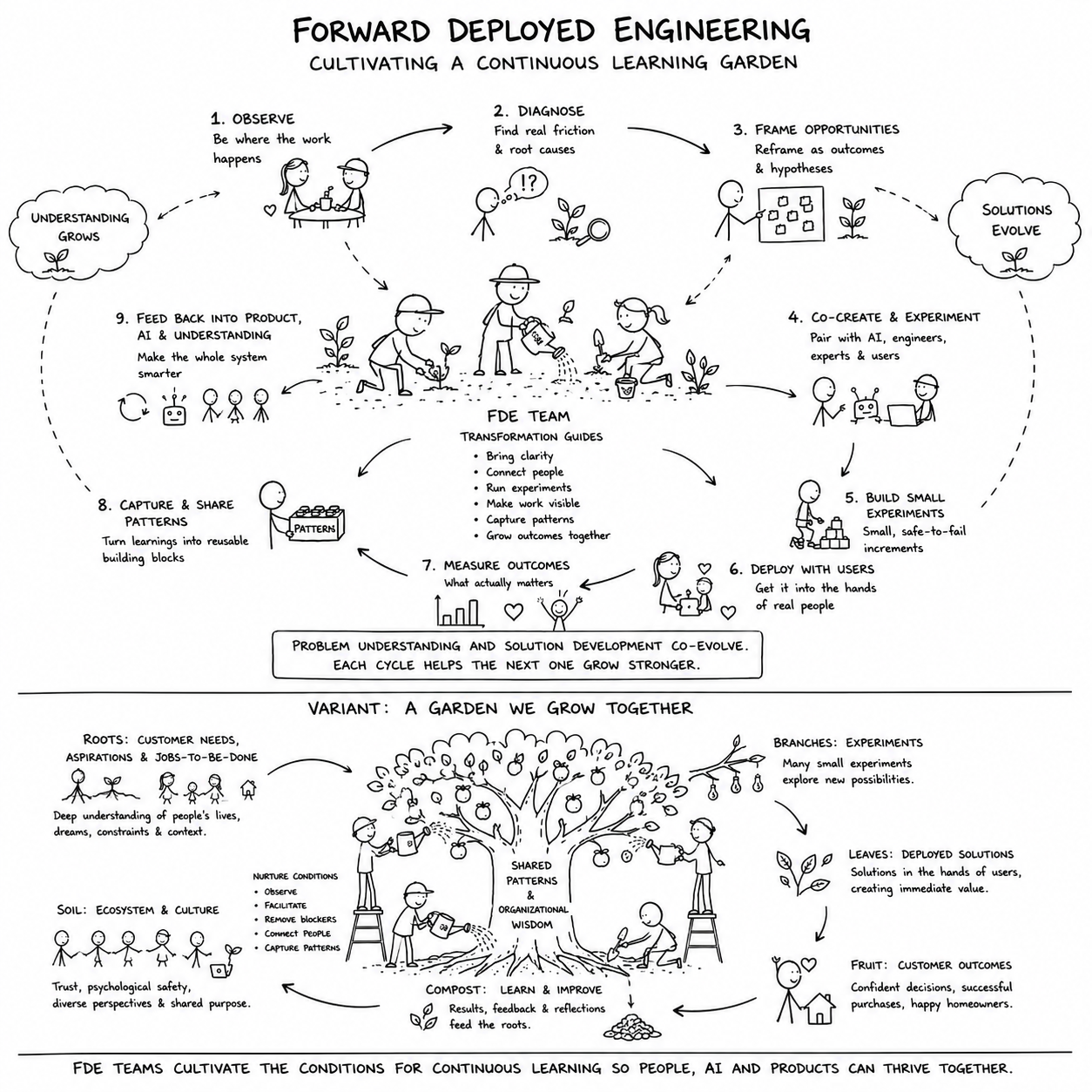
Forward Deployed Engineering teams cultivate the conditions where customer understanding, AI, and solutions continuously grow together. image generated by ChatGPT 5.5
Context
Organizations increasingly invest in AI agents that promise to automate work, accelerate decisions, and transform customer experiences [5]. Yet many initiatives struggle because they begin with technology instead of people. Product roadmaps define features before understanding real needs. AI agents optimize isolated tasks while losing sight of the customer’s larger journey. Engineers deliver software that works technically but fails to create meaningful outcomes.
Christopher Alexander observed a similar problem in architecture fifty years ago. In The Oregon Experiment, he argued that living systems cannot be created through centralized planning [1]. Instead, they emerge through countless local acts guided by people who inhabit the system every day.
The same principle applies to AI-powered product organizations [3].
Imagine an organization whose purpose is to help people become proud homeowners. Success is not measured by page views, recommendations, or conversations with an AI assistant. Success is measured by helping people confidently navigate one of the most important decisions of their lives.
Emma is buying her first apartment in Berlin. She is unsure how much she can afford, whether the neighborhood fits her lifestyle, and what compromises are worth making. She does not need another list of apartments. She needs confidence.
How should an AI organization help her?
Problem
Many organizations attempt to solve this challenge by building increasingly capable AI systems. Teams create more agents, larger models, and more sophisticated recommendations. Product managers prioritize features. Engineers optimize performance. Customer feedback eventually arrives through support tickets or quarterly research studies. The result is often an impressive system that optimizes the wrong things.
Nobody notices that Emma repeatedly abandons apartments after visiting them because the neighborhoods feel different than expected. Nobody discovers that first-time buyers hesitate most when comparing financing options, not when searching for homes. Nobody recognizes that customers who save hundreds of listings are actually less likely to purchase than those who carefully evaluate five.
The organization has data, but it lacks diagnosis. It has automation, but it lacks participation. It has technology, but people are no longer leading the learning process.
Forces
Organizations need to move quickly while avoiding large speculative investments. AI systems improve through learning, but learning only occurs when real people interact with them. Product teams need reusable solutions, while every customer situation contains unique context. Leadership seeks coordination across many initiatives, but centralized planning often slows adaptation.
These forces create a tension between standardization and discovery. The challenge is not building better AI. The challenge is creating an organization that continuously learns how to better serve people.
Therefore
Create a Human-in-the-Lead Forward Deployed Engineer [4] who acts as a Transformation Guide [2] between customers, AI agents, product teams, and engineering.
Rather than deploying software, this person deploys learning.
They work directly alongside customers, observing how real work unfolds. They diagnose where confidence breaks down, where friction appears, and where opportunities emerge. Together with customers, they design small experiments that improve one part of the journey. When an experiment succeeds, they capture it as a reusable organizational pattern that product teams and AI systems can adopt across the platform.
Technology evolves through human learning instead of replacing it. Humans remain in the lead.
How it works
Emma explains that every apartment looks beautiful online, yet many disappoint her during the visit. Instead of immediately improving recommendation algorithms, the Forward Deployed Engineer joins several property visits and observes the mismatch between photographs and lived experience.
A small experiment follows. The AI begins highlighting observations from previous buyers with similar preferences. It explains that apartments on comparable streets often feel noisier during the afternoon or receive less natural light than photographs suggest.
Emma finds this far more valuable than another recommendation. This single improvement becomes a reusable pattern called Expectation Calibration. Soon every customer benefits from knowledge discovered through one person’s experience.
Learning has become product.
Later, another observation emerges. Customers spend enormous effort comparing mortgage offers. The obstacle is not understanding interest rates. It is understanding how different monthly payments affect their future lifestyle.
The team builds another small experiment. Instead of presenting financial products, the AI helps customers explore future scenarios.
“What would your monthly budget look like if you started a family?”
“What happens if energy prices increase?”
Again, customers make better decisions. Again, a local discovery becomes a reusable organizational capability.
This is Alexander’s principle of organic order. The system grows through local acts instead of centralized design.
Human-in-the-Lead
Human-in-the-lead does not mean humans approve every AI decision. It means humans remain responsible for purpose, judgment, and learning.
Customers define what success looks like [5,6,7,8].
The Forward Deployed Engineer determines which observations deserve exploration. Product teams decide which successful patterns belong in the platform. AI contributes where it excels. It remembers every interaction, recognizes emerging patterns across thousands of journeys, proposes hypotheses, and accelerates experimentation.
Together they create something neither could achieve alone. A living learning system. This approach naturally aligns with the principles of an Agentic AI Learning System.
Human-guided learning begins every improvement because discovery starts with observing people rather than analyzing dashboards. Deterministic outcome anchoring keeps everyone focused on meaningful progress. The objective is not more recommendations but more confident homeowners.
Decision latency is reduced because experiments happen immediately instead of waiting for annual planning cycles. Outcome radiators make learning visible across the organization so that everyone understands where customers gain confidence and where they continue to struggle.
Whole-system visibility prevents local optimization by connecting search, financing, neighborhood understanding, property visits, negotiation, and long-term satisfaction into one continuous journey.
Finally, every successful experiment becomes a reusable pattern that teaches both the organization and its AI agents how to better support future customers. The system continuously becomes wiser because every customer contributes to everyone else’s success.
![Mapping Christopher Alexander’s six principles [1] to the Transformation Guide [2], Agentic Learning Systems [3], and Forward Deployed Engineering [4], showing how each perspective supports human-centered organizational learning.](https://miro.medium.com/v2/resize:fit:1400/1*oq5hNY92jqFVaAviqqdzVg.png)
Mapping Christopher Alexander’s six principles [1] to the Transformation Guide [2], Agentic Learning Systems [3], and Forward Deployed Engineering [4], showing how each perspective supports human-centered organizational learning.
Resulting Context
The Forward Deployed Engineer is no longer measured by deployments completed or tickets resolved.
They become the steward of organizational learning. The organization gradually develops its own pattern language for helping people become proud homeowners. AI agents become increasingly effective because they are grounded in real human experience rather than abstract assumptions. Product teams invest in proven patterns instead of speculative ideas.
Customers experience a journey that becomes more thoughtful with every interaction. Christopher Alexander argued that living environments emerge through participation, diagnosis, patterns, piecemeal growth, coordination, and organic order.
In the age of AI, these principles remain remarkably relevant.
The most successful AI organizations will not be those with the most powerful models.
They will be those that continuously learn with people, keep humans in the lead, and transform countless local discoveries into patterns that help every future customer take the next confident step toward becoming a proud homeowner.
Further reading
- The Oregon Experiment. Center for Environmental Structure. Vol. III. Oxford University Press, USA. ISBN 978–0195018240 by Christopher Alexander (1975)
- Pattern: The Transformation Guide* by Thoralf J Klatt
- A Pattern Language for Agentic AI Learning Systems by Thoralf J Klatt
- The Rise of the Forward Deployed Engineer (FDE) in Tech and AI Startups by Harikrishna Marampelly
- Better Discovery Using Jobs-to-be-Done (JTBD) ** by Thoralf J Klatt
- NODES AI 2026 — Building a Customer-Intelligence Brain: How GraphRAG Turns Data into Decisions by Eckhart Boehme
- People, Patterns & Products by Thoralf J Klatt
- Single Source of Truth by Eckhart Boehme
메타데이터
- post_id
- e1a2694a6652
- slug
- human-in-the-lead-forward-deployment-e1a2694a6652
- url
- https://medium.com/elevate-tech/human-in-the-lead-forward-deployment-e1a2694a6652
- canonical_url
- https://medium.com/elevate-tech/human-in-the-lead-forward-deployment-e1a2694a6652
- author_url
- https://medium.com/@thoralfjklatt
- status
- ok
- fetched_at
- 2026-07-09 09:01:30