When the Past Shows Up Quietly: Childhood Trauma in Adults
Not all trauma looks like a breakdown. Sometimes it looks like perfectionism, emotional numbness, self-doubt, or a nervous system that…
When the Past Shows Up Quietly: Childhood Trauma in Adults
Not all trauma looks like a breakdown. Sometimes it looks like perfectionism, emotional numbness, self-doubt, or a nervous system that never fully relaxes.
What Childhood Trauma Looks Like in Adults
Not every childhood trauma is a scar that can be seen. It can be the person who is never safe, the person who overthinks every conversation, the person who says “I’m fine,” when really they’re carrying years of fear, shame or emotional neglect. Childhood trauma doesn’t always come out and say hello, it sometimes comes out and says ‘hey, that’s normal, I’ve been there for a long time’.
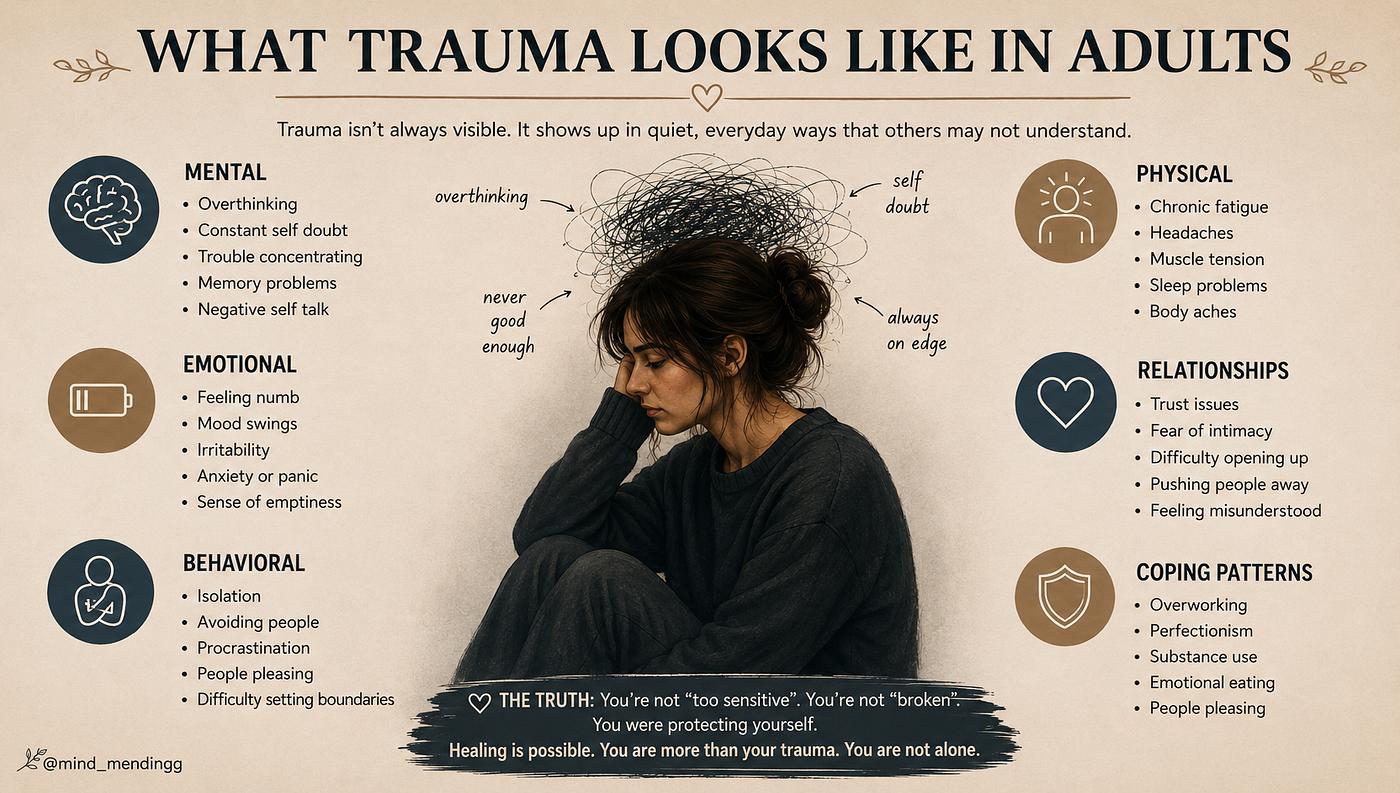
It’s not the pain itself that is the hardest part for many, it’s the fact that they can’t call it by its name. They can recognize that their struggle is with trust, anxiety, numbness, people-pleasing, or anger, but not link those struggles to something that occurred earlier in their lives. This is why childhood trauma has such a profound impact: it can affect an individual’s inner landscape well beyond their childhood (Felitti et al., 1998).
The Adult Signs People Miss
Hypervigilance is one of the most common s ign. It’s the tendency to be on your guard, always looking for trouble, always reading others’ expressions, and believing that something bad is always going to happen. If you’ve had trauma in your life, it can be difficult for adults to unwind, since their bodies are always on guard. In safe environments they may still be in survival mode.
Emotional dysregulation is another typical symptom. Some adults experience feelings as if they are too strong and find it difficult to relax during or after conflict or criticism. Others become withdrawn, apathetic and numb, feeling detached or disconnected from themselves. These can occur in either direction when children have had their feelings ignored, punished or overwhelmed in their early years of life.
Relationships can also be a manifestation of trauma. Some adults develop clingy and fearful behavior, and need to be constantly reassured. Others tend to avoid people and don’t like being close to others. These patterns tend to be misinterpreted as personality traits but can be early life learnt survival strategies.
Another subtle sign is low self-esteem. Everyone can look successful and able on the outside, but on the inside feel that he or she is not enough. This belief may result in perfectionism, overachievement, people-pleasing, problems with boundaries, and/or staying in harmful relationships. Being strong can be a lifelong quest for safety and approval.
What it can Look Like Day to Day
Childhood trauma can show up in everyday life in many ways: over-explaining, excessive apologizing, avoiding conflict, feeling guilty about having needs, and more. For some adults, sleep is a challenge because sleep is perceived as unsafe or unwarranted. Other people can’t stand a lack of information, a lack of certainty, criticism, without going into a panic mode, or self-blame mode.
It may also show up in the body. Common complaints are sleep problems, chronic tension, headaches, digestive problems, fatigue and always feeling “on edge”. Adverse childhood experiences can impact the brain development and the body’s stress response, which is why trauma is not only psychological, but also physical, according to the CDC.

Success can sometimes be the most obvious indicator. Achievement is a coping mechanism, and for many trauma survivors, it ends up making them great students, good workers, or well-functioning adults. They might seem sturdy and attractive on the exterior. However, inside they may feel drained, isolated or fear a lack of performance will lead to failure.
Why Trauma Stays Active
The brain, emotions and attachment system are still developing during the childhood years. The stress system can become over activated if a child is reared in an environment of abuse, neglect, instability, violence, and chronic emotional invalidation. These have an impact on how the person responds to fear, intimacy, disagreement, and failure when they are an adult.
The adverse childhood experiences literature demonstrates an ordered association between early adversity and later health and mental health issues. That is, the more adverse experiences a person’s life will have, the greater will be the likelihood of future problems. Additionally, a recent CDC report revealed that two out of three U.S. adults reported experiencing one or more ACEs, suggesting that these experiences are not uncommon (Anda et al., 2006).

This matters because trauma is not only about what happened. It is also about what the child had to become in order to survive. A child who had to stay invisible, stay perfect, stay quiet, or stay alert may carry those habits into adulthood. What once helped them cope can later make life harder.
Myths that keep People Silent
A harmful myth says that if someone is high-functioning, they cannot be traumatized. That is false. Many adults with childhood trauma appear successful in work or school because success is part of how they learned to stay safe. Functioning well does not cancel out pain.
Another myth says trauma only counts if the person remembers every detail clearly. Memory is not that simple. People may not remember exact events, but the body and emotional patterns can still carry the effects. Trauma can show up through reactions, triggers, attachment styles, and deeply held beliefs long before it becomes a clear story.
A third myth is that childhood trauma is only abuse. Abuse is one form of trauma, but not the only one. Emotional neglect, chronic criticism, parental addiction, instability, witnessing violence, or growing up in constant fear can all shape development in lasting ways. Sometimes the deepest wound is not what was done, but what was missing.
There is also the myth that “everyone has trauma,” so it should not be taken seriously. While many people experience hardship, trauma is shaped by intensity, repetition, age, support, and whether there was a safe adult present. Minimizing it can stop people from getting help and can make healing feel shameful instead of possible.
What the Research Shows
The initial ACE study revealed that there was a close association between ACE and subsequent health-risk behaviors, such as depression, substance use, and multiple chronic health problems. Subsequent studies have continued to reveal the pervasive long-term consequences of childhood maltreatment on mental, emotional, and physical health (Adverse Childhood Experiences (ACEs): Preventing Early Trauma to Improve Adult Health: CDC Vital Signs: November 5, 2019, 2019).
Common findings in research about the impact of childhood trauma on adults include anxiety, depression, problems with trust, emotional numbness, avoidance, perfectionism, and relationship problems. These are not accidental faults. They tend to be acquired coping mechanisms to unsafe environments. The person that had to stay small, silent or hyper-alert could still be operating on the same blueprint years later (Burrows, 2024).
The encouraging message is that trauma is not inevitable. The same studies that demonstrate the extent of the impact of early adversity on adult life also inform the notion that the process of recovery is possible with supportive relationships, therapies, and regulation skills. Healing will not erase the past, but can help diminish its control over the present.
Healing Begins with Naming it
A key piece to healing is remembering that your reaction is understandable. If your childhood told you that love was conditional, conflict was dangerous, or feeling was unsafe, then your adult patterns are not weakness. Their reactions are logical reactions to a life-threatening environment.
The shift is important because shame flourishes in confusion. When people can identify trauma, they are more likely to look at their patterns with compassion. They no longer ask, “What is the matter with me?” and instead ask, “What has taken place with me and what do I need now?”
Therapy, stable relationships, boundary setting, nervous system regulation and learning to experience safety in small increments are all parts of healing. It will almost never be in a straight line. However, with a little work and help from others, it is possible — and can start the moment they start to recognize that their pain has a name.
Closing Thought
Adults who have experienced childhood trauma are sometimes invisible to the outside world. Perfectionism, numbness, anxiety, fear of abandonment, persistent self-doubt, or a body that never settles can all be signs of it. It could also appear as though someone is “doing well” while secretly harboring unacknowledged hurts.
The crucial reality is that while early trauma can influence an adult’s life, it need not permanently define it. People can start to change the patterns that once kept them alive with understanding, compassion, and support.
References
Adverse Childhood Experiences (ACEs): Preventing Early Trauma to Improve Adult Health: CDC Vital Signs: November 5, 2019. (2019, November 5). Cdc.Gov. https://stacks.cdc.gov/view/cdc/82318
Anda, R. F., Felitti, V. J., Bremner, J. D., Walker, J. D., Whitfield, Ch., Perry, B. D., Dube, Sh. R., & Giles, W. H. (2006). The Enduring Effects of Abuse and Related Adverse Experiences in Childhood. European Archives of Psychiatry and Clinical Neuroscience, 256(3), 174–186. https://doi.org/10.1007/s00406-005-0624-4
Burrows, S. (2024). How Childhood Trauma May Impact Adults. In URMC Newsroom. University of Rochester Medical Center. https://www.urmc.rochester.edu/news/publications/health-matters/how-childhood-trauma-may-impact-adults
Felitti, V. J., Anda, R. F., Nordenberg, D., Williamson, D. F., Spitz, A. M., Edwards, V., Koss, M. P., & Marks, J. S. (1998). Relationship of childhood abuse and household dysfunction to many of the leading causes of death in adults. American Journal of Preventive Medicine, 14(4), 245–258. https://doi.org/https://doi.org/10.1016/S0749-3797(98)00017-8
childhood trauma in adults | signs of childhood trauma | adverse childhood experiences | trauma symptoms in adults | emotional neglect in childhood | adult survivors of childhood trauma | childhood trauma and relationships | healing from childhood trauma
psychology #childhoodtrauma #adulttrauma #psychologist #brainscience #mentalhealth
About the Author:
Fatima Maqsood is a psychologist passionate about making psychology accessible through evidence-based, practical, and easy-to-understand writing. She explores mental health, human behavior, emotional well-being, and personal growth through the MindMending platform.
Disclaimer:
This article is for educational purposes only and should not be considered a substitute for professional psychological assessment, diagnosis, or therapy.
메타데이터
- post_id
- e1e7ed9015f5
- slug
- when-the-past-shows-up-quietly-childhood-trauma-in-adults-e1e7ed9015f5
- url
- https://medium.com/@mind_mendingg/when-the-past-shows-up-quietly-childhood-trauma-in-adults-e1e7ed9015f5
- canonical_url
- https://medium.com/@mind_mendingg/when-the-past-shows-up-quietly-childhood-trauma-in-adults-e1e7ed9015f5
- author_url
- https://medium.com/@mind_mendingg
- status
- ok
- fetched_at
- 2026-07-21 05:35:08




