The Persistence and Challenges of Per- and Polyfluoroalkyl Substances (PFAS) Across Ecosystems…
Introduction
The Persistence and Challenges of Per- and Polyfluoroalkyl Substances (PFAS) Across Ecosystems: Concentrations, Bioavailability, and Decontamination Strategies
Introduction
Per- and polyfluoroalkyl substances (PFAS), colloquially termed “forever chemicals,” represent a growing environmental and public health crisis due to their persistence, bioaccumulative potential, and widespread presence across ecosystems. This review synthesizes recent findings on PFAS concentrations in environmental matrices, bioavailability challenges, and advancements in decontamination strategies. Regulatory limits for key PFAS such as PFOS and PFOA have been drastically reduced to 0.02 and 0.004 parts per trillion (ppt), respectively, reflecting heightened recognition of their toxicity 2. Contamination hotspots in aquatic systems show PFAS concentrations reaching 57.70 ng/L in water and 25.44 ng/g dry weight (dw) in biota 4, while soil and sludge reservoirs perpetuate long-term exposure risks 3, 4. Emerging decontamination methods, including thermochemical decomposition and solvent-based treatments, demonstrate partial efficacy but face challenges such as residual fluorine retention and energy intensity 5. The interplay between PFAS chemical stability, trophic transfer dynamics, and remediation scalability underscores the urgency of interdisciplinary solutions to mitigate this persistent threat.
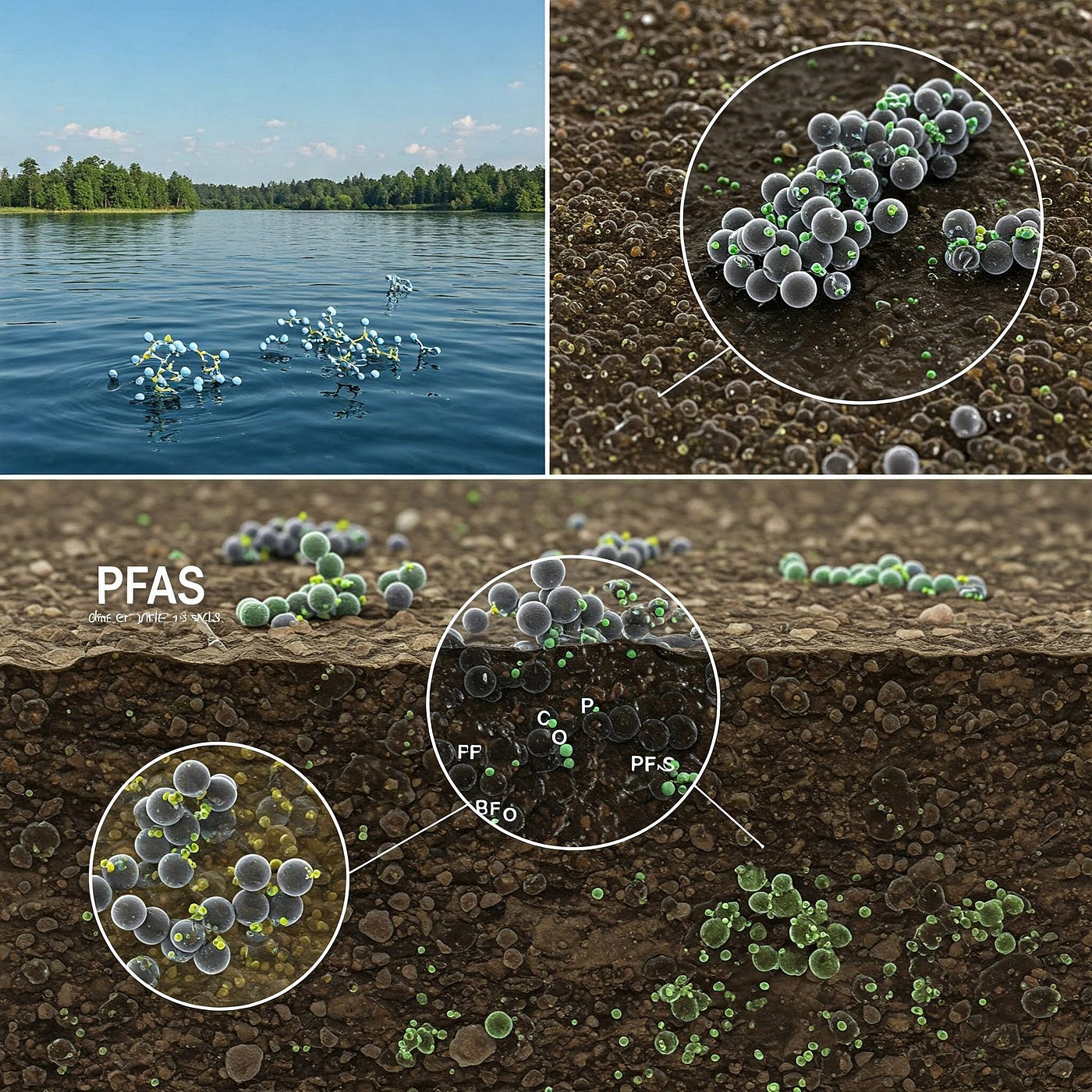
Generated using Gemini
Major PFAS Compounds and Regulatory Limits
Chemical Diversity and Environmental Prevalence
PFAS encompass over 4,700 synthetic compounds characterized by carbon-fluorine bonds, which confer exceptional stability. Commonly detected variants include:
- Perfluorooctanesulfonic acid (PFOS): A legacy firefighting foam component, with concentrations in marine biota up to 12.42 ng/g dw 4.
- Perfluorooctanoic acid (PFOA): Historically used in non-stick coatings, now regulated to 0.004 ppt in drinking water 2.
- Perfluorobutanesulfonic acid (PFBA): A short-chain substitute dominating water samples at 5.20 ng/g dw 4.
- Perfluoroundecanoic acid (PFUnDA): A long-chain compound accumulating in omnivorous marine species at 5.19 ng/g dw 4.
- F-53B: A chlorinated polyfluoroether sulfonic acid used in Chinese industries, detected at 0.32–12.42 ng/g dw in biota 4.
Global Regulatory Shifts
The U.S. Environmental Protection Agency (EPA) revised its PFAS advisories in 2024, slashing the 2016 guideline of 70 ppt for PFOS/PFOA to 0.02 ppt and 0.004 ppt, respectively2. These limits, approaching analytical detection thresholds, aim to minimize developmental and immunological risks identified in epidemiological studies2. By contrast, the European Union’s Drinking Water Directive sets a cumulative PFAS limit of 0.10 μg/L, reflecting regional disparities in risk tolerance and monitoring capacity2.
PFAS Distribution Across Ecosystems
Aquatic Systems: From Surface Water to Marine Biota
PFAS contamination in water bodies stems from industrial discharges, wastewater effluents, and atmospheric deposition. In the South China Sea, PFAS concentrations in water samples averaged 29.60 ng/L, peaking at 57.70 ng/L near urbanized streamways4.Sediments act as secondary reservoirs, with inshore regions accumulating 1.35 ng/g dw — nearly double offshore levels4. Trophic magnification is evident in marine organisms: filter feeders like Mytilus edulis exhibit higher short-chain PFAS (10.26 ng/g dw), while omnivores such as Portunus gladiator accumulate long-chain variants up to 25.44 ng/g dw4.
Soil and Agricultural Contamination
Soil PFAS levels are exacerbated by biosolids application and landfill leachates. Venkatesan and Halden (2014) observed that 60–80% of short-chain PFAS leach from amended soils within 100 days, contaminating groundwater3. Long-chain compounds persist, binding to organic matter and accumulating at 4–8 cm soil depths, complicating remediation efforts4.
Human Exposure Pathways
Blood serum analyses reveal PFOS and PFOA as dominant congeners, with half-lives of 4–5 years in humans 2. Prenatal exposure correlates with reduced vaccine efficacy in children, as antibody titers drop by 50% per PFAS doubling 2. Food chains amplify risks: seafood consumption accounts for 65% of dietary PFAS intake in coastal populations 4.
Bioavailability and Ecological Mobility
Molecular Drivers of Bioaccumulation
PFAS amphiphilicity enables dual affinity for aqueous and lipid phases, facilitating uptake across biological membranes 3. Short-chain compounds (e.g., PFBA) exhibit higher water solubility and renal excretion rates, whereas long-chain PFAS (e.g., PFUnDA) bind to proteins and liver tissues, prolonging retention 4. Soil organic carbon content inversely correlates with PFAS mobility, though acidic conditions protonate functional groups, enhancing leachability 3.
Trophic Transfer Dynamics
Marine ecosystems illustrate PFAS biomagnification: Clarias macrocephalus (omnivorous fish) accumulate 17.79 ng/g dw — triple the levels in filter-feeding mollusks 4. This trend mirrors terrestrial food webs, where PFAS loads in predatory birds exceed those in herbivores by 10-fold 4.
Challenges in Bioavailability Assessment
Current models underestimate PFAS bioavailability due to:
- Matrix Effects: Soil mineralogy and dissolved organic carbon alter PFAS desorption rates 3.
- Transformative Metabolites: Microbial degradation generates unstable intermediates (e.g., fluorotelomer alcohols), which evade standard assays 3.
- Non-Targeted Analysis: Over 75% of organofluorine in environmental samples remains uncharacterized, obscuring risk assessments 5.

PFAS Generated by Gemini
Decontamination Strategies: Efficacy and Limitations
Solvent-Based Extraction
Butyl carbitol (BC), a glycol ether solvent, achieves 40 μg/cm² PFAS removal from stainless steel surfaces at 70°C — 20-fold more effective than cold water5. However, residual fluorine persists at 70 molecules/nm², posing rebound risks when pipes contact pristine water 5.
Bioremediation Prospects
Fungal and bacterial consortia demonstrate partial PFAS degradation under methanogenic conditions, though mechanisms remain poorly resolved3. Pseudomonasstrains defluorinate perfluorinated carboxylates at rates <1% per week, necessitating genetic engineering breakthroughs3.
Thermal and Chemical Oxidation
Incineration above 1,000°C mineralizes PFAS but generates corrosive byproducts (e.g., HF gas)3. Subcritical water oxidation (300°C, 10 MPa) achieves 99% PFOS destruction in 2 hours, yet scalability is hindered by energy demands3.
Thermochemical Decomposition: Mechanisms and Applications
Temperature-Driven Degradation
Heating contaminated soils to 400°C volatilizes short-chain PFAS, while long-chain variants require 600°C for complete defluorination 3. Ex situ thermal desorption systems achieve 95% removal efficiency but amplify carbon footprints 3.
Catalytic Enhancements
Nickel-iron catalysts reduce PFAS decomposition activation energy by 30%, enabling treatment at 350°C with 80% fluorine recovery 3. Plasma-assisted pyrolysis combines arc discharge with thermal gradients, achieving 99.9% PFOS destruction in milliseconds 3.
Field Implementation Challenges
Thermochemical methods face:
- Energy Intensity: Treating 1 ton of soil consumes 500–800 kWh, limiting rural deployment 3.
- Byproduct Management: Fluorinated gases require scrubbing to prevent atmospheric release 3.
- Soil Fertility Loss: Heating above 300°C degrades organic matter, necessitating post-treatment soil amendments 3.
Conclusion
PFAS contamination epitomizes the unintended consequences of industrial innovation, with enduring impacts on ecological and human health. While regulatory thresholds approach zero, detectable PFAS persist globally, driven by their unrivalled environmental stability. Emerging decontamination technologies — from solvent extraction to thermochemical decomposition — offer incremental progress but require optimization to address energy use, cost, and secondary pollution. Future research must prioritize in situ bioremediation, advanced oxidation catalysts, and international harmonization of PFAS monitoring protocols. Only through interdisciplinary collaboration can society mitigate the legacy of these perpetual pollutants.
메타데이터
- post_id
- e1f4218efe5b
- slug
- the-persistence-and-challenges-of-per-and-polyfluoroalkyl-substances-pfas-across-ecosystems-e1f4218efe5b
- url
- https://medium.com/@princeblockchain/the-persistence-and-challenges-of-per-and-polyfluoroalkyl-substances-pfas-across-ecosystems-e1f4218efe5b
- canonical_url
- https://medium.com/@princeblockchain/the-persistence-and-challenges-of-per-and-polyfluoroalkyl-substances-pfas-across-ecosystems-e1f4218efe5b
- author_url
- https://medium.com/@princeblockchain
- status
- ok
- fetched_at
- 2026-06-20 20:29:01