The Hidden Power Challenge in Modern Palm Vein Systems: Why Battery Integration Is the Real…
The Evolution From Single-Mode to Dual-Mode Biometric Recognition
The Hidden Power Challenge in Modern Palm Vein Systems: Why Battery Integration Is the Real Solution

The Evolution From Single-Mode to Dual-Mode Biometric Recognition
The biometric authentication industry has undergone a fundamental transformation in recent years. Traditional palm vein scanners relied exclusively on infrared (IR) imaging to capture the unique vascular patterns beneath the skin’s surface. These IR-only systems were elegantly simple from a power perspective, typically consuming modest amounts of electricity — around 5 volts at 1 ampere was sufficient for basic palm vein recognition devices.
However, the landscape has shifted dramatically. Today’s enterprise-grade palm vein systems increasingly deploy dual-mode technology that combines infrared imaging with RGB (visible light) cameras. This architectural evolution represents more than just an incremental improvement; it fundamentally changes the security paradigm.
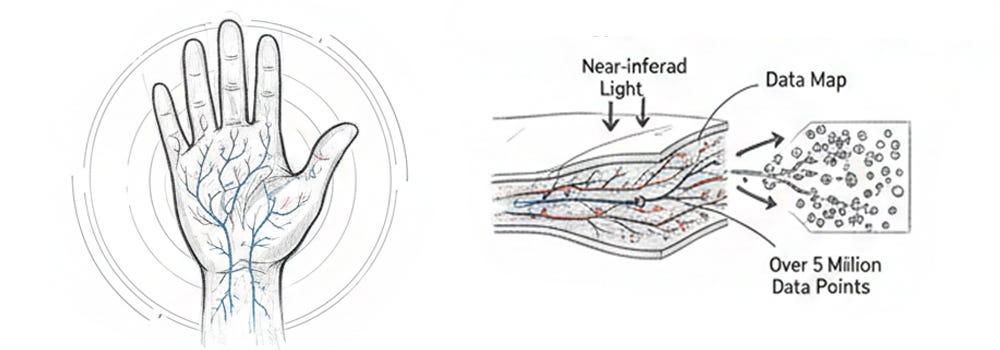
Dual-mode palm vein scanners combine high-resolution RGB cameras for palm print capture and near-infrared imaging for palm vein recognition, creating what industry experts call a “two-layer” security system. The IR module continues to map the internal vascular structure — a biometric identifier that cannot be photographed, copied, or stolen — while the RGB camera simultaneously captures surface-level palm print features including ridge patterns and distinctive lines.
This convergence delivers measurable advantages in security and accuracy. Modern palm recognition algorithms using RGB plus IR technology can reach a false acceptance rate as low as 1 in 100 million, providing the precision required for finance-grade applications. The dual verification significantly reduces spoofing risks and enhances liveness detection, making these systems appropriate for critical applications including financial transactions, national identity programs, and secure facility access.
But this leap in capability comes with a significant trade-off: substantially increased power consumption.
Understanding the Power Requirements of Dual-Mode Systems
To support simultaneous operation of both IR and RGB imaging modules, along with the processing hardware needed for real-time biometric capture, modern dual-mode palm vein scanners typically require at least 5 volts at 1.5 amperes — translating to 7.5 watts of continuous power draw during active scanning operations.
This seemingly modest requirement becomes problematic when we examine the reality of USB power delivery across the diverse ecosystem of host devices these scanners must connect to in real-world deployments.
The USB Power Delivery Gap: Where Theory Meets Reality
The Universal Serial Bus standard was originally designed as a data interface with limited power delivery capabilities. USB 2.0 specification allows hosts to deliver 5V at 500 milliamps for a total power output of 2.5 watts, while USB 3.0 and 3.1 allow 5V at 900 milliamps equivalent to 4.5 watts.
Even USB 3.0 ports specifically designed for charging typically max out at 5V and 1.5A, delivering 7.5 watts — barely meeting the minimum requirement for dual-mode palm vein scanners and leaving no margin for power fluctuations or simultaneous data transfer overhead.
The situation becomes more challenging when we examine specific device categories commonly used as host systems in palm vein deployment projects:
Android Smartphones and Tablets: Most mobile devices output significantly less than 1.5A through their USB ports. Most computer USB ports supply 5V electricity with a maximum current of 0.5A, which means the overall power output will be 2.5 watts at best. While some newer flagship devices support USB Power Delivery protocols that can negotiate higher current levels, this capability is far from universal, especially in the mid-range and budget devices commonly deployed in large-scale biometric projects.

Windows PCs and Laptops: Desktop computers and laptops present a mixed landscape. Standard USB 2.0 ports remain common on many business computers and are limited to 500mA. USB 2.0 ports provide 5V and up to 500mA, which is adequate for many older or low-power devices but may charge them more slowly compared to other USB standards. Even on machines with USB 3.0 ports, laptop manufacturers often implement power management policies that limit USB port current to preserve battery life.
Linux-Based Terminals and Embedded Systems: Industrial terminals, point-of-sale systems, and embedded Linux devices are frequently built to meet specific cost targets, with USB power delivery capabilities often sacrificed to reduce component costs and thermal management requirements.
Industrial and IoT Devices: Factory automation systems, access control terminals, and IoT edge devices typically provide minimal USB power, as these platforms were never designed to support high-performance biometric peripherals.
The Cascade of Problems When Power Falls Short
Insufficient USB power delivery creates a cascade of operational failures that undermine the entire biometric system:
Intermittent Connection Failures: When the scanner attempts to draw more current than the host can provide, voltage levels drop below operational thresholds. This triggers sporadic disconnection and reconnection cycles, creating an unstable system state that confuses both hardware and software layers.
Unexpected System Shutdowns: During peak power demand — such as when both IR and RGB modules activate simultaneously during capture — the scanner may abruptly power down, forcing users to restart the authentication process and creating significant frustration in high-traffic environments.
Recognition Performance Degradation: Insufficient power often manifests as reduced image quality from both camera modules. Underexposed IR images fail to capture fine vascular details, while RGB images suffer from noise and poor contrast. The biometric matching algorithms, starved of high-quality input data, produce inconsistent results with elevated false rejection rates.
System Instability and Crashes: In some cases, the host operating system itself becomes unstable when USB peripherals draw excessive current, leading to driver crashes, system freezes, and in extreme cases, protective shutdown of USB subsystems.
User Experience Collapse: From the end-user perspective, these technical failures translate to a simple reality: the system doesn’t work. Authentication failures, long wait times, and repeated scan attempts destroy confidence in the biometric system and often lead to user resistance and project abandonment.
The critical point to understand is that these failures have nothing to do with the quality of the biometric algorithms, the precision of the optical sensors, or the sophistication of the matching software. They are pure hardware power design problems — but their impact on project success is devastating.
The Powered USB Hub Solution: Appealing in Theory, Problematic in Practice
When development teams encounter power-related failures during deployment, a common response is to introduce a powered USB hub as an intermediary between the host device and the palm vein scanner. The logic seems sound: the hub connects to an external power adapter, providing ample current to the scanner while maintaining the USB data connection to the host.
In controlled laboratory environments and proof-of-concept demonstrations, this approach often works adequately. However, real-world field deployment reveals numerous vulnerabilities in the hub-based solution:
Hardware Reliability Issues: Consumer-grade powered USB hubs are not built for continuous industrial operation. The combination of thermal stress, mechanical wear on connectors, and electrical transients common in commercial environments leads to frequent hub failures. Field experience shows hub lifespans of just 6–12 months in typical deployment conditions.
Power Adapter Dependencies: The hub approach introduces a critical dependency on the quality and specifications of the power adapter. Many teams discover too late that the adapter must support not just the scanner’s 1.5A requirement, but an additional overhead for hub operation — typically requiring a 2A or higher adapter. Cheap or inadequate adapters simply shift the power problem rather than solving it.
Cable Management Complexity: Each powered hub adds multiple cable connections: USB cable from host to hub, USB cable from hub to scanner, and power cable from hub to wall outlet. This cable proliferation increases setup complexity, creates trip hazards, and multiplies potential failure points — every additional connector is an opportunity for intermittent connection issues.
Field Environment Challenges: Deployment environments often lack conveniently located power outlets, forcing long cable runs or the installation of additional infrastructure. In mobile deployments, vehicle-mounted systems, and temporary installations, external power requirements create logistical challenges that teams didn’t anticipate during planning.
Thermal and Space Constraints: Powered hubs generate heat and require ventilation space. In compact installations — inside kiosks, behind wall-mounted terminals, or within embedded enclosures — there may simply be no physical space for a hub and its associated power adapter.
Support and Maintenance Overhead: Every hub in the field represents an additional component requiring support, troubleshooting, and eventual replacement. For deployments spanning hundreds or thousands of locations, this maintenance burden becomes significant and costly.
The fundamental problem with the hub approach is that it attempts to solve an inherent hardware limitation through external accessories, creating new dependencies and failure modes in the process.
Why Power Problems Are Invisible During Development
Many palm vein integration projects sail through initial development and testing phases without encountering power issues, only to face catastrophic failures during production deployment. This disconnect occurs because development and production environments operate under fundamentally different conditions:
Laboratory Development Conditions: During software development and initial integration, scanners are typically connected to engineering workstations equipped with high-quality motherboards, dedicated power supplies, and ample USB power delivery capabilities. Development boards and reference platforms often include voltage regulation circuits specifically designed to support peripheral hardware. In this environment, power is abundant and stable.
Prototype Testing Reality: Even when teams conduct field testing with actual deployment hardware, testing typically occurs under ideal conditions: fully charged batteries, single-user scenarios, controlled ambient temperatures, and test personnel who can accommodate brief disruptions. These conditions mask the power stress that occurs during continuous operation in production.
Production Deployment Shock: When the system enters production use, conditions change dramatically. Host devices experience sustained operation with degraded batteries, thermal stress from continuous use, simultaneous operation of multiple USB peripherals, and the cumulative impact of hundreds or thousands of daily authentication cycles. It’s under these conditions that marginal power delivery reveals itself as a critical failure mode.
The problem is exacerbated by the fact that biometric project teams rarely include power engineering expertise. Software developers focus on algorithm performance and integration APIs, while project managers concentrate on rollout logistics and user training. The subtle but critical domain of USB power delivery falls into a knowledge gap, only becoming visible when systems fail in the field.
**UZINFOCOM’s Engineering Response: Building Power Independence Into the Hardware**

At UZINFOCOM, we approached the dual-mode palm vein power challenge from first principles, asking a fundamental question: Why should a sophisticated biometric device be dependent on the power delivery capabilities of host systems that were never designed to support it?
The answer led to a different architectural philosophy: build power independence directly into the scanner hardware rather than depending on external power sources or accessories.
This philosophy is embodied in the MyID Vein Reader Pro, a self-powered USB palm vein scanner with an integrated rechargeable battery system. By incorporating battery power as a core component of the hardware design, MyID Vein Reader Pro fundamentally eliminates the host power dependency that undermines most dual-mode palm vein deployments.
Technical Architecture of the MyID Vein Reader Pro
The MyID Vein Reader Pro represents a comprehensive reimagining of palm vein scanner power architecture:
Integrated Battery System: The device incorporates a high-capacity lithium-ion battery pack specifically engineered to meet the power demands of dual-mode IR and RGB capture. The battery subsystem includes sophisticated power management circuits that optimize current delivery to the optical modules while minimizing parasitic losses.
Independent Power Domain: The scanner’s IR module, RGB camera, image processing hardware, and communication subsystems all draw power from the internal battery, creating a completely independent power domain. The USB connection to the host device serves exclusively for data communication, with no power dependency on the host.
Operational Endurance: The battery capacity supports 6–8 hours of continuous operation under typical usage patterns — sufficient for full-day deployment in most scenarios. For higher-volume applications, the actual operational duration often extends significantly, as biometric scanners spend most of their time in low-power standby states between authentication events.
Hot-Swappable Charging: A dedicated USB Type-C charging port allows the device to be charged while simultaneously operating, enabling continuous 24/7 deployment in high-traffic environments. The charging system implements intelligent charge management to optimize battery longevity and prevent charge-related thermal issues.
Universal Compatibility: Because the MyID Vein Reader Pro draws no power from its USB data connection, it operates reliably with any host device that provides a functional USB data port — whether Android, Windows, Linux, or embedded systems, regardless of their USB power delivery capabilities.
The Cascade of Benefits From Power Independence
Eliminating host power dependency creates benefits that extend far beyond simply avoiding power-related failures:
Deployment Flexibility: Project teams can select host devices based on software capabilities, form factor, and cost — without needing to verify USB power specifications or conduct power testing. This dramatically simplifies hardware selection and reduces procurement risk.
Simplified Installation: Field installers no longer need to deploy powered hubs, source appropriate power adapters, or route additional power cables. Installation becomes a single USB cable connection, reducing installation time and eliminating opportunities for configuration errors.
Enhanced Reliability: Removing the hub from the deployment eliminates an entire category of failure modes. There are no hub failures, no power adapter failures, no additional cable connection points to work loose, and no hub-related electrical noise introducing system instability.
Consistent Performance: With dedicated battery power, the IR and RGB modules receive stable, consistent electrical power regardless of host device state, battery charge level, or simultaneous peripheral operation. This translates to consistent image quality and predictable recognition performance across all operating conditions.
Extended Host Battery Life: For mobile deployments using tablets or portable terminals as host devices, eliminating the scanner’s power draw from the host USB port significantly extends host device battery life. A tablet that previously required mid-day recharging can now operate through complete shifts.
Reduced Support Burden: Field support teams deal with fewer variables when troubleshooting issues. Power-related support calls — which often involve complex diagnosis of hub configuration, adapter specifications, and cable quality — essentially disappear from the support queue.
Lower Total Cost of Ownership: While a battery-integrated scanner has a higher initial acquisition cost than a basic bus-powered device, the elimination of hubs, adapters, cables, and associated support costs typically delivers lower total cost of ownership over the deployment lifetime.
Stable Power as the Foundation of System Reliability
In enterprise biometric deployments, particularly those involving financial transactions or security-critical access control, system reliability is not optional — it’s fundamental. Users encountering authentication failures quickly lose confidence in the system, often reverting to legacy authentication methods or finding workarounds that undermine security.
Stable electrical power is the foundation upon which reliable biometric systems are built. When optical modules receive consistent power, they generate consistent image quality. When image quality is consistent, biometric algorithms produce predictable results. When results are predictable, users develop trust in the system. When users trust the system, adoption follows.
The inverse is equally true: unstable power creates unstable image capture, which creates inconsistent algorithm performance, which erodes user confidence, which leads to system rejection — regardless of how sophisticated the underlying biometric technology might be.
From UZINFOCOM’s perspective, power stability is not a secondary consideration to be addressed through accessories and workarounds. It’s a primary design requirement that must be engineered into the hardware architecture from the beginning.
Looking Forward: The Industry Transition to Dual-Mode Recognition
The biometric industry’s transition from IR-only to dual-mode IR + RGB palm vein recognition is accelerating, driven by increasing security requirements in financial services, government identity programs, and enterprise access control. Dual-mode security combines RGB and IR imaging to capture both palm surface and vein patterns, providing higher accuracy and enhanced liveness detection.
This technical evolution brings measurable security benefits, but it also raises the baseline power requirements for palm vein scanner hardware. The industry faces a fundamental choice: continue attempting to work around the limitations of bus-powered devices through external accessories, or embrace integrated power architectures that eliminate the dependency.
UZINFOCOM’s position is clear: as biometric scanner power requirements increase to support dual-mode recognition, attempting to source that power from host USB ports becomes increasingly untenable. Powered hubs and external adapters are band-aid solutions that introduce new problems while solving old ones.
The sustainable path forward is to build power independence into scanner hardware through integrated battery systems. This architectural approach aligns with how the broader portable electronics industry has evolved — smartphones, tablets, laptops, cameras, and virtually every other category of sophisticated portable electronics solved the power problem through battery integration, not through dependence on external power accessories.
Palm vein scanners are following the same evolutionary path.
Conclusion: Engineering for Real-World Deployment Success
Laboratory performance specifications tell only part of a biometric system’s story. A palm vein scanner with exceptional recognition accuracy, impressive speed, and sophisticated anti-spoofing capabilities is still a failed product if it cannot maintain stable operation in real-world deployment conditions.
Power engineering is where laboratory promises meet field reality. Teams that treat power delivery as a secondary concern — something to address with hubs and adapters if problems arise — often find themselves managing field failures, explaining system instability to frustrated users, and retrofitting power solutions into deployed systems at significant cost.
Teams that recognize power stability as a primary design requirement from project inception make different hardware choices, deploy more reliable systems, achieve higher user satisfaction, and ultimately deliver more successful biometric implementations.
At UZINFOCOM, we design palm vein hardware for the real world — where host devices have limited power budgets, where installation environments lack convenient power sources, where equipment operates continuously under thermal stress, and where field support teams need systems that simply work without constant intervention.
The MyID Vein Reader Pro embodies this philosophy: dual-mode IR + RGB biometric capability combined with integrated battery power for true deployment independence. It represents our commitment to engineering solutions that don’t just perform well in controlled testing environments, but deliver reliable operation across the diverse, challenging conditions of actual field deployment.
Because in the end, the most sophisticated biometric technology is only valuable if it works reliably when and where users need it.
Learn more about UZINFOCOM’s self-powered palm vein solutions at:
About UZINFOCOM: UZINFOCOM specializes in enterprise-grade biometric authentication systems, with particular expertise in dual-mode palm vein recognition technology. The company’s engineering team focuses on creating hardware solutions designed for real-world deployment conditions, emphasizing reliability, stability, and total cost of ownership over the system lifecycle.
메타데이터
- post_id
- e1fe6b0c570e
- slug
- the-hidden-power-challenge-in-modern-palm-vein-systems-why-battery-integration-is-the-real-e1fe6b0c570e
- url
- https://medium.com/@timkhalikov/the-hidden-power-challenge-in-modern-palm-vein-systems-why-battery-integration-is-the-real-e1fe6b0c570e
- canonical_url
- https://medium.com/@timkhalikov/the-hidden-power-challenge-in-modern-palm-vein-systems-why-battery-integration-is-the-real-e1fe6b0c570e
- author_url
- https://medium.com/@timkhalikov
- status
- ok
- fetched_at
- 2026-06-20 20:29:01