Bonnie & Clyde — Chapter 4
The Road That Never Ends
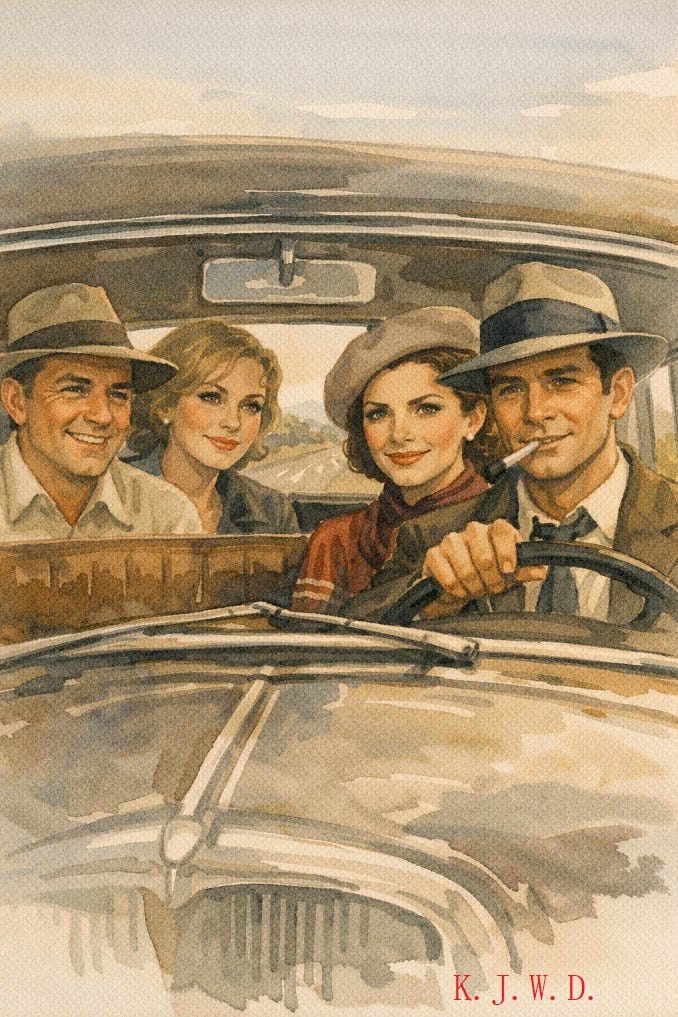
Bonnie & Clyde — Chapter 4
The Road That Never Ends By Kevin J. W. Driscoll © 2026
The road had become their country. It stretched out in every direction, a ribbon of dust and promise. Towns blurred past like half‑remembered dreams — a diner here, a gas station there, faces that looked up too late to matter. Bonnie and Clyde were no longer running; they were living in motion. The car was their house, the horizon their front door.
The Barrow Gang had grown and thinned again, men coming and going like weather. Buck Barrow and Blanche joined for a while, bringing laughter and arguments in equal measure. Nights were filled with the smell of gasoline and gun oil, mornings with the sound of tires chewing gravel. They were always moving, always just ahead of the law. It wasn’t freedom, not really, but it was close enough to pretend.
Bonnie kept writing. Her notebook was full now — poems, scraps of dialogue, lists of towns they’d passed through. She wrote about the road as if it were a living thing, something that breathed and watched them. Clyde teased her for it, but he liked the way she saw the world. “You make it sound like it’s chasing us,” he said once. She looked up from her page. “Maybe it is.”
They slept in fields, in barns, in cars parked under trees. Sometimes they’d wake to the sound of birds and forget, for a moment, who they were. Then the world would remind them — a newspaper headline, a sheriff’s car on the horizon, a stranger’s stare that lasted too long. They were famous now, and fame was just another kind of trap.
Clyde had started walking with a limp after a bullet grazed his leg in Joplin. He hid it well, but Bonnie noticed. She tried not to say anything, but one night, when he winced getting out of the car, she said, “You should rest.” He laughed. “Rest is for folks who got somewhere to stay.” She didn’t argue. She just tore a page from her notebook and wrote a line she’d never show him: Even the strong get tired of running.
They robbed when they had to, not when they wanted to. The money came and went, same as everything else. Sometimes they’d give a little to families worse off than them — a loaf of bread, a few dollars, a smile that said we’re not monsters.
Bonnie liked those moments. They made her feel human again. Clyde never said it out loud, but he liked them too. It reminded him of the boy he used to be, before the world taught him to crawl.
The nights were the best. The car would hum along the highway, the stars scattered like broken glass above them. Bonnie would rest her head against the window, watching the reflection of her own face in the glass. She looked older now, sharper, but her eyes still carried that same hunger. Clyde would glance at her and think, She’s the only thing that ever made sense.
Sometimes they’d talk about the future — not the real one, but the kind you invent to keep hope alive. A little house somewhere, a garden, a dog. Bonnie would laugh and say, “You’d never sit still long enough to plant anything.” He’d grin. “Maybe you’d write about it instead.” They both knew it was a lie, but it was a sweet one.
The road kept narrowing. Every mile brought more danger, more eyes watching. The newspapers had turned them into characters — glamorous, reckless, doomed. Bonnie clipped the stories and tucked them away. “They think they know us,” she said. Clyde shook his head. “They know the pictures. The rest is ours.”
One evening, they stopped at a roadside diner. The waitress recognized them but didn’t say a word. She just poured coffee and looked away. Bonnie left a generous tip, and when they walked out, Clyde said, “You think she’ll tell?” Bonnie shrugged. “Wouldn’t you?” He smiled. “Guess I would.”
Back in the car, the silence felt heavy. The headlights cut through the dark, and the road stretched on, endless and indifferent. Bonnie reached for Clyde’s hand. He squeezed it once, hard, then let go. They didn’t need words; the road was speaking for them.
Later that night, parked under a sky so wide it felt like a ceiling of eternity, Bonnie read him one of her poems. It was about motion — about how the heart keeps beating even when it’s tired. Clyde listened, eyes half‑closed, the smoke from his cigarette curling upward. When she finished, he said, “You make it sound like we’re heroes.”
She smiled. “Maybe we are.” He laughed softly. “Heroes don’t end up in ditches.” She looked at him, the firelight flickering across his face. “Maybe that’s just where the story starts.”
The wind picked up, carrying the smell of rain. Somewhere far off, a train whistle cut through the night. Bonnie closed her notebook, Clyde started the engine, and the car rolled forward into the dark. The road didn’t end; it never did. It just kept going, the way love does when it’s too stubborn to die.
— 30 —
메타데이터
- post_id
- e200642bbcf2
- slug
- bonnie-clyde-chapter-4-e200642bbcf2
- url
- https://medium.com/@kevinjwd/bonnie-clyde-chapter-4-e200642bbcf2
- canonical_url
- https://medium.com/@kevinjwd/bonnie-clyde-chapter-4-e200642bbcf2
- author_url
- https://medium.com/@kevinjwd
- status
- ok
- fetched_at
- 2026-06-22 05:41:33


