The Dürer Tree
Finding history and meaning in the shade of Dürer’s lovingly rendered Linden Baum study…
The Dürer Tree
Finding history and meaning in the shade of Dürer’s lovingly rendered Linden Baum study…
![bole of an ancient Linden, estimate to be 400 years or older — a near contemporary of Dürer’s Tree, photographed in 2005 by Penny Mayes for Geograph® Project [view license]](https://miro.medium.com/v2/resize:fit:740/1*EKVnecoYxU283g60VfeLZA.jpeg)
bole of an ancient Linden, estimate to be 400 years or older — a near contemporary of Dürer’s Tree, photographed in 2005 by Penny Mayes for Geograph® Project [view license]
In 1494, Albrecht Dürer painted a portrait… of a Linden Tree. Genus Tilia, commonly called a Lime Tree in the UK or Basswood in the USA. It’s an exquisite study of a mature tree in full leaf, produced in watercolour and opaque gouache. A personal sketch which shows something of the bastion it is perched on but no other surroundings. Even nowadays, with our mobile phone cameras, it is difficult to take an ‘insta’ picture of a whole tree, yet here we have a snapshot of this particular tree in exquisite detail, as it appeared to Dürer that particular Summer.
![‘Linde von der Nürnberger Burgbastei bei der Walburgis Kapeller / Linden Tree from the Nuremberg Castle Bastion Near the Walpurgis Chapel’ (c.1494) a watercolour study by Albrecht Dürer [view license]](https://miro.medium.com/v2/resize:fit:700/1*Ry2r_BpAGBfp61a1i__xUQ.jpeg)
‘Linde von der Nürnberger Burgbastei bei der Walburgis Kapeller / Linden Tree from the Nuremberg Castle Bastion Near the Walpurgis Chapel’ (c.1494) a watercolour study by Albrecht Dürer [view license]
Linden Trees are important in European folklore. Vikings held their courts (known as ‘Things’) beneath them, couples met beneath them to pledge their love, and people danced around them at the Summer Solstice. Dürer recorded such solstice dancing taking place in 1455 under the Linden tree planted in the eleventh century by the canonised Empress Kunigunde (and perhaps he joined in as he was fond of dancing himself). Linden Trees were also associated with the Goddess Freya and represented health, luck, truth, love, and fertility. The scent of their summer blossoms attracted bees who made delicious honey, and their leaves provided a herbal tea reputed to soothe respiratory diseases. The wood itself was a popular choice for carving — in fact, the word Linden evolves from Medieval terms for lithe, pliant, yielding — and it is used for sculpture to this day.
One could imagine this individual tree being significant to Dürer — perhaps he passed it often, grew familiar with its shape, and wished to record it before embarking on his first journey across the Alps to Italy (1494–95). Certainly, he was fond of Nuremberg and, in 1509, bought a house close to the Imperial Castle, living there with his wife Agnes, and mother Barbara, who helped run his workshop when he was on his travels. It was his final residence until his death in 1528.
One gets a sense of Dürer’s affection for this Linden tree and his intellect trying to figure it out. How can this tall tree flourish among the rocks of the bastion? Another famous Linden Tree that grew within the Imperial Castle walls, known as the Kunigunden Linden, was about four hundred years old in Dürer’s time and lasted another four hundred years, until 1934. When planted, it had to be replaced twice before the young lime tree’s roots could find sufficient purchase in the rocks. So Durer’s tree, growing on Nuremberg’s bastions was a feat of survival.
Dürer’s interest also pre-empts the inspiration that trees have provided for so many later artists into the Post-Modern period. (A few of which have also been discussed, by Remy Dean, in Signifier.)
The fact that Dürer could explore the world independently in sketches and watercolour as well as work to commission was a novel departure from the Medieval idea of Artist as Artisan. It reflected Dürer’s burgeoning success and fame as a unique and independent Artist. Nuremberg was an important centre of trade, and of the printing press so that Dürer’s superb engravings with his distinctive ‘AD’ moniker could easily spread his fame throughout Europe. As the leading artist of the Northern European Renaissance, Dürer focused on the natural world with unprecedented precision to capture its beauty which still speaks to our modern sensibilities.
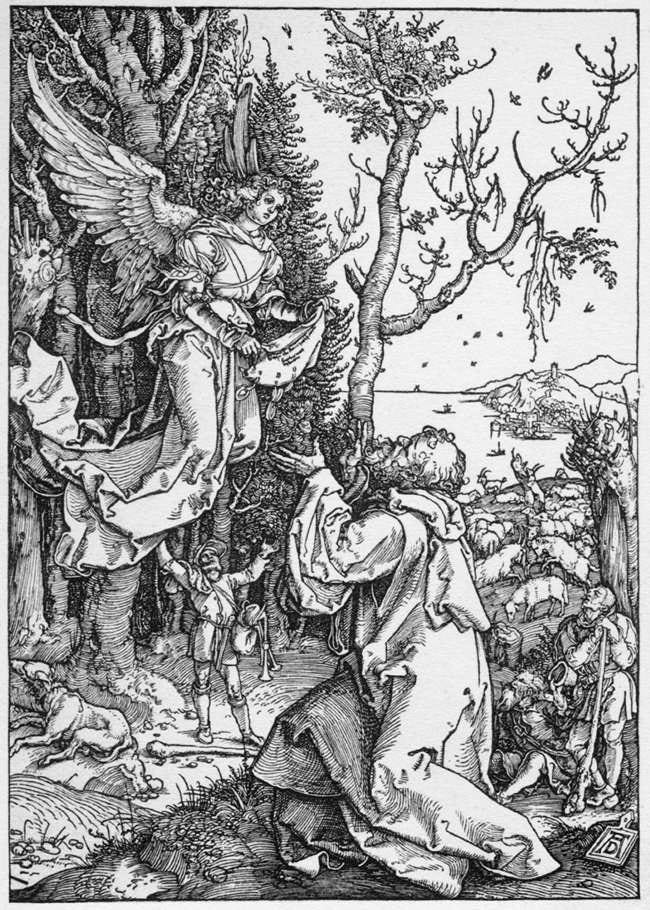
![‘Life of the Virgin: 2. The Angel Appearing to Joachim’ (1505) print from woodcut by Albrecht Dürer and later relief carving in Linden wood after Dürer (c.1515) [view license 1 and 2 ]](https://miro.medium.com/v2/resize:fit:750/0*HVFQACwTekKxtX7a.jpeg)
‘Life of the Virgin: 2. The Angel Appearing to Joachim’ (1505) print from woodcut by Albrecht Dürer and later relief carving in Linden wood after Dürer (c.1515) [view license 1 and 2 ]
Dürer also lived on the brink of changes such as the Reformation. He knew of Luther and had read his pamphlets urging reform within the Church, which stressed the individual’s relationship with the Divine without the mediation of priests. Dürer, although he also worked for the Holy Roman Emperor, was an independent artist who also felt that God had given him the unique talent to appreciate and understand the world. As an artist working in Nuremberg, which did not have a Guild system like other cities, he could also explore many different media such as woodcut, engraving, and painting, giving his creativity free rein. The independent city continued to thrive so that Dürer always returned to Nuremberg, and it is appropriate his house continues as a museum to celebrate his life and achievements.
In future years another pioneering artist-naturalist, Maria Sibylla Merian, also worked and studied at Nuremberg, and there is now a garden named after her in the Imperial Castle grounds.
Trees become a gauge of time passing, the cycle of seasons, the succession of years, representing both time and place at a multi-generational timescale. They are a living document of the world around them, recording details of climate and airborne pollutants. As the western world grows steadily warmer and seasons become unpredictable during these challenging times, it’s good to pause and appreciate our own local trees and the welcome shade they provide in their full-leafed summer splendour. Can we value them, sharing the same appreciation that Dürer displays, acknowledging our fellowship with an artist who lived five hundred years ago in another time of change?
Further Reading:
메타데이터
- post_id
- e2099c40f21c
- slug
- the-dürer-tree-e2099c40f21c
- url
- https://medium.com/signifier/the-d%C3%BCrer-tree-e2099c40f21c
- canonical_url
- https://medium.com/signifier/the-d%C3%BCrer-tree-e2099c40f21c
- author_url
- https://medium.com/@vertuekim
- status
- ok
- fetched_at
- 2026-07-13 06:23:13