Zero Liquid Discharge System: Why Industries Can’t Ignore It Anymore
If you spend even a little time around industrial plants, you start to notice something people outside the sector rarely think about. Water…
Zero Liquid Discharge System: Why Industries Can’t Ignore It Anymore
If you spend even a little time around industrial plants, you start to notice something people outside the sector rarely think about. Water is everywhere. It cools machines, carries chemicals, washes equipment, and keeps processes stable. And once it’s used, it has to go somewhere.
For decades, that “somewhere” was often a nearby river, a drain, or a treatment facility downstream. Regulations were lighter. Water was cheaper. Environmental impact wasn’t discussed at every board meeting.
That’s changed.
Today, industries are under real pressure to reduce wastewater discharge, especially in water-stressed regions. In many cases, the only long term answer is a Zero Liquid Discharge system, commonly called ZLD. It’s not just a piece of equipment. It’s a mindset shift in how industries treat water.
What Zero Liquid Discharge Actually Means
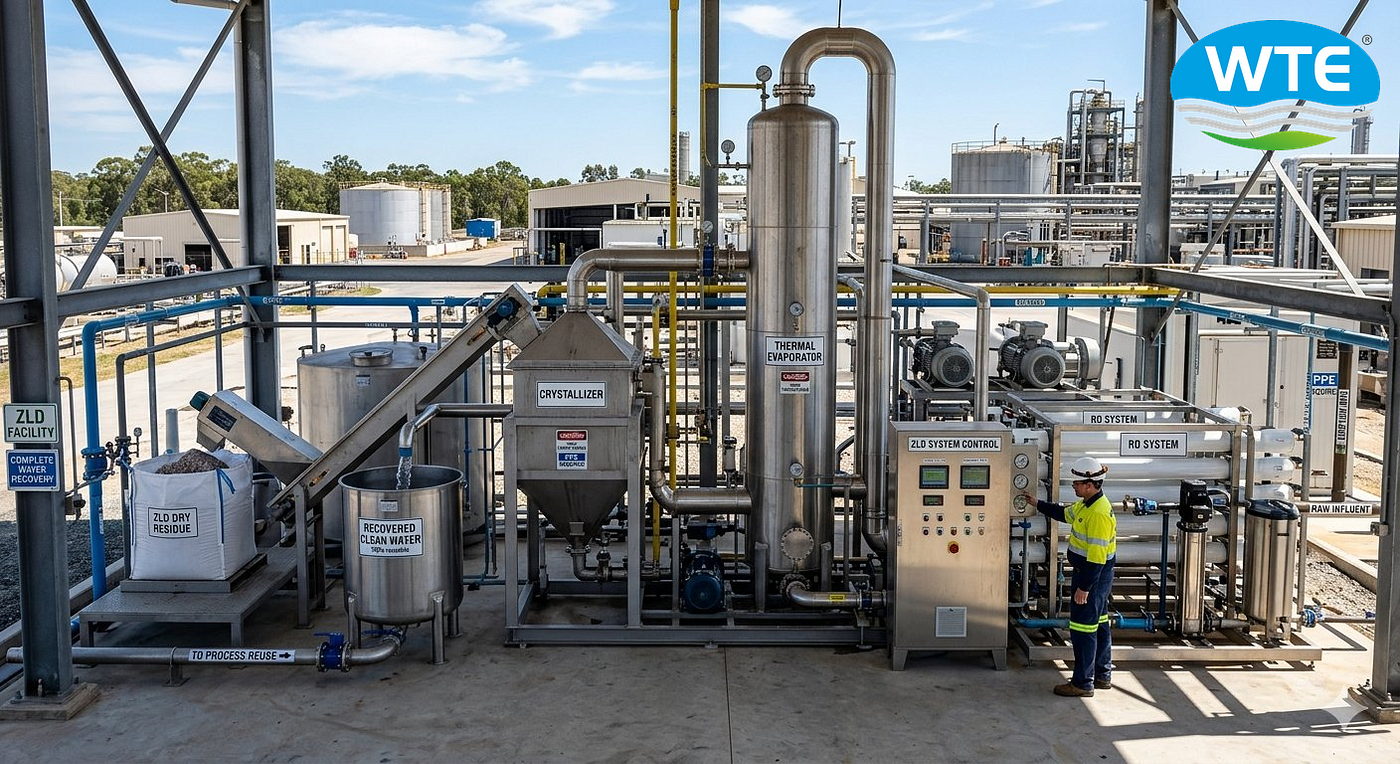
At its core, a Zero Liquid Discharge system is designed to ensure that no liquid waste leaves the plant boundary. The wastewater generated during industrial processes is treated, purified, and reused. What remains is solid waste, usually in the form of salts or sludge, which can be safely disposed of or sometimes even reused.
In simple terms, the plant doesn’t discharge liquid effluent outside its premises.
That sounds straightforward. It isn’t.
ZLD involves multiple treatment stages. Wastewater is first pretreated to remove suspended solids and oils. Then it typically passes through membrane systems such as reverse osmosis. The concentrated reject from these membranes is further treated using evaporators and crystallizers to separate water from dissolved solids. The recovered water goes back into the process. The solids are collected and handled as waste.
Every drop is accounted for.
Why ZLD Is Becoming Essential
There are two main drivers behind ZLD adoption: regulation and water scarcity. But there’s a third one that’s often overlooked, and that’s risk management.
In places like India, especially in industrial belts across Maharashtra, Gujarat, and Tamil Nadu, groundwater depletion is real. Industries that once relied on borewells are now facing restrictions. Local communities are more aware and more vocal. Pollution incidents can shut down operations overnight.
A ZLD system gives industries a level of independence. When you recover and reuse 90 to 95 percent of your water, you reduce your dependency on external sources. Over time, that stability matters more than the initial investment.
From a compliance perspective, ZLD also simplifies things. Instead of constantly worrying about discharge limits and inspections, plants can demonstrate that they are not releasing liquid effluent at all. That builds credibility with regulators and with the public.
Still, it’s not a magic solution. It’s expensive. It consumes energy. And if poorly designed, it can become a maintenance nightmare.
The Technical Side Without the Jargon
Most ZLD systems follow a similar structure, though details vary by industry.
First comes primary treatment. This removes large particles, oil, grease, and easily separable contaminants. Chemical dosing and clarification are common at this stage.
Next is membrane treatment. Reverse osmosis units play a major role here. They separate clean water from dissolved salts and impurities. The permeate, which is relatively pure water, is reused in cooling towers, boilers, or process lines.
The challenge lies in handling the reject stream from reverse osmosis. This stream contains high concentrations of dissolved solids. Discharging it is not an option in a ZLD setup.
So it moves to thermal treatment. Multiple effect evaporators or mechanical vapor recompression systems evaporate the remaining water. What’s left is a highly concentrated slurry. Finally, a crystallizer converts that slurry into solid salts.
It’s a chain of processes. If one stage underperforms, the whole system feels the strain.
That’s why design and integration matter more than brand names or marketing claims.
Industries That Rely on ZLD
ZLD is not limited to one sector. It’s widely used in textile dyeing units, pharmaceutical manufacturing, power plants, chemical industries, and tanneries. These industries generate effluents with high dissolved solids, complex organics, or toxic components.
Textile processing, for example, produces colored wastewater that is difficult to treat biologically. Pharmaceutical plants deal with variable effluent composition. Power plants generate blowdown water with high mineral content.
In such cases, conventional effluent treatment is often not enough to meet strict discharge norms. ZLD becomes the only viable route.
But implementation differs from one industry to another. A pharmaceutical plant cannot simply copy a textile plant’s ZLD design. Wastewater chemistry dictates everything.
The Real Cost Question
Let’s be honest. ZLD systems are capital intensive. The evaporators alone can consume significant energy. Maintenance of membranes and scaling control in thermal units adds to operational costs.
Many companies hesitate because of this.
But there’s another way to look at it. Water procurement is becoming costlier. Regulatory penalties are harsh. Production shutdowns due to environmental non compliance are even more expensive.
When evaluated over ten or fifteen years, a well designed ZLD system often makes economic sense, especially in regions where freshwater access is uncertain.
The key phrase here is well designed.
Oversizing leads to unnecessary costs. Undersizing leads to operational chaos. A thoughtful water balance study, realistic assumptions about flow variation, and proper automation can make a huge difference.
Operational Challenges That Don’t Get Talked About Enough
ZLD is not a plug and play solution. It demands disciplined operation.
Membranes foul. Scaling occurs in evaporators. Salt handling can become messy. If operators are not properly trained, performance drops quickly.
In some plants, I’ve seen evaporators running inefficiently simply because routine cleaning schedules were ignored. Energy consumption shoots up. Then management starts blaming the technology itself.
ZLD works best when it’s treated as a core utility, not an afterthought. Monitoring conductivity, flow rates, and recovery percentages should be part of daily practice, not occasional checks before inspections.
Automation helps, but it doesn’t replace accountability.
Environmental Impact Beyond Compliance
There’s also a broader perspective. By reusing water internally, industries reduce extraction from rivers and aquifers. That benefits surrounding communities. It reduces conflict. It improves corporate reputation in a way that marketing campaigns can’t replicate.
Of course, ZLD shifts the problem from liquid waste to solid waste. The salts generated need responsible disposal. In some cases, salts can be reused in other processes. In others, they must go to secured landfills.
Zero liquid discharge does not mean zero environmental impact. It means controlled impact.
And that distinction matters.
Where ZLD Is Headed
Technology is improving. Energy efficient evaporators, better membrane materials, and smarter process control systems are making ZLD more practical. Some facilities are integrating solar thermal systems to reduce energy consumption. Others are experimenting with recovering valuable byproducts from waste streams.
In the future, I suspect we’ll see more decentralized ZLD systems tailored to specific industrial clusters rather than one size fits all solutions.
What’s clear is that water is no longer treated as an unlimited resource. Industries that recognize this early are positioning themselves for stability.
A Practical Way to Think About It
If you strip away the technical layers, a Zero Liquid Discharge system is about responsibility. It forces a plant to look at its water usage honestly. Where is water wasted? Where can it be reused? What is the true cost of discharge?
It’s not the easiest path. It requires investment, discipline, and careful design.
But in regions facing water stress and tightening regulations, ignoring ZLD is no longer realistic.
At some point, every industry that depends heavily on water will have to answer the same question. Are we willing to treat water as a reusable resource, or are we still thinking in terms of disposal?
The companies that choose reuse are usually the ones thinking long term. And in today’s industrial landscape, long term thinking isn’t optional. It’s survival.
메타데이터
- post_id
- e23df894a07e
- slug
- zero-liquid-discharge-system-why-industries-cant-ignore-it-anymore-e23df894a07e
- url
- https://medium.com/@wteswapnil/zero-liquid-discharge-system-why-industries-cant-ignore-it-anymore-e23df894a07e
- canonical_url
- https://medium.com/@wteswapnil/zero-liquid-discharge-system-why-industries-cant-ignore-it-anymore-e23df894a07e
- author_url
- https://medium.com/@wteswapnil
- status
- ok
- fetched_at
- 2026-06-23 03:48:11