Taylor Swift and Rosetta Tharpe: Arena Weddings 75 Years Apart
What Taylor Swift is only considering today, Rosetta Tharpe actually did in 1951 — a public wedding in front of 20,000 fans at a Major…
Taylor Swift and Rosetta Tharpe: Arena Weddings 75 Years Apart
What Taylor Swift is only considering today, Rosetta Tharpe actually did in 1951 — a public wedding in front of 20,000 fans at a Major League baseball stadium.
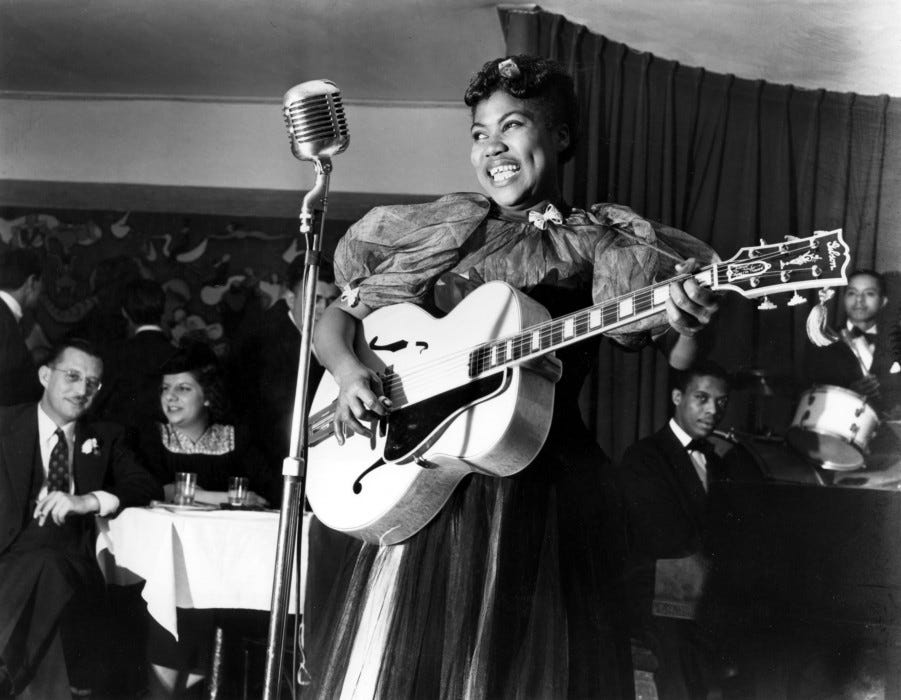
Rosetta Tharpe rocking and rolling in the 1940s. Wikimedia photo
Rumor has it that Taylor Swift and Travis Kelce are planning a wedding at Madison Square Garden this summer.
If it happens, it will be a massive spectacle — just not for the general public. No tickets, no paying crowd, no grandstand seats.
They still won’t be the first. That distinction belongs to Sister Rosetta Tharpe, the Godmother of Rock and Roll. In 1951, Tharpe married in front of more than 20,000 paying fans at Griffith Stadium, a Major League Baseball park in Washington, D.C. It wasn’t just a wedding. It was an event.
Tharpe’s contributions to music can’t be overstated. She didn’t single-handedly invent rock and roll, but she’s rightly called its Godmother. A gospel superstar in the 1930s and ’40s, she dragged the electric guitar out of the rhythm section and into the spotlight, bending notes and creating licks that Eric Clapton, Keith Richards, Chuck Berry, and countless others would later emulate.
Her 1944–45 hit “Strange Things Happening Every Day” — with its driving backbeat, call-and-response energy, and electrified guitar — is frequently cited as one of the earliest precursors to rock and roll, even called by some the “first rock and roll record.”
It crossed over to the R&B charts at a time when gospel and secular sounds rarely mixed.
Long before Chuck Berry’s duck walk or Elvis’s hip swivel, Tharpe was blending raw delta blues, Pentecostal fire, and showmanship into something new.
In May 1964, during her European tour as part of the Blues and Gospel Train, Sister Rosetta Tharpe played at a train station in Manchester, England.
Tharpe arrived dramatically by horse-drawn carriage, strapped on her electric guitar over her coat, and launched into a powerful, rain-soaked rendition of “Didn’t It Rain,” her voice and distorted guitar cutting through the drizzle as the crowd clapped on the backbeat.
Among the faces in that small but historic audience were several young British musicians who would soon shape rock and roll: Eric Clapton, Jeff Beck, Keith Richards, and Brian Jones (with some reports noting Jimmy Page as well).
Many had made the pilgrimage from London the previous year for an earlier stop on the tour. This raw, up-close encounter with American blues and gospel giants — especially Tharpe’s trailblazing guitar work — left a profound impact.
Little Richard called her his favorite singer. Chuck Berry famously said his whole career was “one long Sister Rosetta Tharpe impersonation.”
In 2018, she was posthumously inducted into the Rock & Roll Hall of Fame as an Early Influence.

By Dwight McCann / www.DwightMcCann.com, CC BY-SA 2.5, https://commons.wikimedia.org/w/index.php?curid=2556668
The wedding
On July 3, 1951, Tharpe married Russell Morrison at Griffith Stadium in Washington, D.C., in front of roughly 20,000 paying fans.
Tickets ranged from 90 cents to $2.50. Vendors hawked hot dogs and souvenirs.
A satin carpet stretched from the baseball dugout to a makeshift altar at second base. After the vows, the bride picked up her electric guitar and delivered a full concert backed by gospel choirs.
It was billed as “the most elaborate wedding ever staged.”
Part publicity stunt, part genuine ceremony — it worked.
Morrison became her manager, and they stayed married until her death in 1973 at age 58.
Humble beginnings
Born Rosetta Nubin on March 20, 1915, in the tiny Arkansas Delta town of Cotton Plant, Tharpe grew up with gospel in her bones and delta blues in her fingers. Her parents were cotton pickers, but they bought her a guitar. By age five or six, she was a child prodigy — standing on top of an upright piano in church so the congregation could see her play and sing.
She carried those raw delta roots into her music, blending fiery gospel with blues-infused guitar work.
Long before Elvis, Chuck Berry, or the Beatles, Tharpe was distorting her electric guitar and preaching the good news with a rock-and-roll spirit.
Little Richard called her his favorite singer. Johnny Cash, Eric Clapton, and others cited her as a direct influence.
Two Power Couples, Two Eras
Taylor Swift — global pop supernova — and Travis Kelce — NFL superstar — are reportedly planning their nuptials in one of the world’s most iconic arenas.
Rosetta Tharpe, the Black woman from rural Arkansas who helped birth a genre, filled a baseball stadium with her fans in 1951.
Both moments capture musicians at the peak of their power, turning a deeply personal milestone into shared cultural theater:
One is invitation-only, tightly controlled, and likely to be documented (and leaked) via phones.
The other sold tickets to anyone who could afford them and was captured on a live Decca recording.
Yet the spirit feels connected: the refusal to shrink your biggest personal moment when your art has always been for the public.
People obsess over when and how Taylor Swift gets married because she’s one of the biggest stars on the planet.
But she’s riding a wave that Rosetta Tharpe helped create decades earlier. It wasn’t a white pop star in an arena who first proved you could turn a wedding into a stadium spectacle — it was a five-year-old Black girl standing on a piano in rural Arkansas, guitar in hand, already changing music forever.
I worked for a newspaper on the edge of the delta back in the 1980s. I’ve been around those flat fields and small towns where both Tharpe and the Delta Blues began. While many music pilgrims make the trip to Clarksdale, Mississippi, I made mine to Cotton Plant, Arkansas. They are about 100 miles apart, but not far at all in spirit. There’s not much left — just a small plaque where her childhood home once stood. But standing there, it’s impossible not to feel the weight of one of rock and roll’s most important origin stories. Some legends feel distant. Rosetta Tharpe never has.
메타데이터
- post_id
- e243f6a29ba8
- slug
- taylor-swift-and-rosetta-tharpe-arena-weddings-75-years-apart-e243f6a29ba8
- url
- https://medium.com/the-riff/taylor-swift-and-rosetta-tharpe-arena-weddings-75-years-apart-e243f6a29ba8
- canonical_url
- https://medium.com/the-riff/taylor-swift-and-rosetta-tharpe-arena-weddings-75-years-apart-e243f6a29ba8
- author_url
- https://medium.com/@jamesjordanwriting
- status
- ok
- fetched_at
- 2026-06-10 12:26:30