The IB Primary Years Programme (PYP) in Practice: What a Classroom in the Aravalis Looks Like
A Grade 2 child at Pathways World School, Gurgaon — situated on a 32-acre LEED Platinum-certified campus in the Aravali Hills — does not…
The IB Primary Years Programme (PYP) in Practice: What a Classroom in the Aravalis Looks Like

A Grade 2 child at Pathways World School, Gurgaon — situated on a 32-acre LEED Platinum-certified campus in the Aravali Hills — does not begin a school day with a textbook. She begins it with a question. Where does the water in our taps come from? Why do birds nest in some trees but not others? What changes when we change our clothes? By the end of a six-week unit, she will have visited the campus water-harvesting system, interviewed the gardening staff, drawn a model, debated her hypothesis with classmates, and presented her findings to her parents. She will have studied science, geography, language, mathematics, and ethics — without anyone using those words.
This is inquiry-based learning in the IB Primary Years Programme (PYP), and it is not a teaching trick. It is a curriculum framework adopted by over 2,000 schools across more than 100 countries, built on the premise that young children learn best when they construct meaning themselves rather than receive it pre-packaged. At Pathways World School — India’s first IB Continuum school, established 2003 — the PYP runs from Pre-Nursery to Grade 5, and shapes the texture of every school day in the foothills of the Aravalis.
This is an attempt to describe, concretely, what that looks like.
What is the IB Primary Years Programme?
The IB Primary Years Programme (PYP) is a transdisciplinary, inquiry-based curriculum framework for children aged 3 to 12, administered globally by the International Baccalaureate Organization. Rather than teaching subjects in isolation, the PYP organises learning around six transdisciplinary themes of global significance, with subjects functioning as lenses through which children explore those themes. The framework prioritises conceptual understanding, learner agency, and responsible action over rote memorisation.
The six themes — used by every PYP school worldwide — are: What students explore
1: Who we are: Identity, beliefs, relationships, physical and emotional health 2: Where we are in place and time: Personal histories, civilisations, migrations, exploration 3: How we express ourselves: Ideas, feelings, culture, creativity, the arts 4: How the world works: Natural laws, scientific principles, technology, the environment 5: How we organise ourselves: Communities, economies, systems, decisions 6: Sharing the planet: Resources, rights, peace, conflict, the natural world
Each year, children at a PYP school engage with all six themes (four for Pre-K and Kindergarten), through what the IB calls Units of Inquiry — typically six-week explorations that integrate language, mathematics, science, social studies, the arts, and personal-physical education around a single transdisciplinary question.
What does a PYP classroom actually look like?
[embed]
At Pathways World School, the architecture itself answers part of this question. Primary classrooms are not arranged in rows. There are reading corners with floor cushions, project tables where four to six children cluster together, walls covered in students’ wonderings — sticky notes asking I wonder why…, I noticed that…, What if… The teacher is rarely at the front. More often she is kneeling beside a child, asking, “What made you think that?”
A typical inquiry day in the IB Primary Years Programme might look like this:
Provocation. The teacher introduces a stimulus — a photograph, an artefact, a short video, sometimes a visiting expert. For a unit under How the world works on simple machines, this might be a broken bicycle wheeled into the classroom. Children are not told what to learn. They are invited to wonder.
Tuning in. Children record their existing knowledge and their questions. The class builds a wall of I wonder statements. The teacher notes which questions can be answered through research, which require investigation, and which open up larger conceptual territory.
Finding out. Small groups disperse to different activities. One group is in the school library reading age-appropriate non-fiction. Another is in the science corner experimenting with levers and pulleys. A third is interviewing the school’s maintenance team about the gears in the campus golf cart. Mathematics enters naturally — measuring distances, counting rotations, recording data. Language enters through the writing of observations.
Sorting out. Children come back together. They share what they have found. They make models, draw diagrams, write explanations. The teacher introduces vocabulary and concepts the children’s own discoveries have made meaningful — force, fulcrum, mechanical advantage. The technical terms arrive after the experience, not before.
Going further. The afternoon often deepens the inquiry. A Spanish lesson might explore words for tools and motion. A music class might examine rhythm as a kind of mechanical pattern. PE might involve games that rely on balance and leverage. Personal, social and physical education — which at Pathways includes yoga, mindfulness, and well-being alongside sport — might explore how the body itself is a system of levers.
Reflection. The day ends not with homework instructions but with reflection. What did you learn today? What surprised you? What do you still wonder? In the PYP, reflection is not a closing ritual. It is part of how children learn to think about their own thinking.
How is the PYP different from a CBSE or ICSE classroom?
The difference is not that IB Primary Years Programme classrooms are less structured. They are differently structured. A CBSE or state-board Grade 2 classroom typically organises the day by subject — forty minutes of English, then forty minutes of Mathematics, then EVS. Each subject has its own textbook, its own teacher, its own evaluation. Knowledge is partitioned, and connections between partitions are largely left to the child to make on her own.
In a PYP classroom, the unit of organisation is not the subject but the inquiry. A single Unit of Inquiry on How we express ourselves — exploring, say, festivals across cultures — will pull in language, mathematics, social studies, the arts, and personal-social education. The subjects are still there. They are simply braided together rather than placed in adjacent silos.
This has three practical consequences:
- Children remember more. Because concepts are encountered in multiple contexts within a single unit, they are reinforced through use, not repetition. The mathematics of fractions, met first while sharing a cake during a Sharing the planet unit on resources, is more durable than the mathematics of fractions met on page 47 of a textbook.
- Children ask better questions. PYP classrooms train the habit of questioning before answering. Over years, this becomes a disposition.
- Children develop agency. The IB Primary Years Programme explicitly rests on the principle of learner agency — the child’s belief that she can direct her own learning. Research building on Albert Bandura’s work on self-efficacy suggests that agency is one of the strongest predictors of long-term academic outcome.
What subjects does a child study in the IB Primary Years Programme at Pathways?
A common parental concern when first encountering the IB Primary Years Programme is whether the academic subjects are being adequately covered. At Pathways World School, the PYP curriculum integrates the following formal subject groups:
- Languages — English and Hindi as core languages; Spanish and French as Modern Foreign Languages
- Mathematics — Number, pattern and function, measurement, shape and space, data handling
- Science — Living things, earth and space, materials and matter, forces and energy
- Social Studies — Human and physical geography, history, civics, economics, social organisation
- The Arts — Western and Indian music, theatre, dance, visual arts
- Personal, Social and Physical Education (PSPE) — Sports, yoga, mindfulness, well-being
- Information and Communication Technology — integrated across all learning, with emphasis on responsible use
The point is not that subjects are absent from the IB Primary Years Programme. The point is that they are placed in service of inquiry, not the other way around.
How does PYP assessment work without exams?
In the IB Primary Years Programme, assessment is formative and continuous, not summative and episodic. There are no Grade 2 examinations at Pathways. Instead, teachers maintain ongoing records of each child’s understanding through observation, conferencing, portfolios of work, and the child’s own reflections. At the end of each Unit of Inquiry, children demonstrate their understanding through a culminating task — a presentation, an exhibition, a creative project, a debate.
In Grade 5 — the final year of the PYP — each child undertakes the PYP Exhibition, a year-end inquiry of their own choosing in which they identify a real-world issue, investigate it, take action on it, and present their findings to the school community. This is the moment in which years of inquiry-based learning become visible. A ten-year-old who has spent five years asking questions arrives at the Exhibition not afraid of a blank page.
Why does the Aravali setting matter to the PYP experience?
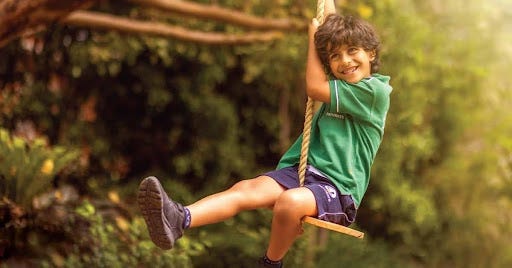
It would be possible to deliver the IB Primary Years Programme in a city classroom, and many excellent schools do. But the framework is meaningfully shaped by the environment in which it is enacted. The 32-acre Pathways World School campus, set in the wooded foothills of the Aravalis off Gurgaon-Sohna Road, makes certain kinds of inquiry physically possible in a way that an urban international school in Delhi NCR cannot.
A Sharing the planet unit on biodiversity can begin with a walk through the campus forest, where children identify trees, observe birds, and notice the absence of certain species during certain months. A How the world works unit on water can begin with the school’s own rainwater harvesting system — the campus is LEED Platinum certified, the only K-12 school chain globally to hold this distinction, and the infrastructure itself becomes pedagogical material. A Where we are in place and time unit on the Aravali range can begin with the question of why the hills around the school are the oldest fold mountains in India.
The campus is also unusual in offering flexible boarding options — day, weekly, fortnightly, and term boarding — which means that for boarding children, learning continues beyond the classroom. An evening walk, a conversation with a residence parent, a weekend project in the science block: each is part of how inquiry settles into a child’s habits.
What kind of child does the IB Primary Years Programme produce?
This is, finally, the question that matters to parents. The answer is encoded in the IB Learner Profile — ten attributes that the PYP, MYP, and DP all explicitly cultivate. A PYP child, over six or seven years, is being shaped to be:
Inquirers · Knowledgeable · Thinkers · Communicators · Principled · Open-minded · Caring · Risk-takers · Balanced · Reflective
These are not slogans on a classroom wall. They are evaluated, discussed, and reflected upon in every Unit of Inquiry. By Grade 5, children at Pathways speak about them in their own voices — I was being a risk-taker today because I tried something I wasn’t sure about. I was being principled when I told my group I disagreed. They have language for the kind of person they are becoming.
This is the quiet ambition of the IB Primary Years Programme. Not to fill children with answers, but to give them the disposition, the language, and the practice to ask questions worth asking — and to do something about the answers.
Frequently Asked Questions
Q. What is the IB Primary Years Programme (PYP)?
Ans: The IB Primary Years Programme (PYP) is a transdisciplinary, inquiry-based curriculum framework for children aged 3 to 12, developed by the International Baccalaureate Organization. It organises learning around six transdisciplinary themes — Who we are, Where we are in place and time, How we express ourselves, How the world works, How we organise ourselves, and Sharing the planet — and emphasises conceptual understanding, learner agency, and responsible action.
Q. Is the IB Primary Years Programme suitable for children transitioning from CBSE or ICSE?
Ans: Yes. The IB Primary Years Programme is designed for children aged 3 to 12 and works well for early transitions, particularly at Pre-Nursery to Grade 2. For older children moving from CBSE or ICSE into a later PYP year, Pathways World School offers a 6–8 week Pre-Term Programme that bridges curricular and cultural gaps before the academic year begins.
Q. Does the IB Primary Years Programme cover the same academic content as CBSE?
Ans: PYP children study language, mathematics, science, social studies, the arts, and personal-physical education — the same broad domains as CBSE. The difference is in integration and method: subjects are taught through transdisciplinary Units of Inquiry rather than in isolation, and assessment is continuous rather than examination-based.
Q. How are children evaluated in the IB Primary Years Programme if there are no exams?
Ans: Assessment in the PYP is formative and continuous. Teachers maintain records through observation, conferencing, student portfolios, and culminating tasks at the end of each Unit of Inquiry. Grade 5 students complete the PYP Exhibition, a year-end inquiry project that demonstrates the full range of skills and attributes developed over the programme.
Q. Where can my child study the IB Primary Years Programme in Gurgaon?
Ans: Pathways World School, located at Aravali Retreat off Gurgaon-Sohna Road, Gurugram-122102, offers the IB Primary Years Programme from Pre-Nursery to Grade 5. Established in 2003, Pathways World School is India’s first IB Continuum school, situated on a 32-acre LEED Platinum-certified campus approximately 35 km from Delhi International Airport.
Pathways World School, Gurgaon is an IB Continuum World School authorised to offer the IB Primary Years Programme (PYP), Middle Years Programme (MYP), and Diploma Programme (DP). To learn more about the IB Primary Years Programme at Pathways, visit our PYP page.
메타데이터
- post_id
- e24b8fbe9675
- slug
- the-ib-primary-years-programme-pyp-in-practice-what-a-classroom-in-the-aravalis-looks-like-e24b8fbe9675
- url
- https://medium.com/@pathwaysworldschool/the-ib-primary-years-programme-pyp-in-practice-what-a-classroom-in-the-aravalis-looks-like-e24b8fbe9675
- canonical_url
- https://medium.com/@pathwaysworldschool/the-ib-primary-years-programme-pyp-in-practice-what-a-classroom-in-the-aravalis-looks-like-e24b8fbe9675
- author_url
- https://medium.com/@pathwaysworldschool
- status
- ok
- fetched_at
- 2026-08-12 13:20:01




