Best Multichain Blockchain Data APIs in 2026
The multichain future is already here
Best Multichain Blockchain Data APIs in 2026
The multichain future is already here
If you had asked a blockchain developer a few years ago what it took to build a successful Web3 application, the answer would have been relatively simple, pick a blockchain, connect to its infrastructure, and start building. they never really had to worry about fragmented data neither did they have to worry about cross chain interoperability or even maintaining infrastructure across multiple networks. All they had to do was to build around a single ecosystem which was basically Ethereum, and that gave them time to focus on other areas like connecting to one node provider, one data source and one set of APIs.
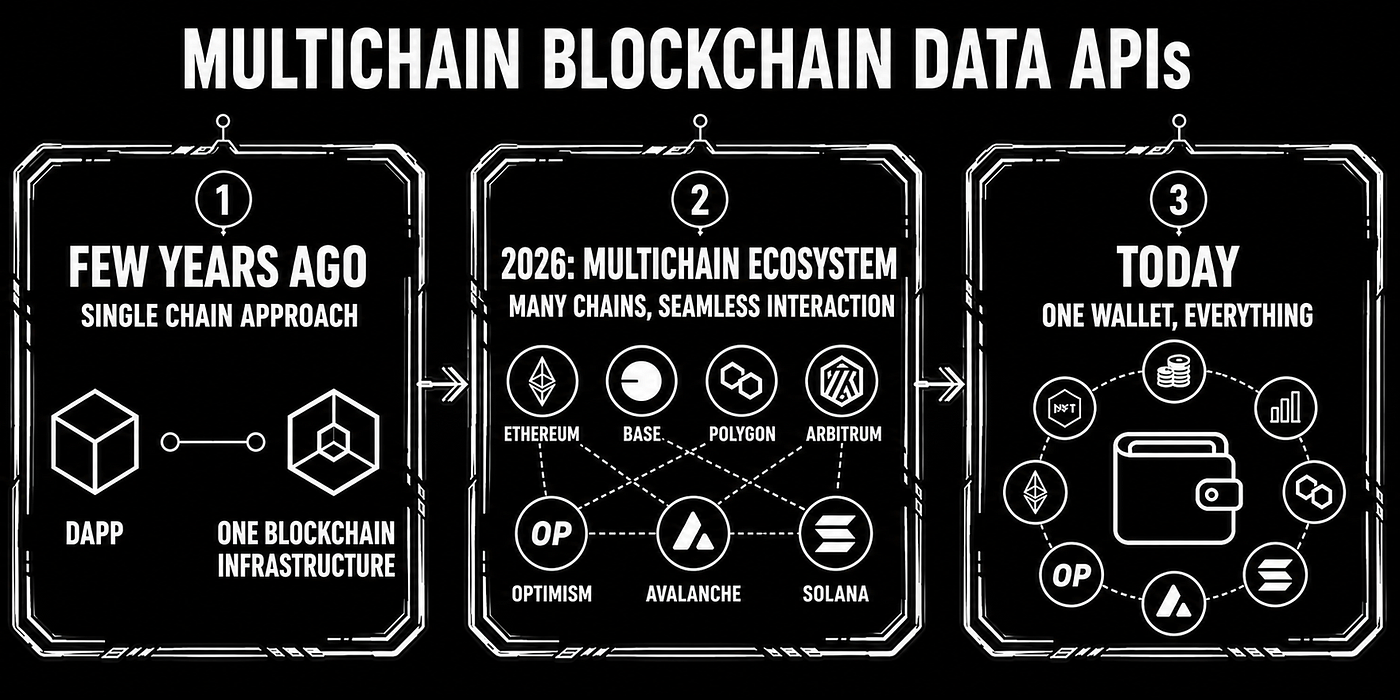
But today things are really different, and that reality no longer exist. The blockchain industry has evolved into a truly multichain ecosystem and users now interact with multiple blockchains, easily moving assets between networks such as Ethereum, Base, Polygon, Arbitrum, Optimism, Avalanche and Solana. And now a single wallet can contain tokens, NFT, Defi positions spread across several chains.
For developers, this shift alone has brought a whole new set of challenges. Challenges such as accessing, organizing and analyzing blockchain data from multiple ecosystems without creating a complex web of custom integrations. It is no longer as simple as just pulling data from one blockchain and calling it a day. The biggest problem is that every single blockchain has its way of doing things and as more chains gets into the picture, developers end up spending more time managing data and integration rather than actually building their own product. And to be honest, no developer enjoys spending weeks stitching together infrastructure when they could be focused on creating something else that is useful.
This is why multichain blockchain data APIs have become so valuable and indispensable. Rather than forcing developers to build and maintain separate data pipelines for every chain they support, these APIs provide a unified gateway to blockchain data, making it easier to build scalable applications, analytics platforms, AI agents, and next-generation Web3 experiences. And this leads us to the next big question “What makes a great multichain blockchain data API?”
WHAT MAKES A GREAT MULTICHAIN BLOCKCHAIN DATA API?
We can all agree that at first glance, most blockchain APIs may seem similar. Many will indeed promise access to on-chain data, support for multiple networks, and developer-friendly integrations. But however, once you begin building real-world applications, the differences become much more clear.

A great multichain blockchain data API is not simply just one that supports a large number of chains. It is an API that should be able to deliver consistent, accurate, and easily accessible data across those networks even while minimizing the complexity developers have to deal with behind the scenes. The main goal there is to spend less time managing infrastructure and more time building products that users actually care about.
When evaluating multichain blockchain data APIs in 2026, developers should consider key factors:
1. Breadth of Chain Coverage
The blockchain ecosystem is no longer dominated by a single network. Modern applications often require support for Ethereum, Base, Arbitrum, Optimism, Polygon, Avalanche, BNB Chain, Solana, and many emerging ecosystems.
The best APIs provide broad chain coverage through a single interface rather than forcing developers to integrate separate APIs for every blockchain.
2. Data Quality and Consistency
Raw blockchain data is notoriously difficult to work with. Different chains expose different structures, event formats, and indexing mechanisms.
A high-quality API should normalize this complexity, providing consistent data schemas regardless of the underlying blockchain.
3. Historical Data Availability
Many applications require more than real-time information. Analytics dashboards, AI agents, portfolio trackers, and compliance tools often need years of historical blockchain data.
The ability to access complete historical records without maintaining custom archive nodes is a major advantage.
4. Developer Experience
Even the most powerful API becomes difficult to adopt if the developer experience is poor.
Documentation quality, SDK availability, response speed, reliability, rate limits, and ease of integration all contribute to how quickly developers can move from idea to production.
5. Scalability
Applications that start with a few hundred users can quickly grow to millions of requests per day.
The ideal API should scale seamlessly without requiring developers to redesign their infrastructure.
6. AI Readiness
One of the biggest shifts in 2026 is the rise of AI-powered blockchain applications.
AI agents increasingly need structured on-chain data to perform analysis, track wallets, identify trends, and automate decisions. APIs that expose clean, queryable, AI-friendly datasets have become significantly more valuable.
With these criteria in mind, let’s examine the leading multichain blockchain data APIs available in 2026.
Best Multichain Blockchain Data APIs in 2026
As blockchain ecosystems continue to expand, the challenge is no longer accessing data from a single network but efficiently working across dozens of interconnected chains.
Modern multichain APIs simplify this complexity by providing a unified view of blockchain data, eliminating much of the operational overhead involved in maintaining infrastructure, building indexers, normalizing data, and supporting multiple networks.
With this covalent stands out by combining broad chain coverage, deeply indexed historical data, consistent APIs, and AI-ready datasets that enable developers to build faster and scale with confidence. These capabilities make it well suited for applications ranging from wallets and DeFi platforms to analytics dashboards and AI-powered blockchain products.
While other providers may excel in specific areas or specialized use cases, choosing a platform ultimately comes down to your project’s technical requirements and long-term goals. What remains consistent across the industry is that reliable multichain data infrastructure has become a foundational layer for modern Web3 development.
Covalent
Covalent has established itself as one of the most comprehensive blockchain data providers in the industry. Rather than simply offering node access, Covalent focuses on delivering deeply indexed blockchain data through a unified API layer.
What makes Covalent particularly valuable in a multichain world is its ability to provide normalized data across dozens of blockchain networks while maintaining a consistent developer experience.
Key Features Extensive multichain support Unified API across supported networks Historical blockchain data access Wallet, token, NFT, and transaction endpoints AI-ready structured datasets Enterprise-grade reliability Rich analytics capabilities Ideal Use Cases Portfolio trackers Wallet intelligence platforms AI agents Blockchain analytics tools Tax and compliance solutions DeFi dashboards Strengths
The biggest strength of Covalent is its indexed approach to blockchain data. Developers can access highly structured information without maintaining custom infrastructure or building complex indexing systems themselves.
For teams building data-heavy products, this significantly reduces engineering overhead.
Goldrush
Goldrush has gained traction as a blockchain data platform focused on developer accessibility and wallet intelligence.
Its APIs provide insights into wallets, transactions, tokens, and on-chain activity across multiple networks.
Key Features
Wallet analytics
Portfolio tracking
Cross-chain visibility
Developer-focused tooling
Ideal Use Cases
Wallet applications
User analytics
Asset tracking solutions
Comparison Table
Provider Multichain Coverage Historical Data Wallet APIs NFT Data AI-Friendly Data.
The multichain future isn’t something that’s coming, it is here already. As more users and assets move across different blockchains, developers need data infrastructure that can keep up without adding unnecessary complexity.
The good news is that there are now several excellent multichain blockchain data APIs that make it much easier to build across ecosystems. Whether you’re creating a wallet, an analytics platform, a DeFi application, or an AI-powered product, choosing the right data provider can save countless hours of engineering work and let your team focus on building features instead of maintaining infrastructure. But one thing is clear, as Web3 continues to evolve, reliable multichain data infrastructure is no longer a nice-to-have, it is a core part of building modern blockchain applications.
As we move into a truly multichain future, the need for reliable, unified blockchain data APIs is more important than ever. Instead of getting bogged down by separate integrations for each chain, developers can rely on platforms like Covalent and GoldRush. Covalent stands out with its deep historical data and broad chain coverage, while GoldRush excels in wallet analytics and ease of use. Whichever you choose, both can help you confidently navigate the complexities of Web3 and keep your project future ready.
메타데이터
- post_id
- e2516a9ea7ec
- slug
- best-multichain-blockchain-data-apis-in-2026-e2516a9ea7ec
- url
- https://medium.com/@francisumo452/best-multichain-blockchain-data-apis-in-2026-e2516a9ea7ec
- canonical_url
- https://medium.com/@francisumo452/best-multichain-blockchain-data-apis-in-2026-e2516a9ea7ec
- author_url
- https://medium.com/@francisumo452
- status
- ok
- fetched_at
- 2026-08-11 03:12:20



