Revisiting “Safe” Withdrawal Rates for Retirement — And What They Mean for Indian Investors
Bill Bengen in his latest book revised his withdrawal rate higher.
Revisiting “Safe” Withdrawal Rates for Retirement — And What They Mean for Indian Investors
Bill Bengen in his latest book revised his withdrawal rate higher.
For nearly three decades, retirement planning across the world rested on a simple idea: Withdraw 4% of your portfolio every year, adjust for inflation, and your money should last 30 years.
This insight came from Bill Bengen, a US financial planner who published a landmark study in 1994. His work became known as the 4% Rule, and it shaped the way millions approached retirement.
But a lot has changed since 1994.
Recently, Bengen revisited his research and concluded that safe withdrawal rates may be higher than he originally estimated, thanks to better diversification and more nuanced asset-allocation models.
That’s great news — for America.
But what about India, where inflation behaves differently, volatility is sharper, and bonds aren’t as deep?
In this BLOG we will walk through what Bengen found, run the same backtest in India and finally, we’ll see why INFLO’s Safety Net framework is designed specifically to solve the unique withdrawal challenges Indian retirees face.
What Bengen Found — And Why It Matters
Bengen’s updated research has two big takeaways:
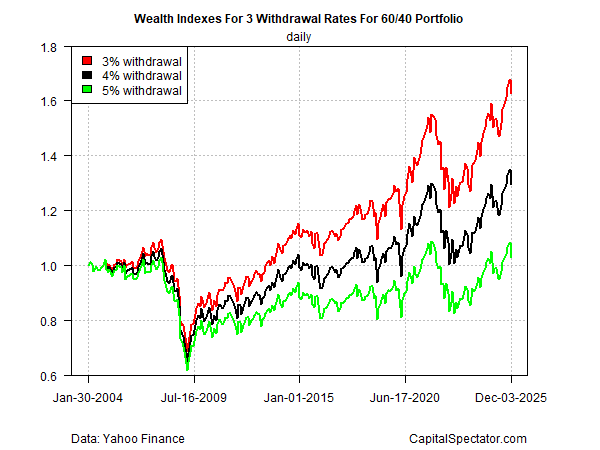
1. Safe withdrawal rates can be higher with better diversification.
By introducing more asset classes and modelling withdrawals dynamically, Bengen moved from ~4% to ~4.7%, and even higher for certain assumptions.
2. The biggest risk is the sequence of returns, not the average.
If you suffer bad market returns in the early years of retirement, your portfolio’s survival odds drop dramatically — even if long-term returns recover later.
This concept is universal. But India’s markets amplify this risk.
So before adopting or rejecting Bengen’s numbers, we must build an Indian analogue.
Indian Reality Check: A 60/40 Portfolio Backtest
Let’s use a simple model:
60% NIFTY 500 (broad Indian equity proxy))
40% G-SEC (10 years) (Debt equivalent)
- Annual withdrawals Nominal
- Start date: 2011
- End date: 11/Dec/2025
This mirrors the SPY/AGG example used in US research but reflects Indian volatility, and Indian return patterns.

✅ FINAL CAGR NUMBERS (2011–2025)
Portfolio CAGR
NIFTY 500: 12.44% High growth, high volatility
G-Sec Index: 6.69% Low return, low volatility
60/40 Hybrid: 10.51% Smoothest risk-adjusted path
What about Drawdowns.

NIFTY 500–29.98% Brutal, long recoveries
G-Sec Index:–7.79% Very stable
60/40 Hybrid:–16.23% Half the NIFTY500 pain
Interpretation: Your 60/40 portfolio delivered ~85% of the equity return with only ~54% of the drawdown of NIFTY500. Beautiful balance.
This is consistent with global literature — but now we have Indian evidence from our own dataset.
Lets talk about withdrawals now

But here’s the twist: History gives you one path. The future can give you ten thousand different ones.
Run 10,000 simulations by reshuffling past returns and suddenly the illusion of certainty evaporates.

As we can see,
The path of returns matters far more than the average return.
Two retirees with the same returns can end up in opposite situations depending on when the bad years strike.
A simple simulation above using Indian return data shows:
- A 4% withdrawal rate works in some paths, fails completely in others, and produces wide outcome dispersion.
This aligns with the spirit of Bengen’s warning: History is a guide, not a guarantee.
For Indian markets — with sharper equity cycles — the risk is even more pronounced.
What Makes Withdrawal Planning Harder in India?
1. Higher, less predictable inflation
Inflation in India can eat up withdrawal power fast.
2. Retirement duration is increasing
People routinely live 25–30 years post-retirement.
3. Behavioral mistakes are more common
Most Indian retirees panic during market crashes — withdraw more, not less.
4. Bonds aren’t the same safety blanket as U.S. Treasuries
Rate cycles here can hurt bond NAVs significantly.
Put together, this means India cannot simply copy Bengen’s 4% rule. We need a structure built for our ecosystem.
This brings us to INFLO’s solution.
Where INFLO Safety Net Fits In
After studying India-specific withdrawal risks, INFLO designed the Safety Net framework — a system built exactly to manage:
- sequence-of-returns risk
- high inflation
- equity volatility
- retiree behavior
- long-term capital survival
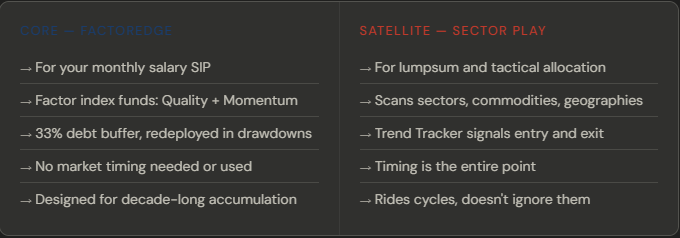
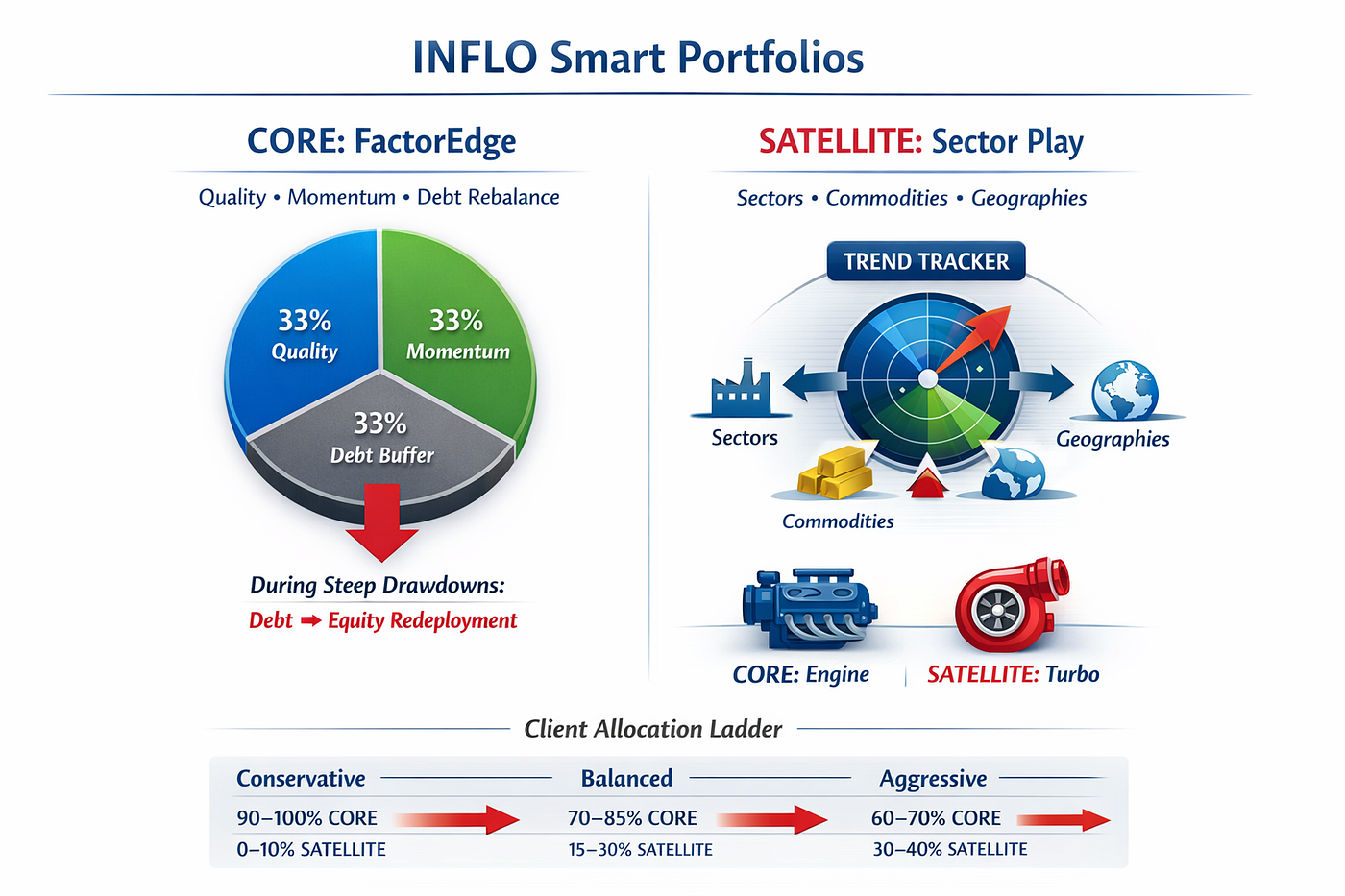
Safety Net uses two pillars:
✔ 1. 90% Conservative Hybrid Funds — The Stability Core
This chunk is designed to:
- smooth volatility
- reduce downside risk
- generate steady yield
- keep the retiree emotionally grounded
It acts as the shock absorber that prevents large early drawdowns — the #1 enemy of safe withdrawals.
✔ 2. 10% Sector Funds Using Timing Models — The Tactical Edge
This tactical sleeve:
Rotates into strong sectors only when timing models approve, captures growth during market leadership, avoids prolonged sector drawdowns adds an inflation-beating kick to long-term returns
It’s small enough to be safe, but smart enough to extend portfolio life materially.
Why Safety Net Works Better Than a Fixed Withdrawal Rule
Because it solves the exact weaknesses exposed by the 60/40 Indian backtest.
1. Lower volatility → higher survival probability
The hybrid core dampens shocks.
2. Tactical growth → combats inflation long term
The 10% tactical sleeve keeps the portfolio evolving.
3. Behavior protection → avoids emotional mistakes
Calm portfolios create calm retirees.
4. Flexible withdrawals → no rigid 4% trap
Withdrawals adjust to:
- market conditions
- life events
- inflation
- risk preference
This makes the plan personalized, not formulaic.
So What Is the “Safe” Withdrawal Rate for Indians?
There is no universal number.
But here is what the data (and experience) tell us:
- 3.0–3.5% is Conservative and correct
- 3.5–4.0% is feasible for disciplined investors
- 4.0%+ exposes you to monte-carlo outliers
Final Word: India Doesn’t Need a Rule. It Needs a System.
Bill Bengen upgraded his rule after 30 years. India never had a rule worth upgrading.
What Indian retirees need is a withdrawal framework that:
- protects from early market crashes
- adapts to inflation
- balances growth with stability
- manages behavior
- survives 25–30 years of retirement
INFLO Safety Net delivers that structure.
It replaces guesswork with discipline, volatility with calm, and rigidity with adaptability.
The result? Your money stands a far higher chance of lasting as long as you do.
Watch this Video where we explain how SAFETYNET is created.
[embed]
메타데이터
- post_id
- e25d8c04b375
- slug
- revisiting-safe-withdrawal-rates-for-retirement-and-what-they-mean-for-indian-investors-e25d8c04b375
- url
- https://medium.com/@inflowealth4/revisiting-safe-withdrawal-rates-for-retirement-and-what-they-mean-for-indian-investors-e25d8c04b375
- canonical_url
- https://medium.com/@inflowealth4/revisiting-safe-withdrawal-rates-for-retirement-and-what-they-mean-for-indian-investors-e25d8c04b375
- author_url
- https://medium.com/@inflowealth4
- status
- ok
- fetched_at
- 2026-06-20 20:29:01