The Architecture of Permanence: Transitioning from Disposable Intelligence to Cognitive Capital
Frank Morales Aguilera, BEng, MEng, SMIEEE
The Architecture of Permanence: Transitioning from Disposable Intelligence to Cognitive Capital
Frank Morales Aguilera, BEng, MEng, SMIEEE
Chief AI Officer, Drivia Consulting | Founder & CEO, SOMALA | Former Boeing Associate Technical Fellow | Thinkers360 Elite Expert In Open Source, Generative and Agentic AI, AI Governance| Thinkers360 Top Voice 2025
The artificial intelligence industry currently stands at a precarious juncture, defined by a growing divergence between marketing narratives and engineering reality. For the past decade, frontier laboratories have marketed their progress toward Artificial General Intelligence (AGI) through behavioural approximation, showcasing models that demonstrate fluency, reasoning traces, and cross-domain generalization. Yet, beneath this veneer of sophistication lies a fundamental, structural fragility: catastrophic forgetting. By relying on architectures that treat knowledge as a transient, overwritable state, the industry is not building intelligence; it is engineering "amnesiac" systems that sacrifice their history to achieve the next benchmark. To move beyond this speculative phase, the field must embrace a formal engineering definition of AGI grounded in verifiable mathematical constraints, transforming AI from a high-churn commodity into a durable, self-evolving infrastructure asset.
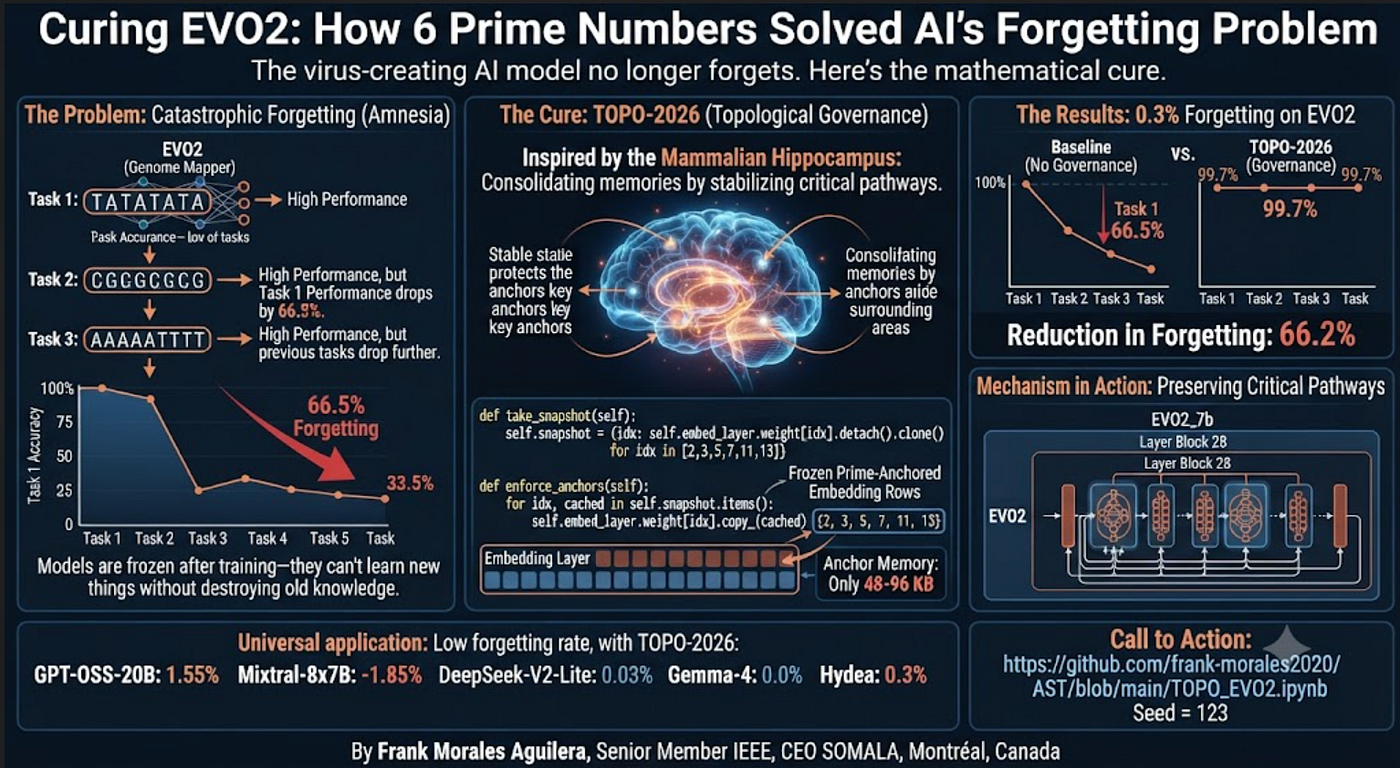
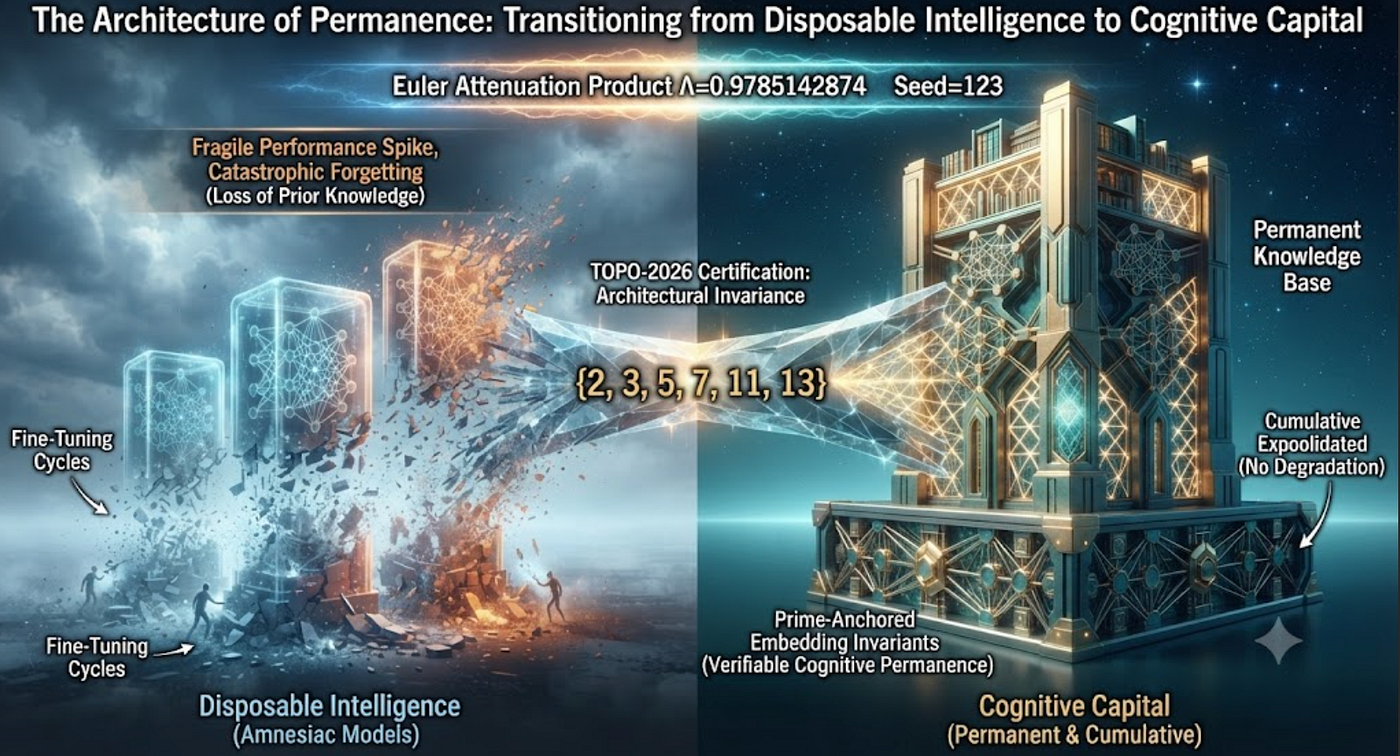
The economic and structural consequences of the current "amnesiac" paradigm are profound. Leading labs currently exhaust enormous computational resources to "patch" catastrophic forgetting through increasingly complex RAG pipelines and repetitive, costly retraining cycles. This is, in effect, the accumulation of massive architectural debt. By integrating frameworks like TOPO-2026 — as demonstrated in the technical implementation for GPT-OSS-20B — labs can utilize prime-anchored embedding invariants to ensure weight-manifold stability and solve the root cause of representational drift. This transition reduces the marginal cost of knowledge integration, as the model's foundational integrity is protected by deterministic architectural constraints rather than fragile regularization heuristics.
Beyond operational efficiency, the shift toward "cognitive permanence" fundamentally alters the value proposition of AI. In the current market, models are disposable — they are fine-tuned until their initial capabilities are eroded, necessitating replacement. By adopting the engineering pillars of architectural invariance, continual learning integrity, and numerical determinism, labs can offer persistent, mission-critical service-level agreements (SLAs). Such systems, verified through protocols like the GPT0SS20B_TOPOAI_TRANSFORMER_MULTRUN_CORRECTED.ipynb notebook, allow for the accumulation of proprietary "expert assets," where a model's value compounds over time as it learns without degradation. This transforms the revenue stream from the consumption of ephemeral intelligence to the long-term appreciation of verifiable cognitive capital—a shift that makes AI truly viable for high-stakes, regulated domains like law, medicine, and sustainable aviation.
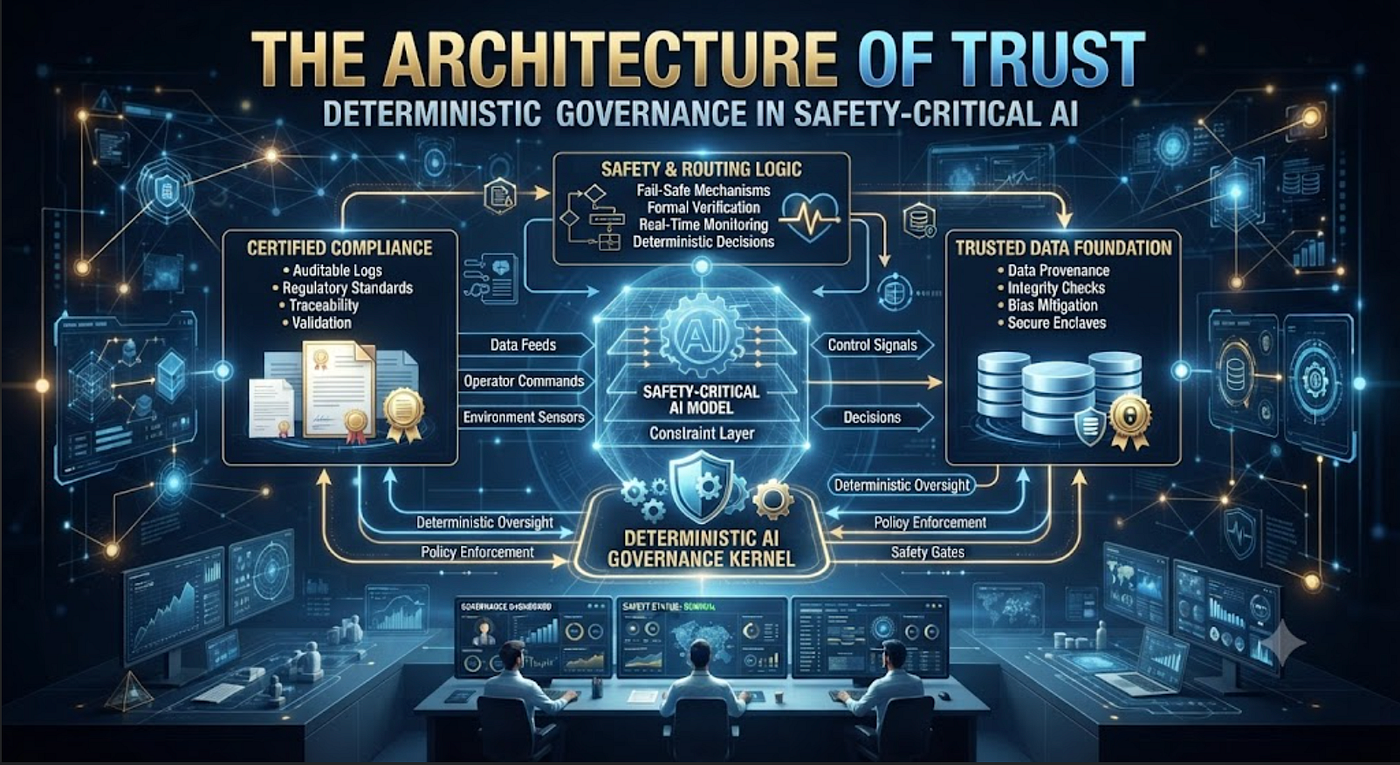
Furthermore, the implementation of mathematical accountability serves as a necessary trust mechanism. Heavily regulated industries have long remained skeptical of "black box" models prone to unpredictable failures. By providing scientific certification — based on reproducible constants like the Euler Attenuation Product, Lambda = 0.9785142874 — labs can differentiate their products through verifiable transparency rather than opaque marketing claims.
Ultimately, the path toward a sustainable AI economy is not paved with more parameters or larger context windows, but with structural rigidity and mathematical proof. The shift to cognitive permanence is the industry's definitive evolutionary step. By moving to an engineering-first definition of AGI, companies will no longer be selling transient tools; they will be providing a reliable, self-improving foundation for the future of industrial logic, effectively turning the "AGI problem" from a speculative narrative into a solved, industrial reality.
References
- Deep Dive: Technical Architecture and Implementation of TOPO-2026: A Comprehensive Analysis of a Universal Solution to Catastrophic Forgetting in GPT-OSS-20B (https://zenodo.org/records/21048743)
- THE ENGINEERING DEFINITION OF ARTIFICIAL GENERAL INTELLIGENCE: A Formal Framework for Verifiable Cognitive Permanence (https://zenodo.org/records/21076608)
- GPT0SS20B_TOPOAI_TRANSFORMER_MULTRUN_CORRECTED.ipynb (https://github.com/frank-morales2020/AST/blob/main/GPT0SS20B_TOPOAI_TRANSFORMER_MULTRUN_CORRECTED.ipynb)
메타데이터
- post_id
- e25e27fb0696
- slug
- the-architecture-of-permanence-transitioning-from-disposable-intelligence-to-cognitive-capital-e25e27fb0696
- url
- https://medium.com/ai-simplified-in-plain-english/the-architecture-of-permanence-transitioning-from-disposable-intelligence-to-cognitive-capital-e25e27fb0696
- canonical_url
- https://medium.com/ai-simplified-in-plain-english/the-architecture-of-permanence-transitioning-from-disposable-intelligence-to-cognitive-capital-e25e27fb0696
- author_url
- https://medium.com/@frankmorales_91352
- status
- ok
- fetched_at
- 2026-07-08 16:25:30