Constructor Function & Prototype in JS
What we will cover today
Constructor Function & Prototype in JS
What we will cover today
- Object Creation Patterns — Why we need constructor functions
- Constructor Functions — Definition, syntax, and how they work
- The
newKeyword – Step-by-step execution (CRITICAL) **thisin Constructor Context** – Whatthisrefers to- Prototype & Prototype Chain — Memory efficiency and shared behavior
- Adding Methods — Constructor vs Prototype (when to use which)
- Factory Pattern — Alternative approach (manual object creation)
- Prototype Pollution & Shadowing — Dangers of modifying built-in prototypes
- Constructor vs Factory — Comparison and use cases
💡 Goal : You should understand how JavaScript creates reusable object blueprints and how the prototype chain enables inheritance.
1. Why Do We Need Constructor Functions?
The Problem: Creating Multiple Similar Objects
Imagine you run a Pizza Shop. You need to create many pizza objects, each with:
size(Small, Medium, Large)toppings(array of toppings)preference(Veg/Non-Veg)crust(Thin/Thick)- A
serve()method to serve the pizza
❌ Naive Approach (Repetitive & Error-Prone)
let pizza1 = {
  size: "Medium",
  toppings: ["cheese", "tomato"],
  preference: "Veg",
  crust: "Thin",
  serve: function () {
    console.log(`A ${this.size} Pizza with ${this.toppings} is served`);
  }
};

let pizza2 = {
  size: "Small",
  toppings: ["cheese", "onion"],
  preference: "Veg",
  crust: "Thick",
  serve: function () {
    console.log(`A ${this.size} Pizza with ${this.toppings} is served`);
  }
};
// ... and so on for pizza3, pizza4, pizza5...
Problems:
- Code duplication — Same structure repeated for every pizza
- Memory waste — Each object has its own copy of
servefunction - Maintenance nightmare — Change
servelogic? Update every single object! - No consistency — Easy to miss a property or typo
✅ Solution: Constructor Functions
A constructor function is a blueprint/template that:
- Defines the structure of objects
- Allows creating multiple instances with the
newkeyword - Shares methods via the prototype (saving memory)
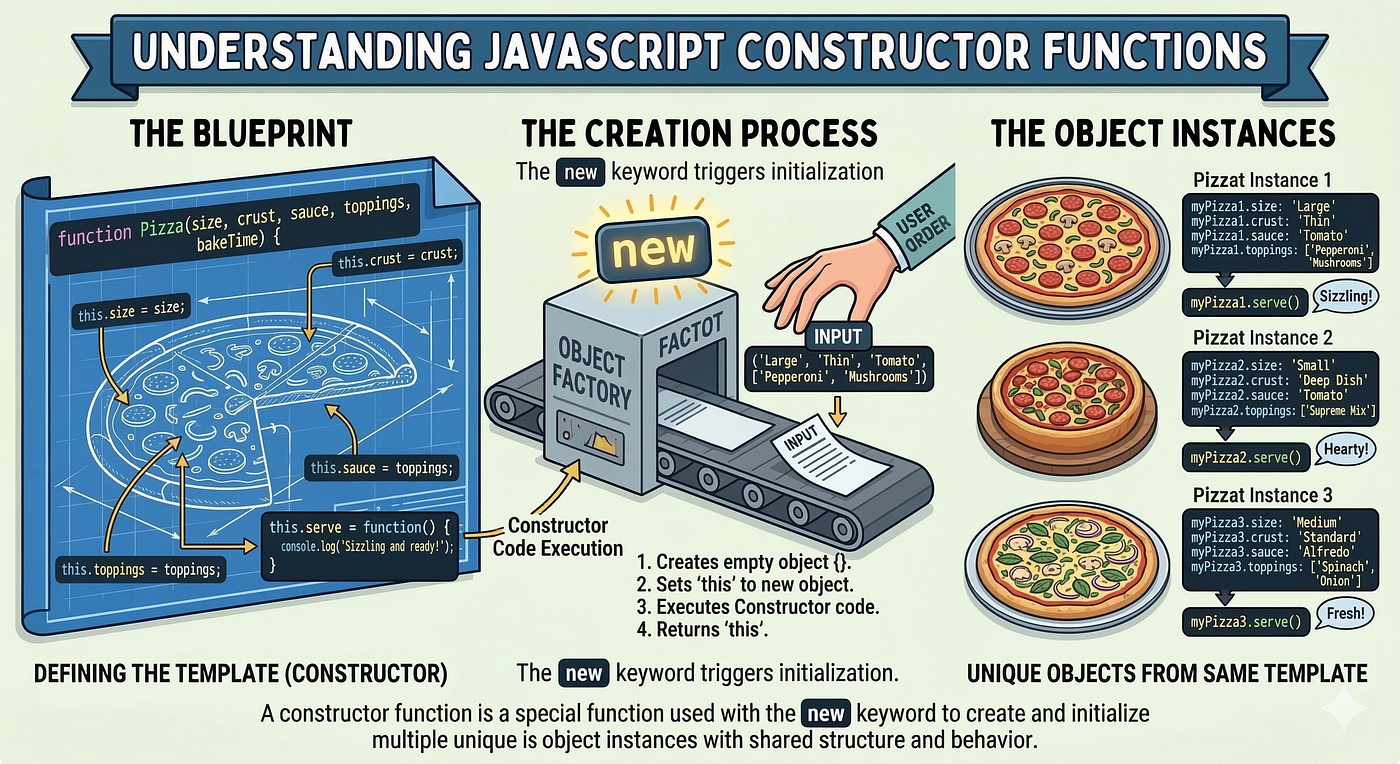
2. Constructor Functions — Definition & Syntax
What is a Constructor Function?
A constructor function is a regular function that:
- Is invoked with the
newkeyword - Uses
thisto assign properties to the newly created object - By convention, is named with PascalCase (e.g.,
Pizza,User,Car)
Basic Syntax
function Pizza(size, toppings, preference, crust) {
  // this -> refers to the new object being created
  this.size = size;
  this.toppings = toppings;
  this.preference = preference;
  this.crust = crust;
}
Creating Instances
let pizza1 = new Pizza("Medium", ["cheese", "tomato"], "Veg", "Thin");
let pizza2 = new Pizza("Small", ["cheese", "onion"], "Veg", "Thick");
let pizza3 = new Pizza("Large", ["pepperoni", "olives"], "Non-Veg", "Thin");
console.log(pizza1); // Pizza { size: "Medium", toppings: [...], ... }
console.log(pizza2); // Pizza { size: "Small", toppings: [...], ... }Each call to new Pizza(...) creates a new, independent object with its own property values.
3. The new Keyword – Step-by-Step Execution
What Happens When You Write new Pizza(...)?
When JavaScript executes new Pizza("Medium", ["cheese", "tomato"], "Veg", "Thin"), it performs 4 steps in order:
Step 1: Create an Empty Object
// JavaScript internally does something like:
let newObj = {};
A brand new, empty object is created in memory.
Step 2: Set the Prototype
// JavaScript sets:
newObj.__proto__ = Pizza.prototype;
// OR (modern way / ES6): Object.setPrototypeOf(newObj, Pizza.prototype);
// OR newObj.prototype = Object.create(Pizza.prototype)
The new object’s prototype is set to Pizza.prototype. This links the object to the constructor's prototype chain.
Step 3: Execute the Constructor with this Bound to the New Object
// JavaScript calls:
Pizza.call(newObj, "Medium", ["cheese", "tomato"], "Veg", "Thin");
Inside the constructor:
thisrefers tonewObj(the newly created object)- All assignments like
this.size = sizeadd properties tonewObj
Step 4: Return the Object (if no explicit return)
// If the constructor doesn't return an object, JavaScript returns newObj
return newObj;
Important: If the constructor explicitly returns a non-primitive (object/array), that value is returned instead of newObj. Returning a primitive (number, string, etc.) is ignored.
Visual Summary
new Pizza("Medium", ["cheese"], "Veg", "Thin")
    │
    ├─► 1. Create {}
    ├─► 2. {}.__proto__ = Pizza.prototype
    ├─► 3. Run Pizza() with this = {}
    │       → this.size = "Medium"
    │       → this.toppings = ["cheese"]
    │       → this.preference = "Veg"
    │       → this.crust = "Thin"
    └─► 4. Return the object
4. this in Constructor Context
What Does this Refer To?
Inside a constructor function when called with new:
🧠
**thisrefers to the newly created object** (the instance being constructed)
function Pizza(size, toppings, preference, crust) {
  console.log(this);  // Pizza {}  (empty at start, then gets properties)
  this.size = size;
  this.toppings = toppings;
  this.preference = preference;
  this.crust = crust;
  console.log(this);  // Pizza { size: "...", toppings: [...], ... }
}
let pizza1 = new Pizza("Medium", ["cheese"], "Veg", "Thin");⚠️ What if You Forget new?
let pizza1 = Pizza("Medium", ["cheese"], "Veg", "Thin"); // No 'new'!thiswill bewindow(browser, non-strict) orundefined(strict mode)- No new object is created
- Properties get assigned to the wrong place
pizza1will beundefined(constructor returns nothing explicitly)
Best Practice: Use PascalCase for constructors so you remember to use new. Some patterns (e.g., checking !(this instanceof Pizza)) can enforce new, but ES6 classes do this automatically.
5. Prototype & Prototype Chain
Why Add Methods on Prototype?
If you add methods inside the constructor:
function Pizza(size, toppings, preference, crust) {
  this.size = size;
  this.toppings = toppings;
  this.preference = preference;
  this.crust = crust;
  this.serve = function () {  // ❌ BAD: New function for EVERY instance
    console.log(`A ${this.size} Pizza with ${this.toppings} is served`);
  };
}
let p1 = new Pizza("M", [], "Veg", "Thin");
let p2 = new Pizza("L", [], "Veg", "Thick");
// p1.serve !== p2.serve → Each has its own copy!Problem: Every instance gets its own copy of serve. 1000 pizzas = 1000 identical functions in memory.
✅ Solution: Add Methods on Prototype
function Pizza(size, toppings, preference, crust) {
  this.size = size;
  this.toppings = toppings;
  this.preference = preference;
  this.crust = crust;
}
Pizza.prototype.serve = function () {
console.log(`A ${this.size} Pizza with ${this.toppings} is served`);
};let p1 = new Pizza("M", [], "Veg", "Thin");
let p2 = new Pizza("L", [], "Veg", "Thick");p1.serve(); // Works!
p2.serve(); // Works!
// p1.serve === p2.serve → Same function, shared!Benefit: All instances share the same serve function. One copy in memory, referenced by all.
How Does p1.serve() Work? (Prototype Chain)
- JavaScript looks for
serveonp1→ Not found - JavaScript looks on
p1.__proto__(i.e.,Pizza.prototype) → Found! serveis called withthis = p1(the object before the dot)
p1  →  { size, toppings, preference, crust }
        │
        └── __proto__  →  Pizza.prototype  →  { serve: function }
This is the prototype chain. If a property isn’t on the object, JS looks up the chain.
Prototype Chain Diagram
Instance (pizza1)              Constructor (Pizza)           Built-in
     │                              │
     │  __proto__                   │  .prototype
     └─────────────────────────────┘
                    │
                    │  __proto__
                    └──────────────────► Object.prototype
                                              │
                                              │  __proto__
                                              └──────────────────► null
6. Adding Methods — Constructor vs Prototype

table of constructor vs Prototype
Rule of Thumb:
- Properties (data) → Constructor (
this.size = size) - Methods (behavior) → Prototype (
Pizza.prototype.serve = function() {})
7. Factory Pattern — Alternative Approach
What is the Factory Pattern?
Instead of new, you use a regular function that:
- Creates an empty object
- Assigns properties
- Returns the object
function createPizza(size, toppings, crust, preference) {
  let obj = {};
obj.size = size;
obj.toppings = toppings;
obj.crust = crust;
obj.preference = preference;
obj.serve = function () {
console.log("Pizza Served");
}; return obj;
}let pizza3 = createPizza("small", ["cheese", "onion"], "Veg", "Thick");
let pizza4 = createPizza("Medium", ["cheese", "tomato"], "Veg", "Thin");console.log(pizza3);
console.log(pizza4);
pizza3.serve();
pizza4.serve();Constructor vs Factory

Constructor vs Factory
8. Prototype Pollution & Shadowing
What is Prototype Shadowing?
Every object in JavaScript has a prototype. Built-in objects (like Array, Object) have prototypes that all instances share.
⚠️ DANGER: Modifying Built-in Prototypes
let person = { name: 'Adam', age: 28, phone: 1234567 };
let arr = [1, 2, 3, 4];
console.log(person);
console.log(arr);// ❌ DANGEROUS: Overwriting Array.prototype.map
Array.prototype.map = function () {
console.log("This is my Map Function");
};// Now EVERY array in the entire application is affected!
let myArr = [5, 6, 7];
myArr.map(); // "This is my Map Function" - Original map is GONE!What happened?
Array.prototype.mapis the sharedmapfunction for all arrays- By reassigning it, you broke the native
mapfor every array everywhere - This is called prototype pollution or monkey patching (when done intentionally for polyfills)
Why is This Bad?
- Breaks existing code — Libraries and your own code expect
mapto work - Unpredictable — Other developers (or you in 6 months) won’t know why
mapbehaves oddly - Global side effects — Affects the entire runtime
When is Modifying Prototypes Acceptable?
- Polyfills — Adding a method that doesn’t exist yet (e.g.,
Array.prototype.includesin old browsers) - Your own constructors —
Pizza.prototype.serveis fine; you own that
Rule: Never modify built-in prototypes in production unless you have a very good reason (e.g., official polyfill).
9. Constructor vs Factory — When to Use Which?
Use Constructor When:
- You want inheritance (prototype chain)
- You need
instanceofchecks - You’re building a class-like hierarchy
- You want memory efficiency (shared methods)
Use Factory When:
- You don’t need
instanceof - You want flexibility (return different object types)
- You’re in a functional style codebase
- You want to encapsulate creation logic
10. Interview Cheat Sheet

Cheatsheet
11. Final Takeaways
- Constructor +
new= Blueprint for creating similar objects **this** in constructor = the new object being created- Prototype = Shared methods; use it for behavior, not per-instance data
- Factory = Alternative without
new; no prototype chain by default - Never modify built-in prototypes (Array, Object, etc.) in production
Related Interview Questions
Basic Level
Q1. What is a constructor function in JavaScript?
- A constructor function is a regular function used with the
newkeyword to create objects. It usesthisto assign properties to the newly created instance. By convention, it's named in PascalCase.
Q2. What happens when you use the new keyword?
- Four steps: (1) Create empty object, (2) Set its prototype to Constructor.prototype, (3) Execute constructor with
thisbound to new object, (4) Return the object (unless constructor returns another object).
Q3. What does this refer to inside a constructor function?
thisrefers to the newly created object (the instance) when the constructor is called withnew.
Q4. Why should we add methods on the prototype instead of inside the constructor?
- Methods on the prototype are shared across all instances, saving memory. Methods inside the constructor create a new copy for each instance.
Intermediate Level
Q5. What is the prototype chain?
- When you access a property, JavaScript first looks on the object. If not found, it looks on
object.__proto__(the constructor's prototype). This continues untilObject.prototypeand thennull. This lookup path is the prototype chain.
Q6. What is the difference between constructor pattern and factory pattern?
- Constructor uses
new, creates objects linked to a prototype, and supportsinstanceof. Factory is a function that creates and returns objects manually, withoutnewor prototype linkage.
Q7. What happens if you call a constructor without new?
thiswill bewindow(non-strict) orundefined(strict). No new object is created. The "instance" variable will beundefinedif the constructor doesn't return anything.
Q8. What is prototype pollution?
- Modifying built-in object prototypes (e.g.,
Array.prototype.map) affects all instances globally. It can break existing code and cause unpredictable behavior.
Advanced Level
Q9. How would you implement the new keyword from scratch?
function myNew(Constructor, ...args) {
  let obj = Object.create(Constructor.prototype);
  let result = Constructor.apply(obj, args);
  return (typeof result === 'object' && result !== null) ? result : obj;
}
Q10. What is the difference between __proto__ and prototype?
prototypeis a property of the constructor function; it's the object that will be used as the prototype for instances.__proto__is a property of an instance; it points to its constructor'sprototype. (In other words:instance.__proto__ === Constructor.prototype)
Link to my github related to JS : click
메타데이터
- post_id
- e28f65480892
- slug
- constructor-function-prototype-in-js-e28f65480892
- url
- https://medium.com/@ashu9472.as/constructor-function-prototype-in-js-e28f65480892
- canonical_url
- https://medium.com/@ashu9472.as/constructor-function-prototype-in-js-e28f65480892
- author_url
- https://medium.com/@ashu9472.as
- status
- ok
- fetched_at
- 2026-07-28 05:39:03