What’s in a Name?
My name is a conversation starter. Not in the fun, “tell me about yourself” way — in the “wait, what IS that?” way.
What’s in a Name?
My name is a conversation starter. Not in the fun, “tell me about yourself” way — in the “wait, what IS that?” way.
It happens in interviews. In viva exams. On first dates, where many awkward men (and they usually are awkward, bless them) use “so what does your name mean?” as their opening move, like they’ve discovered a clever loophole around actual conversation.
Fine.
Let’s have that conversation. Properly, this time.
Mahenaw is Persian, rooted in mah — moon. It sits in a whole family of moon-names: moonlight, moon-faced, moon fairy, beautiful-as-the-moon. New moon, new beginning. Poetic enough.
Ummul Wara is Arabic, and it means “Mother of Mankind” — the epithet tied to Eve, Madonna, Durga- the mother of all people. Not mother of a lineage. Not mother of an estate. Mother of everyone, no exceptions, no shareholders.
So my full name, translated honestly, is something like: The new moon, mother of all people. Cosmic. Universal. Completely, utterly useless for getting me into a family business.
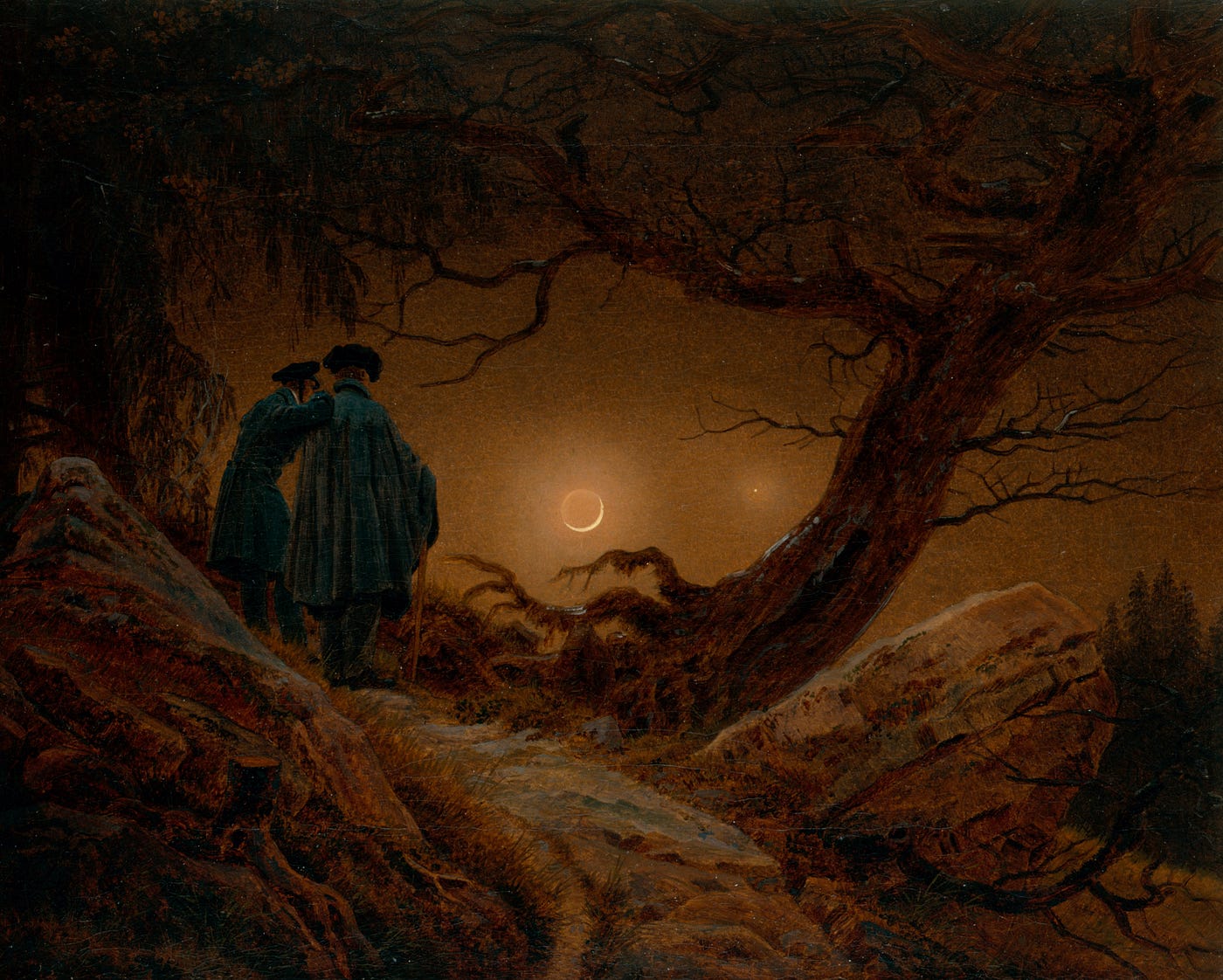
Friedrich, “Two Men Contemplating the Moon” Two men, one moon, no last names required.
Because here’s the part I don’t get asked about on first dates: I don’t carry a family title at the end of my name. My name isn’t a name so much as a small Persian sentence that ends, quite deliberately, in nothing.
And a last name, as it turns out, is not just a title. It’s a key. The Fords. The Waltons. The Gandhis. Say “Trump” or “Gates” in a room and watch how fast the room rearranges itself around you — not because of what you did, but because of the market value or the net worth of the inheritance that name carries. A famous bookstore in Northern India, called “Fakir Chand and Sons”, is quietly proving that the same rule works in Dhaka, too. A powerful last name isn’t inherited wealth. It’s inherited access — to shares, to boardrooms, to the White House, to a role in a movie you didn’t audition for. You don’t win that lottery. You’re already holding the ticket at birth.

Velázquez, “Las Meninas” Four hundred years later, the room still rearranges itself around whoever’s holding the crown.
Now, to be clear — sometimes the ticket is a dud. Lines Brothers, once Britain’s biggest toy maker, was gutted within a few years of the second generation taking the wheel. Yale Express went bankrupt within five years of the founder’s heir becoming president. A&P, once America’s largest supermarket chain, folded the same way. Somewhere, a business school professor is building an entire syllabus out of “what happens when the surname shows up to a meeting the resume should have attended instead.”

Goya, “The Family of Charles IV” The ticket doesn’t come with a return policy — sometimes it’s just a very expensive costume.
But my favourite genre of last-name story isn’t the boardroom flop — it’s the one where an unearned title lands on someone who then uses it to genuinely, spectacularly wreck things for people who never got a vote in the matter. History’s most efficient version of this was the Vatican, where the Borgias turned “nephew” into a euphemism for “future pope,” producing two of them plus a small army of political appointees, mostly remembered today for corruption rather than competence. Closer to home and closer to now: watch what happens when a surname alone — with no résumé attached — walks straight into the prime minister’s office.
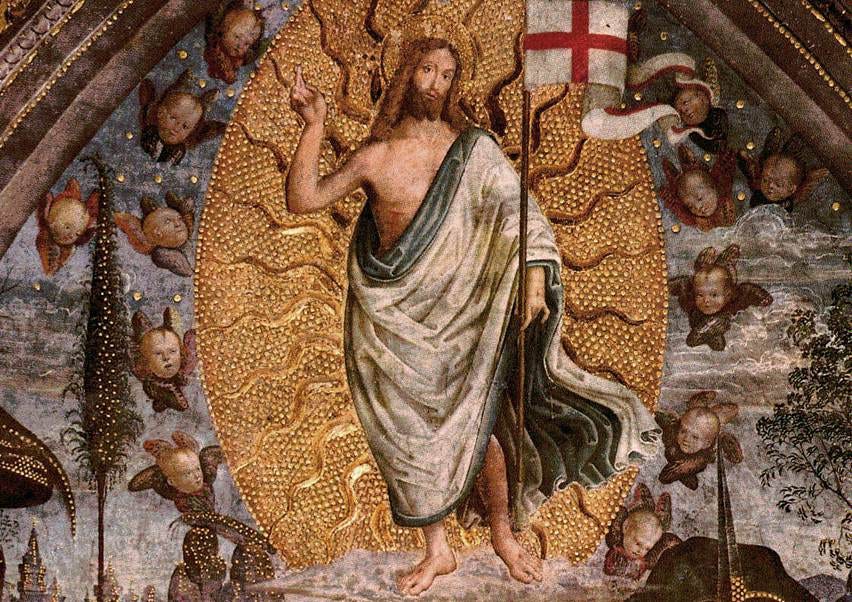
Pinturicchio, “The Resurrection” (Alexander VI kneeling) Nothing says humility like commissioning your own portrait praying at Christ’s feet.
Which brings me to the part of this essay where I stop being cute about it.
Bangladesh just had an election. People exhaled — relief, mostly, at choosing what felt like the lesser of two evils. Sheikh Hasina’s dynasty is finished, at least for now: she’s been sentenced in absentia and remains in hiding, her party barred from taking part. Good riddance to one dynasty, you might think.
Except the man who just won by a landslide returned from 17 years of exile less than two months before the vote. He’d never held government office. He took over his party’s leadership five days after his mother — the previous dynasty’s matriarch — died. Daddy founded the party to remain politically relevant. Mummy ran it twice. Son inherits it, essentially by succession, not by contest. Three generations, one family, and not a single meaningful audition in between.

The Younger Memnon — head of Ramesses II, British Museum Look on my works, ye Mighty — and then watch the empire that stole me collapse, too.
Meanwhile, in offices not far from where I work, well-meaning development partners are pouring millions into “youth empowerment” programmes — trying to convince disengaged, grassroots young people that their vote, their voice, their volunteer hours matter, that the system is theirs to shape if only they show up for it.
I want to believe that too. I help run programmes built on that belief.
But somebody, please, explain to me how a village youth leadership workshop competes with a chairmanship that gets handed over like a house key five days after a funeral. It’s not even an unfair fight. It’s not a fight at all — it’s two entirely different games being played on the same field, and only one of them was ever advertised to the public.
This is what philosopher Olúfẹ́mi Táíwò calls elite capture — not always a villain twirling a moustache, but often just people who’ve never had to imagine a different reality, mistaking their own worldview for the universal one. Development programmes meant for the most disenfranchised quietly end up best serving whoever in the room already had the most access to begin with. Identity politics, elite capture, philanthropy, family businesses, national politics — different rooms, same furniture.
So, thank you, unimaginative parents of mine, for exhausting yourselves finding a name so unique it couldn’t be squeezed onto the end of a family fortune. You accidentally raised someone with nothing to inherit but a moon and the whole of humanity. Could’ve worked a little harder, honestly. I hear “and Sons” has a nice ring to it. But have you ever heard of “and Daughters”? Have you ever wondered why?
Then again — nobody’s ever forgotten my name after they’ve heard the meaning. Can’t say the same for the third Zia, now toying around with my country.
메타데이터
- post_id
- e29c906c2db2
- slug
- whats-in-a-name-e29c906c2db2
- url
- https://medium.com/@mahenaw/whats-in-a-name-e29c906c2db2
- canonical_url
- https://medium.com/@mahenaw/whats-in-a-name-e29c906c2db2
- author_url
- https://medium.com/@mahenaw
- status
- ok
- fetched_at
- 2026-07-27 02:49:41

