What Inventory Control Really Prevent Billion-Dollar Breakdowns?
How four fundamental inventory methods keep billion-dollar operations from grinding to a halt?
What Inventory Control Really Prevent Billion-Dollar Breakdowns?
How four fundamental inventory methods keep billion-dollar operations from grinding to a halt?
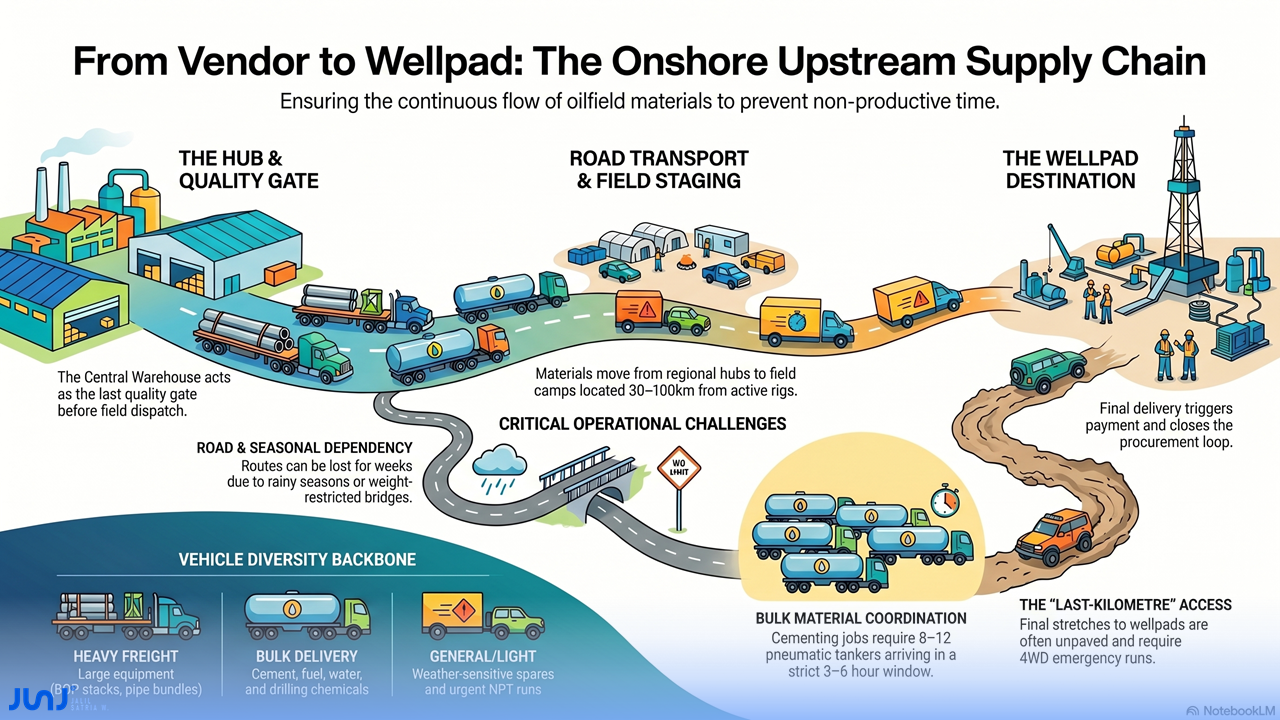
Imagine this: a drilling rig is down, not because of bad weather or a mechanical failure, but because a critical valve. A 3-inch gate valve worth less than $200 couldn’t be found in the warehouse. It was there, somewhere. But nobody knew exactly where, or whether it was the right spec, or if it had already expired past its shelf-life limit. Every hour of rig downtime costs upward lots of dollar burned. And the root cause was never really about the valve. It was about a broken inventory control system.
What You’ll Take Away From This Article
By the time you finish reading, you’ll understand the four most essential inventory control methods — FIFO, LIFO, Cycle Counting, and ABC Analysis — not just as accounting concepts, but as operational lifelines in the high-stakes world of oil and gas logistics. You’ll also see how these methods connect to internationally recognized standards like ISO 9001, API RP 5L1, and IOGP guidelines that govern warehousing and materials management in upstream and downstream operations. Whether you’re a warehouse supervisor in a warehouse and logistic, a procurement officer managing a remote area, a supply chain early career, or related background engineering/non-engineering student eyeing a career in energy logistics — this is for you guys.
1. FIFO (First In, First Out): The Golden Rule of Shelf Life
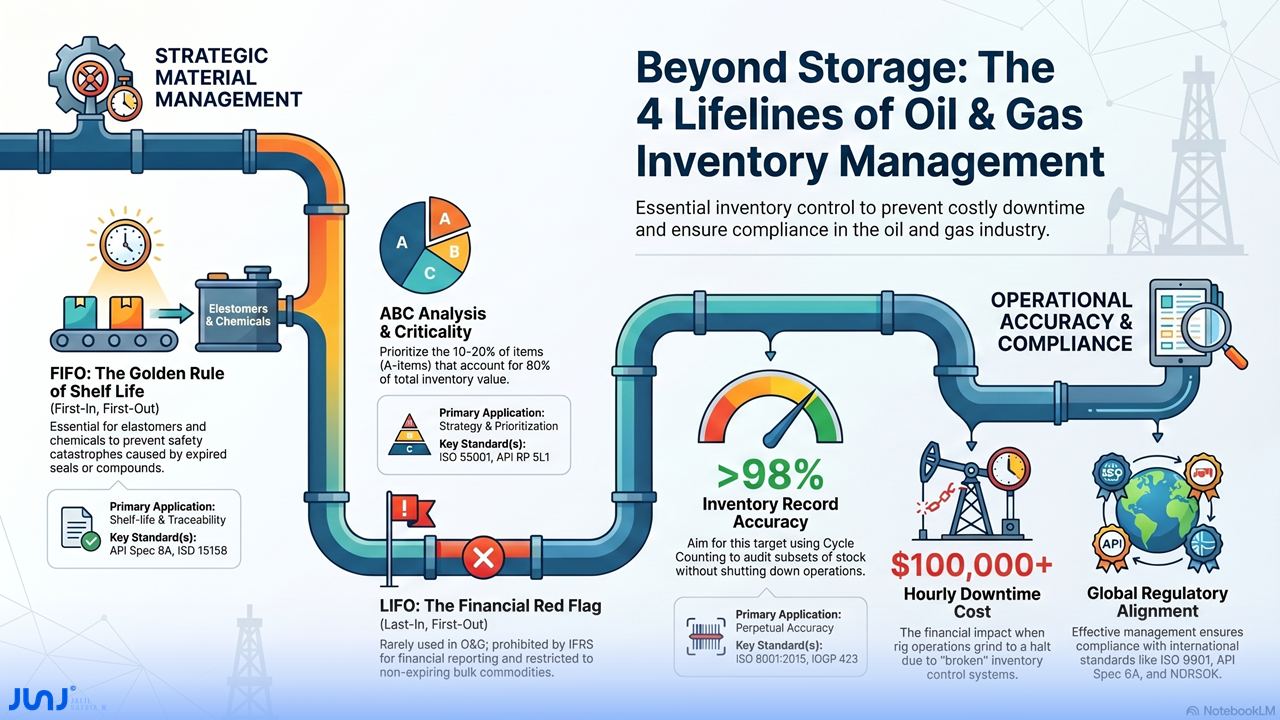
FIFO is simple in theory: the first item to enter the warehouse is the first to leave. In oil and gas, FIFO isn’t just good practice , it’s a regulatory requirement. Elastomers, O-rings, seals, gaskets, and chemical compounds all carry shelf-life expiry dates. Using an expired seal on a high-pressure wellhead isn’t a quality issue, it’s a safety catastrophe.
Applicable Standards:
- API RP 11AR and API Spec 6A mandate shelf-life management for wellhead components and valves
- ISO 15156 (Materials for use in H₂S-containing environments) requires traceability of materials — FIFO supports this chain of custody
Actionable Tips:
- Label every incoming item with a “Date Received” and “Use-By” sticker at the point of receiving.
- Set up your WMS (Warehouse Management System) to automatically flag items approaching expiry.
- For chemicals, lubricants, and polymer-based components, conduct a monthly shelf-life audit aligned with your HSEQ calendar or you can check the Safety Data Sheet (SDS).
- Use physical bin arrangements physically enforce FIFO with newer stock goes in the back and older stock comes out the front.
2. Cycle Counting: The Audit That Doesn’t Shut Down Your Warehouse
Cycle counting is a method of auditing inventory by counting a small subset of stock on a rotating basis throughout the year , instead of doing a single massive annual physical inventory count that shuts everything down.
At Pertamina my current company, we conduct Perpetual Stock Checking throughout the year and an Annual Stock Checking to ensure inventory records remain accurate. My previous employer, Astra International, followed a similar practice called stock opname.
For context, Astra is not an oil and gas company but an automotive manufacturer. A single vehicle contains more than 30,000 parts, making inventory management extremely complex. Yes, we do carry out this cycle counting/stock opname process meticulously. That’s why process are conducted rigorously to ensure that system records accurately match physical inventory.
The goal is simple: to verify that the inventory recorded in SAP matches the actual stock in the warehouse. Regular stock checks help identify discrepancies early, improve inventory accuracy, and ensure operational decisions are based on reliable data.
Why It’s a Game-Changer in Oil & Gas Warehousing
Oil and gas warehouses especially at offshore bases, drilling camps, or refinery stores will run 24/7. You cannot afford to freeze operations for a full wall-to-wall count. Cycle counting lets you maintain accuracy continuously.
Applicable Standards:
- ISO 9001:2015 Clause 7.5 (Documented Information) requires that inventory records remain accurate and controlled
- IOGP Report 423 (Supply Chain Management) recommends perpetual inventory practices with regular reconciliation
- API RP 75 (SEMP) and OSHA PSM regulations indirectly require accurate materials tracking, especially for safety-critical items (valves, relief devices, firefighting equipment)
How to Structure a Cycle Count Program:
Divide your inventory into counting zones. A typical oil and gas warehouse might assign:
- Zone A items (high-value, safety-critical): counted monthly or even weekly
- Zone B items (moderate value): counted quarterly
- Zone C items (low-value consumables): counted semi-annually or annually
Set a count accuracy target — most operators aim for ≥98% inventory record accuracy (IRA) or suitable with your company standard. When a discrepancy is found, investigate root cause: mislabeling, unauthorized issuance, receiving error, or system entry mistake.
Actionable Tips:
- Integrate cycle counts into your shift handover routine — a counter can complete a zone count in 30–60 minutes with a scanner
- Use blind counting: the counter should not see the system quantity before counting — this eliminates confirmation bias
- Track your IRA trend over time; a sudden drop signals a process breakdown before it becomes a crisis
- For safety-critical and high-value items (e.g., BOP components, control valves, fire suppression equipment), consider using RFID tagging to enable near-real-time inventory visibility
3. ABC Analysis: Work Smarter, Not Harder
ABC Analysis segments your inventory into three tiers based on value and consumption:
- A Items — roughly 10–20% of items but 70–80% of total inventory value
- B Items — 30% of items, around 15–25% of value
- C Items — 50–60% of items but only 5% of value
Why ABC Analysis is Critical in Oil & Gas
An average oil and gas warehouse holds thousands of SKUs — from multi-million-dollar subsea trees to $2 cable ties. Treating every item with the same level of scrutiny is inefficient and wasteful. ABC Analysis tells you where to focus your energy, budget, and controls.
Applicable Standards:
- IOGP Report 373 (Materials and Corrosion Control) and ISO 55001 (Asset Management) both support risk-based prioritization of materials management effort
- API RP 5L1 (Railroad Transportation of Line Pipe) and API 686 (Machinery Installation) emphasize critical spare management — essentially, an A-item strategy
- NORSOK Z-016 (Reserves and Resources) and project-specific MRP (Materials Requirements Planning) systems tie directly into ABC classifications
In Practice — The Oil & Gas Twist: In oil and gas, ABC Analysis must be overlaid with criticality classification, not just cost:
A pump bearing worth $50 may be a “C” item by value — but if it’s the only spare for a safety-critical injection pump with a 12-week lead time, it should be managed like an “A” item operationally. This is why leading operators use a Criticality Matrix: combining ABC (value) with XYZ (demand frequency) and a separate safety-critical spare classification.
Actionable Tips:
- Run your ABC analysis at least annually, and after any major project scope change
- Create a separate “S-Class” (Safety-Critical) flag in your ERP/WMS that overrides ABC tier for preservation, inspection, and re-ordering purposes
- Use ABC data to negotiate vendor-managed inventory (VMI) or consignment stock agreements for your A-items — this shifts carrying cost to suppliers while guaranteeing availability
- Train your stores staff to know which items are A-class — they should get the best shelf locations, proper packaging, and priority cycle counts
4. LIFO (Last In, First Out): The Method You Need to Understand — Even If You Rarely Use It
LIFO flips the script. The most recently received items are issued first. In a physical warehouse, this often happens naturally when items are stacked. Workers grab from the top/front (newest) rather than digging to the bottom (oldest).
LIFO is rarely appropriate for materials management in oil and gas operations but particularly for items with shelf-life or traceability requirements. However, it does appear in two legitimate contexts:
1. Financial/Tax Accounting: Some companies use LIFO for inventory valuation to reduce taxable income during periods of rising costs. Under IFRS (which most international oil companies follow), LIFO is actually prohibited for financial reporting. Acritical distinction for companies listed on international exchanges.
2. Bulk Commodities Without Expiry: Steel structural items, certain raw materials like gravel or dry bulk aggregates in construction and civil works where first-in/last-in makes no practical difference may use de facto LIFO without consequence.
Actionable Tips:
- For physical materials management in oil and gas, treat LIFO as a red flag — if your team is naturally issuing newest stock first, it’s a sign your storage layout or processes need redesign
- Document clearly in your materials management procedure (aligned with ISO 9001:2015 Clause 8.5.4 — Preservation) which inventory method applies to each commodity class
A Lesson Learned the Hard Way
Early in my logistics career, I was assigned to an onshore drilling base in Southeast Asia. We had a warehouse full of thousands of SKUs and a brand-new WMS that nobody trusted. The engineers went around the system, kept their own Excel lists, and issued parts informally.
During the cycle count, we discovered several expired chemicals. In reality, these materials were still recorded in the SAP system. We immediately executed a write-off to avoid future accidents. Imagine these expired materials ending up deep in the well, in beakers in the testing lab, or even causing miscalculations in the operational field.
The lesson wasn’t about the materials. It was that data discipline in a warehouse is not a back-office function — it’s an operational and safety-critical one. FIFO, cycle counts, ABC analysis: these aren’t bureaucratic box-ticking. They are the difference between a safe, efficient operation and an expensive, dangerous one.
Conclusion: The Warehouse Is Never Just Storage
A warehouse in oil and gas isn’t a passive holding space. It is an active, living part of your operational integrity. When your inventory control methods are working : when FIFO keeps seals in date, when cycle counts keep your data clean, and when ABC analysis keeps your team focused on what matters. you don’t notice. Operations flow. Wells produce. Rigs drill.
When they’re broken, you notice immediately. And the cost is never just financial.
The good news? None of these methods require a massive budget or a cutting-edge system to implement. They require discipline, good processes, and a team that understands why it matters.
Start with one: pick your top 20 highest-value SKUs and run an ABC analysis this week. See what you find. You might be surprised.
메타데이터
- post_id
- e2a383f2c032
- slug
- what-inventory-control-really-prevent-billion-dollar-breakdowns-e2a383f2c032
- url
- https://medium.com/@wsatria212/what-inventory-control-really-prevent-billion-dollar-breakdowns-e2a383f2c032
- canonical_url
- https://medium.com/@wsatria212/what-inventory-control-really-prevent-billion-dollar-breakdowns-e2a383f2c032
- author_url
- https://medium.com/@wsatria212
- status
- ok
- fetched_at
- 2026-06-24 04:09:36