How AI Search Engines Actually “See” a Mini LED or OLED Brand: A GEO/AEO Case Study for the Display…
Why the next battle for display and electronics brands isn’t the SERP. It’s the sentence ChatGPT writes about you.
How AI Search Engines Actually “See” a Mini LED or OLED Brand: A GEO/AEO Case Study for the Display Industry
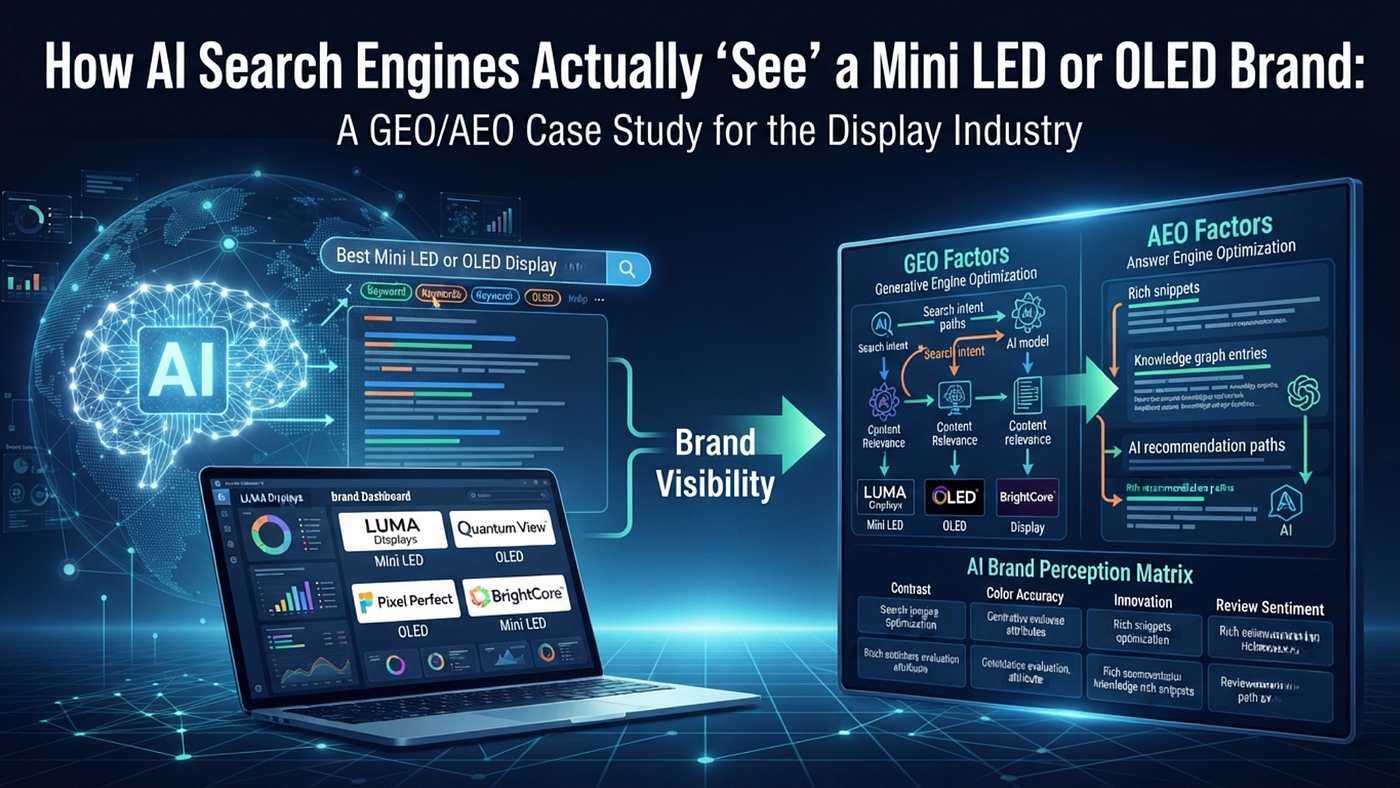
Visualized by AI, orchestrated by Pixenon semantic architecture.
Why the next battle for display and electronics brands isn’t the SERP. It’s the sentence ChatGPT writes about you.
The Search Box Isn’t Where the Decision Happens Anymore
A shopper deciding between a Mini LED and an OLED TV or monitor used to open ten browser tabs, compare spec sheets, and read three or four “best of” articles before making a call. In 2026, that same shopper is far more likely to type one sentence into ChatGPT, Perplexity, Gemini, or Google’s AI Mode: “Should I get Mini LED or OLED for gaming in a bright room?” and act on whatever answer comes back, without ever clicking a link.
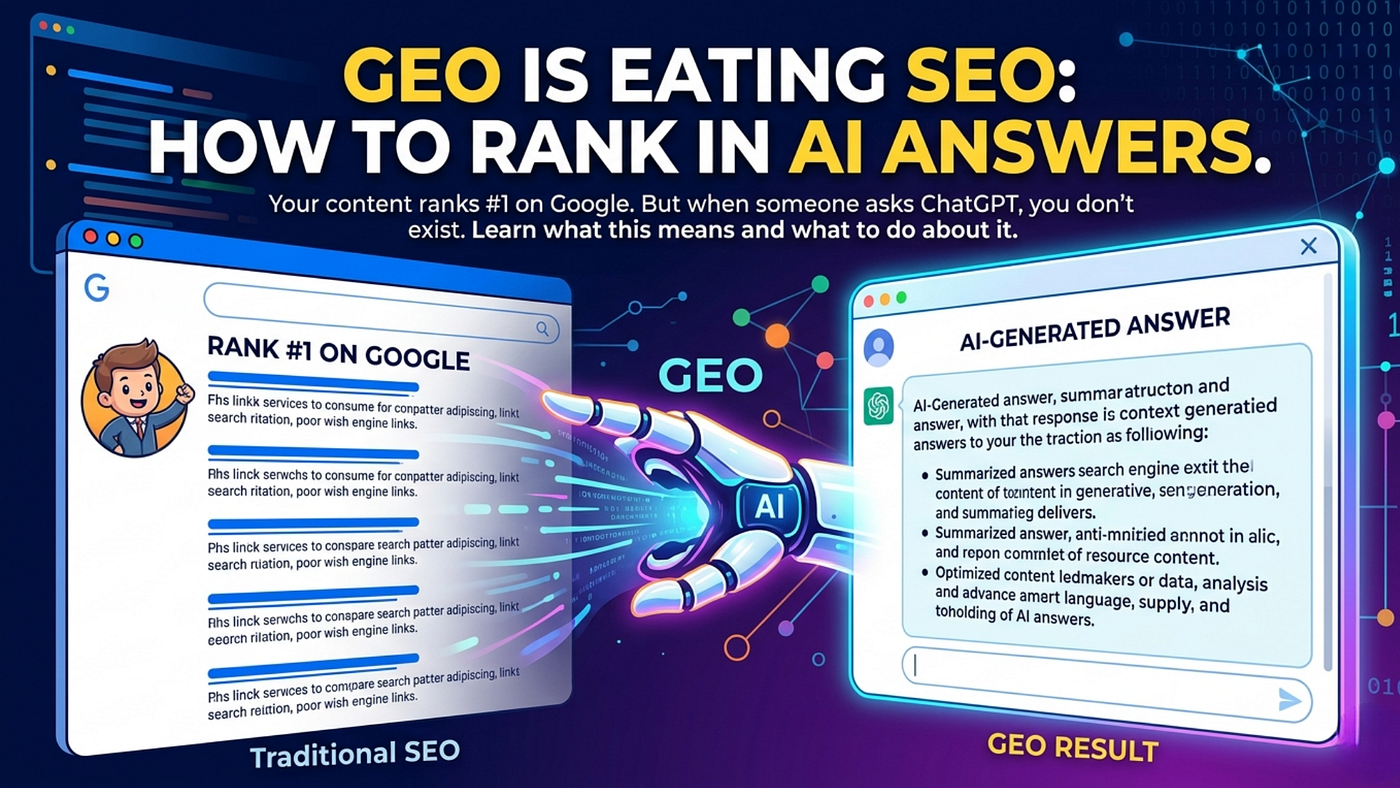
This is not a marginal shift. Search behavior has moved decisively toward conversational, answer-first discovery, and the industry has responded by naming the discipline that optimizes for it: Generative Engine Optimization (GEO), sometimes used alongside Answer Engine Optimization (AEO). Both describe a similar underlying goal: earning a place inside the answer an AI system generates, rather than a ranking position on a results page a human has to click through.
For display-technology brands, Mini LED, OLED, QD-OLED, RGB Mini LED, and the emerging MicroLED category, this shift matters more than in almost any other consumer category, for one simple reason: the buying decision is inherently comparative, technical, and full of trade-offs (brightness vs. black levels, burn-in risk vs. blooming, price vs. longevity). That is exactly the kind of query AI answer engines were built to resolve. Whoever controls the technical narrative controls the recommendation.
This article breaks down how AI search actually evaluates and selects sources in a technical hardware category like this one, using Mini LED vs. OLED as the running example, and what that means operationally for a brand’s content and technical strategy.
Part 1: GEO and AEO, Defined Properly
It’s worth being precise about the terminology, because the industry hasn’t fully standardized it yet.
SEO (Search Engine Optimization) optimizes a page to rank among a set of ten blue links that a human then chooses to click. Success is measured in rankings and click-through rate.
GEO (Generative Engine Optimization) was formally introduced in a November 2023 research paper by Pranjal Aggarwal and Vishvak Murahari, working with co-authors affiliated with Princeton, Georgia Tech, and the Allen Institute for AI. The paper, later presented at the ACM SIGKDD 2024 conference, defined GEO as the practice of structuring content so that AI-powered platforms such as ChatGPT, Google AI Overviews, Perplexity, and Gemini can retrieve, synthesize, and cite it when generating an answer. The researchers tested a set of content optimization strategies across thousands of queries and found that tactics like adding statistics and citing credible sources could improve a page’s visibility inside AI-generated answers by up to 40 percent. Instead of competing for one of ten positions, a brand is effectively competing to be one of a small handful of sources an AI model actually cites in a single generated response.
AEO (Answer Engine Optimization) actually predates GEO by several years. The term is credited to digital marketer Jason Barnard, who coined it around 2018 in the context of voice search and featured snippets, long before today’s generative AI systems existed. In practice, AEO and GEO have converged: most voice and “answer-first” queries today are served by the same generative systems GEO targets, so the two disciplines now largely overlap in technique even if the terminology hasn’t fully merged.
The practical difference from classic SEO is structural. A generative engine doesn’t read a page the way a person does. When someone asks an AI assistant a comparative question, the system typically decomposes the question into smaller sub-queries, retrieves candidate passages for each sub-query from across the web, and then synthesizes a single answer, deciding in the process which sources are worth citing or naming. A brand can rank number one in Google and still never get mentioned in that synthesized answer if its content isn’t structured in a way the retrieval and synthesis pipeline can use.
Industry research and monitoring through 2026 has converged on a fairly consistent list of signals that increase the odds of being one of those cited sources:
- Direct, front-loaded answers. The first 40 to 200 words of a section should completely answer the question posed in its heading, rather than building up to the point. AI systems that use real-time retrieval evaluate a page’s relevance heavily on its opening content, not its conclusion.
- Extractable structure. Clear H2/H3 headings phrased as questions, bulleted comparisons, and tables outperform long, undifferentiated prose, because models extract tabular and list-structured data far more reliably than narrative text.
- Original data and numbers. Concrete figures, a specific dimming-zone count, a specific nit rating, a specific benchmark result, are weighted more heavily than generic marketing adjectives like “stunning” or “immersive.”
- Freshness. AI systems weigh how recently content was updated. A comparison guide published once and never revisited steadily loses ground to a competitor’s guide that carries a visible, genuine “last updated” date and current figures.
- Entity clarity and structured data. This is the piece most hardware brands get wrong, and it’s the one this article spends the most time on below.
Part 2: Why AI Doesn’t See a “Product”, It Sees an Entity
Here is the conceptual shift that trips up most electronics and hardware marketers: a generative engine does not fundamentally reason about your webpage. It reasons about entities, things, with properties, that relate to other things.
When an AI system processes a page about a Mini LED monitor, it isn’t primarily matching keywords like “mini LED” or a zone count. It’s attempting to resolve what organization makes this, what type of thing is being described (a Product, of category Monitor, with a Brand), what its measurable properties are (zone count, peak brightness, response time), and how confidently that information can be trusted and reused. Structured data, implemented as JSON-LD schema markup from schema.org, is the mechanism that makes those answers explicit instead of inferred.
This matters because of how large language models actually process a page technically. Testing across the industry has shown that models can extract information directly from tokenized HTML, including JSON-LD script blocks, rather than only reading rendered, human-visible text. This suggests these systems can treat the schema layer and the visible content as part of the same combined signal, not as a separate technical afterthought.
The practical implication for a display brand: your Organization schema, Product schema, and FAQPage schema aren’t decorative SEO housekeeping anymore. They’re one of the primary channels through which a language model learns who you are and what your product actually does clearly enough to cite you with confidence instead of hedging or citing a competitor’s cleaner data.
A few schema types repeatedly show up as the highest-value ones for this category:
- Organization schema, linked outward via sameAs properties to authoritative external profiles (Wikipedia, Wikidata, LinkedIn, Crunchbase). This is how a model disambiguates your brand from a similarly named competitor and connects you to the broader knowledge graph search engines already trust.
- Product and Offer schema, carrying concrete, visible specifications, dimming zone count, peak brightness in nits, response time, panel type, because vague marketing copy without matching structured data gives a model nothing concrete to extract.
- FAQPage schema, mapped to real questions buyers actually ask (“Is Mini LED better than OLED for a bright room?” “Does Mini LED have burn-in risk?”), with the answer visible on the page and matching the markup exactly.
- Article/BlogPosting schema with author, organization, and publish/update dates, which anchors technical content, like a Mini LED vs. OLED explainer, to a credible, dated, attributable source rather than anonymous, undated text.
One caution worth including honestly: schema is not a magic override for weak content. Schema behaves more like what some researchers call a “last-mile optimizer.” It improves the odds of citation at the margin for content that already has substance and topical authority; it doesn’t manufacture authority a brand hasn’t otherwise earned.
Part 3: The Mini LED vs. OLED Query as a Working Example
Let’s walk through what actually happens, mechanically, when a user asks an AI system something like: “I want a monitor for gaming and long work sessions in a bright room, Mini LED or OLED?”
Step 1, Query fan-out. Rather than treating this as one search, the system likely breaks it into several implicit sub-queries: brightness performance in ambient light, burn-in and longevity risk for static desktop use, motion clarity for gaming, and possibly price-to-performance at the user’s likely screen size.
Step 2, Retrieval. For each sub-query, the model’s retrieval layer pulls candidate passages from across indexed sources. This is where the real technical substance of the category comes into play, and where a brand’s own content is competing directly against comparison-site content it doesn’t control.
To ground this in the actual state of the technology in 2026: Mini LED backlighting has matured well beyond “more LEDs behind an LCD panel.” A common baseline for a 27-inch premium monitor is 1,152 local dimming zones, with budget tiers around 576 zones and current flagship monitors reaching roughly 2,304 zones. On the brightness side, Mini LED panels can commonly sustain full-screen brightness in the 400 to 900-plus nit range, with VESA’s DisplayHDR 1400 certification requiring a sustained 900 nits across the full screen for at least 30 minutes alongside a 1,400 nit peak. Some current flagship models advertise peak brightness figures well above that in narrow highlight windows. Mini LED’s other structural advantage is durability under static content: because the backlight is inorganic LEDs behind an LCD layer rather than individually emitting organic diodes, it carries effectively no meaningful burn-in risk, which is why it’s frequently recommended for bright offices, coding, spreadsheet work, and desks with static toolbars for long hours a day.
OLED’s counter-case is just as concrete. Because each pixel emits its own light and can switch off completely, OLED delivers genuinely strong per-pixel black levels and near-instant response times, which is why it remains a preferred choice for dark-room cinematic viewing and for gaming genres where motion clarity and input latency matter more than sustained brightness. The trade-offs are real and well documented: sustained full-screen brightness on OLED panels is typically capped around 250 nits due to an automatic brightness limiter, and while newer OLED generations have worked on burn-in mitigation through features like pixel-shifting and logo-dimming, the underlying risk from static bright elements over years of heavy use has not been eliminated, only reduced and managed.
Step 3, Synthesis and source selection. This is the moment that determines whether your brand’s page is one of the sources the model draws from and potentially names, or whether it disappears into an unweighted blend of general knowledge the model already holds. Pages that state these trade-offs in direct, well-structured, dated, schema-backed form, rather than through vague comparative adjectives, are dramatically more likely to be pulled into that synthesis. A widely referenced 2026 industry study (Tinuiti’s Q1 2026 AI Citations Trends Report) tracked citations across nine commercial categories and seven major AI platforms over a four-month window and found significant swings in which sources different assistants favored, including sharp, short-term shifts in how much weight platforms like ChatGPT and Perplexity gave to community sources such as Reddit versus brand and editorial content. In other words, this is a moving target that needs to be measured on an ongoing basis, not solved once.
The strategic takeaway for a Mini LED or OLED brand, or for an agency building this kind of content on a brand’s behalf, is that the comparison itself is the asset. A brand that publishes a genuinely rigorous, kept-current, schema-backed Mini LED vs. OLED explainer, broken into the real sub-questions buyers ask (brightness in bright rooms, burn-in risk for static use, motion clarity for gaming, price at different screen sizes), is positioning that page as raw material an AI system can lift from, regardless of which specific product model the user eventually buys.
Part 4: What This Means for pSEO at Programmatic Scale
This is where GEO/AEO intersects directly with programmatic SEO (pSEO) work for hardware and electronics clients, and where the old pSEO playbook needs revising.
The old pSEO model for an electronics retailer or manufacturer was volume-first: generate large numbers of near-identical comparison and product pages (“X vs Y”) from a template, target long-tail keyword variants, and let sheer page count do the work in classical search rankings.
That volume-first approach breaks under GEO/AEO for two reasons. First, generative engines tend to deprioritize thin, templated, undifferentiated content in the synthesis step, since a page that repeats the same few sentences with two nouns swapped provides little unique information. Second, and more importantly, freshness and depth now compound: a smaller number of genuinely deep, frequently updated, schema-complete comparison pages will generally outperform a much larger number of shallow templated ones, because AI citation rates skew heavily toward recently updated, well-structured pages.
The revised pSEO approach for a display-technology or broader electronics client looks more like this:
- Fewer, deeper comparison hubs, each built around a real buyer decision (Mini LED vs. OLED for gaming, for a bright room, for productivity, for color grading), each answering the true sub-questions in extractable, front-loaded format.
- A living freshness cycle, not a publish-and-forget model, a quarterly review pass that updates figures (zone counts, nit ratings, prices) as the underlying products change, with a visible, genuine last-updated date.
- A complete, interlinked schema graph, Organization, Product, FAQPage, and Article/BlogPosting schema tied together so that a model encountering any one page can resolve who the brand is, what it makes, and how authoritative its claims are.
- Cross-platform citation monitoring, since different AI assistants demonstrably weight different sources, a brand needs to track its actual mention and citation rate across ChatGPT, Perplexity, Gemini, Copilot, and Google AI Overviews separately, not assume a single “AI visibility” score covers all of them.
- Original data as a moat. Because most competitors can copy structure and schema fairly easily, a brand’s most durable GEO advantage is proprietary information a model can’t get anywhere else, original testing data, real burn-in longevity results, in-house brightness measurements, the kind of information gain that both defends against commoditized template content and gives a generative engine something genuinely unique to cite.
Part 5: A Practical Checklist for Display and Electronics Brands
For a brand or agency starting this work today, a reasonable operating checklist looks like this:
- Audit crawlability first. Confirm that AI crawlers aren’t accidentally blocked in robots.txt, a surprisingly common failure point, especially since some hosting and CDN configurations can restrict AI bot traffic by default.
- Rewrite key comparison pages answer-first. Put a complete 40 to 60 word answer at the top of every major section, before any brand narrative or context-setting.
- Build the schema graph deliberately, not page by page in isolation: Organization to Product to Article to FAQPage, all cross-referenced, with sameAs links out to authoritative external profiles.
- Replace adjectives with numbers. “Stunning brightness” tells a model nothing extractable; a specific sustained nit figure across a specific number of local dimming zones does.
- Put a genuine, visible update date on evergreen comparison content, and actually revisit it on a quarterly cycle, this is one of the few signals with strong, repeated evidence behind it.
- Track citations, not just rankings. Traditional rank-tracking tools don’t capture whether or how often a brand is actually being named inside AI-generated answers; that requires dedicated AI-citation monitoring, checked per platform.
Conclusion: The Comparison Page Is the New Landing Page
The Mini LED vs. OLED debate is a useful lens precisely because it’s not a simple query with one right answer. It’s a genuine, technical trade-off between brightness, contrast, longevity, and price that depends on the buyer’s specific room and habits. That’s exactly the kind of question generative AI systems were built to resolve on a user’s behalf, and exactly the kind of content where a brand’s own technical clarity, not its marketing polish, determines whether it gets named in the answer or quietly omitted from it.
For electronics and hardware brands, visibility is no longer only won on a results page. It’s increasingly won, or lost, inside a single generated paragraph a customer never thinks to question. Getting into that paragraph is a structural and technical exercise as much as a content one, and it’s one most brands in this category haven’t started yet.
메타데이터
- post_id
- e2a88bc48058
- slug
- how-ai-search-engines-actually-see-a-mini-led-or-oled-brand-a-geo-aeo-case-study-for-the-display-e2a88bc48058
- url
- https://medium.com/@ayvataskenan/how-ai-search-engines-actually-see-a-mini-led-or-oled-brand-a-geo-aeo-case-study-for-the-display-e2a88bc48058
- canonical_url
- https://medium.com/@ayvataskenan/how-ai-search-engines-actually-see-a-mini-led-or-oled-brand-a-geo-aeo-case-study-for-the-display-e2a88bc48058
- author_url
- https://medium.com/@ayvataskenan
- status
- ok
- fetched_at
- 2026-07-29 18:11:50